🔴 BREAKINGUK-Germany R&D Round 3, Collaborative R&D in Quantum, AI, Semiconductors & Green Tech◆Joint funding for cross-border research projects, building on two successful previous rounds of UK-Germany innovation collaboration◆Find verified R&D and manufacturing partners on GTsetu, 100+ countries, zero commission◆🔴 BREAKINGUK-Germany R&D Round 3, Collaborative R&D in Quantum, AI, Semiconductors & Green Tech◆Joint funding for cross-border research projects, building on two successful previous rounds of UK-Germany innovation collaboration◆Find verified R&D and manufacturing partners on GTsetu, 100+ countries, zero commission◆
Home › Blog › UK-Germany R&D Round 3
🔴 Breaking News🔬 Collaborative R&D🇬🇧 UK🇩🇪 Germany💡 Quantum · AI · Semiconductors · Green Tech
UK-Germany R&D Round 3: How Quantum, AI, Semiconductors & Green Tech Are Driving Cross-Border Innovation
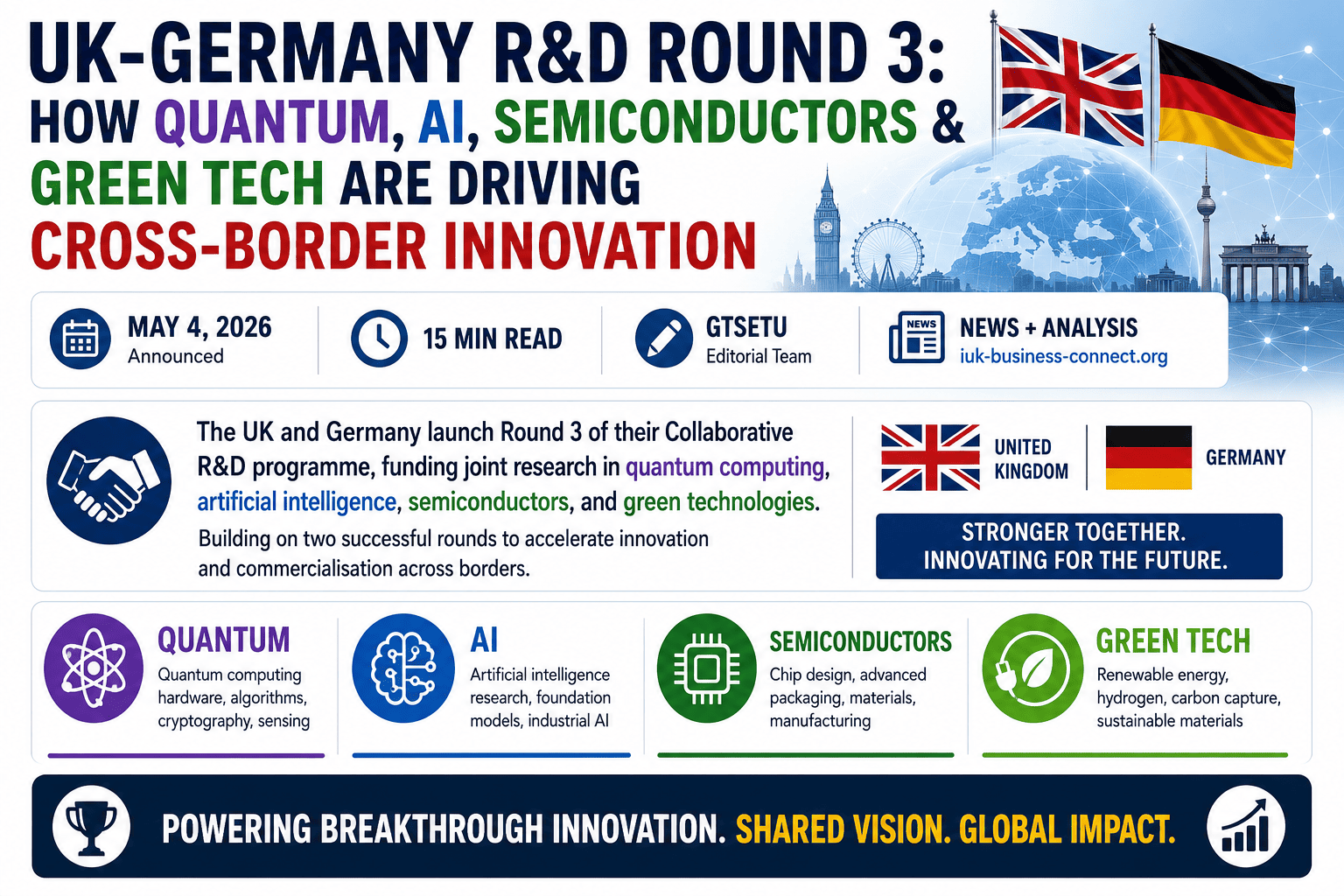
The UK and Germany have launched Round 3 of their Collaborative R&D programme, funding joint research projects in quantum computing, artificial intelligence, semiconductors, and green technologies. Building on two successful previous rounds, this initiative deepens cross-border innovation and commercialisation pathways.
🎯 Direct Answer
On May 4, 2026, the UK and Germany announced Round 3 of their Collaborative R&D programme, funding joint research projects in quantum computing, artificial intelligence, semiconductors, and green technologies. This initiative builds on two successful previous rounds of UK-Germany innovation collaboration, deepening cross-border research partnerships and commercialisation pathways. The programme provides government-backed funding for collaborative projects between UK and German research institutions, universities, and companies, with a focus on technologies that will define the next decade of industrial competitiveness.
📅 May 4, 2026⏱ 15 min read✍️ GTsetu Editorial Team📰 News + Analysis🔗 iuk-business-connect.org
Programme Type
Collaborative R&D
Round 3, Quantum, AI, Semiconductors, Green Tech
Sectors
4 Domains
Quantum · AI · Semiconductors · Green Tech
Geography
UK + Germany
Western Europe · Northern Europe
Announced
May 4, 2026
iuk-business-connect.org, official launch
Section 1, The News
1
The Full Story: UK-Germany R&D Round 3
🔬
Programme Announced, May 4, 2026 · iuk-business-connect.org
UK and Germany Launch R&D Round 3, Collaborative Research in Quantum, AI, Semiconductors, and Green Technologies
On May 4, 2026, the UK and Germany announced Round 3 of their Collaborative R&D programme, funding joint research projects across quantum computing, artificial intelligence, semiconductors, and green technologies. The programme builds on two successful previous rounds of UK-Germany innovation collaboration, deepening cross-border research partnerships and commercialisation pathways.
The initiative provides government-backed funding for collaborative projects between UK and German research institutions, universities, and companies, with a focus on technologies that will define the next decade of industrial competitiveness. This round expands on previous successes in materials science, advanced manufacturing, and digital technologies, extending into the frontier domains of quantum computing, AI, semiconductors, and green tech.
The programme is government-backed but industry-executed, with UK and German companies expected to lead the commercialisation of jointly developed technologies. This mirrors the successful model of the UK-Germany research partnership, now extended into four critical technology sectors.
“Round 3 of our Collaborative R&D programme deepens the UK-Germany innovation partnership in the technologies that will shape the next decade, quantum, AI, semiconductors, and green tech. This is a strategic investment in our shared industrial future.”
— Official Statement, iuk-business-connect.org
“Collaborative R&D is the engine of innovation. By bringing together the best research talent from the UK and Germany, we are accelerating the development of breakthrough technologies and their path to market.”
— UK-Germany R&D Programme Lead
💡 GTsetu Perspective
The UK-Germany R&D Round 3 is not just a research programme, it’s a manufacturing and commercialisation opportunity. The funding creates structured pathways for UK and German companies to collaborate on breakthrough technologies, from quantum computing hardware to semiconductor manufacturing and green tech systems. If you’re a UK or German manufacturer, researcher, or technology company looking to access government-backed R&D funding and cross-border innovation partnerships, the programme provides the framework. GTsetu provides the verified partner discovery.
Section 2, Four Pillars
2
Four Pillars of UK-Germany R&D Round 3
The programme is structured around four distinct technology domains, each with its own funding streams, research priorities, and commercialisation pathways.
⚛️
Quantum Computing
Hardware development, quantum algorithms, cryptography, and quantum sensing technologies. Joint research labs and commercialisation pathways for quantum computing applications.
Quantum Hardware · Algorithms · Cryptography
🧠
Artificial Intelligence
Foundation models, industrial AI, AI for science, and responsible AI frameworks. Joint research centres and cross-border talent exchange programmes.
Foundation Models · Industrial AI · Ethics
💠
Semiconductors
Chip design, advanced packaging, semiconductor materials, and manufacturing processes. Includes collaborative supply chain integration and manufacturing innovation.
Chip Design · Packaging · Materials
🌿
Green Technologies
Renewable energy, hydrogen, carbon capture, and sustainable materials. Joint R&D centres, technology transfer, and manufacturing cooperation for green tech systems.
Renewables · Hydrogen · Carbon Capture
Section 3, The Anatomy
3
What Each Country Brings to the Table
The UK-Germany R&D Round 3 works because each country contributes complementary research strengths, creating a whole that accelerates innovation and commercialisation.
Collaboration Anatomy, UK-Germany R&D Round 3
🇬🇧 United Kingdom
Western Europe · Research Leader
What they bring
Research Excellence + AI Leadership
Quantum
Quantum hardware, algorithms, cryptography
AI
Foundation models, AI research, ethics
Partnership role
Research Partner
Strength
AI, Quantum, Semiconductors
+
R&D Round 3
🇩🇪 Germany
Northern Europe · Engineering Powerhouse
What they bring
Engineering + Manufacturing Excellence
Quantum
Quantum sensing, hardware engineering
Semiconductors
Chip manufacturing, materials, packaging
Partnership role
Engineering Partner
Strength
Semiconductors, Green Tech, Quantum
🎯 Target: Quantum, AI, Semiconductors, Green Tech
🔬 Government-backed collaborative R&D funding
📈 Commercialisation pathways for breakthrough technologies
Section 4, Why This Works
4
Why This Collaborative R&D Model Works for Cross-Border Innovation
🎯 The Core Logic
The UK-Germany R&D Round 3 succeeds because it is built on three interlocking strategic advantages: a proven track record of successful collaboration (Rounds 1 and 2), complementary research strengths (UK’s AI and quantum leadership + Germany’s engineering and semiconductor excellence), and government-backed funding that de-risks cross-border innovation. Neither country could achieve the same outcome independently, UK cannot replicate Germany’s semiconductor manufacturing ecosystem, and Germany cannot independently develop UK’s AI and quantum research depth. The R&D programme makes the whole greater than the sum of its parts.
Why UK-Germany R&D Collaboration Is Accelerating in 2026
Round 1-2
Proven track record, successful collaboration in previous rounds builds trust and momentum
4 Domains
Quantum, AI, Semiconductors, Green Tech, covering the full spectrum of frontier technology
Funding
Government-backed funding reduces financial risk for cross-border R&D projects
Commercial
Clear commercialisation pathways, research with a path to market
Talent
Cross-border talent exchange, researchers and engineers working across both countries
Sovereignty
Both nations prioritise technological sovereignty, reducing dependency on other regions
Section 5, R&D Opportunity
5
R&D Opportunity in 2026, Why Now Is the Time to Partner
🇬🇧🇩🇪 UK-Germany R&D Collaboration 2026–30
Why Every Researcher, Manufacturer, and Tech Company Should Be Paying Attention to UK-Germany R&D Round 3
The UK-Germany R&D Round 3 creates structured, government-backed pathways for collaborative research that did not exist before. For UK researchers and companies, it offers access to Germany’s engineering and semiconductor ecosystem with joint funding. For German researchers and companies, it offers access to UK’s AI and quantum leadership. For manufacturers, it offers early access to breakthrough technologies and commercialisation partnerships. The timing is exceptional, both countries are prioritising technological sovereignty, and the R&D programme provides the framework to achieve it together.
Joint R&D
Co-funded research projects in quantum, AI, semiconductors, and green tech
Commercial
Clear commercialisation pathways, technology transfer and licensing support
Talent
Researcher and engineer exchange programmes between UK and German institutions
Funding
Government-backed funding, reducing financial risk for cross-border R&D
Supply Chain
Semiconductor and green tech supply chain integration across both nations
Sovereignty
Both nations prioritise technological sovereignty, reducing dependency on other regions
🌐 GTsetu for R&D & Technology Partnerships
GTsetu’s verified partner network includes researchers, technology companies, manufacturers, and R&D institutions across the UK, Germany, and 100+ other countries. Every company is verified on 6 government-sourced points: Name, Address, Registration Number, Company Status, Company Type, and Date of Certificate of Incorporation. If you’re a UK researcher seeking German semiconductor partners, a German manufacturer looking for UK AI expertise, or a tech company seeking cross-border R&D collaboration, GTsetu is where your partner search begins. Find R&D and technology partners →
Section 6, Types of Collaboration
6
4 Types of R&D Collaboration, Which Fits Your Situation?
The UK-Germany R&D Round 3 provides the government-backed funding framework. But the specific collaboration structure depends on what you need and what you can invest.
01
Joint Research Project
Co-funded research project with shared objectives, milestones, and deliverables. Ideal for early-stage research where commercial applications are not yet certain. The core model of UK-Germany R&D Round 3.
🔬 Co-funded Research
02
Technical Assistance Agreement (TAA)
One party transfers technical knowhow, process IP, and engineering expertise to another for fees or royalties. Ideal when you need specific IP access without equity commitment.
⚙️ Technology Transfer
03
Joint Venture (JV)
A new shared legal entity co-owned by both parties. Deepest integration, full profit and risk sharing. Best for long-term market presence when both parties have complementary assets.
⚖️ Shared Entity
04
Commercialisation Partnership
Focus on taking research成果 to market. Includes licensing, spin-outs, and manufacturing scale-up. Ideal when R&D is complete and the focus is on commercialisation and market entry.
📈 Scale-up & Licensing
Section 7, How to Partner
7
How to Partner: A 5-Step Playbook for Cross-Border R&D Collaboration
The UK-Germany R&D Round 3 provides the framework and funding. Here is the distilled playbook for executing R&D collaboration within it.
1
Define the Research Gap with Precision
The programme targets quantum, AI, semiconductors, and green tech. Define your research gap that precisely, what specific technology or capability do you need? Vague research questions produce vague proposals and failed applications.
2
Find Verified Research and Technology Partners
The UK and Germany were not random partners, they had complementary research strengths and a proven track record. GTsetu provides verified profiles of research institutions, technology companies, and manufacturers across the UK, Germany, and 100+ countries. Government-sourced verification on 6 key points.
3
Protect IP Before Any Research Data Is Shared
In R&D collaboration, your research data, methodologies, and findings are valuable IP. Execute a mutual NDA before sharing any sensitive information. GTsetu’s built-in NDA workflow handles this automatically with a full digital audit trail.
4
Choose the Right Collaboration Structure
Joint research project for early-stage discovery. TAA for IP transfer. JV for permanent shared entity. Commercialisation partnership for scale-up and licensing. Match the structure to the research and commercial objectives.
5
Formalise in Stages, Research First, Commercialisation Second
The programme funds collaborative research first, commercialisation follows. Never commit to manufacturing scale-up before the research validates the technology. Structure every milestone, research deliverables, IP ownership, commercialisation pathways, formally in writing.
Section 8, Dos and Don’ts
8
Dos and Don’ts of Cross-Border R&D Partnerships
✅ Do These
✅ Build on proven research collaborations, UK-Germany had two successful previous rounds
✅ Verify your partner’s research credentials and IP portfolio, not just marketing claims
✅ Sequence research before commercialisation, validate the technology before scaling
✅ Sign NDA before sharing research data, methodologies, or findings
✅ Choose a partner whose research strengths complement yours, UK’s AI + Germany’s engineering
✅ Leverage government-backed funding, it de-risks cross-border R&D significantly
✅ Run a pilot research project before committing to full-scale collaboration
✅ Use verified platforms like GTsetu rather than cold academic outreach for strategic partners
✅ Document IP ownership and licensing terms before any research data is exchanged
❌ Avoid These
❌ Commit to manufacturing scale-up before research validates the technology
❌ Share research data or methodologies before NDA is countersigned
❌ Accept self-reported research credentials without independent verification
❌ Assume government funding automatically guarantees commercial success, it de-risks but doesn’t guarantee
❌ Partner with a researcher who is also working with competitors, exclusivity terms matter
❌ Neglect the cultural dimension, cross-border R&D requires explicit communication protocols
❌ Choose a partner whose research strengths duplicate yours, the gap is where value is created
❌ Start research on informal terms, formal agreements protect both parties’ IP
❌ Overlook the importance of talent exchange, research collaboration requires people, not just documents
Section 9, Misconceptions
9
Common Misconceptions About Cross-Border R&D Collaboration
Government funding de-risks research but does not guarantee commercial outcomes. Successful commercialisation requires market validation, product development, and go-to-market execution, separate from the research itself. The programme provides the research foundation; commercialisation is a distinct phase requiring additional investment and capability.
❌ Myth
“IP ownership can be sorted out during the research project, it’s not a priority.”
✅ Reality
IP ownership disputes are the most common reason R&D collaborations fail. Define ownership of jointly-developed IP before any research data is exchanged. In R&D, IP accumulates rapidly during the research phase. Clear upfront terms are non-negotiable for successful collaboration.
❌ Myth
“We should start commercialisation in parallel with research to save time.”
✅ Reality
The programme emphasises research first, commercialisation second. Investing in commercialisation before research validates the technology is capital destruction. The correct sequence is: research → validation → commercialisation planning → scale-up. Staged execution reduces risk and optimises resource allocation.
❌ Myth
“Collaborative R&D is only for universities, companies don’t need to participate.”
✅ Reality
The UK-Germany R&D Round 3 is explicitly designed for industry participation, companies are expected to lead commercialisation. University-industry collaboration is encouraged, but industry involvement is essential for the commercialisation pathway. Companies bring manufacturing capability, market access, and commercial expertise that universities alone cannot provide.
❌ Myth
“Cross-border R&D requires physical presence in both countries.”
✅ Reality
The UK-Germany R&D programme is managed with structured research exchanges, regular review meetings, and digital collaboration tools. What matters is clear protocols for IP documentation, scheduled review cycles, and quality audit rights, not permanent physical presence. GTsetu’s encrypted collaboration workspace supports exactly this structured cross-border R&D relationship.
Section 10, GTsetu
10
How GTsetu Helps You Find the Right R&D & Technology Partner
The UK-Germany R&D Round 3 provides the government-backed funding framework. GTsetu provides the verified partner discovery platform, enabling researchers, technology companies, and manufacturers to find each other, evaluate credentials, and collaborate securely across borders.
🌐 Platform Spotlight, GTsetu
Find Verified Research Institutions, Technology Companies, and Manufacturers Across 100+ Countries, Anonymously, Securely, With Zero Broker Fees
Every company on GTsetu is verified using government tie-ups on 6 key points: Name, Address, Registration Number, Company Status, Company Type, and Date of Certificate of Incorporation. This is the foundation of trust. Additional information such as research credentials, technology portfolios, and commercial capabilities is self-reported by companies. You evaluate who is real before you engage. You share nothing sensitive until an NDA is countersigned. And you pay no broker commission on any collaboration formed.
✅
6-Point Government-Sourced VerificationName, Address, Registration Number, Company Status, Company Type, Date of Incorporation confirmed.
🕵️
Anonymous DiscoveryEvaluate verified partner profiles without revealing your identity until mutual interest is confirmed.
📄
Built-In NDA WorkflowShare research data and methodologies only after NDA is executed, full audit trail.
🚫
Zero CommissionNo broker fees, your R&D partnership is entirely between you and your partner.
🌍
100+ CountriesUK, Germany, Europe, Americas, Asia, find partners in every research hub.
🔐
Encrypted CollaborationShare research data, technical documents, and commercial terms securely.
Announced on May 4, 2026, the UK-Germany R&D Round 3 is a Collaborative R&D programme funding joint research projects between UK and German institutions in quantum computing, artificial intelligence, semiconductors, and green technologies. It builds on two previous rounds of successful UK-Germany research collaboration, deepening cross-border innovation and commercialisation pathways with government-backed funding.
Q
What does the programme mean for researchers and manufacturers?
The programme creates structured funding and collaboration pathways for researchers and manufacturers in quantum computing, AI, semiconductors, and green tech. It enables joint R&D projects, technology transfer, and commercialisation of breakthrough technologies, with government backing that de-risks cross-border innovation. For manufacturers, it offers early access to breakthrough technologies and commercialisation partnerships.
Q
How can I find a UK or German research partner for my project?
The systematic approach involves four steps: (1) Define your research gap precisely, which of the four domains does your project address? (2) Search verified platforms, GTsetu lists verified research institutions, technology companies, and manufacturers across the UK, Germany, and 100+ countries. (3) Evaluate anonymously first, review verified profiles before revealing your identity. (4) Execute NDA before sharing research data, GTsetu’s built-in NDA workflow handles this automatically.
Q
How does IP ownership work in collaborative R&D projects?
IP ownership is the most critical aspect of R&D collaboration. Before any research data is exchanged, agree on: (1) Background IP, each party retains ownership of existing IP; (2) Foreground IP, jointly-developed IP is either co-owned or allocated based on contribution; (3) Licensing terms, each party’s rights to use and commercialise the jointly-developed IP. These terms must be documented before research begins. GTsetu’s platform supports secure IP documentation workflows.
Q
Does GTsetu charge commission on R&D partnerships formed through the platform?
No. GTsetu charges zero commission on any collaboration, whether a joint research project, TAA, JV, or commercialisation partnership, formed through the platform. Broker intermediation in R&D partnerships typically costs 5–15% of project value. GTsetu removes the broker entirely. Learn more about GTsetu →
Ready to Find Your R&D Partner? Start on GTsetu.
500+ verified research institutions, technology companies, manufacturers, and R&D partners across the UK, Germany, and 100+ countries. Zero broker fees. Anonymous discovery. Built-in NDA workflows. Your next R&D collaboration starts with a verified profile, not a cold email.
Business Development Expert | Global Trade & Cross-Border Partnerships
Lui Wang is a Business Development Expert at GTsetu, specializing in international trade, cross-border partnerships, and market expansion strategies. With extensive experience working across diverse business ecosystems, Lui helps companies identify growth opportunities, establish strategic collaborations, and navigate the complexities of global commerce.
His expertise spans manufacturing, supply chain partnerships, technology collaborations, market entry strategies, and international business development. Through GTsetu, Lui works closely with businesses, trade organizations, and industry stakeholders to facilitate meaningful connections that drive sustainable growth across regions and sectors.
Lui is particularly passionate about helping organizations build long-term international partnerships, unlock new markets, and strengthen their global competitiveness in an increasingly interconnected economy.