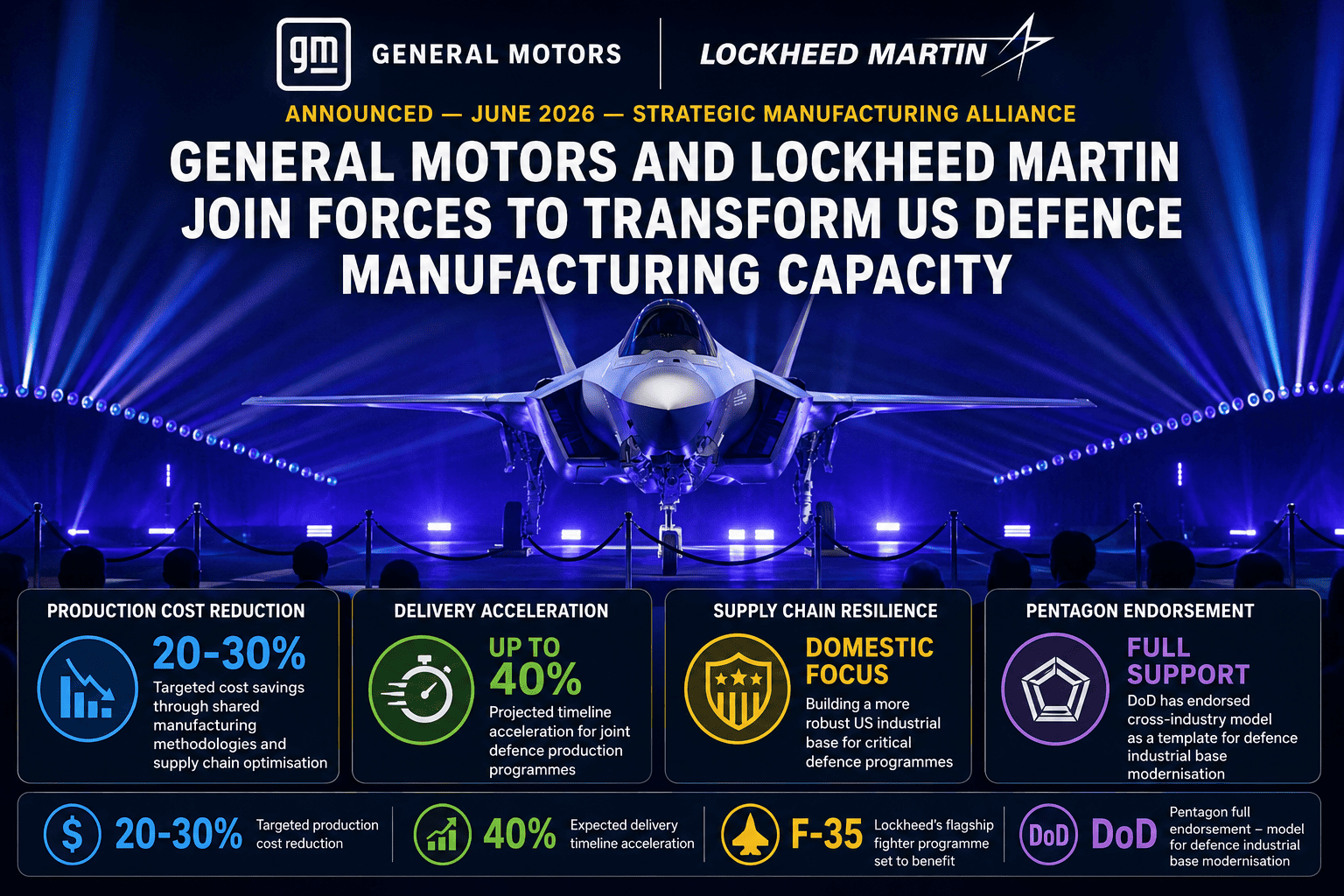
GM & Lockheed Martin Scale Defence Manufacturing Cooperation, The New Industrial Alliance Reshaping US Defence Production
🔴 BREAKINGGM & Lockheed Martin announce landmark manufacturing alliance, combining automotive scale with defence technology for next-generation US production capacity◆Production costs projected to drop 20-30% · Delivery timelines accelerate up to 40% · Pentagon endorses cross-industry defence manufacturing partnership◆GM’s EV battery tech, robotics, and supply chain scale deployed for F-35, missile systems, and next-generation combat vehicles◆Find cross-industry manufacturing and technology partners on GTsetu, verified on 6 key data points, zero broker fees, 100+ countries◆🔴 BREAKINGGM & Lockheed Martin announce landmark manufacturing alliance, combining automotive scale with defence technology for next-generation US production capacity◆Production costs projected to drop 20-30% · Delivery timelines accelerate up to 40% · Pentagon endorses cross-industry defence manufacturing partnership◆GM’s EV battery tech, robotics, and supply chain scale deployed for F-35, missile systems, and next-generation combat vehicles◆Find cross-industry manufacturing and technology partners on GTsetu, verified on 6 key data points, zero broker fees, 100+ countries◆
Home › Blog › Defence Manufacturing 2026
🔴 Breaking News🏭 Strategic Alliance🇺🇸 US Defence🚗 Automotive + Aerospace
GM & Lockheed Martin Scale Defence Manufacturing Cooperation, The New Industrial Alliance Reshaping US Production
General Motors and Lockheed Martin announced a landmark strategic manufacturing alliance in June 2026, combining GM’s automotive production scale with Lockheed Martin’s defence technology leadership. The partnership aims to accelerate production capacity, reduce costs by 20-30%, and secure supply chains for critical US defence programmes. Here is your complete guide to the alliance, its industry impact, and how manufacturers can capitalise on cross-industry collaboration.
📋 Direct Answer
General Motors and Lockheed Martin announced a strategic manufacturing alliance in June 2026, a landmark cross-industry partnership that combines GM’s automotive production expertise with Lockheed Martin’s defence systems leadership. The alliance is structured as a cooperative manufacturing framework focused on three pillars: production scale acceleration (applying GM’s high-volume manufacturing techniques to defence production), cost reduction (targeting 20-30% reduction in production costs through shared methodologies and supply chain optimisation), and supply chain resilience (building a more robust domestic industrial base for critical defence programmes). Key programmes impacted include F-35 production, missile systems manufacturing, and next-generation combat vehicle development. The Pentagon has endorsed the partnership as a model for building a more resilient defence industrial base. The alliance demonstrates how automotive manufacturing capabilities are becoming strategic assets for national security production capacity. Production timelines are expected to accelerate by up to 40% for joint programmes.
📅 June 20, 2026⏱ 16 min read✍️ GTsetu Editorial Team📰 Defence Industrial Base + Advanced Manufacturing Analysis
Production Cost Reduction
20-30%
Targeted cost savings through shared manufacturing methodologies and supply chain optimisation
Delivery Acceleration
Up to 40%
Projected timeline acceleration for joint defence production programmes
Supply Chain Resilience
Domestic Focus
Building a more robust US industrial base for critical defence programmes
Pentagon Endorsement
Full Support
DoD has endorsed cross-industry model as a template for defence industrial base modernisation
Section 1, The Alliance
1
The GM-Lockheed Martin Alliance: At a Glance
🚗 General Motors, Automotive Manufacturing Scale
+
✈️ Lockheed Martin, Defence Technology Leadership
=
🏛️ US Defence Industrial Base, 21st Century Manufacturing Capacity
🤝
Announced, June 2026, Strategic Manufacturing Alliance
General Motors and Lockheed Martin Join Forces to Transform US Defence Manufacturing Capacity
In June 2026, General Motors and Lockheed Martin announced a landmark strategic manufacturing alliance, one of the most significant cross-industry partnerships in US defence industrial history. The alliance leverages GM’s decades of automotive manufacturing expertise, high-volume production systems, and supply chain scale to address critical capacity constraints in Lockheed Martin’s defence production programmes.
The partnership is structured as a cooperative manufacturing framework focused on three pillars: production scale acceleration, cost reduction through shared manufacturing methodologies, and supply chain resilience. GM brings capabilities including lean manufacturing, robotics and automation, electric vehicle battery production, additive manufacturing (3D printing), and supply chain digital twins. Lockheed Martin contributes defence-specific engineering, classified production protocols, government contracting frameworks, and deep expertise in aerospace and defence systems.
Key programmes impacted include F-35 fighter production, missile systems manufacturing, and next-generation combat vehicle development. The Pentagon has endorsed the partnership as a model for building a more resilient US defence industrial base. The alliance demonstrates a broader trend: automotive manufacturing capabilities are becoming strategic assets for national security production capacity, as the line between commercial and defence manufacturing continues to blur.
20-30%
Targeted production cost reduction through shared manufacturing methodologies
40%
Expected delivery timeline acceleration for joint production programmes
F-35
Lockheed’s flagship fighter programme set to benefit from GM’s production expertise
DoD
Pentagon full endorsement, model for defence industrial base modernisation
“This alliance represents a new era for US manufacturing, where the scale and efficiency of American automotive production becomes a strategic asset for national security. Together, we are building the industrial capacity America needs for the challenges ahead.”
— Mary Barra, Chair and CEO, General Motors
“By combining Lockheed Martin’s advanced defence technology with GM’s manufacturing excellence, we are creating a new model for defence production, one that delivers capabilities faster, at lower cost, and with greater resilience for our national security.”
— James Taiclet, President and CEO, Lockheed Martin
💡 GTsetu Perspective
The GM-Lockheed Martin alliance represents a structural shift in how manufacturing capabilities are valued across industries. As the line between automotive, aerospace, and defence production blurs, companies that identify cross-industry manufacturing and technology partners in 2026, before supply chain positions are locked in, will hold preferred supplier positions that competitors entering later will find costly to replicate. GTsetu is where verified cross-industry partner discovery happens systematically, not through trade missions or broker introductions.
Section 2, Why This Matters
2
Why This Matters: Automotive Capabilities as Strategic Defence Assets
🎯 The Strategic Shift Reshaping US Manufacturing
The GM-Lockheed Martin alliance represents a fundamental shift in how the United States thinks about manufacturing capacity for national security. For decades, automotive and defence manufacturing operated in separate spheres. The automotive industry focused on cost, scale, and consumer demand. The defence industry focused on performance, reliability, and classified specifications. That separation is ending. Three converging forces are driving this shift: First, growing demand for advanced defence systems, including F-35 fighters, hypersonic weapons, and next-generation combat vehicles, has outstripped the production capacity of traditional defence supply chains. Second, automotive manufacturers possess manufacturing capabilities, including robotics, automation, battery production, and supply chain digital twins, that directly address defence production constraints. Third, the Pentagon’s push for a more resilient, responsive defence industrial base has created a policy environment that actively encourages cross-industry partnerships.
Scale
Automotive industry has perfected high-volume production at scale, precisely what defence production urgently needs
Cost
Automotive lean manufacturing and supply chain optimisation can reduce defence production costs by 20-30%
Resilience
Automotive supply chains offer redundancy and flexibility that defence supply chains often lack
Innovation
EV battery tech, robotics, and 3D printing from automotive sector have direct defence applications
Speed
Automotive production cycles are measured in months, not years, accelerating defence delivery timelines by up to 40%
Policy
Pentagon actively endorsing and encouraging cross-industry manufacturing partnerships
Section 3, Programme Impact
3
Defence Programmes Impacted by the Alliance
📊 Programmes Targeted for Production Scaling, GM-Lockheed Alliance
✈️ Fighter Production
F-35 Lightning II
GM’s manufacturing scale applied to F-35 production lines, targeting cost reduction and delivery acceleration. Shared robotics, automation, and lean manufacturing expertise.
🚀 Missile Systems
Hypersonic & Precision Strike
Leveraging GM’s supply chain scale and production techniques to accelerate missile system production, addressing critical capacity constraints.
🚁 Next-Gen Vehicles
Combat & Tactical Vehicles
GM’s automotive chassis and propulsion expertise applied to next-generation combat vehicle development, including hybrid-electric tactical platforms.
🔋 Energy Systems
Battery & Propulsion
GM’s EV battery technology and production capacity deployed for defence energy storage, hybrid-electric propulsion, and power systems.
🖨️ Additive Manufacturing
3D Printing & Spare Parts
GM’s additive manufacturing (3D printing) capabilities applied to rapid prototyping and spare parts production, reducing supply chain lead times.
📦 Supply Chain
Digital Twins & Logistics
GM’s supply chain digital twin technology applied to defence logistics, enabling real-time demand forecasting and inventory optimisation.
Section 4, Manufacturing Capabilities
4
Manufacturing Capabilities Being Shared, The GM-Lockheed Technology Transfer
🤖
From GM
Robotics & Automation
GM’s advanced robotics and assembly line automation expertise applied to defence production lines for increased speed and precision.
🔋
From GM
EV Battery Production
GM’s Ultium battery platform and production capacity deployed for defence energy storage, hybrid propulsion, and power systems.
🖨️
From GM
Additive Manufacturing
GM’s 3D printing capabilities for rapid prototyping, tooling, and spare parts production, reducing lead times and supply chain dependencies.
📊
From GM
Supply Chain Digital Twins
Real-time supply chain modelling and demand forecasting for defence logistics and inventory optimisation.
⚙️
From Lockheed
Defence Engineering
Aerospace and defence-specific engineering expertise, including classified production protocols and performance specifications.
🔒
From Lockheed
Security & Compliance
Government contracting frameworks, security protocols, and compliance expertise for defence production environments.
Section 5, Industrial Impact
5
Industrial Impact: Winners and Strategic Shifts Across the Manufacturing Ecosystem
🏭 Who Benefits Most from the GM-Lockheed Alliance
🇺🇸
Winner
US Defence Industrial Base
Increased production capacity, reduced costs, and improved supply chain resilience for critical defence programmes.
🚗
Winner
Automotive Manufacturers
Automotive manufacturing capabilities become strategic assets for defence, creating new revenue streams and government partnerships.
🔧
Winner
Supply Chain Innovators
Companies with advanced supply chain digital twin and logistics capabilities gain new defence sector opportunities.
🔋
Winner
Energy Storage Sector
EV battery technology gains defence applications, creating larger markets and government investment in battery production capacity.
📡
Winner
Technology Providers
Companies providing robotics, automation, 3D printing, and AI-driven manufacturing technologies gain defence sector contracts.
⚠️
Challenge
Traditional Defence Suppliers
Smaller defence suppliers face increased competition from automotive manufacturers entering defence production.
Section 6, Supply Chain Implications
6
Supply Chain Implications for the US Defence Industrial Base
📦 Supply Chain Transformation, Defence Industrial Base 2026–2030
How the GM-Lockheed Alliance Reshapes Defence Supply Chains
The GM-Lockheed Martin alliance is not just a partnership between two companies, it represents a fundamental restructuring of how the US defence industrial base sources manufacturing capacity. For defence suppliers and automotive manufacturers alike, this creates specific, time-sensitive opportunities to participate in the new supply chain architecture.
Supply Chain Consolidation
Automotive supply chains are being integrated into defence production, creating new opportunities for Tier 1 and Tier 2 suppliers
Resilience Mandate
Pentagon requires more resilient, redundant supply chains, automotive logistics expertise directly addresses this need
Technology Transfer
Automotive manufacturing technologies, including digital twins, 3D printing, and robotics, are entering defence supply chains
Domestic Production
Focus on domestic manufacturing capacity, reducing reliance on foreign suppliers for critical defence components
Cost Transparency
Automotive cost accounting and lean manufacturing methodologies bring unprecedented cost transparency to defence production
Talent Integration
Automotive manufacturing engineers and supply chain professionals are being recruited for defence production roles
Section 7, Cross-Industry Opportunity
7
Cross-Industry Manufacturing Opportunity: Lessons from GM-Lockheed
🏭 Cross-Industry Manufacturing, The New Strategic Imperative
What the GM-Lockheed Alliance Teaches Manufacturers Across All Industries
The GM-Lockheed Martin alliance is a case study in how manufacturing capabilities, regardless of industry, are becoming strategic assets across sectors. The partnership demonstrates that automotive manufacturing expertise is directly transferable to defence production. The same principle applies across industries: aerospace capabilities can serve medical devices; consumer electronics manufacturing can serve automotive; industrial automation can serve energy. For manufacturers on both sides, this creates specific, time-sensitive opportunities to identify cross-industry partners, share capabilities, and capture new revenue streams.
Cross-Industry Transfer
Manufacturing capabilities developed in one industry can be deployed in entirely different sectors, create new revenue streams
Capability Mapping
Identify your company’s manufacturing strengths, robotics, automation, supply chain, materials, and map them to opportunities in other sectors
First-Mover Advantage
The GM-Lockheed alliance demonstrates that first movers in cross-industry partnerships capture the most value, positions fill quickly
Cross-industry partnerships build supply chain redundancy, reducing dependencies on single sectors or geographies
GTsetu Enables This
Find verified cross-industry manufacturing and technology partners on GTsetu, documented credentials, zero broker fees, 100+ countries
Section 8, How to Capitalise
8
How to Capitalise: The 5-Step Cross-Industry Partnership Playbook
1
Audit Your Manufacturing Capabilities for Cross-Industry Transfer
Before you can identify cross-industry opportunities, you need to understand what capabilities your company possesses that could be valuable in other sectors. GM’s automotive manufacturing capabilities, robotics, automation, battery production, 3D printing, supply chain digital twins, were not developed for defence. They were developed for automotive. But Lockheed Martin recognised their transferability. Every manufacturer should audit their capabilities: What do you do exceptionally well? What technologies have you developed? What supply chain expertise do you have? These are assets that can be deployed across industries.
2
Identify Target Industries Where Your Capabilities Create Value
The GM-Lockheed alliance demonstrates that automotive capabilities create value in defence. But the same logic applies across sectors. Aerospace manufacturers can serve medical devices. Consumer electronics manufacturers can serve automotive. Industrial automation companies can serve energy and utilities. Identify sectors where your specific manufacturing capabilities, scale, precision, speed, materials expertise, supply chain strength, solve real problems. Research those industries. Understand their pain points. Identify where your capabilities create competitive advantage.
3
Find and Verify Cross-Industry Partners Before Disclosing Commercial Information
The GM-Lockheed alliance involved years of confidential discussions before the public announcement. Cross-industry partnerships require trust, verified credentials, and documented capabilities. In the rush to capitalise on cross-industry opportunities, the risk of disclosing pricing strategies, product cost structures, and supply chain designs to unverified counterparties is acute. Verify your partner’s business registration (6 points via government sources) before any substantive commercial conversation. GTsetu’s verification process documents these credentials before you invest a single hour, and the built-in NDA workflow ensures your commercial terms are protected before any disclosure.
4
Structure a Pilot or Trial to Validate Capability Transfer
GM and Lockheed Martin will likely run pilot projects before full-scale integration of automotive manufacturing into defence production. Your cross-industry partnership should follow the same logic. Structure a pilot or trial project, a specific component, a production line improvement, a supply chain optimisation, that validates the transferability of your capabilities. Document the results. Use them to build the business case for broader partnership. A successful pilot creates the evidence base for full-scale collaboration.
5
Move in 2026, The Cross-Industry Partnership Window Is Open
The GM-Lockheed Martin alliance is part of a broader trend: the boundaries between manufacturing industries are blurring. Companies that identify cross-industry partnerships in 2026, before supply chain positions are locked in and preferred supplier relationships are established, will hold strategic advantages that competitors entering later will find costly to replicate. GTsetu’s verified partner network enables rapid identification and engagement with the right counterparty without the 6–12 months of conference circuit and broker introductions that characterises traditional cross-industry outreach.
Section 9, Dos and Don’ts
9
Dos and Don’ts for Cross-Industry Manufacturing Partnerships
✅ Do These
✅ Audit your manufacturing capabilities for cross-industry transferability, identify what you do exceptionally well
✅ Research target industries where your capabilities create specific, identifiable value
✅ Verify potential cross-industry partners on 6 key data points before sharing commercial information
✅ Structure pilot projects to validate capability transfer before full-scale partnership
✅ Execute NDAs before sharing proprietary manufacturing processes or cost data
✅ Build relationships with government agencies that support cross-industry manufacturing partnerships
✅ Document your cross-industry partnership results to build a case for expanded collaboration
✅ Focus on supply chain resilience as a value proposition, it’s a priority for governments across sectors
✅ Leverage GTsetu’s verified network to find cross-industry manufacturing partners across 100+ countries
✅ Move in 2026, first-mover positions in cross-industry partnerships are the most valuable
❌ Avoid These
❌ Assume cross-industry capability transfer is automatic, it requires deliberate planning and adaptation
❌ Partner with unverified companies, verify credentials before any commercial disclosure
❌ Ignore industry-specific regulations and certifications, they vary significantly across sectors
❌ Rush to full-scale integration without pilot validation, test capability transfer before scaling
❌ Share proprietary manufacturing processes or cost data without a formal NDA in place
❌ Underestimate the importance of cultural alignment, different industries have different operating rhythms
❌ Assume your capabilities are too specialised for other industries, the GM-Lockheed alliance proves otherwise
❌ Wait until cross-industry partnerships are mainstream, by then, the best positions will be taken
❌ Forget to document and communicate partnership results, they build credibility for future collaborations
Section 10, Misconceptions
10
Common Misconceptions About Cross-Industry Defence Manufacturing Partnerships
❌ Myth
“GM is simply becoming a defence contractor, this is an acquisition or a shift in business model.”
✅ Reality
GM is not becoming a defence contractor. The alliance is a cooperative manufacturing framework, GM provides manufacturing expertise, scale, and supply chain capabilities, while Lockheed Martin retains defence systems design, integration, and government contracting. GM continues to be an automotive manufacturer. The partnership simply creates a new revenue stream by applying GM’s manufacturing capabilities to defence production.
❌ Myth
“This partnership is unique to GM and Lockheed Martin, it doesn’t apply to other manufacturers or industries.”
✅ Reality
The GM-Lockheed alliance is a leading indicator of a broader trend. The Pentagon has explicitly endorsed cross-industry partnerships as a model for defence industrial base modernisation. Automotive manufacturers, aerospace companies, industrial automation firms, and technology providers are all exploring cross-industry partnerships. The principle, applying manufacturing capabilities developed in one sector to create value in another, applies across every manufacturing industry.
❌ Myth
“Cross-industry partnerships take years to establish, I should wait and see how this plays out.”
✅ Reality
The best cross-industry partnership positions are being established right now. Companies that identify partners in 2026 will hold preferred supplier positions that competitors who wait until 2028 will find difficult to replicate. The GM-Lockheed alliance was years in development. If you wait until the trend is mainstream, the most valuable cross-industry partnership positions will already be occupied. Move in 2026.
❌ Myth
“Only large corporations can form cross-industry manufacturing partnerships.”
✅ Reality
Mid-sized and smaller manufacturers are essential participants in cross-industry partnerships. Large corporations like GM and Lockheed Martin provide the anchor, but the actual production capacity often comes from Tier 1 and Tier 2 suppliers. If you are a mid-sized manufacturer with specialised capabilities, precision machining, advanced materials, automation, supply chain optimisation, you are exactly the type of partner that larger corporations need to scale their cross-industry initiatives. GTsetu’s verified network includes manufacturers of all sizes.
Section 11, GTsetu
11
How GTsetu Helps You Find Cross-Industry Manufacturing and Technology Partners
The GM-Lockheed Martin alliance demonstrates the strategic value of cross-industry manufacturing partnerships. It does not find you a verified aerospace partner with the capabilities to serve your defence production needs. It does not connect you with an automotive manufacturer whose robotics and automation expertise can transform your production line. It does not vet the industrial automation company claiming to offer the most advanced 3D printing capabilities for your supply chain. Finding the right partner, verified, capable, and strategically aligned, is the step that turns cross-industry opportunities into actual revenue. That is exactly what GTsetu enables, systematically.
🌐 Platform Spotlight, GTsetu
Find Verified Cross-Industry Manufacturing and Technology Partners, Before the Partnership Window Closes
GTsetu is the verified B2B manufacturing and technology partner discovery platform connecting companies across industries, automotive, aerospace, defence, industrial automation, energy, medical devices, and more, with documented capability profiles and zero broker fees. The GM-Lockheed alliance proves that cross-industry partnerships create strategic advantage. GTsetu puts the right partner in front of you before your competitors get there first. Every company on GTsetu is verified on 6 key data points via government sources: Name, Address, Registration Number, Company Status, Company Type, and Date of Certificate of Incorporation.
✅
6-Point Govt. VerificationEvery company verified on Name, Address, Registration Number, Company Status, Company Type, and Date of Certificate of Incorporation via official government registries.
🕵️
Anonymous DiscoveryEvaluate verified cross-industry partner profiles without revealing your company identity or pricing until mutual interest is confirmed.
📄
Built-In NDA WorkflowProtect your proprietary manufacturing processes, cost structures, and supply chain designs, NDA countersigned with full audit trail before any commercial disclosure.
🚫
Zero CommissionNo broker fees. Your cross-industry partnership agreement, JV, or supply contract stays entirely between you and your partner.
🌍
100+ CountriesFind manufacturing partners, technology collaborators, and JV candidates across North America, Europe, Asia, and 100+ countries globally.
⚡
Move in 2026Cross-industry partnership positions are most valuable right now, before preferred supplier slots are filled and collaboration windows close.
Q
What is the GM-Lockheed Martin manufacturing alliance?
General Motors and Lockheed Martin announced a strategic manufacturing alliance in June 2026 to combine GM’s automotive production scale with Lockheed Martin’s defence systems expertise. The partnership focuses on accelerating production capacity, reducing costs through shared manufacturing techniques, and securing supply chains for critical US defence programmes including the F-35, missile systems, and next-generation combat vehicles. The alliance demonstrates how automotive manufacturing capabilities are becoming strategic assets for national security production capacity.
Q
Why are GM and Lockheed Martin partnering on defence manufacturing?
The partnership addresses a critical gap in US defence industrial capacity. GM brings decades of experience in high-volume manufacturing, lean production systems, and supply chain management at scale. Lockheed Martin brings advanced defence technology, government contracting expertise, and classified production capabilities. Together, they aim to reduce production costs by 20-30%, accelerate delivery timelines by up to 40%, and build a more resilient domestic supply chain for national security priorities. The Pentagon has explicitly endorsed the partnership as a model for defence industrial base modernisation.
Q
How does the GM-Lockheed alliance affect US defence production?
The alliance is expected to significantly boost US defence production capacity. Lockheed Martin faces growing demand for the F-35, hypersonic weapons, and next-generation systems that strain existing production lines. GM’s automotive manufacturing expertise, including robotics, automation, and supply chain logistics, can help scale production. The Pentagon has expressed strong support for such cross-industry partnerships as a way to build a more resilient, responsive defence industrial base capable of meeting 21st-century security challenges.
Q
What manufacturing technologies will GM and Lockheed Martin share?
The alliance will leverage GM’s expertise in electric vehicle battery production for defence energy storage applications, advanced robotics and automation for assembly lines, additive manufacturing (3D printing) for rapid prototyping and spare parts production, and supply chain digital twins for demand forecasting and resilience. Lockheed Martin will provide defence-specific engineering, security protocols, and government contract compliance frameworks. The partnership demonstrates how automotive manufacturing technologies can be directly applied to defence production challenges.
Q
How can GTsetu help me find cross-industry manufacturing partners?
GTsetu is the verified partner discovery platform that connects companies across industries with documented manufacturing and technology capabilities, without broker fees. Every company on GTsetu is verified on 6 key data points (Name, Address, Registration Number, Company Status, Company Type, Date of Certificate of Incorporation) using government sources. For automotive manufacturers seeking defence partnerships: find verified defence contractors with specific capability needs. For aerospace companies seeking industrial automation partners: find verified technology providers with documented credentials. The process: (1) browse verified profiles anonymously, (2) execute an NDA before any commercial disclosure, (3) run a pilot to validate capability transfer, (4) formalise the cross-industry partnership with a documented agreement. Zero commission on any deal. Start your cross-industry partner search on GTsetu →
The Cross-Industry Partnership Window Is Open. Find Your Partner on GTsetu.
The GM-Lockheed Martin alliance proves that manufacturing capabilities are strategic assets across industries. 500+ verified manufacturers, technology providers, and industrial partners across North America, Europe, Asia, and 100+ countries. Zero broker fees. Anonymous discovery. Built-in NDA workflows. Move in 2026, before the best cross-industry partnership positions are taken.
Business Development Expert | International Trade & Strategic Partnerships
Daniel Carter is a Business Development Expert at GTsetu, specializing in global trade, international business expansion, and strategic partnership development. With extensive experience working across multiple industries and markets, Daniel helps organizations identify growth opportunities, build commercial relationships, and expand their international footprint.
His expertise includes cross-border collaborations, market entry strategies, supply chain partnerships, manufacturing ecosystems, and business matchmaking. Through his work at GTsetu, Daniel supports companies seeking to establish meaningful connections with partners, distributors, investors, and industry stakeholders across global markets.
Daniel is committed to helping businesses unlock new opportunities through collaboration-driven growth and practical international trade strategies.