Foxconn × Alrajhi Saudi EV JV: What Smart Manufacturers Learn About Global EV Collaboration | GTsetu
🔴 BREAKINGFoxconn × Alrajhi’s Smart Mobility breaks ground at SPARK, Dammam, first EV charger factory in the Middle East◆~$100M JV targets Saudi Vision 2030 goal: 30% electrified vehicles by 2030◆Taiwan’s electronics giant + Saudi family conglomerate = the EV manufacturing collaboration playbook for 2025◆Find your Alrajhi on GTsetu, verified EV & electronics manufacturing partners across 100+ countries, zero broker fees◆🔴 BREAKINGFoxconn × Alrajhi’s Smart Mobility breaks ground at SPARK, Dammam, first EV charger factory in the Middle East◆~$100M JV targets Saudi Vision 2030 goal: 30% electrified vehicles by 2030◆Taiwan’s electronics giant + Saudi family conglomerate = the EV manufacturing collaboration playbook for 2025◆Find your Alrajhi on GTsetu, verified EV & electronics manufacturing partners across 100+ countries, zero broker fees◆
Home › Blog › Foxconn × Alrajhi EV JV
🔴 Breaking News🤝 Joint Venture⚡ EV Manufacturing🇸🇦 Saudi Vision 2030
Foxconn × Alrajhi: Taiwan Meets Saudi Arabia in a $100M EV JV, And What Every Manufacturer Must Learn From It
Foxconn Interconnect Technology (FIT) and Saudi Arabia’s Alrajhi Group just broke ground on the Middle East’s first locally-made EV charger factory, inside King Salman Energy Park, Dammam. Here’s the full story, why it works, and how your company can replicate the same global manufacturing collaboration model.
🎯 Direct Answer
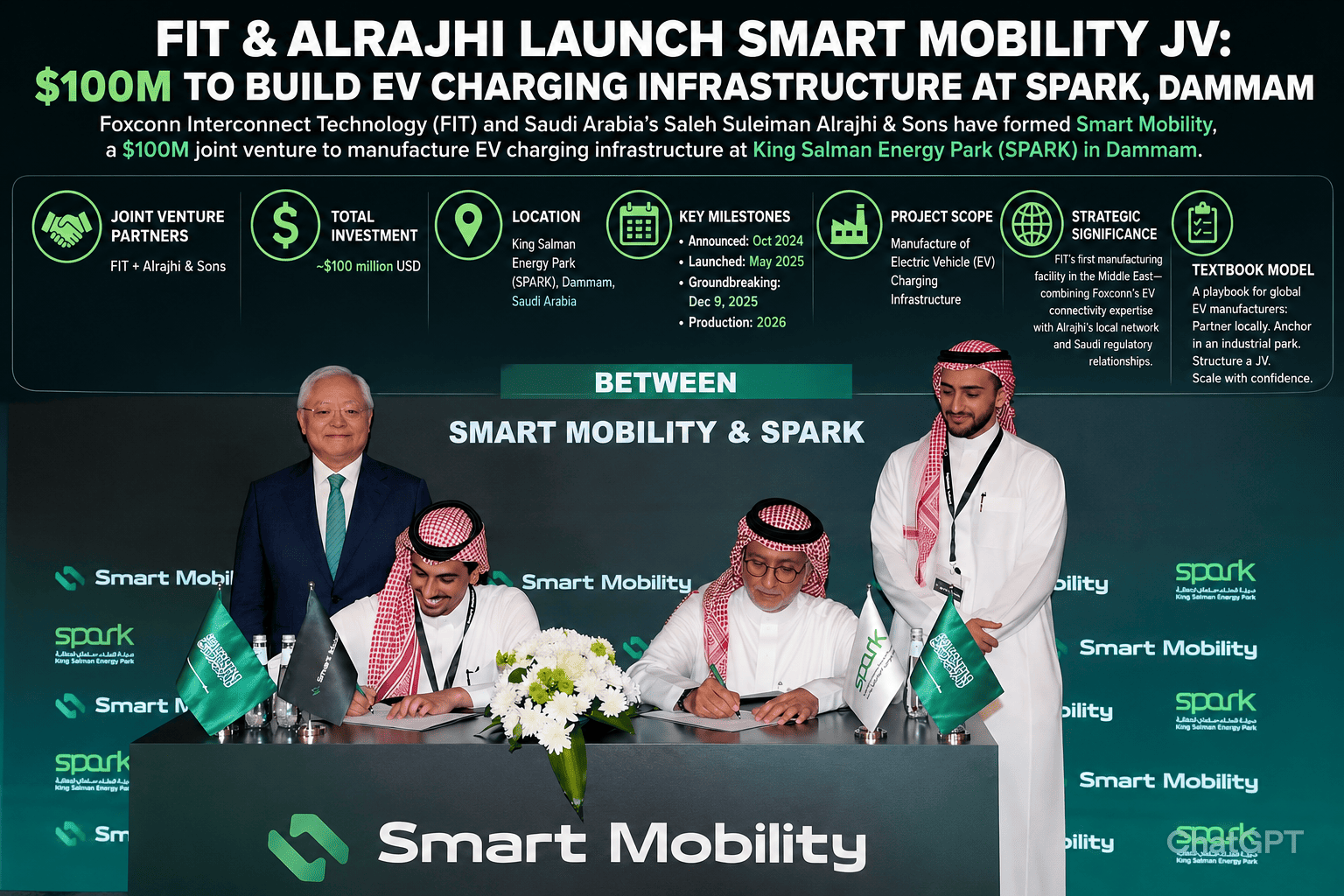
Foxconn Interconnect Technology (FIT) and Saudi Arabia’s Saleh Suleiman Alrajhi & Sons have formed a joint venture called Smart Mobility, with a total investment of approximately $100 million USD, to manufacture electric vehicle (EV) charging infrastructure at King Salman Energy Park (SPARK) in Dammam, Saudi Arabia. The JV was announced by the Saudi Ministry of Energy in October 2024, formally launched in May 2025, and broke ground on its factory on December 9, 2025, with commercial production expected in 2026. This marks FIT’s first manufacturing facility in the Middle East, combining Foxconn’s EV connectivity expertise with Alrajhi’s local business network and Saudi regulatory relationships, all anchored inside a purpose-built industrial city. It is a textbook example of how global EV manufacturers should approach new-geography entry: find a verified local conglomerate with market access and regulatory expertise, anchor inside an established industrial park, and structure a joint entity rather than building greenfield.
📅 March 13, 2026⏱ 18 min read✍️ GTsetu Editorial Team📰 EV Industry News + Analysis
JV Investment
~$100M
Total Smart Mobility investment at SPARK, Dammam
Groundbreaking
Dec 2025
Construction started Dec 9, 2025, production 2026
FIT Auto Revenue
$700M
FIT auto mobility segment revenue target in 2025
Vision 2030 EV Target
30%
Saudi Arabia’s electrified vehicle target by 2030
Section 1, The News
1
The Full Story: Foxconn × Alrajhi, Smart Mobility JV
Live Story, October 2024 → December 2025
Foxconn Builds Its First Middle East EV Factory, Inside Saudi Arabia’s King Salman Energy Park
In October 2024, Saudi Arabia’s Ministry of Energy announced a landmark joint venture between Foxconn Interconnect Technology (FIT), a subsidiary of Taiwan’s Foxconn (Hon Hai), listed on HKEX as the largest consumer electronics connector manufacturer in Greater China, and Saleh Suleiman Alrajhi & Sons, a prominent Saudi family conglomerate with roots dating to 1957 and a portfolio spanning healthcare, construction, steel, manufacturing, and technology.
The JV, named Smart Mobility, was formally launched in May 2025 and broke ground on its manufacturing facility on December 9, 2025 at King Salman Energy Park (SPARK) in Dammam, a purpose-built industrial city designed as Saudi Arabia’s central hub for advanced energy and industrial technology. Commercial production of locally-made EV charging stations is expected to begin in 2026.
This is FIT’s first manufacturing facility in the Middle East, and it was not chosen casually. Saudi Arabia’s Vision 2030 mandates that 30% of all vehicles in the Kingdom be electrified by 2030. Smart Mobility is positioned to become the primary domestic supplier of EV charging infrastructure to meet that target, while simultaneously exporting across MENA. The deal’s total investment is approximately $100 million USD, with endorsement from Saudi Minister of Energy Prince Abdulaziz bin Salman and Minister of Industry Bandar Alkhorayef.
1st
FIT manufacturing facility in the Middle East
30%
Saudi Vision 2030 EV target, guaranteed domestic demand floor
SPARK
King Salman Energy Park, Dammam, purpose-built industrial city
2026
Target year for commercial EV charger production at SPARK
“By reducing the Kingdom’s reliance on imports and fostering domestic expertise, we can boost job creation and enhance the country’s technological self-sufficiency.”
“One of our targets as a country in Saudi Arabia is that by 2030, 30% of the cars have to be electrified.”
— Prince Fahad bin Nawaf Al Saud, CEO, Smart Mobility
💡 GTsetu Perspective
When the world’s largest electronics contract manufacturer decides its first Middle East factory should be an EV charger plant in Saudi Arabia, that’s a signal about where the EV supply chain is going. Foxconn didn’t build this factory because it was easy. It built it because a policy-guaranteed demand floor (30% EV by 2030), a credible local partner, and purpose-built industrial infrastructure made the risk calculus compelling. That same logic applies at every scale, from a $5M licensing deal to a $100M JV. The question is: have you found your Alrajhi?
Section 2, The Timeline
2
Deal Timeline: From Ministry Announcement to Factory Groundbreaking
The Foxconn × Alrajhi Smart Mobility JV moved from government endorsement to groundbreaking in just over a year. This speed, relative to typical greenfield projects, was only possible because both partners brought established assets rather than building from zero.
📅 1957, The Foundation
Alrajhi Family Business Roots Established
The Alrajhi family’s business legacy begins, the family later plays a central role in Saudi Arabia’s economic reforms and the establishment of the world’s first Islamic bank. Saleh Suleiman Alrajhi & Sons formally incorporated in 2011.
📅 2023, FIT Enters EV Space
FIT Acquires Germany’s Prettl SWH Group (Renamed FIT Voltaira)
Foxconn Interconnect Technology strategically expands from connectors into EV connectivity and charging through its acquisition of Germany’s Prettl SWH Group, giving FIT manufacturing expertise across the EV charging value chain.
📅 2024, FIT Deepens EV Position
FIT Acquires Auto-Kabel Group
A second strategic EV acquisition, Germany’s Auto-Kabel Group, further strengthens FIT’s automotive wiring and connectivity capabilities, positioning the company as a full-stack EV infrastructure supplier.
📅 October 23, 2024, Official Announcement
Saudi Ministry of Energy Announces the JV
Saudi Minister of Energy Prince Abdulaziz bin Salman formally announces the FIT × Alrajhi joint venture, with endorsement from the Minister of Industry and Mineral Resources, signalling top-level government support for the Made in Saudi programme.
📅 May 2025, JV Launched
Smart Mobility Formally Established
The joint venture entity Smart Mobility is formally launched, with Prince Fahad bin Nawaf Al Saud appointed as CEO. The JV name encapsulates both its Saudi Vision 2030 alignment and FIT’s expanded EV mobility product portfolio.
📅 September 17, 2025, Factory Confirmed
FIT Chairman Announces December Groundbreaking
FIT Chairman Sidney Lu announces at an event in Taipei that Smart Mobility’s first Middle East factory will break ground in December 2025 at SPARK, with production scheduled for 2026. FIT’s auto mobility revenue target for 2025: $700 million USD.
📅 December 9, 2025, Groundbreaking
EV Charger Factory Breaks Ground at King Salman Energy Park
Smart Mobility holds its groundbreaking ceremony at SPARK headquarters in Dammam, attended by SPARK CEO Mishal Al Zughaibi, Smart Mobility CEO Prince Fahad bin Nawaf, and senior Saudi officials. Construction formally begins on the first locally-manufactured EV charger facility in the Middle East.
⚡ Why Speed Matters in EV Manufacturing Partnerships
From Ministry announcement to groundbreaking in 14 months. That is extraordinarily fast for a $100M cross-border manufacturing facility. The speed was only possible because Alrajhi’s existing Saudi business infrastructure, SPARK’s ready industrial site, and FIT’s pre-built EV manufacturing IP eliminated the three biggest time-killers in any greenfield project: regulatory permitting, infrastructure construction, and technology development. This is the hidden compounding advantage of partnership-first market entry over going alone.
Section 3, The Anatomy
3
Anatomy of the JV, What Each Partner Brings
The Smart Mobility partnership works because neither FIT nor Alrajhi could have achieved this alone at this speed or cost. Each brings precisely what the other lacks. This complementarity is the first principle of any manufacturing collaboration worth doing.
Collaboration Anatomy, Smart Mobility JV, FIT × Alrajhi, King Salman Energy Park, Dammam
FIT (Foxconn)
🇹🇼 Taiwan, HKEX: 6088
What they bringEV Tech + IP + Design
Core businessConnectors, EV charging, 5G AIoT
EV acquisitionsFIT Voltaira + Auto-Kabel (DE)
Auto revenue target$700M in 2025
What they lackSaudi presence, MENA factory
ParentFoxconn / Hon Hai Technology
+
creates
Alrajhi Group
🇸🇦 Saudi Arabia, Est. 2011
What they bringSaudi network + Land + Licenses
PortfolioHealthcare, steel, construction, tech
Factory siteSPARK, Dammam, purpose-built
Govt. relationshipMinistry of Energy, LCGPA aligned
What they lackEV tech IP, global mfg scale
HeritageFamily business roots since 1957
⚡ Smart Mobility: Saudi-made EV chargers for Vision 2030💰 ~$100M joint investment🏭 First EV charger factory at SPARK, Dammam🌍 MENA export platform from Saudi Arabia
Collaboration Dimension
What FIT Provided
What Alrajhi Provided
Why This Balance Works
Technology & IP
EV charging design, power module IP, FIT Voltaira & Auto-Kabel expertise
Saudi manufacturing license and Made in Saudi compliance framework
FIT knows what to build; Alrajhi ensures it qualifies as locally-manufactured under LCGPA
Market Access
Global distribution network, existing OEM customer base across auto industry
Saudi government relationships, Vision 2030 procurement channels
FIT sells globally; Alrajhi opens Saudi government and utility procurement doors
Infrastructure
Capital investment, manufacturing quality systems
SPARK site, factory shell, utilities, Saudi logistics access
Zero greenfield risk, SPARK infrastructure eliminates 2–4 years of site development
Regulatory Navigation
International product certifications (IEC, UL) for export
SASO certification, LCGPA local content compliance, Saudi import duty exemptions
Both partners handle their own regulatory complexity, no dual-learning curve
Talent & Labour
Technical training, engineering processes from European acquisitions
Saudi national workforce, Vision 2030 Saudisation compliance
FIT transfers technical know-how; Alrajhi navigates the Saudisation employment requirement
Government Credibility
Foxconn’s global brand signals credibility for new-market entry
Alrajhi’s decades-long government relationships and family business standing
Dual credibility, global brand + local trust, accelerates approvals and procurement awards
Section 4, Why Saudi Arabia
4
Why Saudi Arabia? The EV Manufacturing Opportunity That Moved Foxconn
🇸🇦 Saudi Arabia EV Manufacturing Opportunity 2025–2030
Why Global EV Manufacturers Are Making Saudi Arabia Their First Middle East Production Base
Saudi Arabia is executing one of the most aggressive industrial transformation programmes in the world, Vision 2030, which explicitly targets EV adoption, local manufacturing, and technology localisation. For global EV manufacturers, this creates a rare combination: policy-guaranteed demand, purpose-built infrastructure, and a government that actively recruits foreign technology partners. This is precisely why FIT’s first Middle East factory landed in Dammam.
30%
Saudi Vision 2030 EV electrification target, policy-guaranteed demand floor
$700M
FIT’s auto mobility segment revenue target, shows EV market scale globally
SPARK
King Salman Energy Park, purpose-built industrial city, zero greenfield risk
MENA
MENA EV charger market growing at 30%+ CAGR, Saudi is the anchor export hub
LCGPA
Local content policies require Saudi-made products, manufacturers inside get priority
2026
Production starts, timed precisely for Saudi fleet electrification acceleration phase
The Saudi EV opportunity has three dimensions that make it unique among emerging EV markets. First, demand certainty, the 30% electrification target is a government mandate backed by procurement budgets, not just aspirational policy. A factory serving a Vision 2030 target is not betting on consumer adoption, it is supplying a policy-driven infrastructure rollout. Second, local manufacturing premium, Saudi Arabia’s Made in Saudi programme and LCGPA local content policies actively favour locally-manufactured products in government procurement. Being inside SPARK, producing locally, is not just operationally convenient, it is a commercial advantage. Third, MENA export positioning, products manufactured in Saudi Arabia can reach the UAE, Kuwait, Qatar, Egypt, and North Africa with logistics economics that Taiwan or Germany cannot match for this market.
🏭 Factory Location Intelligence, King Salman Energy Park (SPARK)
Why SPARK Was Chosen Over a Standalone Factory
King Salman Energy Park (SPARK) is not just a location, it is a strategic manufacturing ecosystem designed specifically for the energy and industrial technology sector. Choosing SPARK gives Smart Mobility advantages that a standalone greenfield factory simply cannot provide in the same timeline.
⚡
Energy Infrastructure
Dedicated power and utilities for energy-intensive manufacturing
🚢
Logistics Access
Proximity to Dammam port for component imports and EV charger exports
🏗️
Ready Infrastructure
Factory shells, roads, warehousing, no greenfield construction delays
🏛️
Government Support
SPARK itself is a Saudi government project, fast-track permits and approvals
🔬
Ecosystem Access
Co-location with other advanced industrial & energy tech companies
👩🔧
Trained Workforce
Technical workforce pool from the broader SPARK industrial ecosystem
🌐 GTsetu for MENA Market Entry
GTsetu’s verified partner network includes manufacturers, contract manufacturers, distributors, and EV component suppliers across the Middle East, Southeast Asia, Europe, and 100+ countries. If you’re evaluating MENA market entry, or looking for a verified local partner to anchor a manufacturing JV, GTsetu is where systematic partner discovery begins.
Section 5, What Is Collaboration
5
What Is an EV Manufacturing Collaboration, And Why Do Companies Do It?
🎯 Definition
An EV manufacturing collaboration is a formal arrangement between two or more companies, typically from different geographies, technology backgrounds, or market positions, to jointly develop, produce, or distribute electric vehicle components, systems, or infrastructure. The EV supply chain is uniquely suited to collaboration because it requires the convergence of multiple specialist capabilities (power electronics, battery management, charging protocols, connectivity, mechanical integration) that rarely exist fully in-house, plus local market access, regulatory compliance, and distribution that vary dramatically by geography. Smart Mobility is the Foxconn playbook: bring the technology and brand; let your partner bring the market, the land, and the government relationships.
Why EV Manufacturers Collaborate, The 6 Strategic Drivers
Policy
Government EV mandates (like Vision 2030) create demand floors only accessible via local manufacturing
Speed
A partner’s existing factory + industrial cluster beats 3–5 years of greenfield EV plant construction
Local Content
LCGPA and similar policies give procurement preference to locally-manufactured EV products
Supply Chain
EV components are import-heavy; a local partner with supply chain relationships cuts cost and lead time
Risk
Shared capital and operational risk in high-capex EV manufacturing, JV spreads the downside
Regulation
Saudi SASO, Saudisation, LCGPA, a local partner navigates this complexity you cannot learn quickly
Section 6, Types of Collaboration
6
4 Types of EV Manufacturing Collaboration, Which Fits You?
Not every EV collaboration needs to be a $100M JV like Smart Mobility. The right structure depends on how much control you need, how much capital you have, and how deeply you want to integrate your manufacturing with your partner’s market ecosystem.
01
Joint Venture (JV)
A new shared legal entity co-owned by both parties. Highest commitment, deepest integration, full profit and risk sharing. The Foxconn × Alrajhi Smart Mobility model, best when both partners have large complementary assets and a long-term market vision backed by policy demand.
⚡ Smart Mobility Model
02
Contract Manufacturing (CM)
You own the EV product design and brand; a local manufacturer builds to your specification. Lower commitment, no equity sharing. Ideal when you need regional production capacity without a permanent partner, or as a fast JV precursor to validate local demand.
🏭 Low-commitment entry
03
Technology / IP Licensing
You license your EV charging technology or power module IP to a local manufacturer who produces and sells in their market. You receive royalties without capital investment. FIT could have licensed its EV IP to a Saudi partner, instead they chose deeper JV equity for higher upside.
💡 Asset-light expansion
04
Distribution Partnership
You manufacture EV chargers; a local distributor handles sales, installation, and service in their market. The lightest form of collaboration, eliminates shipping lead time and navigates local procurement channels. Often the first step before deeper manufacturing collaboration in new EV geographies.
🌍 Market entry step 1
📊 EV Collaboration Model Comparison Matrix
Model
Capital Required
Control
Risk Shared?
Speed to Market
Local Content Benefit
Best For EV Manufacturers
Joint Venture
High (~$100M+)
Shared
✓ Full
14–24 months
Maximum, qualifies for LCGPA preference
Policy-driven markets; long-term anchor
Licensing / IP
Low
Low
~ Partial
6–12 months
✓ High, local licensee qualifies
IP-rich, capital-constrained EV brands
Contract Mfg
Minimal
High
✗ Minimal
1–4 months
~ Partial, depends on CM location
Pilot production; overflow capacity
Distribution
Minimal
Full
✗ Minimal
1–3 months
✗ None, imported product
Demand testing; new market entry
Section 7, How to Collaborate
7
How to Collaborate: A 6-Step EV Partnership Playbook
The Foxconn × Alrajhi Smart Mobility deal didn’t happen by chance, it followed a deliberate sequence that every EV manufacturer seeking a global collaboration partner should replicate. Here is the playbook, distilled from this deal and the patterns of successful cross-border EV manufacturing partnerships.
1
Define the EV Collaboration Objective with Precision
Before searching for a partner, answer three questions: What EV capability do I lack that a partner should provide, local market access, regulatory compliance, manufacturing infrastructure, or distribution? What do I bring that makes me an attractive collaboration partner, technology IP, global brand, quality systems, or capital? And what does success look like in 3 years? FIT’s answers were clear: they needed Saudi manufacturing presence and Vision 2030 market access, and they offered world-class EV charging technology and a Foxconn-grade supply chain. Vague objectives produce vague partner searches.
2
Identify and Verify Potential Partners Systematically
Never rely on trade fair introductions or government matchmaking events alone for strategic EV collaborations. Alrajhi was not a random Saudi family, it was a conglomerate with a proven industrial track record, government relationships developed over decades, and the financial standing to commit to a $100M co-investment. Every one of those attributes is verifiable. Use GTsetu’s verified partner network to identify EV manufacturing candidates whose core statutory registration data is confirmed via government ties.
3
Protect Your EV Technology IP Before Sharing Anything
EV charging IP, power module designs, software protocols, connector specifications, is commercially valuable and hard to reclaim once disclosed. A collaboration that requires sharing your technology must begin with a mutual NDA executed and countersigned before any technical disclosure. In EV manufacturing, this includes power electronics schematics, firmware source code, manufacturing process documentation, and any product roadmap information. GTsetu’s platform requires a mutual NDA before any sensitive details are shared, ensuring your IP is protected from the first conversation.
4
Run a Structured Pilot Before Full Commitment
A $100M JV is not where FIT and Alrajhi started. Before any partnership scales to full capital commitment, validate the fundamentals: Can the partner actually manufacture to your EV product specifications? Does their supply chain meet the lead times they quoted? Do their SASO or local certifications hold under real auditing conditions? A controlled pilot, a small production batch, a trial import consignment, or a scoped technology transfer, surfaces execution gaps before they become expensive legal or operational problems.
5
Structure the EV Collaboration Formally, In Writing, In Detail
A JV requires a full joint venture agreement. An EV licensing deal requires a technology license agreement specifying royalty rate, territory, sub-licensing rights, and IP ownership at expiry. A CM relationship requires a manufacturing services agreement with quality specifications, audit rights, capacity guarantees, and liability clauses. Every EV collaboration needs explicit documentation covering: IP ownership, quality standards and audit rights, local content compliance responsibilities, production volume commitments, governance authority, and exit clauses that protect both parties if the market demand or technology landscape shifts. In Saudi Arabia specifically: include LCGPA local content compliance responsibilities from day one.
6
Establish Communication Cadence and Governance From Day One
The EV supply chain is fast-moving, product specifications change, government EV targets get revised, competing technology standards emerge. Cross-continental EV collaborations amplify every communication gap. Establish from the start: who makes which technical and commercial decisions, how quality disputes are resolved, how often operational reviews happen, and what the escalation path looks like when things go wrong. Smart Mobility has a CEO (Prince Fahad bin Nawaf) explicitly designated, that’s governance clarity from day one. GTsetu’s encrypted collaboration workspace supports structured, secure partner communication as your relationship deepens.
Section 8, Dos and Don’ts
8
Dos and Don’ts of Global EV Manufacturing Collaboration
Drawing from the Smart Mobility deal and the patterns of EV supply chain partnerships that succeeded and failed, here is the definitive list of EV collaboration dos and don’ts.
✅ Do These
✅ Verify your partner’s core statutory registration data (Name, Address, Registration Number, Company Status, Company Type, Date of Incorporation) via government sources before engaging.
✅ Choose a partner inside an established industrial cluster (like SPARK) over a standalone greenfield promise
✅ Align on local content requirements and compliance strategy before production begins
✅ Sign NDA before sharing any EV technology specifications, power module designs, or firmware
✅ Run a pilot production batch before committing full capital to a JV structure
✅ Define IP ownership and licensing terms explicitly, especially for software and firmware
✅ Choose a partner with government relationships relevant to EV procurement channels
✅ Build in exit clauses, EV technology standards and policy targets change; you need optionality
✅ Establish governance with a named CEO-equivalent from day one, ambiguity in EV JVs is expensive
✅ Leverage the policy demand floor, time your production ramp to match government EV rollout schedules
❌ Avoid These
❌ Partner with a company chosen primarily through government matchmaking without independent verification of statutory registration data
❌ Share EV technology IP or firmware before an NDA is signed and countersigned
❌ Assume local content compliance is easy, LCGPA requirements are specific and audited
❌ Skip a pilot and go straight to full-scale JV investment based on stated capacity alone
❌ Rely on government endorsement as a substitute for partner capability verification
❌ Ignore technology obsolescence risk, EV charging standards are evolving; lock-in clauses can kill you
❌ Allow equity imbalances that create governance paralysis in fast-moving EV markets
❌ Begin production before formal JV or CM agreements are executed and countersigned
❌ Underestimate the Saudisation workforce compliance requirements if operating in Saudi Arabia
❌ Build greenfield when an industrial park partner can eliminate 3 years of construction time
Section 9, Common Misconceptions
9
Common Misconceptions That Kill EV Manufacturing Collaborations
Most EV collaboration failures are not caused by bad technology or bad intentions, they are caused by wrong assumptions going in. These are the five most expensive.
❌ Myth
“Government endorsement means the partner is credible and capable.”
✅ Reality
Government endorsement means the JV is policy-aligned, it says nothing about your partner’s actual manufacturing capabilities, financial health, or operational track record. Smart Mobility was endorsed by two Saudi ministers AND has Alrajhi’s 60+ year family business pedigree. Endorsement + independent verification, not endorsement alone. Always verify core statutory registration data independently of any government backing.
❌ Myth
“We can negotiate the IP and ownership terms after production starts, let’s just begin.”
✅ Reality
In EV manufacturing, your power module designs, charging software, and protocol licences are the core commercial assets. Starting production before IP ownership is documented in a formal agreement transfers all leverage to the manufacturer. By the time you’re enforcing terms cross-internationally, your technology is in their machines and your leverage is gone. Formal agreements first, production second, always. Especially in EV where the IP is the business.
❌ Myth
“Local content compliance is just paperwork, any manufacturer in Saudi Arabia qualifies.”
✅ Reality
LCGPA local content compliance in Saudi Arabia is a structured audit process with specific thresholds for domestic value-add, local labour, and Saudi-sourced components. Simply assembling imported sub-systems inside Saudi Arabia does not qualify for full local content status. Companies that choose partners like Alrajhi, with existing LCGPA experience and supply chain relationships, get procurement preference. Those who underestimate it lose tenders to competitors who planned for it from day one.
❌ Myth
“A $100M JV like Smart Mobility is only for Foxconn-scale companies, this model doesn’t apply to us.”
✅ Reality
The Smart Mobility collaboration model, technology IP + local market partner + established industrial site, works at any scale. A $2M EV component licensing deal with a Saudi manufacturer follows the exact same strategic logic as a $100M JV: you bring the IP, they bring the market access and regulatory compliance. The playbook doesn’t change with the investment size. GTsetu’s verified partner network enables the same systematic partner discovery process for companies at every scale.
❌ Myth
“The EV market is still too immature in MENA, we’ll enter when it’s more developed.”
✅ Reality
Policy-driven markets don’t wait for market maturity, they create it. The companies that land manufacturing partnerships inside SPARK and align with Vision 2030 procurement channels in 2025–2026 will hold first-mover supply chain positions for the entire Saudi EV adoption curve. FIT didn’t wait until Saudi Arabia had 1 million EVs, they built the factory while the demand was still being mandated into existence. Late entrants will find established JVs already holding the government procurement relationships.
Section 10, Comparison
10
JV vs Licensing vs Contract Manufacturing, Full EV Comparison
Factor
Joint Venture (Smart Mobility Model)
Technology / IP Licensing
Contract Manufacturing
Distribution Partnership
Legal structure
New co-owned entity (Smart Mobility)
License agreement, no new entity
Manufacturing services agreement
Distribution or reseller agreement
Capital commitment
High, ~$100M in this case
Low, upfront legal + royalties
Minimal, per-unit cost only
Minimal, inventory terms only
EV IP exposure
High, partner has full access
High, licensee gets your tech
Medium, partner gets specs
Low, partner handles finished product
Local content benefit
✓ Maximum, LCGPA fully qualifies
✓ High, local licensee qualifies
~ Depends on CM location
✗ None, imported product
Speed to first production
Slowest (14–24 months)
Medium (6–12 months)
Fastest (1–4 months)
Fastest (1–3 months)
Vision 2030 procurement access
✓ Full, Saudi entity, local content certified
✓ High, through licensee
~ Partial
✗ Low, imported goods disadvantaged
Best when…
Policy-driven demand floor; long-term vision; complementary local partner with market standing
Asset-light global expansion with strong EV IP but limited capital
Pilot EV production; new product introduction; overflow capacity
Testing MENA EV demand before manufacturing commitment
Section 11, GTsetu
11
How GTsetu Helps You Find the Right EV Collaboration Partner
Foxconn found Alrajhi. The question for you is: where do you find your Alrajhi? Most manufacturers still rely on government matchmaking events, trade fairs, and agent referrals, which surface the loudest companies, not the most strategically aligned ones. GTsetu enables systematic partner discovery by confirming core company registration data through government ties, giving you a reliable starting point for your search.
🌐 Platform Spotlight, GTsetu
Find Verified Manufacturing Partners Across 100+ Countries, With Statutory Data Confirmed Through Government Ties
GTsetu is the B2B manufacturing discovery platform where EV component manufacturers, contract manufacturers, distributors, and JV candidates connect with transparent company profiles. GTsetu verifies six specific statutory data points for each listed company using government ties: Name, Address, Registration Number, Company Status, Company Type, and Date of Certificate of Incorporation. You evaluate who is real based on official registration data, not self-reported marketing claims. Before any sensitive details are shared, GTsetu requires a mutual NDA, protecting your IP from the first conversation. Zero broker fees on any partnership formed.
✅
Government-Tied VerificationSix statutory data points confirmed via government ties: Name, Address, Registration Number, Company Status, Company Type, Date of Certificate of Incorporation.
🕵️
Anonymous DiscoveryEvaluate verified company registration profiles without revealing your identity until mutual interest is confirmed.
📄
Mandatory NDA WorkflowGTsetu requires a mutual NDA to be executed before any sensitive information or contact details are shared between parties.
🚫
Zero CommissionNo broker fees. Your JV, licensing deal, or CM contract stays entirely between you and your partner.
🌍
100+ CountriesFind JV candidates, CMs, licensing partners, and EV distributors across every major manufacturing region.
🔐
Encrypted CollaborationShare capacity data, EV product roadmaps, and production specs securely between verified partners after NDA.
What FIT Did to Find Alrajhi, What GTsetu Enables For You
What FIT Did to Find Alrajhi
What GTsetu Enables for You
Why This Matters
Identified a Saudi conglomerate with verified registration and market standing
✓ Browse profiles with six statutory data points confirmed via government ties
Know that the company exists and is properly registered before you engage
Chose a partner at an established industrial cluster (SPARK), not a standalone promise
✓ Filter partners by industrial cluster, geography, certification type, and sector
Find partners with proven infrastructure, not greenfield promises
Structured formal JV documentation before production began
✓ The platform requires a mutual NDA before sharing sensitive information, protecting your IP from the start
EV technology and commercial terms protected from the first conversation
Invested in a partner with complementary (not competing) capabilities
✓ Profile data helps identify potential strategic fit before investing time in discussions
EV collaboration value comes from the capability gap, not the overlap
Committed to zero broker intermediation, direct joint ownership
✓ Zero commission, all partnerships are direct, between you and your partner
Your commercial deal stays between you and your partner, not split with an agent
FAQ
?
Frequently Asked Questions
Q
What exactly is the Foxconn and Alrajhi Smart Mobility joint venture?
Smart Mobility is a joint venture between Foxconn Interconnect Technology (FIT), a Hong Kong-listed subsidiary of Taiwan’s Foxconn, and Saleh Suleiman Alrajhi & Sons, a Saudi family conglomerate. Announced by the Saudi Ministry of Energy in October 2024 and formally launched in May 2025, Smart Mobility broke ground on its EV charger manufacturing plant at King Salman Energy Park (SPARK) in Dammam on December 9, 2025. Commercial production is targeted for 2026. The total investment is approximately $100 million USD. The JV is designed to manufacture locally-made EV charging stations to serve Saudi Arabia’s Vision 2030 electrification targets and to export across MENA, and it represents FIT’s first manufacturing presence in the Middle East.
Q
Why did Foxconn choose Saudi Arabia for its first Middle East EV manufacturing facility?
Three converging factors made Saudi Arabia the right location. First, policy-guaranteed demand, Saudi Vision 2030 mandates 30% vehicle electrification by 2030, creating a demand floor backed by government procurement budgets, not just consumer willingness. Second, Made in Saudi advantage, Saudi Arabia’s LCGPA local content policies give preference in government procurement to domestically-manufactured products. A factory inside SPARK qualifies; imports do not. Third, Alrajhi’s network, Alrajhi’s 60+ years of family business relationships in Saudi Arabia, existing government standing, and experience with industrial regulations eliminates the years FIT would otherwise spend building these relationships from scratch.
Q
What is King Salman Energy Park (SPARK) and why does it matter for EV manufacturing?
King Salman Energy Park (SPARK) is a purpose-built industrial city in Dammam, Saudi Arabia, positioned as the Kingdom’s central hub for advanced industrial and energy technologies. For EV manufacturers, SPARK provides ready factory infrastructure, dedicated energy and utilities, logistics connectivity to Dammam port, and co-location with other energy sector companies, all without the 2–4 year greenfield construction timeline. SPARK’s CEO describes it as positioned to become the region’s central platform for advanced industrial and energy technologies. For Smart Mobility, being inside SPARK also signals Made in Saudi credibility to government procurement agencies, a commercial advantage as real as the operational one.
Q
What EV manufacturing collaboration model is right for my company, JV, licensing, or contract manufacturing?
The right model depends on three factors: how much capital you have, how much control you need, and how deeply you want to be embedded in the target market. A JV (like Smart Mobility) makes sense when both parties have large complementary assets, a long-term vision, and a policy-guaranteed demand floor justifies the capital, best for companies with significant EV IP and a strategic 5+ year horizon. IP licensing works when you have strong EV technology but limited capital or want low-risk geographic expansion without operational responsibility. Contract manufacturing is the fastest path to production capacity without equity exposure, ideal for piloting new geographies or handling volume overflow. GTsetu supports all four models: JV matching, licensing partner search, 500+ verified CMs, and verified distributors across 100+ countries.
Q
How can GTsetu help me find an EV manufacturing partner like Alrajhi?
GTsetu’s five-step process: (1) Define your objective, what capability gap does the partner fill, and what do you bring to the table? (2) Search verified profiles, GTsetu lists companies with six statutory data points (Name, Address, Registration Number, Company Status, Company Type, Date of Incorporation) confirmed via government ties. (3) Evaluate anonymously first, review partner registration profiles without revealing your company identity or EV technology details. (4) Mandatory NDA before disclosure, GTsetu requires a mutual NDA to be executed before any sensitive information or contact details are shared. (5) Run a controlled pilot, validate capability claims under real conditions before a full JV commitment. Zero broker commission on any partnership formed. Start your partner search on GTsetu →
Q
What are the biggest risks in cross-border EV manufacturing JVs like Smart Mobility?
The five most significant risks are: (1) EV technology IP leakage, power module and software IP is the core commercial asset; NDA and explicit IP ownership clauses in the JV agreement are essential before any disclosure. (2) Local content compliance failure, LCGPA requirements are specific and audited; a partner without prior compliance experience will cost you procurement bids. (3) Technology obsolescence, EV charging standards are evolving; JV agreements need flexibility clauses for technology updates. (4) Partner capability inflation, always verify core statutory registration data and conduct capability audits beyond government endorsements. (5) Governance deadlock in fast-moving markets, EV market conditions change quickly; JV agreements need clear decision-making protocols and revision mechanisms. Starting with a partner whose registration data is verified through government ties is the first step in reducing these risks.
Ready to Find Your Alrajhi? Start on GTsetu.
500+ companies listed. Zero broker fees. Government-tied verification of six statutory data points for each partner. Anonymous discovery. Mandatory NDA workflow before any sensitive details are shared. Your next EV manufacturing collaboration starts with a verified company registration profile, not a government matchmaking event.
Business Development Expert | International Trade & Strategic Partnerships
Daniel Carter is a Business Development Expert at GTsetu, specializing in global trade, international business expansion, and strategic partnership development. With extensive experience working across multiple industries and markets, Daniel helps organizations identify growth opportunities, build commercial relationships, and expand their international footprint.
His expertise includes cross-border collaborations, market entry strategies, supply chain partnerships, manufacturing ecosystems, and business matchmaking. Through his work at GTsetu, Daniel supports companies seeking to establish meaningful connections with partners, distributors, investors, and industry stakeholders across global markets.
Daniel is committed to helping businesses unlock new opportunities through collaboration-driven growth and practical international trade strategies.