VinFast’s Supplier Partnership Strategy: How an Asset-Light Ecosystem Is Driving Global Manufacturing Growth
🔴 MARKET INSIGHTVinFast splits Vietnam manufacturing into an independent third-party platform, $530M divestment of VFTP, announced May 12, 2026◆CKD plants live in Thoothukudi, India (50K → 150K units/yr) and Subang, Indonesia (50K → 350K units/yr)◆VinFast becomes a contract manufacturer for Tensor’s L4 robocar program · VinRobotics drives physical AI on the production line◆29 new aftersales partner MOUs signed · 1,100+ global service workshops targeted in 2026◆Find your VinFast-ecosystem component, CKD assembly, or distribution partner on GTsetu, verified on 6 key data points, zero broker fees◆🔴 MARKET INSIGHTVinFast splits Vietnam manufacturing into an independent third-party platform, $530M divestment of VFTP, announced May 12, 2026◆CKD plants live in Thoothukudi, India (50K → 150K units/yr) and Subang, Indonesia (50K → 350K units/yr)◆VinFast becomes a contract manufacturer for Tensor’s L4 robocar program · VinRobotics drives physical AI on the production line◆29 new aftersales partner MOUs signed · 1,100+ global service workshops targeted in 2026◆Find your VinFast-ecosystem component, CKD assembly, or distribution partner on GTsetu, verified on 6 key data points, zero broker fees◆
Home › Blog › VinFast Manufacturing Ecosystem 2026
📊 Market Insight🔧 Contract Manufacturing🇻🇳 Vietnam🌏 ASEAN + Global
VinFast’s Supplier Partnership Strategy: How an Asset-Light Ecosystem Is Driving Global Manufacturing Growth
VinFast is quietly rewriting the playbook for how an emerging automaker scales globally, not by owning every factory, but by building a partner ecosystem around a protected core of brand, R&D, and design. A $530 million Vietnam manufacturing divestment, CKD assembly plants built with local partners in India and Indonesia, a contract-manufacturing deal with AI firm Tensor, and a freshly signed network of 29 aftersales partners all point the same direction. Here is the complete breakdown of the strategy, what it means for component suppliers and assemblers worldwide, and how to plug into it.
📋 Direct Answer
VinFast is restructuring its global operations around a partner-built manufacturing ecosystem rather than wholly-owned infrastructure. On May 12, 2026, the Vietnamese EV maker announced it will split its manufacturing subsidiary, VinFast Trading and Production JSC (VFTP), and sell it to a buyer group led by Future Investment Research and Development JSC for roughly US$530 million, turning Vietnam’s capital-intensive factory floor into an independent, third-party-owned manufacturing platform that builds VinFast-branded EVs under a long-term supply agreement, while VinFast itself keeps brand, R&D, intellectual property, and sales. The same logic runs through its overseas growth: CKD assembly plants built with local government and industrial partners in Thoothukudi, India (50,000 → 150,000 units/year) and Subang, Indonesia (50,000 → 350,000 units/year); an on-site Supplier Park in Hai Phong hosting Tier-1 partners like FORVIA, Lear, and Grupo Antolin alongside joint ventures such as AAPICO Hitech; a manufacturing-and-industrialization partnership with U.S. AI firm Tensor for its L4 robocar program; and 29 new aftersales partner MOUs signed at VinFast’s May 2026 Global Business Conference, en route to a target of 1,100+ global service workshops in 2026. The shareholder vote on the Vietnam divestment is scheduled for May 27, 2026, with completion targeted for Q3 2026.
📅 June 18, 2026⏱ 17 min read✍️ GTsetu Editorial Team📰 Automotive & EV Manufacturing Analysis
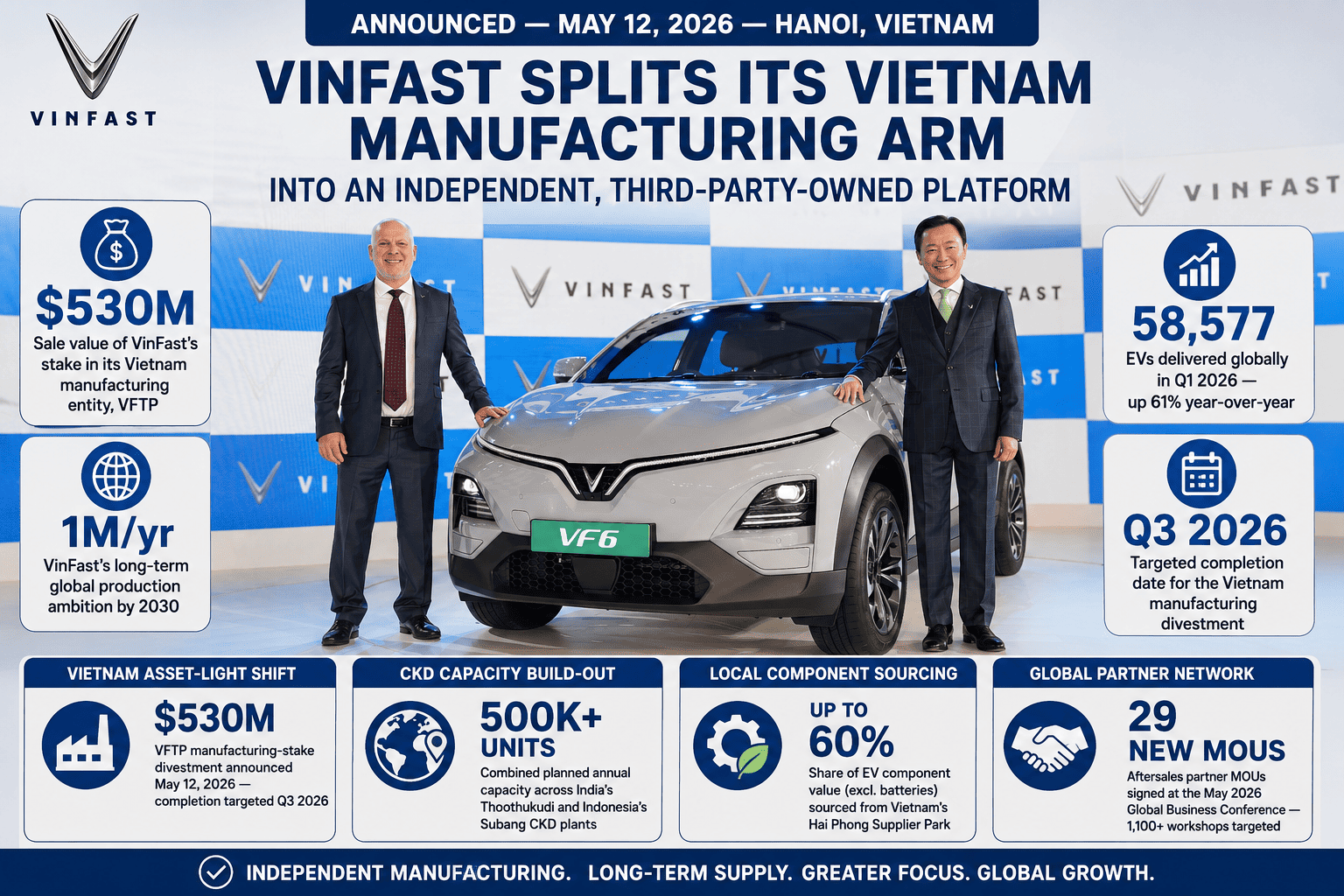
Vietnam Asset-Light Shift
$530M
VFTP manufacturing-stake divestment announced May 12, 2026, completion targeted Q3 2026
CKD Capacity Build-Out
500K+ Units
Combined planned annual capacity across India’s Thoothukudi and Indonesia’s Subang CKD plants
Local Component Sourcing
Up to 60%
Share of EV component value (excl. batteries) sourced from Vietnam’s Hai Phong Supplier Park
Global Partner Network
29 New MOUs
Aftersales partner MOUs signed at the May 2026 Global Business Conference, 1,100+ workshops targeted
Section 1, The Strategy
1
The Full Story: VinFast’s Partner-Built Manufacturing Ecosystem
🏭 Hai Phong, Vietnam, going independent, third-party-operated
+
🇮🇳 Thoothukudi, India, CKD plant, 50K→150K units/yr
+
🇮🇩 Subang, Indonesia, CKD plant, 50K→350K units/yr
=
🌐 One Brand, A Partner-Built Manufacturing Network
🔗
Announced, May 12, 2026, Hanoi, Vietnam
VinFast Splits Its Vietnam Manufacturing Arm Into an Independent, Third-Party-Owned Platform
On May 12, 2026, VinFast Auto Ltd. disclosed plans to split its Vietnamese subsidiary, VinFast Trading and Production JSC (VFTP), into two entities: a new VinFast Vietnam JSC (VFVN) that retains global R&D, intellectual property, brand-building, sales, and after-sales, and a slimmed-down VFTP that keeps the physical factory complex in Hai Phong along with its industrial assets. VinFast will then sell its entire stake in VFTP to a buyer group led by Future Investment Research and Development JSC for approximately VND 13.3 trillion (US$530 million).
Once the transaction completes, Vietnam’s capital-intensive vehicle production becomes an independent, third-party-owned manufacturing platform that continues to build VinFast-branded EVs to VinFast’s designs and technical standards under a long-term supply agreement, while VinFast itself sheds the heaviest capex line on its balance sheet and redirects capital toward higher-value activities: product design, software, brand-building, and the sales and service network it is racing to build out worldwide.
It is, in effect, the same logic VinFast has already been applying abroad, CKD plants built jointly with state and industrial partners in India and Indonesia, a Tier-1 supplier park inside its own Hai Phong campus, and now a manufacturing-as-a-service relationship with an outside AI company, formalised at the level of VinFast’s home-market factory floor. The Proposed Transactions require shareholder approval at an Extraordinary General Meeting scheduled for May 27, 2026, with completion targeted for the third quarter of 2026.
$530M
Sale value of VinFast’s stake in its Vietnam manufacturing entity, VFTP
58,577
EVs delivered globally in Q1 2026, up 61% year-over-year
1M/yr
VinFast’s long-term global production ambition by 2030
Q3 2026
Targeted completion date for the Vietnam manufacturing divestment
VinFast’s transition is designed to be capital-efficient, combining in-house design and R&D with targeted external manufacturing partnerships for flexibility, speed, and cost control.
— Paraphrased from VinFast’s official 2026 strategy communications
Localization is not a branding exercise, it is a structural requirement for long-term competitiveness, embedding the company into each market’s political economy rather than treating it as a temporary guest.
— Paraphrased from Pham Sanh Chau, CEO, VinFast Asia
💡 GTsetu Perspective
VinFast’s pivot is a useful case study for any emerging manufacturer watching legacy and Chinese OEMs build wholly-owned plants on every continent. Rather than racing to match that capital intensity, VinFast is protecting the parts of the business that are hard to copy, brand, design, software, distribution, and building everything capital-intensive through partners: CKD assemblers, Tier-1 suppliers, JV manufacturers, and now an independent contract platform in its own home market. For suppliers, assemblers, and distributors, that means the addressable opportunity is not “sell to VinFast’s factory”, it is “become part of VinFast’s factory network.” GTsetu is where that kind of verified partner discovery happens systematically.
Section 2, The Build
2
The 9-Year Build: From a Hai Phong Groundbreaking to a Global Partner Network
📅 September 2017, Foundations
VinFast Launches Its Automotive Project, and an Integrated Supplier Park, in Hai Phong
VinFast launches its automotive manufacturing project in Hai Phong, Vietnam, pairing the factory with an on-site Supplier Park designed to build a “synchronous ecosystem” for Vietnam’s nascent auto industry, recruiting global Tier-1 suppliers including FORVIA, Lear Corporation, and Grupo Antolin onto the same campus from the outset, rather than building every component capability in-house.
📅 2018–2023, JV Manufacturing
Joint Ventures Extend the Supplier Park, AAPICO Hitech, VinES, Gotion
VinFast signs a joint-venture MOU with Thailand’s AAPICO Hitech to build a Body-in-White plant inside the Hai Phong Supplier Park (51%/49% equity, roughly $60 million invested). Battery subsidiary VinES expands pack assembly into Ha Tinh and develops a second lithium-cell facility there in collaboration with China’s Gotion, building local and joint-venture manufacturing capability around VinFast’s own designs rather than owning every link of the chain outright.
📅 October 2023, Going Overseas
VinFast Announces CKD Manufacturing Plans for India and Indonesia
VinFast outlines a global growth strategy built around CKD (completely knocked down) plants in priority markets, starting with India and Indonesia, each planned at up to 50,000 units of Phase 1 annual capacity and US$150–200 million of initial capex, designed to unlock local EV adoption (then near 1% penetration in both markets) plus government incentives, tariff relief, and access to local raw materials.
📅 August 2025, India Live
Thoothukudi Plant Inaugurated, VinFast’s First Manufacturing Facility Outside Vietnam
VinFast inaugurates its 408-acre EV assembly plant at SIPCOT Industrial Park, Thoothukudi, Tamil Nadu, an initial $500 million phase within a planned $2 billion long-term commitment, starting with 50,000 units of annual capacity for the VF 6 and VF 7, expanding toward 150,000 units. By mid-2026 the plant has crossed its 10,000th locally produced EV.
📅 December 2025, Indonesia Live, India Expands
Subang Plant Opens in Indonesia; Tamil Nadu Gains 200 More Hectares
VinFast inaugurates its 171-hectare Subang, West Java plant just 17 months after groundbreaking, a $300 million first phase within a planned $1 billion-plus build-out, starting at 50,000 units/year and scaling toward 350,000, with localization targets of 40% by 2026, 60% by 2029, and 80% from 2030. Days later, VinFast signs an MOU with the Tamil Nadu government for roughly 200 additional hectares at Thoothukudi to support new electric bus and e-scooter production.
📅 March 2026, Becoming a Manufacturer-for-Hire
VinFast Becomes the Manufacturing Partner for Tensor’s L4 Robocar Program
VinFast highlights its role as manufacturing and industrialization partner for Tensor, a U.S. AI company building personally owned Level 4 autonomous “robocars,” while separately deepening collaboration with VinRobotics, a Vingroup affiliate specializing in industrial humanoid robots and physical AI, to automate its own production lines. The Tensor deal flips the ecosystem model: VinFast is no longer only sourcing manufacturing partners, it is becoming one for an outside technology company.
📅 May 2026, The Ecosystem Formalised ✓
Global Business Conference, 29 Aftersales MOUs, and the Vietnam Manufacturing Split
VinFast’s Global Business Conference (May 4–10, Hanoi) gathers 200+ investors and partners across North America, Europe, the Middle East, India, Indonesia, the Philippines, and Kazakhstan, producing 29 signed aftersales partner MOUs en route to a 1,100+ workshop target for 2026. Days later, on May 12, VinFast announces the VFTP split and $530 million divestment of its Vietnam manufacturing operations, the clearest signal yet that the partner-built model is now the company’s default, not the exception. Shareholder approval is sought at an EGM on May 27, with completion targeted for Q3 2026.
Section 3, Owned vs. Partner
3
Owned vs. Partner Model, The Complete Breakdown
This is where the strategy becomes concrete for suppliers, assemblers, and service operators. Here is every major function VinFast has shifted from owned infrastructure to a partner relationship, with what changed and what it means for your business.
📊 Key Functions, VinFast Ecosystem 2026, Owned Model → Partner Model
🇻🇳 Vietnam ✓ SHIFTED
Core Vehicle Manufacturing
Wholly Owned→3rd-Party Platform
$530M VFTP sale; VinFast keeps brand, R&D, IP and signs a long-term supply agreement for VinFast-branded output.
🔩 Component Supply
Hai Phong Supplier Park
In-House→Up to 60% On-Site Partners
FORVIA, Lear, Grupo Antolin and JV partner AAPICO Hitech co-located on the Hai Phong campus.
🇮🇳🇮🇩 India & Indonesia ✓ SHIFTED
Market Entry Model
Export-Only (CBU)→Local CKD Partnerships
Built with state industrial parks (SIPCOT, Subang) under phased localization mandates.
🤖 Autonomous Tech
L4 Robocar Manufacturing
Build In-House→Manufacture for Tensor
VinFast supplies large-scale manufacturing execution; Tensor supplies the AI and autonomy stack.
🛠️ Aftersales ✓ SHIFTED
Service Network
Dealer-Only→29 New MOU Partners
Multi-model network (dealerships plus independent partners) targeting 1,100+ workshops in 2026.
⚙️ Production-Line Automation
Smart Manufacturing & Robotics
Manual / In-House→VinRobotics Collaboration
Vingroup-affiliate robotics partner integrates industrial humanoid robots and physical AI on the line.
Partnership Footprint, The Numbers
Metric
Vietnam (Hai Phong)
India (Thoothukudi)
Indonesia (Subang)
Phase 1 investment
Founding investment (2017); now being divested for ~$530M
$500M of a planned $2B total
$300M of a planned $1B+ total
Annual capacity (current → planned)
Up to ~300,000 EVs/year
50,000 → 150,000 units/year
50,000 → 350,000 units/year
Local content / localization target
Up to 60% of component value (excl. batteries)
Ramping under Tamil Nadu MOU; expanding scope to buses & scooters
40% by 2026, 60% by 2029, 80% from 2030
Direct jobs
Transferring to new third-party owner under the Share Transfer
~3,000–3,500
Up to 15,000 direct at full capacity
Ownership model (post-2026)
Independent 3rd-party (VFTP sold, supply agreement in place)
VinFast-owned CKD plant, built with state-allocated land
VinFast-owned CKD plant, built under local content regulation
⚠️ Critical: Localization Thresholds Are Not Optional
Indonesia’s import-incentive regime ties preferential treatment for VinFast’s fully-imported (CBU) EVs to a binding commitment: a set volume of locally assembled production by 2026, scaled to each brand’s 2025 import total, for VinFast, roughly 17,000 units. Miss the threshold and the incentive exposure shifts. The same logic runs through India’s SIPCOT land-allocation terms and Indonesia’s phased 40%/60%/80% local-content targets. Any supplier, CKD partner, or component manufacturer entering the VinFast ecosystem should treat these regulatory thresholds as a hard planning input, not a footnote, missed localization deadlines affect VinFast’s own cost structure and, by extension, the supplier programs and volumes it can commit to.
Section 4, Partner Winners
4
Which Partner Categories Gain Most From VinFast’s Ecosystem Strategy?
🏭 Manufacturing & Component Partners
🔩
Component / Tier-1
Hai Phong Supplier Park Tenants
On-site land, discounted rent, and a buy-all-output commitment for suppliers joining VinFast’s production chain in Vietnam.
⚙️
CKD Assembly
India & Indonesia Localization Partners
Local component and tooling suppliers feeding Thoothukudi and Subang as both plants ramp toward mandated local-content thresholds.
🔋
Battery & JV
Cell & Pack Joint-Venture Partners
VinES-style structures bring in specialist cell and pack manufacturers (e.g. Gotion) under shared-equity arrangements.
🏭
Body-in-White / Structures
Stamping & Welding JV Operators
Co-invested structural manufacturing capacity, on the AAPICO Hitech model, embedded directly inside VinFast’s campus footprint.
🇻🇳
Contract Manufacturing
The New VFTP Operator & Its Sub-Tier
The buyer group acquiring VFTP inherits a turnkey EV factory with a multi-year VinFast supply agreement, and the supplier ecosystem that comes with it.
🤖
Robotics & AI
Automation & Autonomous-Tech Partners
VinRobotics for factory-floor automation; Tensor-style relationships where VinFast becomes the build partner for outside AI/mobility ventures.
🌐 Distribution & Service Partners
🛠️
Aftersales
Independent Service Workshop Operators
29 newly signed MOU partners plus the existing dealer network, scaling toward 1,100+ workshops in 2026.
🚗
Dealerships
Multi-Market Retail & Financing Partners
Dealer and finance tie-ups (e.g. Central Bank of India retail financing) supporting expansion in India, the US, and the Middle East.
⚡
Charging Infrastructure
Co-Investment Partners (V-Green Model)
VinFast affiliate V-Green seeks co-investors to build out charging networks in new markets alongside vehicle rollout.
📦
Parts Logistics
Spare-Parts Distribution Partners
VinFast’s 24-hour common-parts delivery target in key markets depends on a regional warehousing and logistics partner layer.
Section 5, Why Now
5
Why Go Asset-Light Now?
🎯 The Three Forces Behind the Pivot
Three converging pressures make 2026 the year VinFast formalised a partner-built model rather than continuing to fund every factory itself. First, capital discipline, VinFast has financed years of global expansion partly through Vingroup support, and shedding the most capital-intensive line on its balance sheet (vehicle manufacturing in Vietnam) frees resources for higher-return activities like product design, software, and market entry. Second, speed of multi-market expansion, building wholly-owned, greenfield plants in every priority market (India, Indonesia, the US, the EU, the Middle East) is both slower and far more capital-hungry than recruiting local CKD, JV, and aftersales partners who already understand local regulation, labor markets, and incentive structures. Third, competitive pressure from both legacy and Chinese EV makers, global scale is increasingly a network-design problem, not just a factory-construction problem, and an asset-light core lets VinFast move faster across more markets simultaneously than a capital-heavy, fully-owned model would allow.
$530M
Freed up from the Vietnam manufacturing divestment for redeployment into design, software, and global expansion
3+ Markets
Simultaneous manufacturing footprints (Vietnam, India, Indonesia) plus a planned North Carolina, US plant by 2028
61%
Year-over-year global delivery growth in Q1 2026 (58,577 EVs), demand is outrunning what owned capacity alone can serve
Hybrid Model
In-house brand, R&D, and design paired with targeted external manufacturing and service partnerships for speed and cost control
200+
Investors and partners gathered at the May 2026 Global Business Conference across seven regions
1M/yr
VinFast’s stated long-term global production target by 2030, a scale that a partner network can reach faster than owned-only capacity
Section 6, Manufacturing Opportunity
6
The Manufacturing Opportunity for Component Suppliers, CKD Assemblers, and Service Partners
The Structural Shift VinFast’s Ecosystem Strategy Will Drive Over the Next Few Years
VinFast’s pivot to a partner-built model is not a one-off transaction, it is a template the company is likely to keep applying as it scales toward its 1 million-vehicle ambition. For component suppliers, contract assemblers, and service operators, this creates specific, time-sensitive openings that are most valuable to act on while the new Vietnam manufacturing platform, the India and Indonesia CKD plants, and the expanded aftersales network are still building out their supplier and partner base.
Vietnam Platform
The incoming VFTP owner inherits a multi-year VinFast supply agreement and will likely expand its own supplier base to meet it
India Localization
Thoothukudi’s ramp from 50K to 150K units and its new bus/scooter scope opens a fresh round of Tamil Nadu and pan-India component sourcing
Indonesia Local Content
The 40%/60%/80% localization curve at Subang is a multi-year mandate for Indonesian and regional suppliers to win in early and stay in
Aftersales Build-Out
Reaching 1,100+ workshops from today’s ~800 requires hundreds of new independent service partners across multiple regions in 2026 alone
Contract Manufacturing
VinFast’s Tensor relationship shows a path for other AI-mobility ventures to use VinFast, or its own supplier network, as a manufacturing partner
Charging & Robotics
V-Green’s search for charging co-investors and VinRobotics’ automation push open adjacent infrastructure and technology partnership lanes
Section 7, How to Capitalise
7
How to Capitalise: The 6-Step VinFast Ecosystem Action Playbook
1
Map Your Capability Against VinFast’s Localization Roadmap
Before approaching VinFast or its manufacturing partners, identify exactly where your capability sits, body structures, electronics, interiors, battery components, CKD sub-assembly, charging hardware, or service capacity, and map it against the specific localization targets for the plant you’re targeting: India’s expanding bus/scooter scope, Indonesia’s 40%/60%/80% curve, or the new Vietnam platform’s supply agreement. The clearer your fit against a specific, dated milestone, the faster a partnership conversation moves.
2
Identify Your Partnership Lane
VinFast’s ecosystem spans at least five distinct partnership types: on-site Tier-1 component supply (Hai Phong model), co-invested joint-venture manufacturing (AAPICO model), CKD localization supply (India/Indonesia model), independent contract manufacturing (the new VFTP-owner model), and distribution/aftersales (the 29-MOU model). Define precisely which lane fits your business before reaching out, a generic “we’d like to supply VinFast” pitch moves far slower than a request scoped to a named plant, model, and localization milestone.
3
Verify Counterparties Before Disclosing Commercial Information
A high-profile restructuring like the VFTP split generates an enormous volume of inbound interest, suppliers approaching the incoming owner, CKD candidates approaching VinFast India and Indonesia teams, and aftersales operators approaching VinFast’s regional partner managers. Not every counterparty in that rush is what it claims to be. Verify business registration (6 points via government sources: Name, Address, Registration Number, Company Status, Company Type, and Date of Certificate of Incorporation) before sharing pricing, capacity, or BOM-level detail, and put an NDA in place before any substantive disclosure.
4
Build Your Proposal Around the Local Incentive Structure
Each market in VinFast’s network carries its own incentive architecture: Vietnam’s Hai Phong Supplier Park offers discounted land rental (50% off for three years, 20% off for the next five) plus a commitment to purchase a participating supplier’s full agreed output; India’s SIPCOT allocation comes with state government support for permits and infrastructure; Indonesia’s local-content rules are tied directly to import-tariff relief. A proposal that explicitly works with, rather than around, these structures is easier for VinFast’s local teams to approve internally.
5
Structure Agreements to Account for the Vietnam Ownership Change
Any supply or distribution agreement touching VinFast’s Vietnam manufacturing should explicitly address the pending VFTP ownership change, the EGM vote on May 27, 2026, the targeted Q3 2026 completion, and the long-term supply agreement that will govern VinFast-branded production once VFTP is independently owned. Contracts signed before the deal closes should specify what happens to volume commitments, quality standards, and exclusivity terms under the new ownership structure rather than assuming continuity by default.
6
Move While the Partner Network Is Still Being Built
The biggest opportunity sits with the partners who plug in while VinFast’s network is actively expanding, the incoming Vietnam manufacturing owner sourcing its own supplier base, India and Indonesia ramping toward their next localization milestone, and the aftersales network growing from roughly 800 to 1,100+ workshops within 2026. Suppliers, assemblers, and service operators who establish themselves now are positioned as VinFast’s ecosystem scales toward its 1 million-vehicle ambition; those who wait until the network has matured will find the preferred positions already filled.
Section 8, Dos and Don’ts
8
Dos and Don’ts for Prospective VinFast Ecosystem Partners
✅ Do These
✅ Scope your pitch to a named plant, model line, and localization milestone, generic supplier outreach moves slowly
✅ Understand which of the five partnership lanes (Tier-1 supply, JV manufacturing, CKD localization, contract manufacturing, aftersales) fits your business
✅ Track the VFTP divestment timeline (EGM May 27, 2026; targeted completion Q3 2026) if your relationship touches Vietnam manufacturing
✅ Align proposals with each market’s incentive structure, Hai Phong rent discounts, SIPCOT land support, Indonesia’s local-content rules
✅ Verify the counterparty’s registration and credentials before sharing pricing, capacity, or design data
✅ For India/Indonesia entrants: plan around the staged localization curve, not a single point-in-time content requirement
✅ Execute an NDA before disclosing commercial terms to prospective VinFast-ecosystem partners
✅ Consider the aftersales/service lane, reaching 1,100+ workshops in 2026 requires hundreds of new operators globally
✅ For tech and AI ventures: study the Tensor relationship as a model for using VinFast as a contract manufacturer
✅ Move early, the incoming Vietnam manufacturing owner and the India/Indonesia plants are still actively building their supplier base
❌ Avoid These
❌ Assume the Vietnam manufacturing divestment is final, it still requires shareholder and creditor approval before completion
❌ Treat VinFast’s India or Indonesia local-content targets as already met, both are multi-year, phased commitments
❌ Pitch a generic “we want to supply VinFast” proposal without naming a plant, model, or localization milestone
❌ Confuse VinFast’s asset-light shift with an exit from Vietnam, brand, R&D, and sales remain firmly under VinFast
❌ Share BOM-level cost data or capacity figures with unverified counterparties claiming to represent VinFast or its new manufacturing owner
❌ Assume Indonesia’s CKD assembly automatically means full local content, phased targets run through at least 2030
❌ Sign multi-year supply or distribution agreements without addressing how the VFTP ownership change affects continuity
❌ Overlook the aftersales/service lane in favor of manufacturing-only partnership conversations, it’s growing fastest right now
❌ Assume VinFast only manufactures its own vehicles, the Tensor partnership shows it is also a contract manufacturer for others
❌ Wait for the network to fully mature before engaging, the most accessible openings exist while it’s still being built out
Section 9, Misconceptions
9
Common Misconceptions About the VinFast Ecosystem
❌ Myth
“VinFast is exiting Vietnam manufacturing entirely.”
✅ Reality
VinFast is selling the manufacturing-asset entity (VFTP), not the brand. A new entity, VinFast Vietnam JSC (VFVN), retains R&D, intellectual property, brand-building, and sales, and VinFast-branded EVs will continue to be built in Vietnam under a long-term supply agreement with the new, independently owned manufacturing platform.
❌ Myth
“The Vietnam manufacturing sale is already done.”
✅ Reality
The Proposed Transactions still require approval at an Extraordinary General Meeting on May 27, 2026, plus creditor and related-party approvals, with completion targeted for the third quarter of 2026. Partners structuring agreements around the new ownership should plan for that timeline, not assume it has already closed.
❌ Myth
“CKD assembly in India and Indonesia already means full local production.”
✅ Reality
CKD assembly means final assembly happens locally, not that all components are locally sourced. Indonesia’s localization curve runs from 40% in 2026 to 80% only from 2030 onward; India’s local-content build-out is still ramping alongside its capacity expansion. The component-sourcing opportunity for local and regional suppliers extends across this entire multi-year window.
❌ Myth
“VinFast only manufactures its own vehicles.”
✅ Reality
VinFast is the manufacturing and industrialization partner for Tensor’s Level 4 autonomous robocar program, building another company’s product on VinFast’s own production lines. This positions VinFast itself as a contract-manufacturing option for outside automotive and mobility ventures, not only as a buyer of components.
❌ Myth
“29 signed aftersales MOUs means 29 new workshops are already open.”
✅ Reality
An MOU is a commitment to build, not an open facility. VinFast’s plan is for these partners to construct EV service workshops aligned with its global service standards over the course of 2026, as part of the broader push from roughly 800 to more than 1,100 workshops worldwide. The rollout window is the opportunity, it is still actively underway, not finished.
Section 10, GTsetu
10
How GTsetu Helps You Find the Right VinFast-Ecosystem Manufacturing Partner
VinFast’s asset-light strategy opens the door, it does not hand you a verified Tier-1 supplier for the new Vietnam manufacturing platform. It does not vet the CKD component partner claiming the right credentials for Thoothukudi or Subang. It does not introduce you to a service operator capable of meeting VinFast’s aftersales standards. Finding the right partner, verified, capable, and aligned to the specific lane you need, is the step that turns the ecosystem opportunity into actual production volume. That is exactly what GTsetu enables, systematically.
🌐 Platform Spotlight, GTsetu
Discover Verified VinFast-Ecosystem Manufacturing, CKD, and Distribution Partners, Across ASEAN and Beyond
GTsetu is the verified B2B manufacturing and trading partner discovery platform connecting component suppliers, CKD assemblers, contract manufacturers, and distribution operators with documented capability profiles, zero broker fees on any partnership formed. VinFast’s expanding ecosystem creates the opening across Vietnam, India, Indonesia, and its broader global network. GTsetu puts the right verified partner in front of you before the network matures and the best positions are taken. Every company on GTsetu is verified on 6 key data points via government sources: Name, Address, Registration Number, Company Status, Company Type, and Date of Certificate of Incorporation.
✅
6-Point Govt. VerificationEvery company verified on Name, Address, Registration Number, Company Status, Company Type, and Date of Certificate of Incorporation via official government registries.
🕵️
Anonymous DiscoveryEvaluate verified component, CKD, and distribution partner profiles without revealing your company identity or pricing until mutual interest is confirmed.
📄
Built-In NDA WorkflowProtect your component costs, capacity figures, and BOM-level designs, NDA countersigned with full audit trail before any commercial disclosure.
🚫
Zero CommissionNo broker fees. Your supply, CKD, or distribution agreement stays entirely between you and your partner.
🌏
ASEAN + Global ReachFind manufacturing partners, CKD assemblers, and distributors across Vietnam, India, Indonesia, and 100+ countries globally.
⚡
Move in 2026First-mover partner positions are most valuable right now, while the new Vietnam platform and the India/Indonesia plants are still actively building their supplier base.
No, VinFast is restructuring around manufacturing, not exiting it. On May 12, 2026, VinFast announced it will split its Vietnamese subsidiary VFTP and sell the manufacturing-focused entity to a buyer group led by Future Investment Research and Development JSC for roughly US$530 million. VinFast retains brand-building, R&D, intellectual property, and sales through a new entity, VinFast Vietnam JSC (VFVN), and will continue to have VinFast-branded EVs produced in Vietnam under a long-term supply agreement with the newly independent manufacturing platform. The deal needs shareholder approval at an EGM on May 27, 2026, with completion targeted for Q3 2026.
Q
What is VinFast’s CKD manufacturing strategy in India and Indonesia?
VinFast operates CKD assembly plants in Thoothukudi, Tamil Nadu (India) and Subang, West Java (Indonesia). The Thoothukudi plant, VinFast’s first manufacturing facility outside Vietnam, launched in August 2025 with 50,000 units of annual capacity (a $500 million phase within a planned $2 billion long-term commitment) and is expanding toward 150,000 units, having crossed its 10,000th locally produced EV by mid-2026. The Subang plant launched in December 2025 with 50,000 units of capacity (a $300 million phase within a $1 billion-plus plan), scaling toward 350,000 units, with localization targets of 40% by 2026, 60% by 2029, and 80% from 2030 onward.
Q
What is VinFast’s partnership with Tensor?
VinFast serves as the manufacturing and industrialization partner for Tensor, a U.S. AI company developing personally owned Level 4 (L4) autonomous robocars. Under the arrangement, Tensor focuses on autonomous-driving software and AI while VinFast contributes large-scale manufacturing execution, making VinFast a contract manufacturer for an outside technology company, not just a builder of its own vehicles. This positions VinFast itself as a manufacturing partner for other automotive and mobility ventures, adding a new lane to its already broad partner ecosystem.
Q
How large is VinFast’s global aftersales partner network?
At its 2026 Global Business Conference held May 4–10 in Hanoi, VinFast signed Memoranda of Understanding with 29 international aftersales partners, as part of a plan to expand its global service network to more than 1,100 workshops in 2026, up from roughly 800. The event brought together more than 200 investors and partners across North America, Europe, the Middle East, India, Indonesia, the Philippines, and Kazakhstan. The 29 MOUs represent a commitment to build EV service workshops aligned with VinFast’s global service standards over the course of 2026.
Q
How can GTsetu help me find partners in the VinFast ecosystem?
GTsetu is the verified partner discovery platform that connects component suppliers, CKD assemblers, contract manufacturers, and distribution operators with documented company profiles, without broker fees. Every company on GTsetu is verified on 6 key data points (Name, Address, Registration Number, Company Status, Company Type, and Date of Certificate of Incorporation) using government sources. For suppliers entering VinFast’s ecosystem: find verified manufacturing and CKD partners across Vietnam, India, Indonesia, and 100+ countries. For service operators: find aftersales and distribution partners aligned with VinFast’s expanding network. The process: (1) browse verified profiles anonymously, (2) execute an NDA before any commercial disclosure, (3) validate capability through a pilot or trial, (4) formalise the partnership with a documented agreement. Zero commission on any deal. Start your VinFast-ecosystem partner search on GTsetu →
The VinFast Manufacturing Ecosystem Is Expanding. Find Your Partner on GTsetu.
The Vietnam manufacturing platform is being restructured. The India and Indonesia CKD plants are ramping up. The aftersales network is growing from 800 to 1,100+ workshops. 500+ verified component suppliers, CKD assemblers, contract manufacturers, and distributors across Vietnam, India, Indonesia, and 100+ countries. Zero broker fees. Anonymous discovery. Built-in NDA workflows. Move in 2026, while the partner base is still being built.
Business Development Expert | Global Trade & Cross-Border Partnerships
Lui Wang is a Business Development Expert at GTsetu, specializing in international trade, cross-border partnerships, and market expansion strategies. With extensive experience working across diverse business ecosystems, Lui helps companies identify growth opportunities, establish strategic collaborations, and navigate the complexities of global commerce.
His expertise spans manufacturing, supply chain partnerships, technology collaborations, market entry strategies, and international business development. Through GTsetu, Lui works closely with businesses, trade organizations, and industry stakeholders to facilitate meaningful connections that drive sustainable growth across regions and sectors.
Lui is particularly passionate about helping organizations build long-term international partnerships, unlock new markets, and strengthen their global competitiveness in an increasingly interconnected economy.