Stellantis, Wayve & Uber Build Autonomous Mobility Platform, Europe, UK & USA Alliance
🔴 BREAKINGStellantis · Wayve · Uber announce landmark autonomous mobility platform June 3, 2026, uniting vehicle manufacturing, AI software, and mobility services across France, UK, and USA◆Robotaxi platform · Autonomous fleet manufacturing · AI-driven driving software · Integrated mobility ecosystem · France · UK · USA◆The alliance creates a new model for autonomous mobility, combining manufacturing, AI software, and mobility services into a single integrated ecosystem◆Find your automotive technology, AI software, and mobility services partner on GTsetu, verified on 6 key data points, zero broker fees, 100+ countries◆🔴 BREAKINGStellantis · Wayve · Uber announce landmark autonomous mobility platform June 3, 2026, uniting vehicle manufacturing, AI software, and mobility services across France, UK, and USA◆Robotaxi platform · Autonomous fleet manufacturing · AI-driven driving software · Integrated mobility ecosystem · France · UK · USA◆The alliance creates a new model for autonomous mobility, combining manufacturing, AI software, and mobility services into a single integrated ecosystem◆Find your automotive technology, AI software, and mobility services partner on GTsetu, verified on 6 key data points, zero broker fees, 100+ countries◆
Home › Blog › Automotive Technology › Autonomous Mobility 2026
🔴 Breaking News🚗 Autonomous Mobility🇫🇷🇬🇧🇺🇸 France-UK-USA🤖 AI Autonomous Driving
Stellantis, Wayve & Uber Build Autonomous Mobility Platform, Europe, UK & USA Alliance
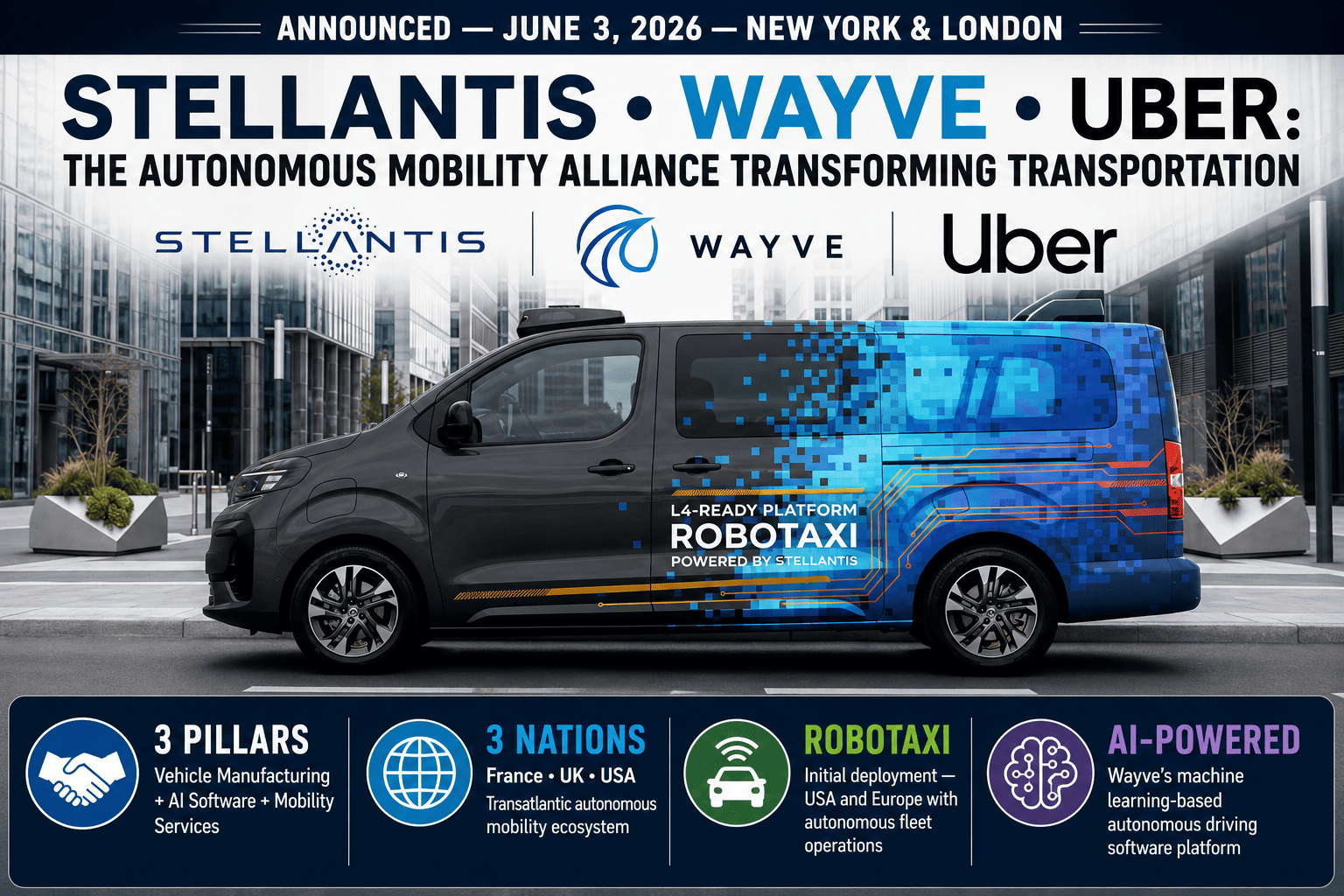
On June 3, 2026, Stellantis, Wayve and Uber announced a landmark strategic alliance to build an integrated autonomous mobility platform spanning France, the United Kingdom, and the United States. The partnership unites Stellantis’ vehicle manufacturing, Wayve’s AI-driven autonomous driving software, and Uber’s global mobility network into a single ecosystem, a new model for autonomous mobility that combines manufacturing, AI software, and mobility services. Here is your complete industry analysis and action guide for technology partners.
📋 Direct Answer
Stellantis, Wayve and Uber announced a landmark strategic alliance on June 3, 2026 to build an integrated autonomous mobility platform spanning France, the United Kingdom, and the United States. The partnership unites Stellantis’ global vehicle manufacturing (producing autonomous-ready electric vehicles), Wayve’s AI-driven autonomous driving software (providing machine learning-based autonomous driving capabilities), and Uber’s global mobility platform (contributing the rider network, fleet management, and mobility services infrastructure). This represents a new model for autonomous mobility, moving from fragmented technology development to an integrated ecosystem that combines manufacturing, AI software, and mobility services under one unified platform. The alliance is expected to accelerate the deployment of robotaxi services, autonomous fleet operations, and next-generation mobility solutions across global markets, with initial deployment focused on the USA and Europe. The partnership creates significant opportunities for automotive technology suppliers, AI software providers, and mobility services partners across the autonomous mobility value chain.
📅 June 3, 2026⏱ 16 min read✍️ GTsetu Editorial Team📰 Automotive + AI + Mobility Services Analysis
Type
Strategic Alliance
Stellantis · Wayve · Uber, manufacturing, AI software, mobility services
Participating Nations
3 Countries
France · UK · USA, transatlantic autonomous mobility ecosystem
On June 3, 2026, Stellantis CEO Carlos Tavares, Wayve CEO Alex Kendall, and Uber CEO Dara Khosrowshahi jointly announced a landmark strategic alliance to build an integrated autonomous mobility platform spanning France, the United Kingdom, and the United States. The partnership unites Stellantis’ global vehicle manufacturing capabilities, Wayve’s AI-driven autonomous driving software, and Uber’s global mobility network into a single integrated ecosystem, creating a new model for autonomous mobility that combines manufacturing, AI software, and mobility services under one unified platform.
The alliance moves beyond traditional automotive partnerships by integrating three essential pillars of autonomous mobility: vehicle production (Stellantis manufactures autonomous-ready electric vehicles), AI driving software (Wayve provides machine learning-based autonomous driving capabilities), and mobility services (Uber contributes its global rider network, fleet management, and mobility infrastructure). This represents a fundamental shift from fragmented technology development to an integrated ecosystem approach that industry analysts believe will accelerate the deployment of robotaxi services and autonomous fleet operations.
The platform is expected to launch initial robotaxi services in the USA and Europe, with a global expansion roadmap planned for subsequent years. The alliance creates significant opportunities for automotive technology suppliers, AI software providers, mobility services partners, and component manufacturers across the autonomous mobility value chain. Industry experts describe this as the most significant autonomous mobility partnership since the formation of the original Waymo and Cruise initiatives, with the unique distinction of combining manufacturing, software, and services from day one.
3 Pillars
Vehicle Manufacturing + AI Software + Mobility Services
3 Nations
France · UK · USA, transatlantic autonomous mobility ecosystem
Robotaxi
Initial deployment, USA and Europe with autonomous fleet operations
“This alliance represents the convergence of three essential capabilities for autonomous mobility, manufacturing, AI software, and mobility services. By integrating these pillars from day one, we are creating a platform that can deploy autonomous mobility at scale, not just as a technology demonstration but as a real commercial service.”
— Stellantis CEO Carlos Tavares, Alliance Announcement
“Our AI-driven autonomous driving software is built for real-world complexity. By partnering with Stellantis’ manufacturing scale and Uber’s global mobility network, we can finally bridge the gap between autonomous driving technology and everyday mobility services. This is how autonomous mobility becomes accessible to everyone.”
— Wayve CEO Alex Kendall
💡 GTsetu Perspective
The Stellantis-Wayve-Uber alliance represents a structural shift in autonomous mobility development. The companies that establish automotive technology partnerships, AI software integration relationships, and mobility services collaborations in 2026, while the platform is being built and supply chain positions are being allocated, will hold preferred supplier status and integrated ecosystem positions that competitors entering in 2028 will find difficult to replicate. GTsetu is where verified technology partner discovery happens systematically, connecting automotive component suppliers, AI software companies, mobility services partners, and technology providers across the autonomous mobility ecosystem.
Section 2, The Evolution
2
The Road to Alliance: How Stellantis, Wayve and Uber Came Together
📅 2023, Initial Discussions
Wayve AI Technology Attracts Automotive Industry Interest
Wayve’s AI-driven autonomous driving approach gains significant industry attention. Multiple automotive manufacturers begin exploratory conversations with the UK-based AI company about potential partnerships and technology integration.
📅 2024, Strategic Alignment
Stellantis and Wayve Explore Technology Integration
Stellantis and Wayve deepen engagement on potential integration of Wayve’s AI driving software into Stellantis vehicle platforms. Uber begins parallel discussions about mobility services integration and fleet deployment opportunities.
📅 Early 2025, Platform Vision
Three-Party Alliance Concept Developed
The three companies begin developing a shared vision for an integrated autonomous mobility platform. The concept of combining manufacturing, AI software, and mobility services into a single ecosystem takes shape.
📅 Late 2025, Alliance Agreement
Strategic Alliance Framework Finalised
Stellantis, Wayve, and Uber finalise the strategic alliance framework. Manufacturing integration, software development roadmaps, and mobility services deployment plans are agreed.
📅 June 3, 2026, LAUNCHED ✓
Autonomous Mobility Platform Announced, New York & London
Stellantis, Wayve and Uber jointly announce the integrated autonomous mobility platform. The alliance is described as a new model for autonomous mobility, combining manufacturing, AI software, and services. Initial robotaxi deployment expected in 2027.
Section 3, Platform Structure
3
Platform Structure: Manufacturing, AI Software, and Mobility Services
The Stellantis-Wayve-Uber alliance is structured as an integrated autonomous mobility platform spanning three core pillars and three nations. Here is the complete breakdown of the platform structure and partner contributions.
The Stellantis-Wayve-Uber autonomous mobility platform is built on four core technology pillars that collectively represent the state of the art in AI-powered autonomous driving. AI-Driven Autonomous Driving: Wayve’s machine learning approach enables autonomous vehicles to learn from real-world driving experience, rather than relying solely on pre-programmed rules, allowing continuous improvement and adaptation to new driving conditions. Sensor Fusion & Computer Vision: Advanced sensor integration combining cameras, radar, and LiDAR through AI-powered computer vision for comprehensive environmental perception and object detection. Autonomous Navigation & Decision-Making: AI algorithms for route planning, obstacle avoidance, and real-time driving decisions in complex urban environments. Fleet Management & Operations: Uber’s platform provides fleet management, rider matching, route optimisation, and operational infrastructure for commercial autonomous mobility services.
AI
Machine learning-based autonomous driving with real-world learning and continuous improvement capabilities
Vision
Advanced computer vision and sensor fusion for comprehensive environmental perception and object detection
Navigation
AI-powered route planning, obstacle avoidance, and real-time decision-making in complex environments
Fleet
Uber’s fleet management, rider matching, route optimisation, and operations infrastructure
EV
Stellantis autonomous-ready electric vehicle platforms with integrated sensor suites and compute hardware
Mobility
Robotaxi platform integrating manufacturing, AI software, and mobility services into a single ecosystem
Section 6, Opportunity
6
The Autonomous Mobility Opportunity: Who Benefits Most from the Alliance?
🤖 Automotive & AI Technology Opportunity, Alliance 2026-2030
The Structural Mobility Industry Shifts the Alliance Will Drive Over the Next Decade
The Stellantis-Wayve-Uber alliance is not just a partnership, it is a catalyst for the convergence of automotive manufacturing, AI software, and mobility services into a single integrated ecosystem. For technology companies on all sides, this creates specific, time-sensitive opportunities that are most valuable to act on in 2026-2027, before supply chain positions are locked and integration agreements are finalised.
Component Suppliers
The alliance creates new demand for sensors, compute hardware, EV components, and autonomous driving modules, component suppliers gain preferred supplier status
AI & Software
AI companies specialising in computer vision, machine learning, and autonomous systems are critical partners for the Wayve software platform
Sensor Manufacturers
Camera, radar, LiDAR, and sensor fusion providers are essential for the autonomous driving platform, European and US suppliers have a clear advantage
Mobility Services
Fleet management, operations, and mobility services partners are being integrated into Uber’s autonomous mobility ecosystem
EV Infrastructure
Charging infrastructure, battery technology, and EV component suppliers are critical to the autonomous fleet deployment
Integration Partners
Companies with systems integration, testing, and validation capabilities are essential for bringing the platform to commercial deployment
Section 7, How to Capitalise
7
How to Capitalise: The 6-Step Action Playbook for Technology Partners
1
Map Your Technology Capability to Alliance Requirements
Before you can engage with alliance partners, you need to identify exactly how your automotive technology, AI software, or mobility services capability aligns with the platform’s requirements. Are you a component manufacturer, AI software developer, sensor specialist, or mobility services provider? Map your capability to the four core technology pillars and identify which alliance partner needs your specific expertise. GTsetu’s partner discovery process starts with this capability mapping, you need to know your competitive position before you can brief a partner on what you bring to the autonomous mobility ecosystem.
2
Identify Your Alliance Partner Gap
The alliance creates a new integrated autonomous mobility ecosystem. Do you need a Stellantis vehicle platform for your autonomous driving software? A Wayve AI integration for your mobility services? An Uber deployment partner for your autonomous fleet? Define your partner gap precisely: automotive supplier, AI software integrator, mobility services partner, or infrastructure provider. GTsetu’s verified network provides documented partner profiles for every one of these needs across all three alliance nations.
3
Verify Partners Before Sharing Technology
Technology partnerships involve sensitive IP, proprietary designs, and confidential information. Not all prospective partners will be legitimate or cleared for automotive and AI technology collaboration. In the alliance opportunity rush, the risk of disclosing proprietary technology to unverified counterparties is acute. Verify your partner’s business registration (6 points via government sources: Name, Address, Registration Number, Company Status, Company Type, Date of Certificate of Incorporation) before any substantive technical conversation. GTsetu’s verification process documents these credentials before you invest a single hour, and the built-in NDA workflow ensures your proprietary technology is protected before any disclosure.
4
Audit Your Security and Compliance Requirements
Automotive technology, AI software, and mobility services partnerships across borders involve complex security and compliance requirements. Understand the automotive safety standards, data privacy regulations, and technology transfer frameworks that apply to your partnership. For US partners, understand the federal and state autonomous vehicle regulations. For UK partners, understand the AI and data protection frameworks. For French partners, understand the EU automotive and mobility regulations. Your compliance audit is non-negotiable before you can form a cross-border technology partnership under the alliance.
5
Structure Your Technology or Services Agreement for the Alliance
Every technology partnership, manufacturing agreement, and services deal associated with the alliance opportunity needs to explicitly address the platform’s integrated structure. If you sign a supply agreement for autonomous driving components, the IP ownership, technology transfer, and integration terms need to reflect the alliance’s unified platform approach. If you sign a services agreement for fleet operations, the data sharing and operational terms need to be clearly defined. Contracts written before the alliance was announced need to be reviewed and amended. GTsetu’s collaboration workspace supports structured, documented commercial negotiation and agreement management, protecting both parties as the platform is built.
6
Move in 2026, Alliance Partner Positions Are Being Established Now
The alliance opportunity is largest for the companies that establish technology partnerships, supply agreements, and integration relationships in 2026 and 2027, before the platform is finalised and preferred partner statuses are locked in. For component suppliers, partnerships formed in 2026 will have two years of platform integration before competitors who wait for commercial launch enter. For AI software providers, the 2026 window is when integration work packages are being allocated. For mobility services partners, the 2026 window is when deployment planning is being structured. The companies that wait for the platform to reach commercial deployment before acting will find that the early movers have already established the relationships that generate the compound advantage. GTsetu’s verified partner network enables rapid identification and engagement with the right technology counterparty without the 12-18 months of conference circuit and industry introduction that characterises traditional automotive and AI networking.
Section 8, Dos and Don’ts
8
Dos and Don’ts for Technology Partners Under the Alliance
✅ Do These
✅ Map your technology capability to the alliance’s four core pillars immediately
✅ Identify your partner gap, automotive, AI software, or mobility services
✅ Verify all prospective partners on 6 key data points before sharing any technical information
✅ Execute NDAs before discussing proprietary designs, algorithms, or commercial terms
✅ Audit your security and compliance requirements, safety, data privacy, and technology transfer regulations
✅ Establish technology or supply partnerships in 2026 before preferred positions are locked in
✅ Structure agreements to account for the alliance’s integrated platform approach
✅ Consider all three nations, France, UK, and USA have unique and complementary strengths
✅ Build relationships across all three alliance partners, integrated ecosystem requires cross-sector collaboration
✅ Leverage GTsetu to find verified technology partners across automotive, AI, and mobility sectors
❌ Avoid These
❌ Wait until the platform reaches commercial deployment to identify partners, positions will be taken
❌ Assume all prospective technology partners are legitimate without verification
❌ Share proprietary designs, algorithms, or commercial terms without an NDA in place
❌ Ignore security and compliance requirements, technology partnerships have serious legal implications
❌ Limit partner search to a single country, the alliance is transatlantic and requires cross-border collaboration
❌ Assume only the three alliance partners matter, the full ecosystem includes suppliers and service providers
❌ Structure agreements without accounting for the platform’s integrated IP and data sharing framework
❌ Focus only on one sector, automotive, AI, and mobility services are converging in this alliance
❌ Attempt to go it alone, the alliance is built on integration and collaboration across sectors
❌ Miss the 2026 partner identification window, the platform’s ecosystem is being built now, not later
Section 9, Misconceptions
9
Common Misconceptions About the Autonomous Mobility Alliance
❌ Myth
“This is just another automotive partnership, similar to existing industry collaborations.”
✅ Reality
This alliance is fundamentally different from traditional automotive partnerships. It integrates three distinct capabilities, vehicle manufacturing (Stellantis), AI software (Wayve), and mobility services (Uber), into a single ecosystem from day one. Unlike typical supplier relationships, this is a strategic alliance that positions the three companies as co-creators of a unified autonomous mobility platform, not as customer-supplier partners.
❌ Myth
“The alliance only benefits the three large companies, smaller technology providers have no role.”
✅ Reality
The platform creates substantial opportunities for technology providers of all sizes, component suppliers, AI software companies, sensor manufacturers, and mobility services partners. The integrated ecosystem requires a diverse supply chain and partner network that includes specialised technology providers across automotive, AI, and mobility sectors. GTsetu’s platform specifically enables partner discovery across all these categories.
❌ Myth
“Autonomous mobility is still years away, there’s no urgency to engage now.”
✅ Reality
The partner selection and ecosystem integration is happening now. The companies that establish technology partnerships, supply agreements, and integration relationships in 2026-2027 will hold preferred positions when the platform scales. The time to act is now, not when the platform reaches commercial deployment. Early movers gain integration advantage and relationship capital that late entrants cannot replicate.
❌ Myth
“The alliance is only relevant to the automotive sector.”
✅ Reality
The alliance spans three distinct sectors, automotive manufacturing, AI software, and mobility services. Technology providers from all three sectors are essential to the platform. AI companies, sensor manufacturers, EV infrastructure providers, fleet operators, and mobility services partners all have critical roles. This is a cross-sector convergence, not a single-industry partnership.
Section 10, GTsetu
10
How GTsetu Connects Technology Partners Across the Autonomous Mobility Ecosystem
The Stellantis-Wayve-Uber alliance creates the opportunity, an integrated autonomous mobility platform spanning three nations and three sectors. It does not find you the verified automotive component supplier with autonomous vehicle experience. It does not connect you with the AI software company with the right machine learning capability. It does not verify the mobility services partner’s operational readiness. Finding the right technology partner, verified, compliant, and strategically aligned, is the step that turns the alliance opportunity into actual integration agreements. That is exactly what GTsetu enables, systematically.
🌐 Platform Spotlight, GTsetu
Find Verified Technology Partners Across the Autonomous Mobility Ecosystem, Before Integration Positions Are Locked
GTsetu is the verified B2B technology partner discovery platform connecting automotive suppliers, AI software companies, mobility services providers, and technology partners across France, the UK, the USA, and 100+ countries, zero broker fees on any partnership formed. The alliance creates the integrated ecosystem. GTsetu puts the right technology partner in front of you before your competitors get there first. Every company on GTsetu is verified on 6 key data points via government sources: Name, Address, Registration Number, Company Status, Company Type, and Date of Certificate of Incorporation.
✅
6-Point Govt. VerificationEvery company verified on Name, Address, Registration Number, Company Status, Company Type, and Date of Certificate of Incorporation via official government registries.
🕵️
Anonymous DiscoveryEvaluate verified technology partners across all three alliance nations without revealing your company identity or technical capabilities until mutual interest is confirmed.
📄
Built-In NDA WorkflowProtect your proprietary designs, algorithms, and commercial terms, NDA countersigned with full audit trail before any technical disclosure.
🚫
Zero CommissionNo broker fees. Your technology partnership, supply agreement, or services contract stays entirely between you and your partner.
🌍
France · UK · USA + 100+ CountriesFind technology partners across the alliance nations and 100+ countries globally.
⚡
Move in 2026First-mover partner positions are most valuable right now, before preferred supplier slots are filled and integration agreements are finalised.
Q
What is the Stellantis-Wayve-Uber autonomous mobility platform announced June 3, 2026?
On June 3, 2026, Stellantis, Wayve and Uber announced a landmark strategic alliance to build an integrated autonomous mobility platform spanning France, the United Kingdom, and the United States. The partnership unites Stellantis’ vehicle manufacturing, Wayve’s AI-driven autonomous driving software, and Uber’s global mobility network into a single ecosystem. This represents a new model for autonomous mobility, combining manufacturing, AI software, and mobility services under one integrated platform.
Q
Which companies and countries are participating in the alliance?
The alliance brings together three industry leaders: Stellantis (global vehicle manufacturing, headquarters in France), Wayve (UK-based AI autonomous driving software company), and Uber (USA-headquartered global mobility platform). The partnership spans three nations, France, the United Kingdom, and the United States, creating a transatlantic autonomous mobility ecosystem. Each company contributes core capabilities: Stellantis (vehicle manufacturing and integration), Wayve (AI autonomous driving software), and Uber (mobility services and fleet operations).
Q
What technology does the autonomous mobility platform cover?
The platform integrates four core technology pillars: AI-Driven Autonomous Driving (Wayve’s machine learning approach enabling real-world learning), Sensor Fusion & Computer Vision (advanced environmental perception), Autonomous Navigation & Decision-Making (route planning and real-time driving decisions), and Fleet Management & Operations (Uber’s platform for fleet operations and rider matching). The platform also includes Stellantis’ autonomous-ready electric vehicle platforms with integrated sensor suites and compute hardware.
Q
What makes this alliance different from traditional automotive partnerships?
This alliance is fundamentally different from traditional automotive partnerships. It integrates three distinct capabilities, vehicle manufacturing (Stellantis), AI software (Wayve), and mobility services (Uber), into a single ecosystem from day one. Unlike typical supplier relationships, this is a strategic alliance that positions the three companies as co-creators of a unified autonomous mobility platform, not as customer-supplier partners. The alliance moves beyond fragmented technology development to an integrated ecosystem approach that industry analysts believe will accelerate the deployment of autonomous mobility services.
Q
How can GTsetu help me find technology partners for the autonomous mobility platform?
GTsetu is the verified partner discovery platform that connects automotive suppliers, AI software companies, mobility services providers, and technology partners across all three alliance nations and 100+ countries, without broker fees. Every company on GTsetu is verified on 6 key data points (Name, Address, Registration Number, Company Status, Company Type, Date of Certificate of Incorporation) using government sources. For component suppliers: find verified manufacturing and technology partners. For AI companies: connect with integration partners across the alliance. For mobility services: discover fleet operations and infrastructure partners. The process: (1) browse verified profiles anonymously, (2) execute an NDA before any technical disclosure, (3) establish partnership with documented agreement. Zero commission on any deal. Start your alliance partner search on GTsetu →
The Alliance Partner Window Is Open. Find Your Technology Partner on GTsetu.
The Stellantis-Wayve-Uber autonomous mobility platform is being built now. Technology partnerships, supply agreements, and integration relationships are being established in 2026. 500+ verified technology partners across automotive, AI, mobility services, and 100+ countries. Zero broker fees. Anonymous discovery. Built-in NDA workflows. Move in 2026, before the best partner positions are locked in.
Business Development Expert | Global Trade & Cross-Border Partnerships
Lui Wang is a Business Development Expert at GTsetu, specializing in international trade, cross-border partnerships, and market expansion strategies. With extensive experience working across diverse business ecosystems, Lui helps companies identify growth opportunities, establish strategic collaborations, and navigate the complexities of global commerce.
His expertise spans manufacturing, supply chain partnerships, technology collaborations, market entry strategies, and international business development. Through GTsetu, Lui works closely with businesses, trade organizations, and industry stakeholders to facilitate meaningful connections that drive sustainable growth across regions and sectors.
Lui is particularly passionate about helping organizations build long-term international partnerships, unlock new markets, and strengthen their global competitiveness in an increasingly interconnected economy.