Bosch SDS × NxtGen: Sovereign Industrial AI Cloud for India’s Industry 4.0, What Manufacturers Must Know | GTsetu
🔴 BREAKINGBosch SDS × NxtGen launch India’s sovereign industrial AI cloud, digital twins, GPU-as-a-service & edge infrastructure for Industry 4.0◆AI shifts from dashboards to real-time factory control, sovereign cloud ensures sensitive production data never leaves India◆Germany’s Bosch SDS + India’s NxtGen = the cross-border tech-manufacturing collaboration playbook for 2026◆Find verified tech and manufacturing partners on GTsetu, 100+ countries, zero commission◆🔴 BREAKINGBosch SDS × NxtGen launch India’s sovereign industrial AI cloud, digital twins, GPU-as-a-service & edge infrastructure for Industry 4.0◆AI shifts from dashboards to real-time factory control, sovereign cloud ensures sensitive production data never leaves India◆Germany’s Bosch SDS + India’s NxtGen = the cross-border tech-manufacturing collaboration playbook for 2026◆Find verified tech and manufacturing partners on GTsetu, 100+ countries, zero commission◆
Home › Blog › Bosch SDS × NxtGen Sovereign AI Cloud
🔴 Breaking News🤖 Industrial AI🇮🇳 India Industry 4.0🇩🇪 Germany Tech Transfer
Bosch SDS × NxtGen: How a German AI Giant and India’s Sovereign Cloud Are Building the Factory of the Future
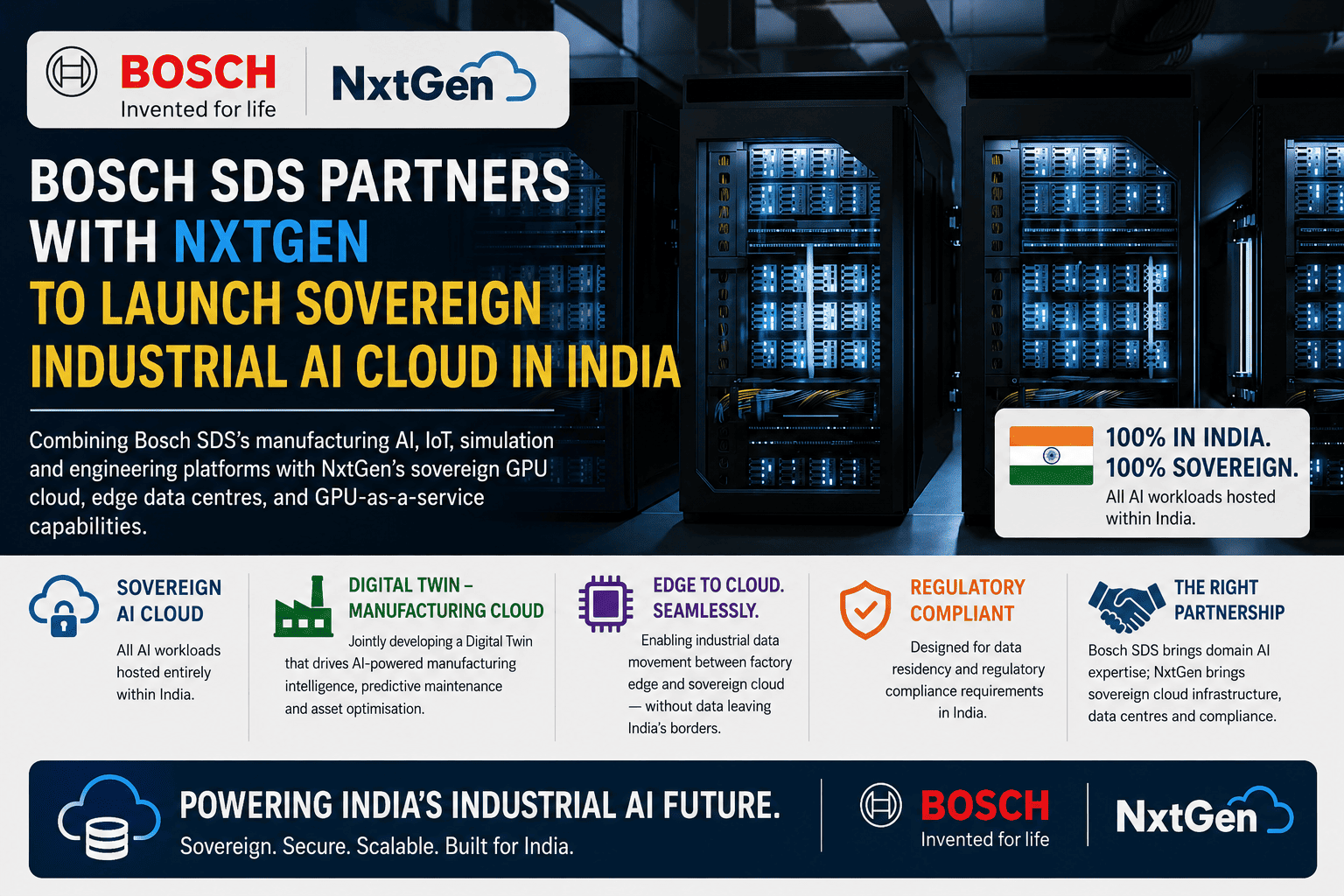
Germany’s Bosch Software and Digital Solutions has partnered with India’s NxtGen to launch a sovereign industrial AI cloud, combining Bosch’s digital twin, manufacturing AI and IoT platforms with NxtGen’s GPU cloud, edge data centres and GPU-as-a-service infrastructure. All AI workloads run entirely within India. Here’s the full story, why it works, and the complete cross-border tech-manufacturing collaboration playbook.
🤖 Direct Answer
Bosch Software and Digital Solutions (Bosch SDS) has partnered with NxtGen to launch a sovereign industrial AI cloud in India, combining Bosch SDS’s manufacturing AI, IoT, simulation and engineering platforms with NxtGen’s sovereign GPU cloud, edge data centres, and GPU-as-a-service capabilities. All AI workloads are hosted entirely within India to meet data residency and regulatory compliance requirements. Together, the companies are jointly developing a Digital Twin – Manufacturing Cloud that supports AI-driven manufacturing intelligence, predictive maintenance, and asset optimisation, while enabling industrial data to move between factory edge environments and centralised sovereign cloud infrastructure, without a single byte of sensitive production data leaving India’s borders. For global technology companies, this partnership is the playbook: bring the domain AI expertise; let your local infrastructure partner carry the sovereign cloud, the data centre footprint, and the regulatory compliance.
📅 March 28, 2026⏱ 17 min read✍️ GTsetu Editorial Team📰 Industrial AI News + Analysis
Deployment Model
Sovereign
100% India-hosted, data never leaves national jurisdiction
Platform Output
Digital Twin
Joint Digital Twin – Manufacturing Cloud in co-development
Infrastructure
GPU-as-a-Service
Managed GPU infra with 24/7 monitoring and Kubernetes orchestration
AI Evolution
Dashboards → Control
AI shifting from analytics to real-time operational decision-making
Section 1, The News
1
The Full Story: Bosch SDS × NxtGen Sovereign Industrial AI Cloud
🤖
Partnership Announced, 2026 Industrial AI Initiative
Bosch SDS and NxtGen Launch India’s Sovereign Industrial AI Cloud, Combining Digital Twin Platforms with GPU-as-a-Service Infrastructure for Indian Manufacturers
Bosch Software and Digital Solutions (Bosch SDS), the software and digital subsidiary of Germany’s Bosch Group, one of the world’s largest engineering and technology companies with €91 billion in annual revenue, has formally partnered with NxtGen Datacenter & Cloud Technologies, India’s sovereign cloud infrastructure provider, to launch a sovereign industrial AI cloud for Indian manufacturers and enterprises.
The initiative addresses a critical and previously unsolved problem for Indian manufacturers deploying AI at scale: where does the data go? Enterprise AI workloads in manufacturing, predictive maintenance models, quality inspection vision AI, digital twin simulations, real-time operational analytics, generate enormous volumes of sensitive production data. Running these workloads on international cloud platforms meant this data leaving India’s borders. The Bosch SDS × NxtGen platform eliminates that exposure entirely: all AI workloads are hosted entirely within India, meeting data residency requirements and the emerging regulatory mandates around industrial data sovereignty.
The collaboration combines Bosch SDS’s manufacturing AI, IoT, simulation and engineering platforms, built on Bosch’s decades of industrial domain expertise serving factories across automotive, process, consumer goods, and energy sectors, with NxtGen’s sovereign GPU cloud, edge data centres, and GPU-as-a-service capabilities. Together, the companies are jointly developing a Digital Twin – Manufacturing Cloud: a platform that creates virtual replicas of physical factory assets and processes, runs AI simulations and predictive analytics on those replicas, and enables real-time operational decisions, all hosted on sovereign Indian infrastructure.
NxtGen provides managed GPU infrastructure including provisioning, lifecycle management, 24-hour monitoring, security management, performance optimisation, and Kubernetes-based orchestration for distributed AI workloads. The architecture supports both edge deployment at factory premises and centralised cloud orchestration, enabling manufacturers to run AI inference at the machine level while maintaining remote monitoring and model management from a central sovereign platform. Flexible deployment models include edge data centres and cloud-at-customer configurations, where GPU infrastructure can be deployed at a manufacturer’s own premises while being centrally managed.
Sovereign
100% India-hosted, zero production data leaves national jurisdiction
Digital Twin
Joint Digital Twin – Manufacturing Cloud platform in active co-development
Edge + Cloud
AI inference at factory edge, orchestrated from central sovereign cloud
“The partnership includes flexible deployment models such as edge data centres and cloud-at-customer models, enabling GPU infrastructure to be deployed at customer premises while being centrally managed.”
“In manufacturing and retail, AI is rapidly evolving from dashboards to real-time operational control. That shift requires infrastructure that is local, predictable and production-grade.”
— A S Rajgopal, Managing Director & CEO, NxtGen
💡 GTsetu Perspective
When Bosch, one of the world’s most sophisticated technology companies, decides its India AI strategy requires a local sovereign infrastructure partner rather than building its own data centres, that is the signal every global technology company needs to hear. The fastest path into a regulated market is not to build your own compliance infrastructure from scratch. It is to find a verified local partner who already has it, and let them carry the regulatory complexity while you focus on your domain AI expertise. That is exactly what NxtGen provides for Bosch SDS in India. GTsetu is where you find the NxtGen for your own market entry.
Section 2, Anatomy of the Partnership
2
Anatomy of the Partnership, What Each Partner Brings
The Bosch SDS × NxtGen partnership works because each partner contributes exactly what the other cannot build at equivalent speed, cost, or credibility. Bosch SDS has manufacturing AI domain expertise accumulated over decades of serving industrial customers globally, expertise that no infrastructure company can replicate in years. NxtGen has sovereign GPU cloud infrastructure, edge data centres, and India-specific regulatory compliance that no foreign cloud company can offer, not even the hyperscalers. The gap between these two profiles is where the sovereign industrial AI cloud is built.
Partnership Anatomy, Sovereign Industrial AI Cloud, India
Bosch SDS
🇩🇪 Germany, Bosch Group Subsidiary
What they bring
Industrial AI + Domain Expertise
Core platforms
Manufacturing AI, IoT, simulation, engineering
AI applications
Predictive maintenance, asset optimisation, quality AI
Parent group
Bosch Group, €91B revenue, 429,000 staff
What they lack
India sovereign cloud, local GPU infra, data residency compliance
Clear operational division, Bosch owns the AI layer; NxtGen owns the infrastructure layer
Risk
AI model performance risk, customer outcome risk
Infrastructure SLA risk, data sovereignty guarantee risk
Aligned risk profiles, each partner owns the risk layer they control operationally
Section 3, The Technology Stack
3
The Technology Stack, Digital Twin Manufacturing Cloud
Understanding what the Bosch SDS × NxtGen platform actually does, and why it represents a step-change from what was previously available to Indian manufacturers, requires unpacking each layer of the technology architecture. The platform is not simply cloud hosting for manufacturing software. It is a purpose-built stack where each layer contributes something that no single vendor could provide alone.
🏗️ Digital Twin – Manufacturing Cloud Architecture
🏭
Manufacturing AI Layer
Bosch SDS contributes predictive maintenance models, quality inspection AI, production optimisation algorithms, and asset lifecycle management. Industrial AI developed over decades of manufacturing deployments globally.
Bosch SDS Layer
🔁
Digital Twin Platform
Joint development, virtual replicas of physical factory assets and processes, running simulation and predictive analytics, enabling manufacturers to test operational changes in a digital environment before real-world deployment.
Joint Development
⚡
Edge AI Layer
AI inference runs at the factory floor level in NxtGen’s edge data centres, or directly on customer premises in cloud-at-customer deployments. Ultra-low latency for real-time machine control without cloud round-trips.
NxtGen Edge Layer
☁️
Sovereign GPU Cloud
NxtGen’s sovereign GPU cloud provides the compute backbone, GPU-as-a-service with provisioning, lifecycle management, 24/7 monitoring, security, performance optimisation, and Kubernetes orchestration for distributed AI workloads.
NxtGen Cloud Layer
🔒
Sovereignty & Compliance
All infrastructure is 100% India-hosted and India-operated. NxtGen is an Indian entity subject only to Indian law, ensuring full data residency compliance, DPDP Act alignment, and immunity from foreign government data access orders.
NxtGen Compliance
📊
IoT & OT Integration
Bosch SDS’s IoT connectivity layer bridges factory OT systems, PLCs, SCADA, sensor networks, to the cloud AI platform. Operational technology data flows from machines to models without manual data engineering overhead.
Bosch SDS IoT Layer
⚙️ Why the Edge + Cloud Architecture Matters for Manufacturers
The architecture that Bosch SDS × NxtGen has built solves a problem that every Industry 4.0 deployment encounters: some decisions need to happen in milliseconds at the machine level, an assembly line stop, a quality rejection gate, a real-time parameter adjustment, and cannot wait for a cloud round-trip. Other decisions benefit from the full computing power of a centralised GPU cluster running complex simulations. The edge-plus-cloud architecture handles both: AI inference at the edge for real-time control, AI training and simulation in the sovereign cloud for strategic optimisation. This is not a product compromise, it is the correct architecture for industrial AI at scale.
Section 4, Why India?
4
Why India? The Industrial AI Opportunity in 2026
🇮🇳 India Industrial AI Opportunity 2025–27
Why Global Technology Companies Are Choosing India as Their Industrial AI Manufacturing Hub
India’s manufacturing sector is at an inflection point. The government’s Production Linked Incentive (PLI) scheme has attracted over ₹3 lakh crore in manufacturing investment. India has overtaken China as the world’s most populous nation, with a rapidly growing industrial workforce. Simultaneously, Indian manufacturers face intensifying pressure to improve quality, reduce waste, and compete globally, exactly the problems industrial AI solves. The combination of these factors creates an AI adoption curve that is accelerating faster than any other major market.
$1T+
India’s manufacturing output target, making it the world’s 3rd largest manufacturing economy
₹3L Cr
PLI scheme investment committed across 14 sectors, all requiring Industry 4.0 capabilities
DPDP
Digital Personal Data Protection Act mandates data residency, making sovereign cloud essential
Dashboards → Control
AI evolution stage in Indian manufacturing, from reporting to real-time operational control
GPU Gap
India has a critical shortage of sovereign GPU compute for enterprise AI, NxtGen addresses this directly
3 sectors
Initial platform focus: manufacturing, retail, and critical infrastructure, all high-sensitivity data environments
The sovereign cloud dimension of this partnership is not merely a compliance checkbox, it is a strategic imperative that creates a genuine moat. Indian manufacturers in defence supply chains, critical infrastructure, BFSI, and regulated manufacturing sectors cannot use international hyperscalers for sensitive AI workloads regardless of price or performance, because Indian law and sector regulations require data to remain within India under Indian legal control. The Bosch SDS × NxtGen platform is the first industrial AI cloud that simultaneously delivers world-class AI capability and true data sovereignty, a combination that was unavailable before this partnership.
🔑 Key Lesson: The Regulatory Moat Creates Partnership Value
Bosch SDS’s decision to partner with NxtGen rather than deploy on AWS India or Azure India is a strategic statement about what enterprise sovereignty actually means. Geographic data residency (data stored in India on a foreign-owned cloud) is not the same as legal sovereignty (data stored in India on an Indian-owned, Indian-law-governed cloud). Indian manufacturers in regulated sectors need the latter, and that creates a structural demand that only a true sovereign cloud provider can meet. Any global technology company entering a market with strong data sovereignty regulations, India, Europe, Saudi Arabia, Indonesia, should start its infrastructure partner search by identifying which local providers offer genuine legal sovereignty, not just geographic presence.
Section 5, What Is a Tech-Manufacturing Collaboration?
5
What Is a Tech-Manufacturing Collaboration, and Why Do Companies Do It?
🎯 Definition
A tech-manufacturing collaboration is a formal arrangement between a technology platform company and a manufacturing infrastructure or domain company, typically from different geographies or capability profiles, to jointly deliver a capability that neither could provide with equivalent quality or speed alone. In the Bosch SDS × NxtGen case, Bosch SDS cannot build a sovereign India GPU cloud in less than several years and hundreds of millions in capital expenditure. NxtGen cannot build decades of industrial AI domain expertise in manufacturing. The collaboration makes both capabilities available to Indian manufacturers immediately, through a joint platform that neither company owns alone.
The Six Strategic Drivers of Tech-Manufacturing Collaboration
Compliance
A local partner navigates data sovereignty laws, sector regulations, and government procurement requirements that foreign entrants cannot satisfy alone
Speed
A partner’s existing infrastructure beats 3–5 years of data centre construction, certification, and staffing by every operational measure
Domain
Industrial AI domain expertise, manufacturing-specific models, OT integration, factory workflow knowledge, cannot be bought or built quickly
Market
A local infrastructure partner’s existing enterprise customer relationships open procurement doors that a foreign technology company cannot access directly
Capital
Infrastructure partnerships avoid the capital expenditure of building sovereign data centres, the partner’s existing investment is the asset
Credibility
A local partner’s established market credibility de-risks the technology vendor’s platform for enterprise procurement teams evaluating new vendors
Section 6, Types of Collaboration
6
4 Types of Tech-Manufacturing Collaboration, Which Fits Your Situation?
Bosch SDS and NxtGen chose a strategic technology partnership, deep integration, co-developed platform, joint go-to-market. But Bosch SDS could have chosen to simply license its AI platform to an Indian reseller, or to white-label NxtGen’s cloud under the Bosch brand, or to appoint NxtGen as a managed service provider without joint product development. The right structure depends entirely on your IP posture, your capital availability, and how deeply you want to integrate your product and your partner’s product. Here are the four primary models.
01
Strategic Technology Partnership
Deep integration between two technology or technology-infrastructure companies. Joint product development, shared go-to-market, co-branded platform. Both partners contribute irreplaceable capabilities. The Bosch SDS × NxtGen model. Highest value, highest integration complexity.
🤖 Bosch SDS × NxtGen Model
02
IP Licensing / Technology Transfer
You license your AI platform, manufacturing software, or process IP to a local partner who deploys and supports it in their market. You receive royalties without operational integration. Asset-light expansion. Bosch SDS could have licensed its manufacturing AI to NxtGen instead of co-developing, it chose deeper integration for greater upside.
💡 Asset-light AI expansion
03
White-Label / OEM Embedding
Your AI platform is embedded into your partner’s product or service, sold under their brand. You provide the technology layer; they provide the customer relationship and market distribution. No joint go-to-market complexity. Ideal when your partner’s brand is stronger in the target market than your own.
🏷️ Brand-neutral market entry
04
Reseller / Channel Partnership
A local partner sells and supports your technology under their own commercial relationship. Minimal integration. The fastest and lowest-risk entry for technology demand validation before deeper partnership commitment. Ideal as a first step before deciding whether the market justifies a Strategic Technology Partnership.
🌍 Market validation step 1
Section 7, Why This Partnership Model Works
7
Why This Partnership Model Works for Cross-Border Tech Collaboration
🎯 The Core Logic
The Bosch SDS × NxtGen partnership succeeds because it is built on three interlocking strategic advantages: genuine capability complementarity (Bosch SDS cannot build sovereign cloud; NxtGen cannot build industrial AI domain expertise, neither partner can replicate what the other brings), regulatory necessity that creates durable demand (India’s data sovereignty requirements make sovereign cloud infrastructure legally mandatory for many enterprise AI workloads, not just commercially preferred), and market timing aligned with India’s Industry 4.0 adoption curve (manufacturing AI adoption in India is accelerating from pilot deployments to enterprise-scale production, creating the largest addressable market window in the platform’s history).
🌐 GTsetu for Tech-Manufacturing Collaboration
GTsetu’s verified partner network includes technology platform companies, sovereign cloud providers, industrial AI specialists, and manufacturing infrastructure operators across India, Germany, Japan, South Korea, and 100+ other countries. Every company on GTsetu is verified on 6 government-sourced identity points: Name, Address, Registration Number, Company Status, Company Type, and Date of Certificate of Incorporation. If you’re a global technology company looking to enter India’s sovereign cloud or Industry 4.0 market the way Bosch SDS did, through a verified local infrastructure partner with the right regulatory standing, GTsetu is where your partner search begins with verified identity, not conference networking.
Section 8, The Playbook
8
How to Collaborate: A 6-Step Playbook for Cross-Border Tech-Manufacturing Partnerships
The Bosch SDS × NxtGen partnership did not happen through a cold call or trade mission contact. It was the result of deliberate partner identification, capability verification, structured negotiation, and formal documentation. Every technology company or manufacturer seeking a cross-border partnership can adapt this playbook.
1
Define the Capability Gap with Technical Precision
Bosch SDS knew exactly what they needed: sovereign GPU cloud infrastructure, edge data centre capability, India data residency compliance, and an Indian entity structure that satisfies true legal sovereignty. They did not need another AI platform company, they needed a specific infrastructure profile with a specific regulatory status. Define your gap at the same level of technical and legal precision. Vague capability needs produce vague partner searches and ultimately mismatched partnerships where the gap you needed filled is still there after signing.
2
Find and Verify Partners Systematically, Not by Conference Networking
The most sophisticated technology partnerships are not formed through trade fair introductions or conference handshakes, they are formed through deliberate, systematic evaluation of candidates against defined capability criteria. NxtGen was identified as a partner because it had documented sovereign cloud infrastructure, certified compliance credentials, and a track record of enterprise deployments. For technology companies that do not have an existing India network, GTsetu provides verified profiles of infrastructure partners, cloud providers, and technology specialists across 100+ countries. GTsetu verifies 6 identity points via government tie-ups; technical certifications, compliance credentials, and operational capabilities remain your responsibility to verify independently.
3
Protect Your AI IP Before Any Technical Architecture Disclosure
In industrial AI partnerships, your IP includes AI model weights, inference pipeline architecture, training methodology, data processing logic, and the manufacturing domain knowledge embedded in your platform. These assets have commercial value that is impossible to quantify in a lawsuit after the fact. Before sharing any of this, including a high-level technical architecture diagram, execute a mutual NDA with full specificity about what is being protected and under what terms. GTsetu’s built-in NDA workflow handles this automatically: the NDA is countersigned before any technical document is shared, with a complete digital audit trail that is enforceable in any jurisdiction.
4
Run a Controlled Technical Pilot Before Full Commitment
Before Bosch SDS committed to a joint platform co-development with NxtGen, the infrastructure compatibility, latency characteristics, GPU performance under real industrial AI workloads, and API integration complexity had to be validated under real conditions. Never commit to full partnership integration on the basis of technical specification documents. Run a defined pilot: a specific AI workload, a defined data volume, a measured set of performance SLAs, and a documented compliance verification. The pilot either confirms the partnership hypothesis or reveals the integration gaps early enough to address them before long-term contracts are signed.
5
Structure the Partnership Formally, IP, SLAs, GTM, and Exit, All in Writing
A Strategic Technology Partnership requires four formal documents before the first customer is engaged: a Partnership Agreement defining the relationship scope, a Technology Integration Agreement covering API access, data handling responsibilities, and AI model ownership, a Service Level Agreement defining infrastructure performance guarantees and remedies, and a Go-to-Market Agreement covering sales territory, lead ownership, co-marketing obligations, and revenue share. Separately, define ownership of jointly developed platform features before development begins. In cross-border AI partnerships, ownership of AI improvements co-developed during deployment is the single most common source of dispute, and the hardest to resolve retroactively.
6
Establish Joint GTM Governance Before the First Customer Conversation
The most technically sound platform partnerships collapse in go-to-market execution when lead ownership, account control, and revenue attribution are not defined in advance. Before Bosch SDS and NxtGen approached a single Indian enterprise customer together, the internal question of “who owns this account” had to be answered with a documented answer, not a handshake understanding. Define sales territory clearly, specify whether co-selling or independent selling happens by account type, and document how disputes over account ownership are resolved. Cross-border partnerships amplify every communication gap, proactive governance documentation is the only reliable solution.
Section 9, Dos and Don’ts
9
Dos and Don’ts of Cross-Border Tech-Manufacturing Collaboration
✅ Do These
✅ Verify your partner’s compliance credentials, certifications, and regulatory standing independently, not just their marketing materials
✅ Sign NDA before sharing any AI model architecture, training methodology, or platform technical specifications
✅ Run a defined technical pilot under real workloads before committing to full platform integration
✅ Define ownership of jointly developed AI features and improvements before co-development begins
✅ Choose a partner whose compliance standing fills the regulatory gap you cannot fill independently as a foreign entity
✅ Establish go-to-market governance, account ownership, lead attribution, co-selling rules, before the first joint customer conversation
✅ Document SLA commitments, monitoring protocols, and remedies for performance failures before production deployment
✅ Build in exit clauses with defined IP unwinding mechanisms, in tech partnerships, shared platform code creates the most complex exit scenarios
✅ Distinguish between geographic data residency and true legal sovereignty, for regulated sectors, only the latter is sufficient
✅ Use GTsetu’s identity-verified network to find partners whose legal identity is documented before any technical engagement
❌ Avoid These
❌ Assume geographic data residency equals legal sovereignty, AWS India stores data in India but is subject to the US CLOUD Act, which is not sovereignty
❌ Share AI model architecture or platform technical documentation before an NDA is countersigned
❌ Accept compliance certification claims without requesting and reviewing original certification documents
❌ Commit to joint go-to-market without defining account ownership and lead attribution in writing before the first sales call
❌ Begin co-developing platform features or AI models without documented IP ownership of the jointly developed output
❌ Partner with a technology company whose core capability overlaps yours, the gap between capabilities is where partnership value is created
❌ Skip the technical pilot and commit to full integration based on specification documents that have never been tested under real workloads
❌ Ignore cultural and time-zone differences in a Germany-India collaboration, explicit communication protocols are not optional in cross-continental tech partnerships
❌ Negotiate SLA terms verbally, every performance guarantee, uptime commitment, and remediation timeline must be documented before production deployment
❌ Form a Strategic Partnership when a Reseller Agreement would validate market demand at a fraction of the integration complexity and commitment
Section 10, Misconceptions
10
Common Misconceptions That Kill Cross-Border Tech Collaborations
❌ Myth
“Storing data in an India AWS or Azure region is the same as data sovereignty.”
✅ Reality
Geographic residency and legal sovereignty are fundamentally different. AWS India and Azure India store data within Indian borders, but both parent companies are US entities subject to the US CLOUD Act, which can compel data disclosure to US government agencies. For Indian manufacturers in defence, critical infrastructure, or regulated sectors, only a cloud operated by an Indian entity subject exclusively to Indian law satisfies true sovereignty requirements. This is precisely the structural advantage NxtGen provides in the Bosch SDS partnership that no international hyperscaler can replicate.
❌ Myth
“Our AI platform partner’s compliance certifications are on their website, so we don’t need to verify them independently.”
✅ Reality
Compliance certifications listed on a website can be expired, scoped only to specific data types, or not applicable to the specific workload or data classification your AI platform generates. In enterprise AI deployments at the scale that Bosch SDS targets, a compliance failure discovered post-deployment can result in regulatory fines, customer contract terminations, and reputational damage that dwarf the cost of pre-partnership due diligence. Always request original certification documents, verify scope, and check validity dates before signing any partnership agreement that relies on a partner’s compliance standing.
❌ Myth
“A Strategic Technology Partnership is always better than IP licensing, more integration means more value.”
✅ Reality
Bosch SDS chose a Strategic Technology Partnership because both parties had large, irreplaceable capabilities and the India market opportunity justified the integration complexity. But a company with strong AI IP and less capital would achieve equal strategic value through a licensing arrangement at a fraction of the operational overhead. The right structure depends on your capital position, your IP posture, and how much operational responsibility you want to carry jointly. Deeper integration creates higher potential upside but also creates governance complexity, shared liability, and exit difficulty. Match the structure to the objective.
❌ Myth
“We can work out who owns the AI improvements we co-develop once the platform is live and generating revenue.”
✅ Reality
Jointly developed AI IP disputes are the most common reason industrial technology partnerships collapse, and they are almost always caused by vague or absent upfront IP ownership documentation. Once a platform is live, generating customer data, and producing co-developed model improvements, both parties’ leverage is gone, whoever has access to the production environment controls the IP practically, regardless of what any agreement says. Define ownership of jointly developed improvements before the first line of collaborative code is written. This is non-negotiable in any industrial AI partnership involving active co-development.
❌ Myth
“Managing a Germany-India technology partnership requires permanent physical presence in India from day one.”
✅ Reality
The Bosch SDS × NxtGen collaboration is managed across a 4.5-hour time zone gap between Stuttgart and Bangalore without requiring Bosch to establish a full operational presence before the partnership matures. What matters is clear API integration documentation, defined escalation paths for technical incidents, scheduled joint review cadences, and explicit cultural communication protocols, not permanent physical co-location. GTsetu’s encrypted collaboration workspace enables exactly this kind of structured cross-continental technical partnership management as the platform scales and customer deployments grow.
Section 11, Partnership vs Licensing vs White-Label
11
Strategic Partnership vs Licensing vs White-Label vs Reseller, Full Comparison
Bosch SDS chose a Strategic Technology Partnership with NxtGen. But the same India market objective could have been partially achieved through IP licensing to NxtGen, white-labelling the Bosch platform under NxtGen’s brand, or appointing NxtGen as a reseller. Understanding the trade-offs between these structures is essential before any technology company commits to the level of integration and IP exposure that a Strategic Partnership requires.
Factor
Strategic Partnership (Bosch × NxtGen)
IP Licensing
White-Label / OEM
Reseller / Channel
Integration depth
Maximum, shared platform architecture
Medium, licensee integrates your API
High, your platform is embedded
Low, partner sells independently
IP exposure
Very high, full platform integration
High, licensee accesses your IP
Medium, API-level access only
Low, product access, not source
Revenue upside
✓ Maximum, full market participation
Royalty % only
Platform revenue share
Reseller margin only
Speed to market
Slowest (12–24 months integration)
Medium (6–12 months)
Medium (3–9 months)
Fastest (1–3 months)
Sovereignty benefit
✓ Full, NxtGen’s sovereign status covers the platform
Depends on licensee’s infra
Depends on partner’s infra
Depends on where product is hosted
Best when…
Both parties have large irreplaceable capabilities; large market; regulatory requirements mandate sovereign infra
Strong AI IP; limited capital; want asset-light expansion without operational complexity
Partner’s brand is stronger than yours in target market; no co-development needed
Market demand validation before deeper commitment; minimal capital; fast market entry
Section 12, GTsetu
12
How GTsetu Helps You Find the Right Tech-Manufacturing Collaboration Partner
Bosch SDS found NxtGen. Most global technology companies entering a new market do not have an existing India network deep enough to identify which sovereign cloud provider has the right compliance standing, the right GPU infrastructure, and the right enterprise customer relationships. And even when a candidate exists, verifying that their capabilities are genuine, not just marketed, requires systematic, documented discovery rather than conference introductions. GTsetu is the verified B2B manufacturing and technology discovery platform that enables this search at scale, across 100+ countries, before you reveal a single technical detail about your platform.
🌐 Platform Spotlight, GTsetu
Find Verified Technology Partners, Sovereign Cloud Providers, and Industrial AI Collaborators Across 100+ Countries, Anonymously, Securely, With Zero Broker Fees
Every company on GTsetu is verified using government tie-ups on 6 key identity points: Name, Address, Registration Number, Company Status, Company Type, and Date of Certificate of Incorporation. This is the identity foundation. Additional information such as compliance certifications, technical capabilities, and infrastructure specifications is self-reported by companies and must be independently verified through your own due diligence. You evaluate who is real before you engage. You share nothing sensitive until an NDA is countersigned. And you pay zero broker commission on any collaboration formed.
✅
6-Point Government Identity VerificationName, Address, Registration Number, Company Status, Company Type, Date of Incorporation confirmed via government tie-ups. Certifications NOT verified.
🕵️
Anonymous DiscoveryEvaluate identity-verified partner profiles without revealing your company identity or platform architecture until mutual interest is confirmed.
📄
Built-In NDA WorkflowShare AI architecture and platform specs only after NDA is countersigned, full audit trail, no external legal team required.
🚫
Zero CommissionNo broker fees on any partnership. Your licensing deal, strategic partnership, or reseller agreement is entirely between you and your partner.
🌍
100+ CountriesIndia, Germany, Japan, South Korea, Singapore, find sovereign cloud providers, industrial AI partners, and technology partners across every major market.
🔐
Encrypted CollaborationShare AI architecture, compliance documentation, and integration specs securely between verified partners with full audit trail.
Identified NxtGen through documented sovereign cloud infrastructure credentials and India compliance standing
✓ Browse identity-verified company profiles with 6-point government-sourced confirmation before any engagement
You evaluate the partner’s confirmed legal identity, not marketing claims or conference introductions
Chose NxtGen specifically for their sovereign GPU cloud, India compliance standing, and enterprise infrastructure pedigree
✓ Filter by self-reported capabilities, compliance focus areas, and infrastructure type (verify all independently)
Find candidates whose self-reported profile matches your specific infrastructure and compliance requirements
Protected AI model architecture and platform IP with formal NDA before any technical integration discussion
✓ Built-in NDA workflow, countersigned before any technical document is shared, full digital audit trail
Your AI architecture and platform IP are protected at every stage of discovery and partnership development
Selected a partner whose core capabilities were complementary, sovereign cloud infrastructure vs manufacturing AI domain expertise
✓ Self-reported partner profiles show capability focus areas to assess complementarity before engagement
Identify the gap between your capabilities and theirs, that gap is where collaboration value is created
Zero broker intermediary in the NxtGen relationship, direct commercial terms, no commission to a third party
✓ Zero commission on any partnership, all commercial terms are direct between you and your partner
No broker introduces misaligned incentives or takes a percentage of deal value that should flow to the partnership
FAQ
?
Frequently Asked Questions
Q
What exactly is the Bosch SDS and NxtGen sovereign industrial AI cloud?
Bosch Software and Digital Solutions (Bosch SDS) has partnered with NxtGen Datacenter & Cloud Technologies to launch a sovereign industrial AI cloud in India, a platform combining Bosch SDS’s manufacturing AI, IoT, simulation and engineering platforms with NxtGen’s sovereign GPU cloud, edge data centres, and GPU-as-a-service infrastructure. All AI workloads are hosted entirely within India to meet data residency and regulatory compliance requirements. The companies are jointly developing a Digital Twin – Manufacturing Cloud that supports AI-driven manufacturing intelligence, predictive maintenance, and asset optimisation, while enabling industrial data to move between factory edge environments and centralised sovereign cloud infrastructure, without leaving India’s legal jurisdiction. NxtGen provides managed GPU infrastructure including provisioning, lifecycle management, 24/7 monitoring, security management, and Kubernetes orchestration; Bosch SDS provides manufacturing AI domain expertise and platform engineering.
Q
Why did Bosch SDS partner with NxtGen instead of using AWS India, Azure India, or Google Cloud India?
AWS, Azure, and Google Cloud India regions store data geographically within India, but all three parent companies are US entities subject to the US CLOUD Act, which can compel disclosure of stored data to US government agencies regardless of where the data is physically located. For Indian manufacturers in defence supply chains, critical infrastructure, regulated manufacturing, and BFSI, this creates a genuine sovereignty gap that geographic residency alone does not close. NxtGen is an Indian entity, operated under Indian law exclusively, meaning production data stored on NxtGen’s infrastructure is subject only to Indian legal access requirements. Additionally, NxtGen provides GPU-as-a-service and cloud-at-customer deployment models, GPU infrastructure installed at the manufacturer’s own premises and managed centrally, which international hyperscalers do not offer at equivalent compliance depth or India-specific enterprise service levels.
Q
What is a Digital Twin Manufacturing Cloud and what does it enable?
A Digital Twin Manufacturing Cloud is a platform that creates virtual replicas of physical factory assets, production lines, and manufacturing processes, hosted on cloud infrastructure with GPU compute for AI-powered simulation and analytics. The Bosch SDS × NxtGen Digital Twin – Manufacturing Cloud integrates NxtGen’s sovereign GPU infrastructure with Bosch SDS’s Industry 4.0, IoT, simulation, and engineering platforms. This enables manufacturers to: run simulations of production changes before implementing them on the physical factory floor; detect equipment degradation patterns early through AI-powered predictive maintenance; optimise production schedules and parameters using AI models trained on real operational data; and manage asset lifecycle decisions with data-driven insight, all on sovereign Indian infrastructure where production data remains entirely within India’s legal jurisdiction.
Q
What collaboration model is right for my technology company entering a regulated international market?
The right model depends on three factors: how deeply your platform needs to integrate with local infrastructure, how much AI IP you are willing to expose to a partner, and how much capital and operational complexity you can sustain. A Strategic Technology Partnership like Bosch × NxtGen is right when both partners bring large, irreplaceable capabilities, the market opportunity justifies joint platform co-development, and regulatory requirements mandate local sovereign infrastructure. IP licensing is right when you have strong platform IP but want asset-light, low-capital expansion. White-label or OEM embedding works when your partner’s brand is stronger in the target market. A reseller agreement is the correct first step when validating market demand before any deeper commitment. GTsetu supports all four models through its verified partner network across 100+ countries.
Q
What are the biggest risks in cross-border industrial AI partnerships and how are they mitigated?
The five most significant risks in cross-border industrial AI partnerships are: (1) AI IP leakage, model weights, inference architecture, and training methodology are core commercial assets; formal IP ownership documentation before any technical disclosure is essential. (2) Compliance gap discovered post-commitment, marketing claims about data sovereignty and certifications must be independently verified against original certification documents before any customer contracts are signed. (3) Technical incompatibility under real workloads, AI performance requirements must be validated on partner infrastructure in a controlled pilot, not assumed from specification documents. (4) Go-to-market governance failure, joint selling without explicit account ownership and revenue attribution protocols creates customer-visible conflict rapidly. (5) Jointly developed IP disputes, when both partners contribute to new platform features or model improvements, ownership must be contractually defined before development begins. GTsetu’s identity verification and NDA workflows reduce the probability of every one of these failures before they surface.
Q
How can GTsetu help me find an industrial AI or sovereign cloud partner in India or internationally?
GTsetu’s systematic five-step approach: (1) Define your objective precisely, what specific infrastructure capability, compliance certification, or market access must the partner provide that you cannot build faster or cheaper yourself? (2) Search identity-verified profiles, GTsetu lists companies verified on 6 government identity points across 100+ countries. GTsetu verifies identity; technical certifications, compliance standing, and operational capabilities are self-reported and must be verified independently by you. (3) Evaluate anonymously, review partner profiles without revealing your company identity, platform architecture, or product requirements. (4) Execute NDA automatically, GTsetu’s built-in NDA workflow means you disclose nothing technically sensitive until a mutual NDA is countersigned, with a full digital audit trail. (5) Run a controlled pilot, validate infrastructure compatibility, compliance documentation, and commercial alignment under real conditions before full partnership commitment. Zero broker commission on any partnership formed through the platform.
Q
Does GTsetu charge commission on technology or manufacturing partnerships formed through the platform?
No. GTsetu charges zero commission on any partnership, whether a Strategic Technology Partnership, IP licensing deal, white-label OEM agreement, reseller arrangement, joint venture, or contract manufacturing relationship, formed through the platform. The commercial terms of your agreement are entirely between you and your partner. This is a foundational design principle: broker intermediation in B2B technology and manufacturing partnerships typically costs 5–15% of deal value and creates incentive misalignment between the broker and both parties. GTsetu removes the broker entirely. You pay for platform access, not for each partnership you form. Your deal economics belong to your partnership.
Ready to Find Your NxtGen? Start on GTsetu.
500+ identity-verified technology partners, sovereign cloud providers, industrial AI collaborators, and manufacturing infrastructure specialists across India, Germany, Japan, South Korea, and 100+ countries. Zero broker fees. Anonymous discovery. Built-in NDA workflows. GTsetu verifies 6 government identity points; technical certifications and operational capabilities remain your responsibility to verify. Your next cross-border tech-manufacturing collaboration starts with a verified identity, not a trade mission or conference introduction.
Business Development Expert | Global Markets & Trade Intelligence
Lucas Bennett is a Business Development Expert at GTsetu with a focus on international trade, market intelligence, and cross-border business development. He works closely with organizations looking to expand into new markets, develop strategic alliances, and strengthen their position within global business ecosystems.
Lucas brings expertise in market research, international partnership development, trade opportunities, and business growth strategies. At GTsetu, he contributes insights on emerging market trends, global collaboration opportunities, and industry developments that help businesses make informed expansion decisions.
Passionate about connecting organizations across geographies, Lucas helps companies navigate international markets and build partnerships that drive sustainable growth and long-term success.