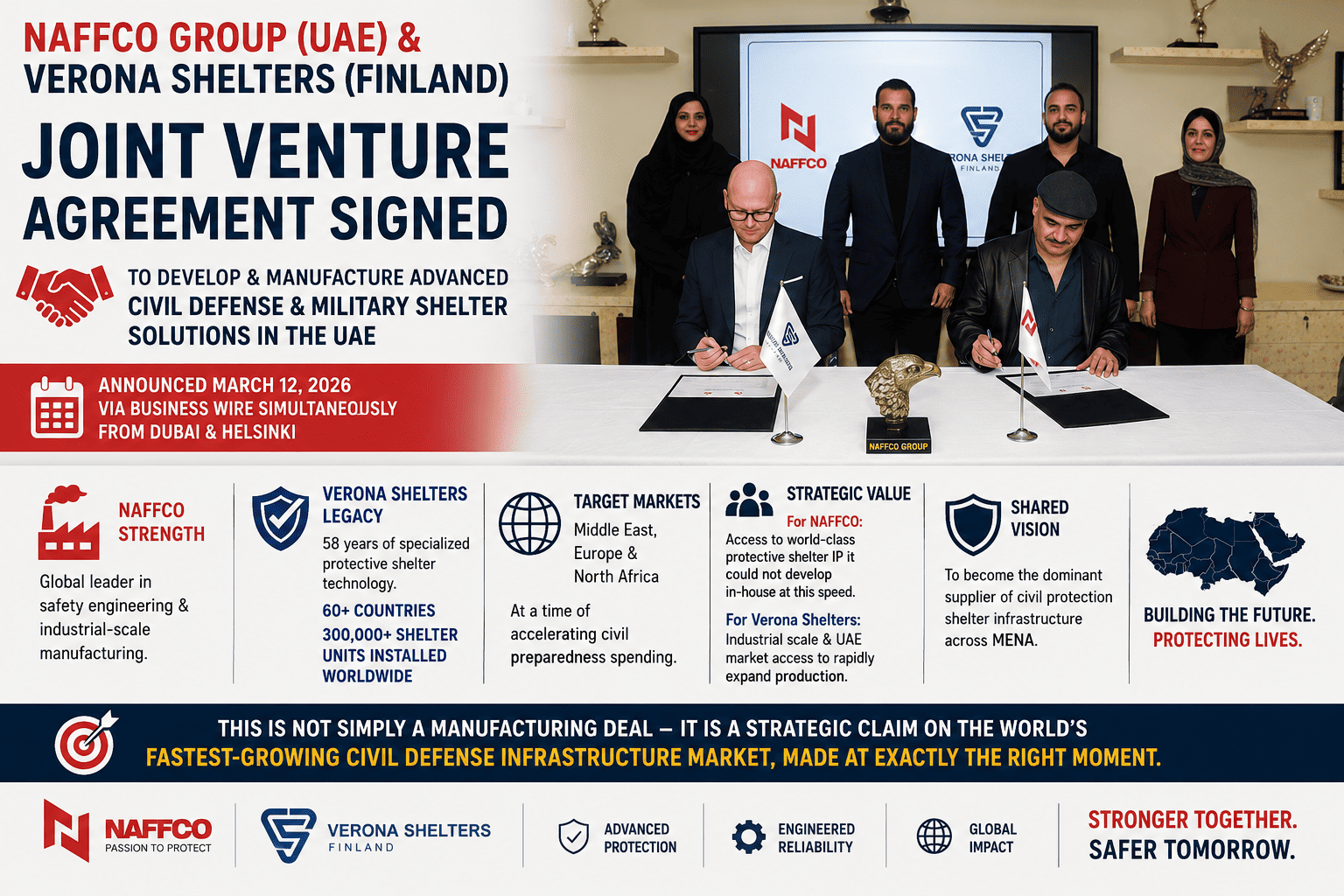
🔴 BREAKINGNAFFCO Group × Verona Shelters launch strategic JV to manufacture civil defense & military shelter systems in UAE, announced March 12, 2026◆300,000+ units installed across 60+ countries, Finland’s 58-year shelter technology meets UAE’s industrial-scale manufacturing◆Civil defense infrastructure becomes a global strategic priority as governments accelerate resilience spending, MENA, Europe, North Africa in focus◆Find your global manufacturing partner on GTsetu, verified on 6 key points, zero broker fees◆🔴 BREAKINGNAFFCO Group × Verona Shelters launch strategic JV to manufacture civil defense & military shelter systems in UAE, announced March 12, 2026◆300,000+ units installed across 60+ countries, Finland’s 58-year shelter technology meets UAE’s industrial-scale manufacturing◆Civil defense infrastructure becomes a global strategic priority as governments accelerate resilience spending, MENA, Europe, North Africa in focus◆Find your global manufacturing partner on GTsetu, verified on 6 key points, zero broker fees◆
Home › Blog › NAFFCO × Verona Shelters Civil Defense JV
🔴 Breaking News🤝 Joint Venture🛡️ Civil Defense Manufacturing🇦🇪 UAE Industry
NAFFCO × Verona Shelters: The Civil Defense JV Scaling Protective Infrastructure Globally, And What Every Manufacturer Must Learn From It
UAE’s NAFFCO Group and Finland’s Verona Shelters have formed a strategic joint venture to manufacture advanced civil defense and military shelter solutions in the UAE, at a moment when governments worldwide are making civil protection infrastructure a national strategic priority. Here is the full story, why this collaboration works, and the complete cross-border manufacturing partnership playbook for manufacturers targeting the global civil defense market.
🛡️ Direct Answer
NAFFCO Group (UAE) and Verona Shelters (Finland) have entered into a Joint Venture Agreement to develop and manufacture advanced civil defense and military shelter solutions in the United Arab Emirates, announced March 12, 2026 via Business Wire simultaneously from Dubai and Helsinki. The partnership combines NAFFCO’s global leadership in safety engineering and industrial-scale manufacturing with Verona Shelters’ 58 years of specialized protective shelter technology, a company that has completed projects in over 60 countries and installed more than 300,000 shelter units worldwide. The JV targets markets across the Middle East, Europe, and North Africa, at a time when governments and critical industries are accelerating civil preparedness spending. For NAFFCO, this is access to world-class protective shelter IP it could not develop in-house at this speed. For Verona Shelters, this is the industrial manufacturing scale and UAE market access needed to rapidly expand production capacity. Together, they are positioned to become the dominant supplier of civil protection shelter infrastructure across MENA. This is not simply a manufacturing deal, it is a strategic claim on the world’s fastest-growing civil defense infrastructure market, made at exactly the right moment.
📅 March 28, 2026⏱ 18 min read✍️ GTsetu Editorial Team📰 Civil Defense Industry News + Analysis
Verona’s Track Record
300,000+
Shelter units installed across 60+ countries since 1968
JV Announced
Mar 12, 2026
Dual announcement: Dubai, UAE & Helsinki, Finland via Business Wire
Verona Founded
1968
58 years of specialized protective shelter technology IP
Target Markets
MENA + EU
Middle East, North Africa, and Europe, three of the fastest-growing civil defense markets
Section 1, The News
1
The Full Story: NAFFCO × Verona Shelters, A Civil Defense JV for a More Dangerous World
🇦🇪 NAFFCO Group, Dubai, UAE
+
🇫🇮 Verona Shelters, Helsinki, Finland
=
🛡️ Civil Defense & Military Shelter JV, UAE
🛡️
Breaking, March 12, 2026, Business Wire / Dubai & Helsinki
NAFFCO Group and Verona Shelters Launch Strategic JV to Scale Civil Defense and Military Shelter Production Globally, From a UAE Manufacturing Base
On March 12, 2026, simultaneously from Dubai, UAE and Helsinki, Finland, NAFFCO Group, the world’s leading producer and supplier of life safety solutions, and Verona Shelters, a Finland-based global leader in shelter technology with a history stretching back to 1968, jointly announced a strategic Joint Venture Agreement to develop and manufacture advanced civil defense and military shelter solutions in the United Arab Emirates.
The timing is not incidental. The JV launches at a moment when civil protection infrastructure is shifting from a niche government expenditure category to a core national strategic priority. Governments across the GCC, Europe, and North Africa are accelerating resilience investment following a succession of regional security events, climate emergencies, and geopolitical tensions that have made protective shelter systems a front-line procurement category for defence ministries, civil emergency agencies, and critical infrastructure operators.
The collaboration combines NAFFCO’s global leadership in safety engineering and industrial-scale manufacturing, spanning fire suppression, emergency systems, and customised safety vehicles, with Verona Shelters’ 58 years of specialized protective shelter expertise, representing over 300,000 units installed across 60+ countries. Together, the JV will deliver next-generation, high-performance shelter systems built to international standards, manufacturing them in the UAE for distribution across the Middle East, Europe, and North Africa.
Verona Shelters provides fully integrated turnkey systems including shelter systems, smart components, lifecycle services, and the Verona Shelters Academy, a knowledge platform for civil protection expertise. NAFFCO brings the industrial manufacturing infrastructure, UAE market relationships, regional distribution network, and safety engineering scale needed to take Verona’s specialized technology to industrial production levels. The JV is structured to capture the global civil preparedness infrastructure boom from the world’s most strategically positioned manufacturing base for MENA distribution.
300,000+
Shelter units Verona has installed across 60+ countries since 1968
58 Years
Verona Shelters’ specialized shelter technology IP, built since 1968
UAE Base
Manufacturing anchored in the UAE, optimal for MENA, North Africa, and export to Europe
3 Markets
Middle East, North Africa & Europe, the three fastest-growing civil defense procurement markets
“Civil protection infrastructure is becoming a strategic priority for governments around the world. This partnership allows us to scale our shelter technology globally and bring proven protection solutions to regions where preparedness and resilience are becoming increasingly important.”
— Marko Nokka, CEO, Verona Shelters Group
“NAFFCO has long been committed to advancing safety and emergency preparedness. Partnering with Verona Shelters enables us to expand our capabilities in advanced civil defense shelter solutions and deliver these systems at an industrial scale across the Middle East, North Africa, and beyond. We expect this partnership to become one of the most significant industrial collaborations in the civil protection shelter sector.”
— Khalid Al Khatib, CEO, NAFFCO Group
💡 GTsetu Perspective
When the CEO of one of the world’s leading life safety manufacturers describes a partnership as potentially “one of the most significant industrial collaborations in the civil protection shelter sector”, that is a signal about where global defense and civil preparedness procurement is heading. The window to establish manufacturing JVs in the civil protection sector is open right now, while governments are in the early stages of multi-year capital programmes. Companies that establish verified local manufacturing partnerships today will hold procurement relationships and supply chain positions that late entrants in 2028 will find structurally inaccessible. GTsetu is where systematic partner discovery for these collaborations starts.
Section 2, Context Timeline
2
Context Timeline: Why Civil Defense Manufacturing Is Booming Right Now
The NAFFCO × Verona Shelters JV did not emerge in a vacuum. It reflects a structural shift in global government procurement priorities, and the companies that read this shift early and established manufacturing partnerships accordingly are positioned to dominate a decade-long infrastructure cycle. Understanding the context is essential for any manufacturer considering entering the civil defense or safety infrastructure space.
🛡️ NAFFCO, Verona Shelters & the Global Civil Defense Cycle, Key Milestones
1968
Verona Shelters Founded in Finland
Verona Shelters begins its specialized civil protection shelter manufacturing journey in Finland, a country with a deep tradition of national resilience infrastructure. Over 58 years, the company accumulates over 300,000 units installed across 60+ countries, building the most comprehensive civilian shelter IP portfolio in the world.
Est.
NAFFCO Becomes the World’s Leading Life Safety Solutions Provider
NAFFCO Group is founded in Dubai, UAE and grows to become the world’s leading producer and supplier of life safety solutions, spanning fire suppression systems, fire alarms, emergency systems, and customized safety vehicles including fire trucks, ambulances, and mobile hospitals. The company builds industrial manufacturing scale and a global distribution network from its UAE base.
2022–25
Global Civil Defense Spending Accelerates Sharply
A succession of geopolitical events, regional conflicts, and climate emergencies drives governments worldwide to dramatically increase civil preparedness infrastructure budgets. The GCC accelerates national resilience programmes; European NATO members reinstate civil defense obligations dormant since the Cold War; North African governments begin major emergency infrastructure programmes. Civil protection shelter procurement shifts from ad-hoc to strategic multi-year capital programmes.
2025
“Major Growth in the GCC Region and Beyond”, Verona Middle East Director
Verona Shelters’ Executive Director for the Middle East specifically cites regional events as a driver of accelerated GCC demand for protective infrastructure, noting the expectation of major shelter procurement growth across the Gulf region and beyond. This demand signal provides the commercial justification for the NAFFCO × Verona JV, local UAE manufacturing is the fastest path to supplying this demand at scale.
Mar 2026
NAFFCO × Verona Shelters Joint Venture Agreement, Dubai & Helsinki
The strategic Joint Venture Agreement is jointly announced from Dubai and Helsinki via Business Wire. NAFFCO’s industrial manufacturing infrastructure meets Verona’s specialized protective shelter technology in a UAE-based production partnership targeting MENA, Europe, and North Africa. Described by NAFFCO’s CEO as potentially one of the most significant industrial collaborations in the civil protection shelter sector.
🛡️ Why UAE Manufacturing for Civil Defense, The Strategic Logic
The UAE is not the obvious location for Finnish shelter technology manufacturing, until you map the procurement geography. The MENA region is the fastest-growing civil defense procurement market globally. The UAE has free zone manufacturing infrastructure, zero-tariff access to GCC markets, and logistics connectivity to North Africa, South Asia, and Europe that no alternative location matches. NAFFCO’s existing distribution network, manufacturing infrastructure, and government relationships in the UAE eliminate years of market development for Verona. The UAE is not just a manufacturing location, it is the distribution hub for the three fastest-growing civil defense markets on Earth simultaneously: GCC, MENA, and North Africa. For any company targeting the civil protection infrastructure sector, this is the right base at the right time.
Section 3, The Anatomy
3
Anatomy of the JV, What Each Partner Brings to the Table
The NAFFCO × Verona Shelters JV is structurally clean, neither company has significant overlap with the other’s core competency, and each brings exactly what the other lacks for the civil defense shelter market at scale. This complementarity is the first principle of any manufacturing collaboration worth doing. When you find perfect complementarity, neither party needs to build from zero or compromise their core business to make the partnership work.
UAE factory; MENA distribution scale; industrial capacity
🛡️ Next-gen civil defense & military shelter systems, UAE manufactured
🌍 MENA, Europe & North Africa distribution from UAE base
🏭 Industrial-scale shelter production to international standards
Collaboration Dimension
What NAFFCO Provides
What Verona Provides
Why This Balance Works
Manufacturing Infrastructure
Industrial-scale UAE factory, safety engineering workforce, tested production systems
Process design, shelter engineering specifications, quality and certification standards
Verona’s 58-year IP runs on NAFFCO’s industrial hardware, no new greenfield facility required
Market Access
GCC government and civil defense procurement relationships; MENA distribution network
Europe and global shelter project references; established credibility in 60+ countries
Both parties unlock new government procurement pools for each other simultaneously
Technology IP
Life safety engineering systems, fire suppression integration, emergency vehicle knowledge
58 years of blast protection, NBC filtration, emergency power, and structural shelter certification IP
NAFFCO manufactures to Verona’s spec, elevating product quality to international civil defense standards that no competitor can replicate quickly
Certification & Compliance
Existing safety product certification systems and UAE regulatory compliance infrastructure
International civil defense shelter certifications, STANAG compliance, NBC rating systems
Verona’s international certifications de-risk the product for government procurement evaluation teams, the most critical barrier in defense sector tenders
Capital Commitment
Existing facility capex, production infrastructure, UAE market investment
Engineering expertise, product development investment, knowledge transfer programme
Asset contribution is asymmetric but balanced, NAFFCO brings hardware; Verona brings decades of irreplaceable IP
Reputational Risk
Production quality risk, NAFFCO’s manufacturing reputation is on the line
Technology reputation risk, Verona’s 58-year brand endorses every JV-produced shelter
Both sides have significant skin in the game, different but real stakes that align incentives throughout the JV lifecycle
Section 4, The Civil Defense Market Opportunity
4
Why UAE, The Global Civil Defense Manufacturing Opportunity Explained
🌍 Global Civil Defense Infrastructure Market 2025–2030
Why Every Protective Infrastructure Manufacturer Should Be Establishing UAE Manufacturing Partnerships Right Now
Governments across MENA, Europe, and North Africa are simultaneously accelerating civil protection infrastructure investment following a convergence of geopolitical, security, and climate drivers. The UAE occupies the exact geographic and logistical intersection of all three target markets. For manufacturers in protective shelter, blast-rated systems, or emergency infrastructure, establishing a UAE manufacturing JV in 2026 is the equivalent of establishing a contract manufacturing partnership in China in 2004, early enough to build structural market advantages before the category becomes crowded.
GCC
Region cited by Verona’s Middle East director as expecting major growth in shelter procurement
NATO
European members reinstating civil defense obligations dormant since the Cold War, creating a new procurement wave
60+
Countries where Verona has completed shelter projects, track record that any new market entrant cannot replicate
UAE Hub
Zero-tariff GCC access + North Africa + Europe logistics, the optimal distribution hub for three simultaneous growth markets
NAFFCO
Already the world’s leading life safety manufacturer in UAE, government relationships and distribution infrastructure already in place
Turnkey
Verona delivers full turnkey systems including shelter systems, smart components, lifecycle services and knowledge platform
Three structural forces are simultaneously driving civil defense manufacturing demand at a scale that has not been seen since the Cold War-era civil protection investment cycle. First, geopolitical tension escalation, regional conflicts, drone warfare, and hybrid security threats are driving governments to establish or restore civil shelter infrastructure dormant for decades, creating a first-mover opportunity for manufacturers with certified shelter IP. Second, climate emergency preparedness, extreme weather events are driving demand for blast and weather-rated emergency shelter infrastructure for civilian and critical industry use across the MENA region. Third, critical infrastructure protection, industrial operators in energy, petrochemical, nuclear, and data centre sectors are investing in blast-rated operational continuity facilities, an entirely separate and rapidly growing procurement channel from government civil defense budgets.
🌐 GTsetu for Global Defense Manufacturing Partnerships
GTsetu’s verified partner network includes safety engineering manufacturers, civil defense infrastructure companies, contract manufacturers, and protective systems distributors across the UAE, GCC, India, Germany, South Korea, Finland, and 100+ other countries, with 6-point government identity verification (Name, Address, Registration Number, Company Status, Company Type, Date of Certificate of Incorporation). If you are a protective infrastructure technology company looking to access MENA manufacturing and distribution, or a UAE manufacturer seeking technology partnerships in civil defense or safety engineering, GTsetu is where systematic, identity-verified partner discovery begins. Note: certifications, export licensing, and regulatory approvals are NOT verified by GTsetu and remain your responsibility to verify independently.
Section 5, What Is a Defense Manufacturing Collaboration
5
What Is a Defense Manufacturing Collaboration, And Why Do Companies Choose JVs?
🎯 Definition
A defense or safety manufacturing collaboration is a formal agreement between two or more companies to jointly develop, produce, or distribute protective systems, civil infrastructure products, or safety engineering equipment by combining complementary capabilities. In the NAFFCO × Verona model, this takes the form of a Joint Venture (JV), a new co-owned entity combining NAFFCO’s industrial manufacturing infrastructure and UAE market relationships with Verona Shelters’ 58 years of specialized shelter technology IP. Unlike a contract manufacturing arrangement, a JV creates shared ownership, shared governance, and shared commercial upside in a new entity built specifically for the target market. Defense and civil protection manufacturing collaborations most commonly take JV form, rather than pure contract manufacturing, because government procurement in this sector typically requires local manufacturing content, long-term maintenance and support commitments, and technology certification that a simple CM arrangement cannot credibly deliver.
Why Defense and Safety Manufacturers Choose JVs Over Other Structures, The 6 Drivers
Tender
Government procurement in civil defense requires local manufacturing content, only a JV satisfies the local content rules that contract manufacturing cannot meet
IP
58 years of shelter IP cannot be licensed at arm’s length, a JV structure ensures both parties have aligned incentives to transfer and protect the technology correctly
Scale
Industrial-scale production of certified shelter systems requires long-term factory commitment that only a JV governance structure credibly sustains for government buyers
Lifecycle
Civil defense shelters require long-term maintenance, spare parts, and upgrade services, government buyers need to know both entities are committed for 20+ years
Certification
International certifications (STANAG, NBC ratings, blast standards) are held by the JV entity, ensuring both parties’ reputations are attached to every product delivered
Market
MENA government procurement relationships belong to neither partner alone, the JV creates a combined commercial identity that is stronger than either company approaching alone
Section 6, Types of Collaboration
6
4 Types of Manufacturing Collaboration, Which Fits Your Situation?
NAFFCO and Verona chose a Joint Venture, the deepest and most committed form of manufacturing collaboration. That was the right structure for them given the government procurement requirements, the complexity of the IP transfer, and the long-term maintenance obligations in the civil defense sector. But the right collaboration structure depends entirely on what you need, what you can invest, and how deeply you need to integrate. Here are the four primary models, with the civil defense and safety engineering context applied to each.
01
Joint Venture (JV)
A new co-owned legal entity with shared equity, governance, profits, and risk. The NAFFCO × Verona model. Best for civil defense and defense manufacturing where government tenders require local content, long-term lifecycle commitments are needed, and both parties bring large irreplaceable assets. Executes in 12–24 months. Highest strategic defensibility once established.
🛡️ NAFFCO × Verona Model
02
Technology / IP Licensing
You license your shelter engineering IP, design specifications, and certification rights to a local manufacturer in exchange for royalties. No new entity, no equity exchange. Faster than a JV, lower capital commitment, but weaker manufacturing quality control and potentially limited eligibility for government tenders requiring wholly locally manufactured content. Best for commercial and industrial buyers rather than government.
🔬 Asset-light expansion
03
Contract Manufacturing
You own the design and certification; a local manufacturer produces to your specification for a per-unit fee. Fastest to market, minimal capital commitment. Appropriate for specific tender opportunities where full local manufacturing content is not required, or for building production volume track record before committing to a full JV. Less appropriate for government civil defense programs requiring deep local manufacturing integration.
🏭 Capacity without commitment
04
Distribution Partnership
You manufacture at home; a local distributor represents your product in a new market. The fastest, lightest form of market entry. Appropriate for testing government procurement appetite before manufacturing investment, but in the civil defense sector, government buyers almost always require local manufacturing commitment for large tenders. Distribution partnerships work best as the validation step before a JV or licensing decision.
🌍 Market entry, step 1
📊 Collaboration Model Comparison, Defense & Civil Protection Manufacturing
Model
Capital Required
Technology IP Transfer
Govt Tender Eligible?
Speed to Market
Lifecycle Commitment
Joint Venture
High, shared capex
✓ Full transfer
✓ Maximum eligibility
Slow, 12–24 months
✓ Long-term anchor
IP Licensing
Low
~ Partial
~ Depends on terms
Medium, 3–9 months
License term only
Contract Mfg
Minimal
~ Process only
✗ Often ineligible
Fastest, 1–4 months
Per-order only
Distribution
Minimal
✗ None
✗ Low, no local mfg
Fastest, 1–3 months
Agreement term only
Section 7, How to Collaborate
7
How to Build a Cross-Border Defense Manufacturing Partnership: A 6-Step Playbook
The NAFFCO × Verona Shelters JV followed a strategic logic that every manufacturer targeting civil defense, safety engineering, or protective infrastructure can adapt. The key distinction from commercial manufacturing partnerships is the government procurement dimension, civil defense JVs must be structured to win tenders, not just to produce products. Here is the six-step playbook, calibrated for the civil defense and safety manufacturing sector.
1
Define the Strategic Capability Gap With Precision
NAFFCO knew exactly what they needed: Verona’s 58 years of specialized blast protection and civil shelter IP, and the international certifications and track record needed to credibly bid on government civil defense tenders that NAFFCO could not win without qualified shelter technology. They did not need more manufacturing capacity, they needed specific IP access and a globally credible shelter engineering partner. Define your gap that precisely. Are you seeking technology IP, manufacturing scale, government procurement access, international certification endorsement, or regional distribution relationships? Each gap requires a different partner profile, and a different collaboration structure to address it. Vague needs produce vague partner searches and misstructured agreements that collapse at the tender stage.
2
Identify and Verify Partners Systematically, Before Any Technical Disclosure
In civil defense and safety manufacturing, the stakes of selecting the wrong partner are higher than in commercial manufacturing. A shelter system that fails a blast certification test does not produce a customer complaint, it potentially ends the partnership, the certification, and the government relationship simultaneously. Systematic partner verification must happen before any technical disclosure. GTsetu provides 6-point government identity verification (Name, Address, Registration Number, Company Status, Company Type, Date of Certificate of Incorporation) for companies across 100+ countries. This establishes that the company is real and legally registered before you engage. Certifications, export licensing, government procurement references, and engineering credentials remain your responsibility to verify independently, GTsetu does not verify these. But starting with a verified legal identity is the essential first step that cold introductions and trade show handshakes cannot provide.
3
Protect Your Technology IP Before Any Technical Disclosure
Verona Shelters’ 58 years of blast protection engineering, NBC filtration system designs, emergency power integration specifications, and structural certification documentation represent decades of irreplaceable investment. This IP, if shared without adequate legal protection, could be used by a competitor to qualify for the same government tenders the JV was designed to win. In civil defense and safety engineering, IP leakage is existential, it is not just a commercial loss, it is a competitive positioning loss that can take years to recover from. Before sharing any shelter engineering specification, design drawing, certification documentation, or manufacturing process data, execute a mutual NDA with clear provisions covering: the scope of information covered, the exclusivity of any disclosed technology for joint development purposes, the prohibition on competitive use of disclosed information, and the duration of confidentiality obligations beyond any JV or licensing agreement termination. GTsetu’s built-in NDA workflow handles this automatically before any sensitive information is exchanged, with a full digital audit trail.
4
Run a Structured Pilot Before Full JV Commitment
Even with a partner of NAFFCO’s pedigree, world-leading life safety manufacturer, decades of government procurement relationships, proven industrial-scale production, a pilot engagement before committing to a full JV structure is essential. In civil defense manufacturing, the pilot answers questions that no reference check or site visit can answer. Can the partner’s manufacturing workforce actually execute to the dimensional and material tolerances required by blast-rated shelter specifications? Does their supply chain for structural components, filtration systems, and emergency power units maintain the lead times they committed to? And critically, can their quality control team document compliance in the format required by international certification bodies? A pilot production run on a single shelter type, with full quality documentation and independent certification testing, costs a fraction of the losses from discovering a manufacturing capability gap after a government tender has been won and delivery obligations committed.
5
Structure the JV Agreement Formally, Every Commercial and IP Term in Writing
Civil defense manufacturing JVs have unique contractual requirements that go beyond standard manufacturing agreements. The NAFFCO × Verona JV agreement must cover, at minimum: the full scope of technology transfer (which Verona IP is transferred to the JV entity, under what license, with what exclusivity), the ownership of certifications held by the JV (STANAG, NBC ratings, blast standard compliance), the geographic exclusivity of the JV’s market rights (MENA, Europe, and North Africa, which regions does each party retain independent commercial rights in?), the profit sharing and revenue distribution structure, the decision-making governance for tender responses and commercial pricing, the IP ownership of improvements and adaptations developed jointly during JV operation, and the dissolution and wind-down terms including certification ownership in the event of JV termination. This last point is critical in government markets: if the JV dissolves, the company that holds the certifications holds the commercial future of the product line. Failing to document this upfront creates structural disputes that are extremely difficult to resolve after government relationships have been built on the JV’s commercial identity.
6
Establish Joint Go-to-Market and Delivery Governance From Day One
In civil defense manufacturing JVs, the go-to-market governance is as important as the production governance. Government tender strategy, pricing authority, customer relationship ownership, after-sales service and maintenance responsibility split, and government procurement relationship management must all be defined explicitly before the first tender response is submitted. A JV that wins a large civil defense shelter tender without a pre-agreed delivery governance model faces a predictable crisis: who manages the customer? Who signs the delivery certificates? Who is responsible when a shelter fails a post-installation blast compliance test? NAFFCO brings MENA government procurement relationships; Verona brings European and international shelter project references. The JV governance structure must explicitly define how each party’s relationships are managed through the JV commercial identity, not independently by each party, to avoid the channel conflict and relationship ambiguity that destroys government sector JVs in their first tender cycle.
Section 8, Dos and Don’ts
8
Dos and Don’ts of Defense and Safety Manufacturing Collaboration
✅ Do These
✅ Build on existing relationships where possible, the fastest path to a JV is through a proven prior engagement, not a cold approach
✅ Verify the partner’s past government tender wins independently, claimed government relationships and documented procurement history are different things
✅ Confirm international certification status independently, which certifications are current, which have lapsed, which require re-certification for the target market
✅ Sign an NDA before sharing any engineering specifications, shelter design drawings, or certification documentation
✅ Define certification ownership explicitly, which entity holds certifications, and what happens to them if the JV structure changes
✅ Run a production pilot before submitting the first government tender, a failed tender delivery exposes both partners and cannot be quietly withdrawn
✅ Agree on tender strategy governance before the first government RFP, who prices it, who signs it, who owns the customer relationship
✅ Include lifecycle service obligations in the JV structure, governments buying shelter systems expect 20+ year maintenance relationships, not just delivery partners
✅ Use verified platforms like GTsetu rather than defence industry events for strategic partner discovery, verified identity is the starting point, not a final due diligence step
✅ Document the full technology transfer programme, 58 years of shelter IP transfers through structured engineering programmes, not just drawings handover
❌ Avoid These
❌ Share shelter engineering IP, certification documentation, or blast specification data before an NDA is countersigned, in defense manufacturing, this is an irreversible loss
❌ Accept self-reported government procurement relationship claims without independently verified past tender wins and customer references
❌ Assume safety product manufacturing expertise automatically transfers to specialized civil defense shelter production, they require different engineering skills, tooling, and quality systems
❌ Commit to a government tender before the JV production capability has been pilot-validated under real manufacturing conditions
❌ Leave certification ownership undefined in the JV agreement, this is the most common cause of civil defense JV dissolution disputes
❌ Partner with a technology provider who is also competing for the same government tenders independently, this conflict destroys JV commercial value and creates pricing ambiguity in procurement processes
❌ Choose a JV structure when the manufacturing objective can be met by a licensing or contract manufacturing arrangement, JV governance complexity is costly and the structure is difficult to unwind
❌ Neglect geographic exclusivity terms, know exactly which markets the JV has exclusive rights to, and which each party retains independent commercial rights in, before the first joint tender
❌ Underestimate cross-cultural communication requirements, UAE-Finland collaboration requires explicit communication protocols for technical documentation, quality standards interpretation, and government procurement relationship management
❌ Start production on an informal basis before the JV agreement is fully executed, informal arrangements in civil defense manufacturing create certification disputes that are legally and commercially catastrophic to resolve
Section 9, Common Misconceptions
9
Common Misconceptions That Kill Defense Manufacturing JVs
❌ Myth
“A JV is always the right structure for a civil defense manufacturing partnership, equity sharing means full commitment.”
✅ Reality
A JV is the right structure when government tenders require local manufacturing content, long-term lifecycle commitments are contractually necessary, and both parties bring large irreplaceable assets. For commercial and industrial civil protection buyers, an IP licensing arrangement may achieve the same market access with significantly lower governance complexity and capital commitment. NAFFCO and Verona chose a JV specifically because the government procurement channel in MENA requires it, not because JVs are inherently superior to licensing or contract manufacturing in every scenario. Match the structure to the procurement channel, not to the optics of commitment.
❌ Myth
“Our existing safety manufacturing certifications automatically qualify us for civil defense shelter production.”
✅ Reality
NAFFCO is the world’s leading life safety manufacturer, and they still chose to partner with Verona Shelters for the specialized certifications and IP that 58 years of civil defense shelter manufacturing provides. Fire suppression certification, safety vehicle manufacturing credentials, and emergency systems qualifications are entirely different from blast-rated shelter STANAG compliance, NBC filtration system certification, and civil defense structural engineering approval frameworks. These certifications take years to earn independently and require documented project track records that no new market entrant can fabricate. The NAFFCO × Verona JV is proof that even the world’s most credentialed safety manufacturer recognizes when a technology partner’s certifications are strategically irreplaceable.
❌ Myth
“We can establish market presence and then find a local manufacturing JV partner once demand is proven.”
✅ Reality
In government procurement markets, the sequence is reversed: you establish the manufacturing partnership first, then the local manufacturing capability unlocks the government procurement access that proves the demand. NAFFCO and Verona did not establish MENA market presence and then look for a UAE factory, NAFFCO’s existing UAE factory, government relationships, and procurement access is the reason the JV makes commercial sense for Verona. The window to establish manufacturing JVs in civil defense is open now, while governments are entering the early stages of multi-year programmes. Late entrants in 2028 will find procurement relationships already locked to early JV partnerships established in 2025–2026.
❌ Myth
“IP transfer in a civil defense JV is straightforward, we share the design drawings and the partner manufactures to spec.”
✅ Reality
Transferring 58 years of civil defense shelter engineering knowledge is a multi-year structured programme, not a document handover. It includes: design drawings and specifications, manufacturing process documentation, quality control procedures and inspection protocols, material sourcing and supplier qualification lists, certification application processes and compliance documentation requirements, engineering team training and technical knowledge transfer, and lifecycle service and maintenance procedure training. The Verona Shelters Academy, a dedicated knowledge platform for civil protection expertise, exists precisely because this knowledge cannot be transmitted through documents alone. Any civil defense JV that treats IP transfer as a file exchange rather than a structured engineering programme will discover this gap at the worst possible moment: during post-delivery certification testing.
❌ Myth
“A cross-border manufacturing JV between a UAE and a Finnish company requires permanent physical presence in both countries to manage effectively.”
✅ Reality
The NAFFCO × Verona JV will be managed from UAE manufacturing operations and Helsinki technology support centres, with structured engineering visit programmes, remote quality audit protocols, and digital collaboration systems for technical documentation exchange. What matters is not physical proximity, it is having explicit protocols for technical documentation transfer, scheduled engineering review sessions, certification audit rights, and quality control inspection frameworks that work across time zones and cultural communication differences. Cross-border civil defense JVs have specific communication requirements: engineering terminology must be aligned across languages, quality standard interpretations must be documented and agreed, and escalation paths for technical disputes must be defined before they arise. GTsetu’s encrypted collaboration workspace supports exactly this structured cross-border working relationship from the first partner engagement.
Section 10, JV vs Licensing vs CM
10
JV vs Licensing vs Contract Manufacturing, Full Defense Manufacturing Comparison
Factor
JV (NAFFCO × Verona Model)
IP Licensing
Contract Manufacturing
Distribution Partnership
Legal structure
New co-owned legal entity; shared equity and governance
License agreement; no new entity created
Manufacturing services agreement; no new entity
Distribution or representation agreement only
Capital commitment
High, shared factory capex and entity setup
Low, royalty payments only
Minimal, per-unit manufacturing fee
Minimal, inventory terms and margin split only
IP ownership
✓ Jointly developed IP belongs to JV
Original IP stays with licensor
✓ Brand retains fully
✓ Manufacturer retains fully
Speed to production
Slowest, 12–24 months setup
Medium, 3–9 months
Fastest, 1–4 months
Fastest, 1–3 months
Govt tender eligibility
✓ Maximum, local manufacturing content
~ Depends on terms and local rules
✗ Often ineligible for full local content
✗ Low, no local manufacturing
Best when…
Government tenders require local content; both parties have large irreplaceable assets; long-term lifecycle commitments needed
Strong IP; limited capital; commercial and industrial buyers; government local content not required
Specific tender opportunities; rapid production needed; full local content not required
Validating government procurement appetite before manufacturing investment; test before commit
Section 11, GTsetu
11
How GTsetu Helps You Find the Right Manufacturing Partner
NAFFCO found Verona Shelters. The question for you is: where do you find your NAFFCO, or your Verona? Most manufacturers in civil defense, safety engineering, and protective infrastructure still rely on industry conference introductions, ministry referrals, and broker-facilitated connections, none of which provide verified partner identity before you disclose your engineering IP or strategic plans. GTsetu enables systematic, government-identity-verified partner discovery across the UAE, MENA, Europe, and 100+ countries, before you share a single sensitive document.
🌐 Platform Spotlight, GTsetu
Find Government-Identity-Verified Defense Technology Partners, Safety Manufacturers, and Civil Protection Infrastructure Companies, Across 100+ Countries, Before You Share a Single Engineering Specification
GTsetu is the B2B manufacturing discovery platform where defense technology companies and industrial manufacturers find each other with 6-point government identity verification (Name, Address, Registration Number, Company Status, Company Type, Date of Certificate of Incorporation), and zero broker fees on any partnership formed. GTsetu does NOT verify ISO certifications, export licenses, defense sector approvals, government procurement references, financial standing, or capacity data. Those remain your responsibility to verify independently. You evaluate verified identity before you commit a conversation. And you share nothing sensitive until an NDA is in place.
✅
6-Point Government Identity VerificationName, Address, Registration Number, Company Status, Company Type, Date of Certificate of Incorporation, verified using government ties. Certifications, export licenses, and procurement records NOT verified.
🕵️
Anonymous DiscoveryEvaluate identity-verified partner profiles without revealing your company identity, engineering strategy, or technology specifics until mutual interest is confirmed.
📄
Built-In NDA WorkflowShare engineering specifications, shelter design IP, and certification documentation only after NDA is executed, full audit trail, no external legal required for standard terms.
🚫
Zero CommissionNo broker fees. Your JV agreement, licensing deal, or distribution arrangement stays entirely between you and your partner.
🌍
UAE, MENA + 100 CountriesFind identity-verified safety manufacturers, civil defense technology companies, protective infrastructure partners, and distributors across every major manufacturing region globally.
🔐
Encrypted CollaborationShare engineering documentation, JV term sheets, and production specifications securely between verified partners with complete access control and audit trail.
What NAFFCO × Verona Did, What GTsetu Enables For You
What This JV Did
What GTsetu Enables for You
Why This Matters
NAFFCO evaluated Verona based on 300,000+ units installed across 60+ countries, a documented, verifiable track record before any IP disclosure
✓ Browse verified company profiles with government-sourced identity verification before engaging
You evaluate verified legal identity, not marketing claims, before any sensitive conversation begins
Verona’s 58 years of IP was shared only after a formal JV structure was agreed, protecting the technology before disclosure
✓ Built-in NDA workflow ensures no engineering IP, design specs, or certification documentation is shared before a countersigned NDA is in place
Your shelter engineering IP, blast protection designs, and certification documentation are protected from the first conversation
NAFFCO brings UAE market access and manufacturing; Verona brings shelter IP and international certifications, neither replicates the other
✓ Filter self-reported partner profiles by capabilities, market coverage, and sector, identify complementarity before engagement (verify certifications independently)
Find the gap between your capabilities and your target market’s requirements, then find a verified partner who fills it
The JV announcement was simultaneous from both headquarters, a formal, documented partnership from day one with no ambiguity about the structure
✓ Encrypted collaboration workspace to manage JV documentation, term sheet negotiation, and technical specification exchange securely
Your JV structure, IP agreements, and production documentation are managed with full access control from first engagement to production launch
No broker intermediary, NAFFCO and Verona’s commercial terms are entirely between the two JV partners, not split with a middleman
✓ Zero commission on any partnership, all JV, licensing, or distribution terms are direct between you and your partner
No broker splits your JV equity, your licensing royalty, or your tender margin, the deal is yours
FAQ
?
Frequently Asked Questions
Q
What exactly is the NAFFCO and Verona Shelters joint venture?
NAFFCO Group (Dubai, UAE) and Verona Shelters (Helsinki, Finland) have entered into a Joint Venture Agreement to develop and manufacture advanced civil defense and military shelter solutions in the United Arab Emirates. Announced on March 12, 2026 via Business Wire simultaneously from both headquarters, the JV combines NAFFCO’s global leadership in safety engineering and industrial-scale manufacturing with Verona Shelters’ 58 years of specialized protective shelter expertise, including over 300,000 units installed across 60+ countries globally. The partnership targets markets across the Middle East, Europe, and North Africa, aiming to deliver next-generation, high-performance shelter systems built to international standards. This is a full joint venture, a co-owned entity with shared equity, shared governance, and shared commercial commitment, chosen specifically because civil defense government procurement in MENA requires local manufacturing content and long-term lifecycle commitments that simpler collaboration structures cannot credibly deliver.
Q
Who is Verona Shelters and why are they significant in the civil defense sector?
Verona Shelters is a Finnish global leader in shelter technology founded in 1968 and headquartered in Helsinki. The company provides fully integrated turnkey systems that protect people, operations, and critical infrastructure, including civil defense blast shelters, NBC-rated shelter systems, military-grade field shelters, and associated smart components and lifecycle services. Since 1968, Verona has completed projects in over 60 countries and installed more than 300,000 units worldwide, making it one of the most experienced civil protection shelter manufacturers globally. The company also operates the Verona Shelters Academy, a dedicated knowledge platform for civil protection and resilience expertise, recognizing that 58 years of shelter engineering knowledge requires structured educational transfer, not just technical documentation. This depth of documented track record, international certification portfolio, and structured knowledge transfer capability is the core IP that NAFFCO’s manufacturing scale and MENA distribution access will now take to industrial production scale for regional and global markets.
Q
Why is civil defense manufacturing experiencing a boom right now?
Three structural forces are simultaneously driving civil defense manufacturing demand at a scale not seen since the Cold War-era civil protection investment cycle. First, geopolitical tension escalation, regional conflicts, drone warfare, and hybrid security threats are driving governments to establish or restore civil shelter infrastructure dormant for decades; Verona’s Middle East director specifically cited regional events as a driver of expected major GCC growth. Second, climate emergency preparedness, extreme weather events are driving demand for blast and weather-rated emergency shelter infrastructure for civilian and critical industry use across the MENA region. Third, critical infrastructure protection, industrial operators in energy, petrochemical, nuclear, and data centre sectors are investing in blast-rated operational continuity facilities, an entirely separate and rapidly growing procurement channel from government civil defense budgets. This combination creates a multi-decade civil protection infrastructure investment cycle, exactly the conditions that justify a large-scale manufacturing JV at this moment.
Q
Why did NAFFCO choose a JV with Verona rather than developing civil shelter technology independently?
Verona Shelters brings 58 years of specialized shelter technology expertise, over 300,000 units installed across 60+ countries, that would take NAFFCO decades to develop independently. Building equivalent specialized civil defense shelter IP requires deep engineering knowledge of blast resistance specifications, NBC (nuclear, biological, chemical) filtration system design, emergency power system integration, structural certification standards, and the documented project track record across diverse geographies and government certification frameworks that government procurement teams require before awarding large tenders. Verona has already developed and proven all of this globally. Developing it independently would take NAFFCO 10–20 years and significant R&D investment with no guarantee of achieving equivalent international certification recognition. The JV approach is faster, commercially superior, and more strategically defensible than either company building the other’s capabilities from scratch, which is exactly why the world’s most experienced civil defense manufacturers choose partnership over independent development when entering new product categories.
Q
What collaboration model is right for my defense or safety manufacturing company?
The right model depends on whether your primary revenue channel is government procurement, which favours local manufacturing JVs for tender eligibility, or commercial and industrial procurement, where licensing and contract manufacturing may be sufficient. A JV (like NAFFCO × Verona) is right when both partners bring large irreplaceable assets, government tenders require locally manufactured products, and a long-term market anchor with lifecycle service commitments is the strategic goal. IP licensing is right when your engineering IP is strong but you lack capital or desire for full operational integration, and your target buyers are commercial rather than government. Contract manufacturing is right for rapid production in a new geography for specific tender opportunities where full local manufacturing content is not required. A distribution agreement is the right first step when validating government procurement appetite and relationship quality before any manufacturing investment commitment. GTsetu supports all four models across 100+ countries, with government-identity-verified partner discovery for every structure.
Q
What are the biggest risks in cross-border defense manufacturing JVs like NAFFCO × Verona?
The five most significant risks are: (1) Specialized IP leakage, civil defense shelter engineering represents decades of R&D; formal IP ownership documentation, NDA coverage, and sub-contracting restrictions are essential before any technical disclosure. (2) Manufacturing capability gap, safety product manufacturing expertise does not automatically transfer to specialized civil defense shelter production; blast-rated structural manufacturing requires specific tooling, material sourcing, and quality control that must be validated in a production pilot before any tender commitment. (3) Government procurement access inflation, partners often overstate their government relationships; verify with specific documented past tender wins, delivery references, and named government contacts before relying on these claims in a tender strategy. (4) International certification ownership disputes, who is named on STANAG compliance certificates, blast protection ratings, and NBC system approvals determines who controls the commercial future of the product line if the JV structure changes. (5) Technology transfer underinvestment, transferring 58 years of shelter engineering knowledge requires structured programmes including engineering team secondments, process documentation, hands-on training, and quality system alignment, not just design drawings handover. Starting with a government-identity-verified partner from GTsetu reduces basic identity risk; certifications, procurement credentials, and capability verification remain your responsibility to validate independently.
Q
Does GTsetu charge commission on defense manufacturing JVs formed through the platform?
No. GTsetu charges zero commission on any collaboration formed through the platform, whether a full joint venture, IP licensing agreement, contract manufacturing arrangement, distribution partnership, or any other structure. The commercial terms of your agreement are entirely between you and your partner. This is a foundational design principle of the GTsetu platform: broker intermediation in defense and safety manufacturing partnerships typically costs 5–15% of deal value, creates incentive misalignment between the broker and both parties, and introduces a third party into commercial conversations that require strict confidentiality. GTsetu removes the broker entirely. Your JV equity structure, your licensing royalty terms, your tender strategy, all of it stays between you and your verified partner. GTsetu verifies identity; everything else is yours.
Ready to Find Your NAFFCO, or Your Verona Shelters? Start on GTsetu.
Government-identity-verified defense technology companies, safety manufacturers, civil protection infrastructure partners, and industrial distributors across the UAE, MENA, Europe, and 100+ countries. Zero broker fees. Anonymous discovery before any IP disclosure. Built-in NDA workflows. GTsetu verifies 6 government identity points (Name, Address, Registration Number, Company Status, Company Type, Date of Certificate of Incorporation). Certifications, export licenses, procurement references, and financials remain your responsibility. Your next cross-border defense or safety manufacturing collaboration starts with a verified identity, not a trade exhibition handshake or ministry introduction.
Business Development Expert | International Trade & Strategic Partnerships
Daniel Carter is a Business Development Expert at GTsetu, specializing in global trade, international business expansion, and strategic partnership development. With extensive experience working across multiple industries and markets, Daniel helps organizations identify growth opportunities, build commercial relationships, and expand their international footprint.
His expertise includes cross-border collaborations, market entry strategies, supply chain partnerships, manufacturing ecosystems, and business matchmaking. Through his work at GTsetu, Daniel supports companies seeking to establish meaningful connections with partners, distributors, investors, and industry stakeholders across global markets.
Daniel is committed to helping businesses unlock new opportunities through collaboration-driven growth and practical international trade strategies.