DHL Express + ASEAN-BAC MoU: Trade Logistics & MSME Support Across Southeast Asia
🔴 BREAKINGDHL Express + ASEAN-BAC MoU — Strategic Alliance to Boost Trade Logistics & MSME Support Across 9 Southeast Asian Nations◆Philippines, Indonesia, Malaysia, Singapore, Thailand, Vietnam, Cambodia, Laos, Myanmar — MSMEs to benefit from preferential shipping rates◆Find verified trade and logistics partners on GTsetu — 100+ countries, zero commission◆🔴 BREAKINGDHL Express + ASEAN-BAC MoU — Strategic Alliance to Boost Trade Logistics & MSME Support Across 9 Southeast Asian Nations◆Philippines, Indonesia, Malaysia, Singapore, Thailand, Vietnam, Cambodia, Laos, Myanmar — MSMEs to benefit from preferential shipping rates◆Find verified trade and logistics partners on GTsetu — 100+ countries, zero commission◆
DHL Express × ASEAN-BAC: How a Strategic MoU Is Unlocking Trade Logistics & MSME Growth Across Southeast Asia
DHL Express and ASEAN-BAC have signed a strategic Memorandum of Understanding to boost trade logistics and MSME support across nine Southeast Asian nations. The alliance simplifies cross-border supply chains, provides preferential shipping rates, and unlocks regional trade integration for thousands of MSMEs.
🎯 Direct Answer
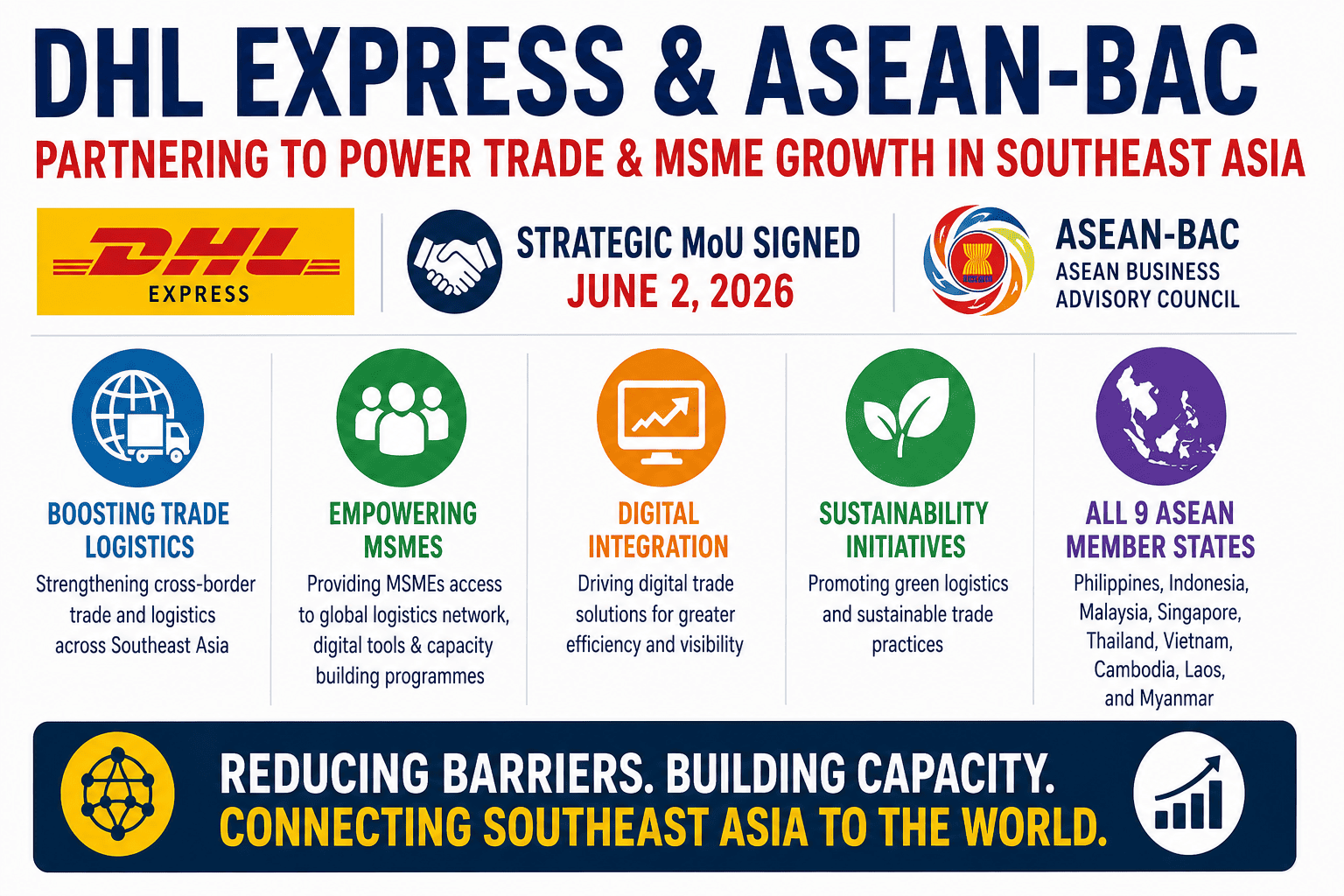
On June 2, 2026, DHL Express signed a Memorandum of Understanding (MoU) with the ASEAN Business Advisory Council (ASEAN-BAC), establishing a strategic alliance to enhance trade logistics and MSME support across nine Southeast Asian nations — the Philippines, Indonesia, Malaysia, Singapore, Thailand, Vietnam, Cambodia, Laos, and Myanmar. The MoU aims to simplify cross-border logistics, provide MSMEs with preferential shipping rates, and integrate supply chains across the ASEAN maritime region. This partnership leverages DHL’s global logistics network to empower local businesses, reduce trade barriers, and accelerate regional economic integration.
📅 June 2, 2026⏱ 14 min read✍️ GTsetu Editorial Team📰 News + Analysis
Deal Type
MoU
Memorandum of Understanding — Strategic Alliance
Sector
Trade Logistics
Cross-border supply chain + MSME support
Geography
9 Nations
Philippines · Indonesia · Malaysia · Singapore · Thailand · Vietnam · Cambodia · Laos · Myanmar
Announced
June 2, 2026
DHL Express · ASEAN-BAC official signing
Section 1 — The News
1
The Full Story: DHL Express × ASEAN-BAC Strategic MoU
📦
Deal Announced — June 2, 2026 · DHL
DHL Express Signs Strategic MoU with ASEAN-BAC to Boost Trade Logistics and MSME Support Across Southeast Asia
On June 2, 2026, DHL Express — the world’s leading international express logistics provider — signed a Memorandum of Understanding (MoU) with the ASEAN Business Advisory Council (ASEAN-BAC), establishing a strategic alliance to enhance trade logistics and MSME support across nine Southeast Asian nations.
The MoU covers the Philippines, Indonesia, Malaysia, Singapore, Thailand, Vietnam, Cambodia, Laos, and Myanmar — creating a unified framework to simplify cross-border logistics, provide MSMEs with preferential shipping rates, and integrate supply chains across the ASEAN maritime region. This strategic alliance is designed to empower local businesses, reduce trade barriers, and accelerate regional economic integration.
The partnership leverages DHL’s global logistics network and ASEAN-BAC’s deep regional business relationships to create tangible benefits for MSMEs — including preferential shipping rates, simplified customs procedures, and access to DHL’s supply chain expertise. This is expected to significantly lower the barriers for ASEAN MSMEs to participate in regional and global trade.
9
ASEAN nations covered — Philippines, Indonesia, Malaysia, Singapore, Thailand, Vietnam, Cambodia, Laos, Myanmar
MSME
Preferential shipping rates and simplified cross-border logistics for thousands of MSMEs
Maritime
ASEAN maritime region — cross-border supply chain integration across archipelagic nations
“This MoU reflects our commitment to empowering MSMEs across ASEAN by providing them with the logistics tools they need to compete globally. Together with ASEAN-BAC, we are breaking down trade barriers and building a more integrated Southeast Asian economy.”
— DHL Express Official Statement
“ASEAN-BAC is proud to partner with DHL Express to support the region’s MSMEs. This strategic alliance will provide tangible benefits — preferential rates, simplified logistics, and access to global markets — that will drive economic growth across Southeast Asia.”
— ASEAN-BAC Official Statement
💡 GTsetu Perspective
The DHL Express × ASEAN-BAC MoU is not just a logistics deal — it’s a manufacturing and trade enabler. By simplifying cross-border logistics and providing MSMEs with preferential shipping rates, it lowers the barriers for manufacturers across ASEAN to participate in regional and global supply chains. If you’re a manufacturer in Southeast Asia looking to expand your export capabilities, or a logistics provider seeking regional partnerships, this MoU signals that the ASEAN maritime region is open for business. GTsetu helps you find the verified partners to make it happen.
Section 2 — Key Pillars
2
Key Pillars: Trade Logistics & MSME Support
The DHL Express × ASEAN-BAC MoU is structured around two interconnected pillars — each designed to unlock specific benefits for businesses across Southeast Asia.
📦
Trade Logistics
Simplified cross-border shipping, streamlined customs procedures, and integrated supply chain solutions across the ASEAN maritime region. Leverages DHL’s global network to reduce delivery times and costs.
Cross-Border Shipping · Customs · Supply Chain
🤝
MSME Support
Preferential shipping rates for MSMEs, access to DHL’s supply chain expertise, and capacity building programmes. Designed to empower local businesses to compete in regional and global markets.
Preferential Rates · Capacity Building · Market Access
Section 3 — The Anatomy
3
What Each Partner Brings to the Table
The DHL Express × ASEAN-BAC MoU works because each partner contributes complementary strengths — creating a whole that enables MSMEs to access global trade opportunities.
4
Why This MoU Model Works for Trade Logistics & MSME Development
🎯 The Core Logic
The DHL Express × ASEAN-BAC MoU succeeds because it is built on three interlocking strategic advantages: DHL’s global logistics infrastructure and expertise, ASEAN-BAC’s deep regional business relationships and MSME network, and the ASEAN region’s rapidly growing trade volumes. Neither party could achieve the same outcome independently — DHL cannot replicate ASEAN-BAC’s regional MSME trust and access, and ASEAN-BAC cannot replicate DHL’s global logistics network. The MoU structure makes the partnership scalable and actionable.
Why ASEAN Trade Logistics Is Accelerating in 2026
670M
ASEAN population — one of the world’s fastest-growing economic regions
MSME
MSMEs account for 97% of all enterprises in ASEAN — the backbone of the regional economy
Maritime
ASEAN is one of the world’s most important maritime regions — logistics is the lifeblood of trade
RCEP
RCEP trade agreement is accelerating cross-border trade — logistics infrastructure is the bottleneck
Digital
E-commerce growth across ASEAN is driving demand for efficient cross-border logistics
9
Nations covered — from Philippines to Myanmar, the MoU spans the full ASEAN maritime region
Section 5 — ASEAN Logistics Opportunity
5
ASEAN Logistics Opportunity in 2026 — Why Now Is the Time to Partner
🌏 ASEAN Logistics & Trade 2026–30
Why Every Manufacturer, Exporter, and Logistics Provider Should Be Watching the DHL Express × ASEAN-BAC MoU
The DHL Express × ASEAN-BAC MoU creates structured, government-backed pathways for logistics collaboration that did not exist before. For manufacturers across ASEAN, it offers simplified cross-border shipping and preferential rates. For logistics providers, it signals a region that is prioritising supply chain integration. For MSMEs, it lowers the barriers to participating in regional and global trade. The timing is exceptional — ASEAN is one of the world’s fastest-growing regions, and logistics is the critical enabler of that growth.
Preferential
Shipping rates for MSMEs — lowering the cost of cross-border trade
Simplified
Customs procedures and documentation — reducing trade friction
Network
Access to DHL’s global logistics network — reaching customers worldwide
Capacity
Building MSME capacity through training and supply chain expertise
Regional
Supply chain integration across the ASEAN maritime region — 9 nations connected
Trust
DHL’s brand + ASEAN-BAC’s regional trust — the partnership unlocks both
🌐 GTsetu for Logistics & Trade Partnerships
GTsetu’s verified partner network includes manufacturers, exporters, logistics providers, and trade facilitators across ASEAN and 100+ other countries. Every company is verified on 6 government-sourced points: Name, Address, Registration Number, Company Status, Company Type, and Date of Certificate of Incorporation. If you’re an MSME looking for logistics support, a manufacturer seeking export partnerships, or a logistics provider looking for regional collaborators, GTsetu is where your partner search begins. Find trade and logistics partners →
Section 6 — Types of Collaboration
6
4 Types of Logistics & Trade Collaboration — Which Fits Your Situation?
The DHL Express × ASEAN-BAC MoU is a strategic alliance at the highest level. But for individual businesses, the right collaboration structure depends on what you need and what you can invest.
01
Strategic Alliance / MoU
Non-binding framework agreement that establishes shared objectives and cooperation principles. Ideal for high-level partnerships where the details will be developed over time. The DHL Express × ASEAN-BAC model.
📝 Framework Agreement
02
Service Level Agreement (SLA)
Operational agreement defining service standards, delivery times, pricing, and performance metrics. Ideal when you need guaranteed logistics services with clear accountability.
📊 Operational Agreement
03
Preferred Provider Agreement
Exclusive or preferred supplier arrangement with negotiated rates and priority service. Ideal for MSMEs seeking access to a global logistics network at competitive rates.
🏷️ Negotiated Rates
04
Supply Chain Integration
Full operational integration with shared systems, data exchange, and collaborative planning. Ideal for long-term strategic partnerships where both parties commit significant resources.
🔗 Deep Integration
Section 7 — How to Partner
7
How to Partner: A 5-Step Playbook for Logistics & Trade Collaboration
The DHL Express × ASEAN-BAC MoU provides the framework. Here is the distilled playbook for executing logistics and trade partnerships within it.
1
Define Your Logistics or Trade Gap with Precision
MSMEs across ASEAN needed preferential shipping rates and simplified logistics. Define your gap that precisely — is it cost, speed, customs complexity, or regional coverage? Vague needs produce vague partner searches.
2
Find Verified Logistics and Trade Partners
DHL and ASEAN-BAC were not random partners — they had complementary strengths and regional trust. GTsetu provides verified profiles of logistics providers, manufacturers, and trade facilitators across ASEAN and 100+ countries. Government-sourced verification on 6 key points.
3
Protect Commercial Terms Before Sharing Data
In logistics partnerships, your shipping data, pricing models, and customer information are valuable. Execute a mutual NDA before sharing any sensitive operational data. GTsetu’s built-in NDA workflow handles this automatically.
4
Choose the Right Partnership Structure
MoU for framework. SLA for operational guarantees. Preferred provider for negotiated rates. Full integration for long-term strategic partnerships. Match the structure to the objective, not to what’s easiest to negotiate.
5
Formalise in Stages — Start with a Pilot, Then Scale
The MoU is the framework. Start with a pilot programme — test shipping routes, rates, and processes. Validate the partnership’s operational viability. Then scale regionally. Structure every milestone formally in writing.
Section 8 — Dos and Don’ts
8
Dos and Don’ts of Logistics & Trade Partnerships
✅ Do These
✅ Build on established relationships and frameworks — ASEAN-BAC and DHL had existing regional ties
✅ Verify your partner’s operational credentials and network coverage — not just marketing claims
✅ Start with a framework agreement (MoU) and develop operational details in stages
✅ Sign NDA before sharing shipping data, customer lists, or pricing models
✅ Choose a partner whose network complements yours — regional reach + global infrastructure
✅ Pilot test the partnership on specific routes before expanding regionally
✅ Use verified platforms like GTsetu rather than cold outreach for strategic partners
✅ Define performance metrics (delivery times, cost, reliability) in the agreement
✅ Leverage the partnership to provide tangible benefits — preferential rates, simplified processes
❌ Avoid These
❌ Expand to full regional coverage before validating the partnership on specific routes
❌ Share shipping data or customer information before NDA is countersigned
❌ Accept self-reported logistics capabilities without operational verification
❌ Assume an MoU guarantees operational execution — it’s a framework, not a service agreement
❌ Partner with a logistics provider whose network overlaps entirely with yours — complementarity is key
❌ Neglect the customs and regulatory dimension — cross-border logistics requires compliance expertise
❌ Choose a partner whose strengths duplicate yours — the gap is where value is created
❌ Start operations on informal terms — formal agreements protect both parties
❌ Overlook the importance of last-mile delivery — especially in archipelagic nations like Indonesia and Philippines
Section 9 — Misconceptions
9
Common Misconceptions About Logistics & Trade MoUs
❌ Myth
“An MoU is just a handshake — it doesn’t create any real value.”
✅ Reality
The DHL Express × ASEAN-BAC MoU creates real, tangible value — preferential shipping rates, simplified customs procedures, and capacity building for MSMEs. An MoU is a framework that enables operational agreements, service-level commitments, and measurable outcomes. It’s the first step, but it’s an essential one that unlocks the partnership’s potential.
❌ Myth
“Logistics partnerships are about shipping only — the MSME support is just marketing.”
✅ Reality
MSME support is central to the MoU’s value proposition. Preferential shipping rates, capacity building, and supply chain expertise are designed to empower MSMEs to access regional and global markets. The partnership recognises that MSMEs are the backbone of the ASEAN economy — and that logistics is the critical enabler of their growth.
❌ Myth
“You need to have a full supply chain integration before you can start.”
✅ Reality
The partnership framework emphasises staged implementation. Start with a pilot programme on specific routes, validate operational viability, then expand regionally. Full integration is a long-term outcome, not a prerequisite. This staged approach reduces risk and allows both parties to learn and adapt before making large commitments.
❌ Myth
“The DHL Express × ASEAN-BAC MoU is only for large corporations.”
✅ Reality
The MoU is explicitly designed for MSMEs — providing preferential shipping rates, simplified logistics, and capacity building. It’s a strategic alliance to empower local businesses, not just large corporations. The partnership recognises that MSMEs are the engine of ASEAN’s economic growth.
❌ Myth
“Cross-border logistics partnerships require physical presence in every ASEAN country.”
✅ Reality
The partnership leverages DHL’s existing regional presence and ASEAN-BAC’s local business networks. What matters is clear operational protocols, service-level agreements, and regional coordination — not physical presence in every location. GTsetu’s digital collaboration workspace supports structured cross-border logistics partnerships across the ASEAN region.
Section 10 — GTsetu
10
How GTsetu Helps You Find the Right Logistics & Trade Partner
The DHL Express × ASEAN-BAC MoU provides the framework. GTsetu provides the verified partner discovery platform — enabling manufacturers, MSMEs, and logistics providers to find each other, evaluate credentials, and collaborate securely across borders.
🌐 Platform Spotlight — GTsetu
Find Verified Manufacturers, Logistics Providers, and Trade Partners Across 100+ Countries — Anonymously, Securely, With Zero Broker Fees
Every company on GTsetu is verified using government tie-ups on 6 key points: Name, Address, Registration Number, Company Status, Company Type, and Date of Certificate of Incorporation. This is the foundation of trust. Additional information such as logistics capabilities, trade credentials, and operational coverage is self-reported by companies. You evaluate who is real before you engage. You share nothing sensitive until an NDA is countersigned. And you pay no broker commission on any collaboration formed.
✅
6-Point Government-Sourced VerificationName, Address, Registration Number, Company Status, Company Type, Date of Incorporation confirmed.
🕵️
Anonymous DiscoveryEvaluate verified partner profiles without revealing your identity until mutual interest is confirmed.
📄
Built-In NDA WorkflowShare shipping data and commercial terms only after NDA is executed — full audit trail.
🚫
Zero CommissionNo broker fees — your logistics partnership is entirely between you and your partner.
🌍
100+ CountriesASEAN nations, India, Europe, Americas — find partners in every trade hub.
On June 2, 2026, DHL Express signed a Memorandum of Understanding (MoU) with the ASEAN Business Advisory Council (ASEAN-BAC) to enhance trade logistics and MSME support across nine Southeast Asian nations — the Philippines, Indonesia, Malaysia, Singapore, Thailand, Vietnam, Cambodia, Laos, and Myanmar. The strategic alliance aims to simplify cross-border logistics, provide MSMEs with preferential shipping rates, and integrate supply chains across the ASEAN maritime region.
Q
What does the MoU mean for MSMEs in ASEAN?
The MoU is designed to empower MSMEs with preferential shipping rates, simplified cross-border logistics, and enhanced supply chain integration. It provides MSMEs with access to DHL’s global logistics network at more accessible rates, helping them expand beyond domestic markets into regional and global trade. The partnership also includes capacity building programmes and supply chain expertise.
Q
How can I find a logistics partner for my business in Southeast Asia?
The systematic approach involves four steps: (1) Define your logistics gap precisely — is it cost, speed, customs complexity, or regional coverage? (2) Search verified platforms — GTsetu lists verified logistics providers, manufacturers, and trade facilitators across ASEAN and 100+ countries. (3) Evaluate anonymously first — review verified profiles before revealing your identity. (4) Execute NDA before sharing sensitive data — GTsetu’s built-in NDA workflow handles this automatically.
Q
What’s the difference between an MoU and a service-level agreement?
An MoU (Memorandum of Understanding) is a framework agreement that establishes shared objectives and cooperation principles. It’s non-binding and typically high-level. A Service Level Agreement (SLA) is an operational agreement that defines specific service standards, delivery times, pricing, and performance metrics. It’s binding and measurable. In the DHL Express × ASEAN-BAC partnership, the MoU provides the framework, and SLAs will define the operational details for MSMEs.
Q
Does GTsetu charge commission on logistics partnerships formed through the platform?
No. GTsetu charges zero commission on any partnership — whether an MoU, SLA, preferred provider agreement, or full supply chain integration — formed through the platform. Broker intermediation in logistics partnerships typically costs 5–15% of contract value. GTsetu removes the broker entirely. Learn more about GTsetu →
Ready to Find Your Logistics Partner? Start on GTsetu.
500+ verified manufacturers, logistics providers, trade facilitators, and MSME support networks across ASEAN and 100+ countries. Zero broker fees. Anonymous discovery. Built-in NDA workflows. Your next logistics partnership starts with a verified profile — not a cold call.
Business Development Expert | Global Trade & Cross-Border Partnerships
Lui Wang is a Business Development Expert at GTsetu, specializing in international trade, cross-border partnerships, and market expansion strategies. With extensive experience working across diverse business ecosystems, Lui helps companies identify growth opportunities, establish strategic collaborations, and navigate the complexities of global commerce.
His expertise spans manufacturing, supply chain partnerships, technology collaborations, market entry strategies, and international business development. Through GTsetu, Lui works closely with businesses, trade organizations, and industry stakeholders to facilitate meaningful connections that drive sustainable growth across regions and sectors.
Lui is particularly passionate about helping organizations build long-term international partnerships, unlock new markets, and strengthen their global competitiveness in an increasingly interconnected economy.