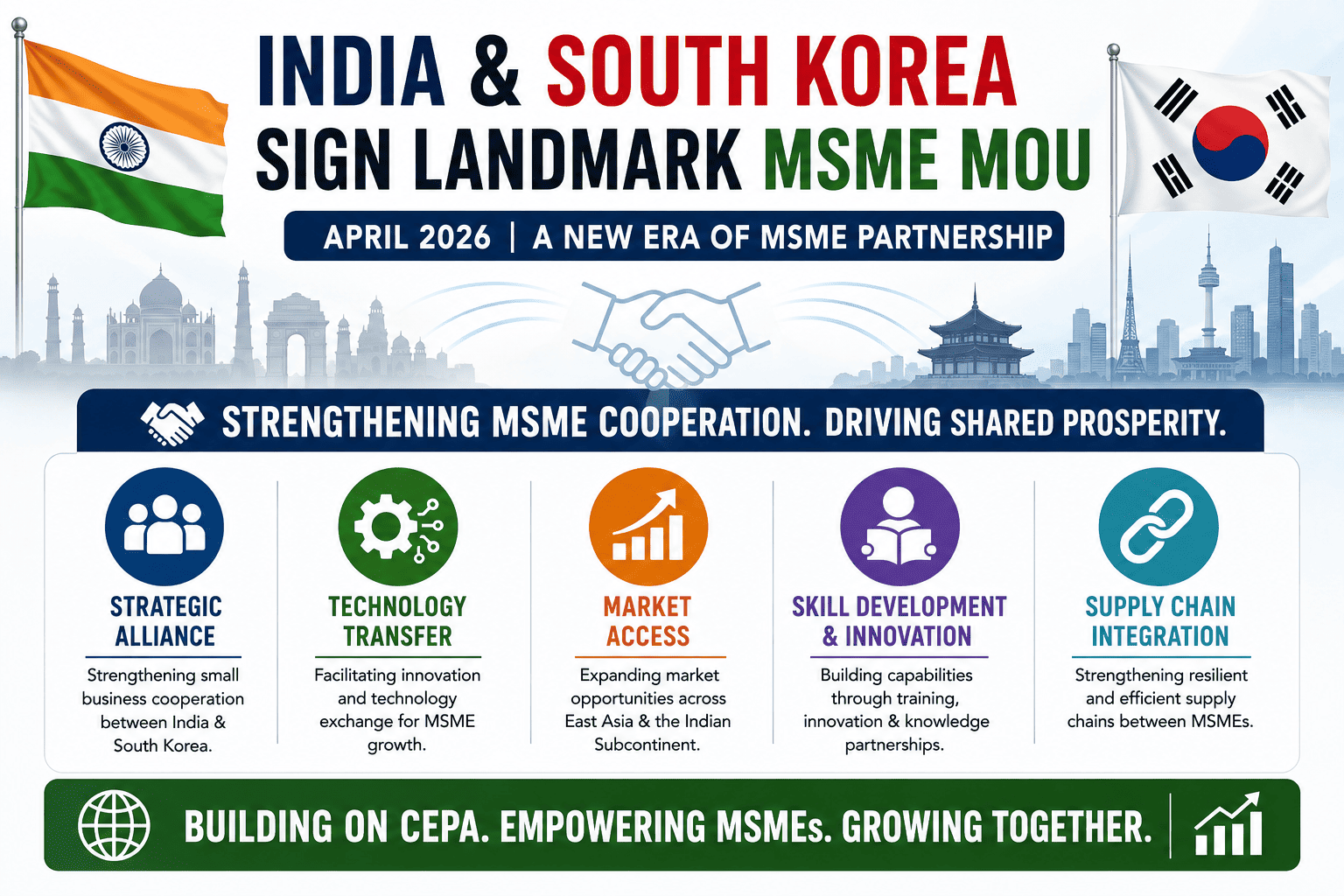
India-South Korea MSME MoU: What Small Businesses Must Learn About East Asia-India MSME Cooperation
🔴 BREAKINGIndia-South Korea MSME MoU signed, Strategic alliance to strengthen small business cooperation, technology transfer, and market access between East Asia and the Indian Subcontinent◆MoU establishes frameworks for MSME technology transfer, joint ventures, and skill development between Korean and Indian small businesses◆Find verified MSME partners and small business collaborators on GTsetu, 100+ countries, zero commission◆🔴 BREAKINGIndia-South Korea MSME MoU signed, Strategic alliance to strengthen small business cooperation, technology transfer, and market access between East Asia and the Indian Subcontinent◆MoU establishes frameworks for MSME technology transfer, joint ventures, and skill development between Korean and Indian small businesses◆Find verified MSME partners and small business collaborators on GTsetu, 100+ countries, zero commission◆
Home › Blog › India-South Korea MSME MoU
🔴 Breaking News🏢 MSME Cooperation🇮🇳 India🇰🇷 South Korea🤝 Small Business
India-South Korea MSME MoU: How East Asia’s Small Business Powerhouse Is Partnering with India’s MSME Sector
India and South Korea have signed a landmark MSME MoU in April 2026, a strategic alliance that strengthens small business cooperation, technology transfer, and market access between East Asia and the Indian Subcontinent. The Memorandum of Understanding establishes frameworks for joint ventures, skill development, and innovation partnerships between Korean and Indian MSMEs.
🎯 Direct Answer
India and South Korea have signed a landmark MSME MoU in April 2026, establishing a strategic alliance that strengthens small business cooperation, technology transfer, and market access between East Asia and the Indian Subcontinent. The Memorandum of Understanding creates frameworks for joint ventures, skill development, innovation partnerships, and supply chain integration between Korean and Indian MSMEs. This agreement builds on the Comprehensive Economic Partnership Agreement (CEPA) between the two nations and positions MSMEs as key drivers of bilateral economic growth.
📅 April 21, 2026⏱ 14 min read✍️ GTsetu Editorial Team📰 News + Analysis
Deal Type
Strategic Alliance
Memorandum of Understanding for MSME Cooperation
Sector Focus
MSME Cooperation
Small business, technology transfer, joint ventures
Regions
East Asia + India
South Korea and Indian Subcontinent
Date
April 21, 2026
Signed by MSME Ministers of both nations
Section 1, The News
1
The Full Story: India-South Korea MSME MoU
🏢
MoU Signed, April 21, 2026
India and South Korea Forge Landmark MSME MoU to Boost Small Business Cooperation, Technology Transfer, and Market Access
On April 21, 2026, India and South Korea signed a landmark MSME MoU, establishing a strategic alliance that strengthens small business cooperation, technology transfer, and market access between East Asia and the Indian Subcontinent. The Memorandum of Understanding was signed by the MSME Ministers of both nations, marking a significant milestone in bilateral small business relations.
The MoU creates frameworks for joint ventures, skill development, innovation partnerships, and supply chain integration between Korean and Indian MSMEs. It builds on the Comprehensive Economic Partnership Agreement (CEPA) between the two nations and positions MSMEs as key drivers of bilateral economic growth.
South Korea, home to world-class technology and manufacturing capabilities, brings innovation, quality standards, and global supply chain access to the partnership. India, with its vast MSME network of over 63 million enterprises, offers scale, market access, and a growing domestic economy. Together, the agreement creates a powerful bridge for small business collaboration between East Asia and the Indian Subcontinent.
Strategic Alliance
MoU framework for MSME cooperation
63M+
Indian MSMEs, the world’s largest small business network
Korea + India
East Asia and Indian Subcontinent regions
Technology
Transfer + joint venture + skill development focus
“This MoU is a game-changer for MSMEs in both nations. Korean technology and Indian scale create a powerful combination that will drive innovation, create jobs, and strengthen supply chains across borders.”
— MSME Minister of India, April 2026
“South Korea’s MSMEs are ready to partner with India’s dynamic small business sector. Together, we can build resilient supply chains, co-develop innovative products, and create new markets for both our nations.”
— MSME Minister of South Korea, April 2026
💡 GTsetu Perspective
The India-South Korea MSME MoU recognises a fundamental truth: small businesses are the engine of economic growth in both nations. For Indian MSMEs, Korean technology and quality standards represent a leap forward. For Korean MSMEs, India’s market of 1.4 billion offers unprecedented scale. GTsetu helps you find verified MSME partners in both nations, whether you’re an Indian manufacturer seeking Korean automation technology or a Korean startup looking for Indian manufacturing partners.
Section 2, MSME Sector
2
MSME Sector: The Backbone of Both Economies
The India-South Korea MSME MoU recognises that small businesses are the backbone of both economies. In India, MSMEs account for over 30% of GDP and 45% of manufacturing output. In South Korea, SMEs represent 99.9% of all businesses and employ over 80% of the workforce. The agreement creates unprecedented opportunities for cross-border collaboration between these small business powerhouses.
🏢 MSME Sector Overview, India vs South Korea
🇮🇳 India
MSMEs63+ million
GDP Contribution30%+
Manufacturing Output45%
Employment110+ million
🇰🇷 South Korea
SMEs99.9% of businesses
Employment80%+ of workforce
InnovationR&D-intensive SMEs
Export Share~40% of exports
🏭 Why MSMEs Drive Economic Growth
MSMEs are not just small businesses, they are the innovation labs, employment generators, and supply chain backbone of modern economies. The India-South Korea MSME MoU recognises that enabling small business collaboration creates a multiplier effect: technology transfer, job creation, supply chain resilience, and market access. For individual MSMEs, this agreement is a signal that cross-border partnerships are not just for large corporations, they are now accessible to small businesses too. GTsetu helps you navigate this opportunity with verified partner discovery, protected communication, and zero broker fees.
Section 3, The Anatomy
3
What Each Partner Brings to the Strategic Alliance
Like every successful international collaboration, the India-South Korea MSME MoU works because each nation contributes what the other cannot efficiently replicate. This complementarity principle is the foundation of any MSME collaboration worth entering.
Technology transfer is the most powerful engine of the India-South Korea MSME MoU. South Korean MSMEs are world leaders in advanced manufacturing, automation, and smart factory solutions. Indian MSMEs are scaling rapidly and seeking to upgrade their technology. The convergence creates a unique opportunity for technology transfer, co-development, and joint manufacturing.
🔧 Technology Transfer Focus Areas
Smart Mfg
Smart Manufacturing & Industry 4.0
Korean expertise in smart factory solutions, industrial automation, and IoT integration. Indian MSMEs can leapfrog to Industry 4.0 capabilities through Korean technology partnerships.
Automation
Automation & Robotics
South Korea is a global leader in industrial robotics and automation. Technology transfer enables Indian MSMEs to automate production lines, reducing costs and improving quality consistency.
Digital
Digital Transformation
Korean digital tools, ERP systems, and data analytics platforms. Indian MSMEs can digitise operations, supply chains, and customer relationships through Korean technology partnerships.
Materials
Advanced Materials & Components
Korean expertise in advanced materials, precision components, and specialised manufacturing. Indian MSMEs can access high-quality inputs for downstream manufacturing and exports.
🔑 Key Lesson: Technology Transfer Requires Ecosystem Collaboration
The India-South Korea MSME MoU demonstrates that technology transfer is not just about technology, it’s about capability building, workforce training, and operational integration. Successful technology transfer requires Indian MSMEs to have the absorptive capacity to receive and adapt Korean technology. For Korean MSMEs, it requires understanding India’s business environment and regulatory framework. GTsetu connects verified technology partners with MSMEs ready for technology adoption. The fastest path to technology transfer is through a verified connection platform.
Section 5, Why This Works
5
Why This Strategic Alliance Works for MSMEs
🎯 The Core Logic
The India-South Korea MSME MoU succeeds because it is built on three interlocking strategic advantages: complementary business ecosystems (Korean technology and quality meets Indian scale and market access), shared economic ambition (both nations prioritise MSME growth and employment), and mutual interest in supply chain resilience (diversifying away from single-source dependencies). Neither nation could achieve the same result through any other mechanism, India cannot replicate Korea’s innovation ecosystem, and Korea cannot replicate India’s market scale.
Why India-South Korea MSME Collaboration Is Accelerating
63M+
Indian MSMEs, one of the world’s largest small business networks
#1
South Korea ranks #1 globally in robot density, automation expertise for Indian MSMEs
CEPA
Comprehensive Economic Partnership Agreement, established trade framework since 2009
40%
South Korea’s SME export share, global supply chain integration
$50B
Bilateral trade target, MSMEs will be significant contributors to growth
30%+
India’s GDP from MSMEs, the sector is critical to India’s economic future
Section 6, Joint Ventures
6
Joint Ventures: The MSME Partnership Model
🏢 Joint Ventures, MSME Collaboration
Why Joint Ventures Are the Preferred Model for MSME Collaboration
Joint ventures are emerging as the preferred partnership model for India-South Korea MSME collaboration. Rather than simple supplier-buyer relationships, JVs create shared ownership, shared risk, and shared reward, the foundation for long-term, trust-based partnerships. The India-South Korea MSME MoU explicitly supports JV formation as a key mechanism for technology transfer and market access.
Shared Risk
Both partners share investment, operational, and market risks
Tech Transfer
Korean technology embedded in Indian manufacturing operations
Market Access
Indian JV partner provides domestic market access; Korean partner provides export channels
Governance
Shared governance ensures both partners’ interests are protected
Scale
Combined resources enable scale that individual MSMEs cannot achieve alone
Trust
Equity partnership builds trust that arm’s-length relationships cannot match
🌐 GTsetu for MSME Collaboration
GTsetu’s verified partner network includes MSMEs, technology providers, component manufacturers, and supply chain partners across India, South Korea, and 100+ countries. Every organisation on GTsetu is verified on 6 government-sourced points: Name, Address, Registration Number, Company Status, Company Type, and Date of Certificate of Incorporation. Additional capabilities like quality certifications, manufacturing capacity, and OEM approvals are self-reported. If you’re an Indian MSME seeking Korean automation technology, or a Korean small business looking for Indian manufacturing partners, GTsetu is where your partner search begins. Find MSME partners →
Section 7, Types of Collaboration
7
4 Types of MSME Collaboration, Which Fits Your Business?
The India-South Korea MSME MoU supports multiple collaboration models. The right structure depends entirely on your business needs, resources, and strategic objectives. Here are the four primary models for MSME collaboration.
01
Joint Venture
A new legal entity co-owned by both partners. Deepest integration, shared risk, shared reward. Best for long-term market presence when both partners have significant assets to contribute. Korean technology + Indian operations.
🏢 India-Korea Model
02
Technology Licensing
Korean technology licensed to Indian MSMEs for fees or royalties. No equity sharing. Fast to execute, lower risk, ideal when technology access is the primary objective and trust is already established.
📄 Tech Transfer
03
Supply Chain Partnership
Korean MSMEs source components from Indian partners or vice versa. No equity sharing but long-term supply agreements. Best for integrating into each other’s supply chains.
🔗 Supply Chain
04
Skill Development Partnership
Korean training institutions partner with Indian MSMEs to upskill workforce. Focus on knowledge transfer and capability building. Ideal for preparing Indian MSMEs for technology adoption.
🎓 Skill Building
📊 Collaboration Model Comparison, MSME Partnerships
Model
Capital Required
Tech Access
Market Impact
Speed
Reversibility
Joint Venture
High (shared)
✓ Full access
✓ Maximum
Slow (12-24 mo)
Low
Tech Licensing
Low (fees)
✓ Full access
Moderate
Fast (3-6 mo)
Moderate
Supply Chain
Minimal
~ Partial
Moderate
Fast (3-6 mo)
High
Skill Dev
Low
~ Knowledge
Long-term
Moderate (6-12 mo)
High
Section 8, How to Collaborate
8
How to Collaborate: A 5-Step Playbook for MSMEs
The India-South Korea MSME MoU demonstrates that international MSME collaboration follows a pattern. Here is the distilled playbook for small businesses seeking cross-border partnerships.
1
Define Your MSME Collaboration Gap with Precision
Indian MSMEs need technology; Korean MSMEs need scale and market access. Define your gap that precisely, is it technology IP, manufacturing capability, market access, or skill development? Vague needs produce vague partner searches and failed negotiations.
2
Find Verified MSME Partners, Not Just Any Business
The crucial word is “verified.” The India-South Korea MSME MoU is the framework, but you need to find the right business partner. GTsetu provides verified profiles of MSMEs, technology providers, and manufacturing partners across India, South Korea, and 100+ countries. GTsetu verifies organisations using government tie-ups on 6 key points. Additional information like certifications and manufacturing capabilities is self-reported and should be validated independently.
3
Protect Your IP Before Any Technical Disclosure
In MSME collaboration, your manufacturing processes, product designs, and customer relationships are valuable IP. Before sharing anything sensitive, execute a mutual NDA. This is non-negotiable regardless of how well you think you know the prospective partner. GTsetu’s built-in NDA workflow handles this automatically.
4
Choose the Right Collaboration Structure for Your Objective
The India-South Korea MSME MoU supports multiple models: joint ventures (deep integration), technology licensing (focused access), supply chain partnerships (operational), and skill development (capability building). Match the structure to your objective.
5
Formalise and Scale in Stages, Start with a Pilot Project
The India-South Korea MSME MoU establishes the framework; business partnerships should follow a pilot-first approach. Start with a small project to validate the collaboration, then scale. This sequence, framework first, pilot, then scale, is the correct order for MSME collaboration.
Section 9, Dos and Don’ts
9
Dos and Don’ts of MSME Collaboration
✅ Do These
✅ Build on the national MSME MoU framework for business-level collaboration
✅ Verify your partner’s manufacturing capability, certifications, and customer references
✅ Start with a pilot project to validate the collaboration before scaling
✅ Sign NDA before sharing manufacturing processes, product designs, or client lists
✅ Define IP ownership and licensing terms before beginning technology transfer
✅ Invest in skill development alongside technology transfer
✅ Build in regular communication protocols, weekly updates, quarterly reviews
✅ Use verified platforms like GTsetu for MSME partner discovery
✅ Document the collaboration formally, JV agreement, licensing contract, or supply agreement
❌ Avoid These
❌ Rely solely on the national MoU, you still need business-level agreements
❌ Share manufacturing processes, product designs, or commercial data before NDA is countersigned
❌ Accept self-reported capabilities without plant visits or quality audits
❌ Start production on informal terms, IP ownership and quality standards must be documented
❌ Choose a partner whose strengths duplicate yours, complementarity drives value
❌ Neglect exclusivity terms, know whether your technology partner can work with competitors
❌ Underestimate the need for cultural alignment, India-Korea collaboration requires explicit communication protocols
❌ Scale production before the pilot project validates the partnership
❌ Assume that national-level agreements automatically create business opportunities
❌ Ignore the need for local market knowledge, Korean partners need Indian market expertise; Indian partners need Korean quality expectations
Section 10, Misconceptions
10
Common Misconceptions That Kill MSME Partnerships
❌ Myth
“The MSME MoU is enough, we don’t need a formal business-level partnership agreement.”
✅ Reality
The India-South Korea MSME MoU creates a national framework that enables business-level collaboration. It does not replace the need for individual MSMEs to sign formal partnership agreements, define IP ownership, and establish commercial terms. National agreements signal intent; business agreements deliver value.
❌ Myth
“Joint ventures are the only way to collaborate, other models aren’t serious enough.”
✅ Reality
The India-South Korea MSME MoU supports multiple collaboration models, joint ventures, technology licensing, supply chain partnerships, and skill development. Each model has its place. Many successful MSME collaborations start with licensing or supply chain partnerships before progressing to joint ventures. Don’t overcommit before you validate the partnership.
❌ Myth
“Technology transfer happens automatically with the MoU, we don’t need to manage it.”
✅ Reality
Successful technology transfer requires explicit processes, training programmes, and ongoing support, not just a signed agreement. The MoU enables technology transfer; you must manage it. GTsetu helps you find verified technology partners who have demonstrated transfer capability through previous collaborations.
❌ Myth
“Korean MSMEs only want to export; Indian MSMEs only want to import, it’s one-way.”
✅ Reality
The India-South Korea MSME MoU creates a two-way partnership. Korean MSMEs access India’s market of 1.4 billion. Indian MSMEs access Korean technology and East Asian supply chains. The best collaborations are reciprocal, not one-way. Look for partners who value mutual benefit, not just one-directional benefit.
❌ Myth
“The government will identify and match MSME partners, we don’t need to search.”
✅ Reality
The MoU creates the enabling environment, but you must find and evaluate your own business partner. Government matchmaking events are useful but not sufficient. GTsetu provides the verified partner discovery infrastructure that enables MSMEs to find their own ideal partners, with government-sourced verification, anonymous discovery, and zero broker fees.
Section 11, GTsetu
11
How GTsetu Helps MSMEs Find the Right Partner
The India-South Korea MSME MoU creates a national framework. But MSME-level collaboration requires a different infrastructure: verified partner discovery, protected communication, and zero-broker engagement. GTsetu is that infrastructure for MSME partnerships across 100+ countries.
🌐 Platform Spotlight, GTsetu
Find Verified MSME Partners, Technology Providers, and Manufacturing Partners Across 100+ Countries, Anonymously, Securely, With Zero Broker Fees
Every organisation on GTsetu is verified using government tie-ups on 6 key points: Name, Address, Registration Number, Company Status, Company Type, and Date of Certificate of Incorporation. This is the foundation of trust. Additional information such as manufacturing capabilities, quality certifications, and technology specialisations is self-reported by organisations. You evaluate who is real before you engage. You share nothing sensitive until an NDA is countersigned. And you pay no broker commission on any partnership formed, the deal is entirely between you and your partner.
✅
6-Point Government-Sourced VerificationName, Address, Registration Number, Company Status, Company Type, Date of Incorporation confirmed using government tie-ups.
🕵️
Anonymous DiscoveryEvaluate verified partner profiles without revealing your identity until mutual interest is confirmed.
📄
Built-In NDA WorkflowShare manufacturing processes, product designs, and commercial data only after NDA is executed, full audit trail, no external legal required.
🚫
Zero CommissionNo broker fees, your JV, licensing, supply chain, or skill development partnership is entirely between you and your partner.
🌍
100+ CountriesIndia, South Korea, Japan, Germany, Taiwan, find MSME partners in every manufacturing hub.
🔐
Encrypted CollaborationShare production specifications, quality standards, and commercial terms securely between verified partners.
The India-South Korea MSME MoU is a strategic alliance signed in April 2026 to strengthen cooperation between Micro, Small, and Medium Enterprises of both nations. The Memorandum of Understanding establishes frameworks for technology transfer, market access, skill development, and joint ventures between Korean and Indian MSMEs. It builds on the Comprehensive Economic Partnership Agreement (CEPA) between the two nations and positions MSMEs as key drivers of bilateral economic growth.
Q
How will the MoU benefit Indian and Korean MSMEs?
Indian MSMEs gain access to Korean technology, automation expertise, and quality standards, enabling them to upgrade manufacturing capabilities and access global supply chains. Korean MSMEs gain access to India’s market of 1.4 billion, cost-competitive manufacturing, and talent pool. Both benefit from joint ventures, technology licensing, supply chain integration, and skill development programmes. The MoU creates a two-way bridge for MSME collaboration between East Asia and the Indian Subcontinent.
Q
What is the difference between an MoU and a legally binding contract?
A Memorandum of Understanding (MoU) is a formal agreement that outlines mutual understanding, cooperation principles, and intended actions, but it is not a legally enforceable contract. It establishes a framework for collaboration without creating enforceable obligations. The India-South Korea MSME MoU establishes the strategic framework for MSME cooperation; individual business partners must then sign legally binding agreements for joint ventures, licensing, or supply contracts. Use the MoU as the enabling framework; use business agreements to execute.
Q
How can I find a verified MSME partner in India or South Korea?
The systematic approach involves four steps: (1) Define your collaboration gap precisely, technology, manufacturing capacity, market access, or skill development. (2) Search verified platforms, GTsetu lists verified MSMEs, technology providers, and manufacturing partners across India, South Korea, and 100+ countries. GTsetu verifies organisations using government tie-ups on 6 key points. (3) Evaluate anonymously first, review verified profiles before revealing your identity or business requirements. (4) Execute NDA before any technical disclosure, GTsetu’s built-in NDA workflow handles this automatically. Verified platforms protect you from fraudulent or unverified partners.
Q
What happens if my Korean technology partner works with my competitors in India?
This is one of the most important questions in technology transfer partnerships. Before signing any technology licensing or joint venture agreement, explicitly negotiate: (1) Exclusivity scope, is the technology exclusive to you in India or the Indian Subcontinent? (2) Competitive supply terms, can the technology provider work with competitors during the agreement period? (3) Field of use restrictions, can the technology be used in competitive segments? These terms must be in the agreement before signing. The India-South Korea MSME MoU establishes the enabling framework; you must protect your competitive position through business-level agreements.
Q
Does GTsetu charge commission on MSME partnerships formed through the platform?
No. GTsetu charges zero commission on any partnership, whether a joint venture, technology licensing agreement, supply chain partnership, or skill development collaboration, formed through the platform. The commercial terms of your agreement are entirely between you and your MSME partner. This is a foundational design principle: broker intermediation in MSME partnerships typically costs 5–15% of deal value and creates incentive misalignment. GTsetu removes the broker entirely. Learn more about GTsetu →
Ready to Find Your MSME Partner? Start on GTsetu.
500+ verified MSMEs, technology providers, manufacturing partners, and organisations across India, South Korea, and 100+ countries. Zero broker fees. Anonymous discovery. Built-in NDA workflows. Your next MSME collaboration starts with a verified profile, not a trade fair introduction.
Business Development Expert | Global Trade & Cross-Border Partnerships
Lui Wang is a Business Development Expert at GTsetu, specializing in international trade, cross-border partnerships, and market expansion strategies. With extensive experience working across diverse business ecosystems, Lui helps companies identify growth opportunities, establish strategic collaborations, and navigate the complexities of global commerce.
His expertise spans manufacturing, supply chain partnerships, technology collaborations, market entry strategies, and international business development. Through GTsetu, Lui works closely with businesses, trade organizations, and industry stakeholders to facilitate meaningful connections that drive sustainable growth across regions and sectors.
Lui is particularly passionate about helping organizations build long-term international partnerships, unlock new markets, and strengthen their global competitiveness in an increasingly interconnected economy.