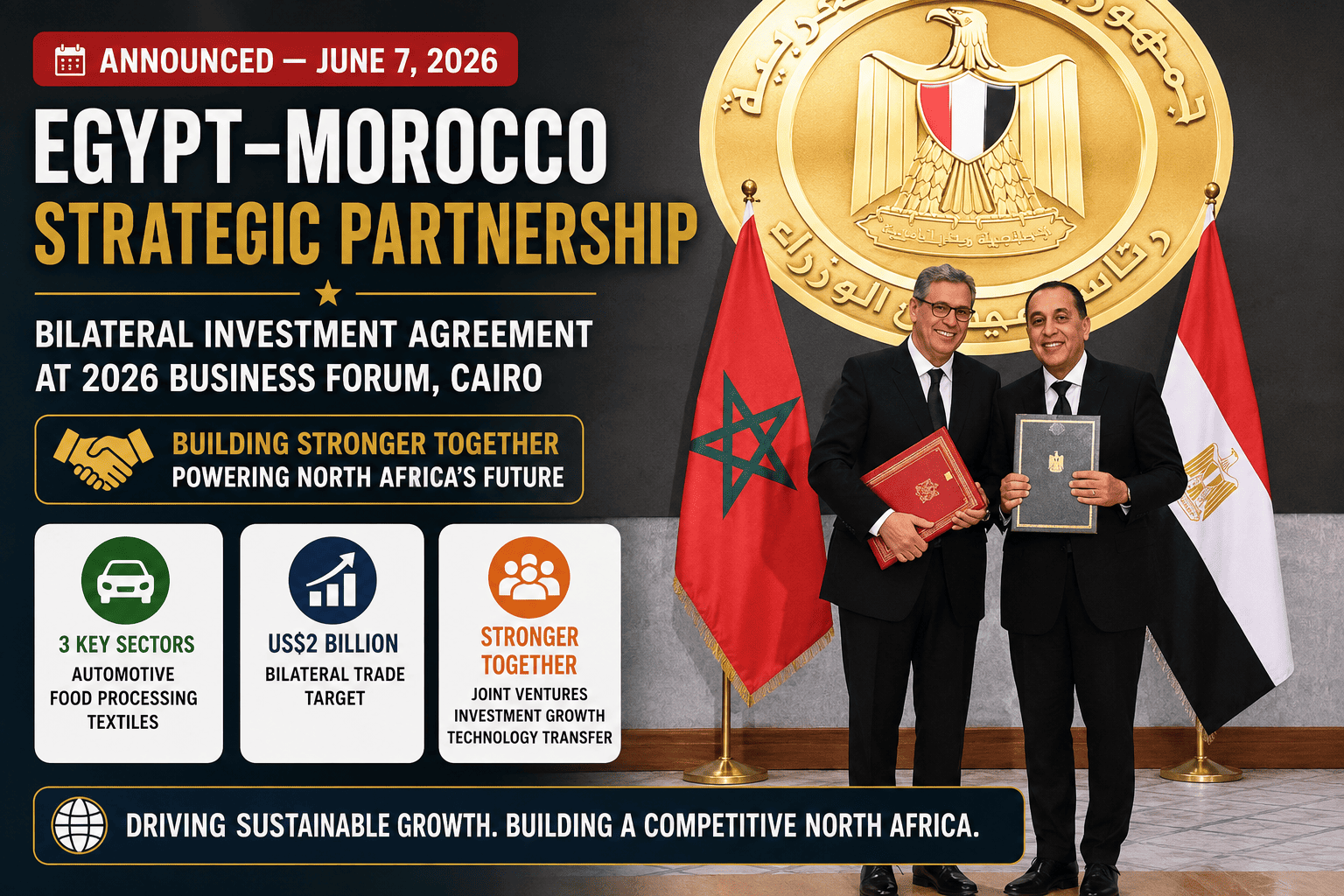
Egypt-Morocco Strategic Partnership: What Businesses Must Learn About MENA Manufacturing Collaboration
🔴 BREAKINGEgypt-Morocco Strategic Partnership signed: Automotive, Food Processing, Textiles, Bilateral Investment deal at 2026 Business Forum◆Egypt-Morocco bilateral trade targets US$2 billion; joint ventures and technology transfer across three key manufacturing sectors◆North African manufacturing collaboration accelerates under new strategic alliance◆Find verified business partners on GTsetu, 100+ countries, zero commission◆🔴 BREAKINGEgypt-Morocco Strategic Partnership signed: Automotive, Food Processing, Textiles, Bilateral Investment deal at 2026 Business Forum◆Egypt-Morocco bilateral trade targets US$2 billion; joint ventures and technology transfer across three key manufacturing sectors◆North African manufacturing collaboration accelerates under new strategic alliance◆Find verified business partners on GTsetu, 100+ countries, zero commission◆
Home › Blog › Egypt-Morocco Strategic Partnership
🔴 Breaking News🏭 Manufacturing🇪🇬 Egypt🇲🇦 Morocco🌍 MENA
Egypt-Morocco Strategic Partnership: How North African Manufacturing Collaboration Is Unlocking Investment & Growth
Egypt and Morocco signed a landmark Bilateral Investment Strategic Partnership at the 2026 Egypt-Morocco Business Forum in Cairo, establishing comprehensive frameworks for collaboration across automotive, food processing, and textiles sectors. The partnership aims to boost bilateral trade, facilitate joint ventures, and enhance manufacturing capabilities in North Africa.
🎯 Direct Answer
Egypt and Morocco have signed a landmark Strategic Partnership on Bilateral Investment at the 2026 Egypt-Morocco Business Forum in Cairo, establishing comprehensive frameworks for collaboration across three key manufacturing sectors: Automotive (vehicle assembly, auto components, and electric vehicle manufacturing), Food Processing (agricultural exports, halal certification, and value-added food production), and Textiles (garment manufacturing, technical textiles, and sustainable fashion).
The partnership aims to boost bilateral trade to US$2 billion, facilitate joint ventures, enhance technology transfer, and strengthen supply chain integration between the two North African economies. The agreement includes provisions for investment promotion, market access facilitation, and regulatory harmonisation to create a more integrated manufacturing ecosystem in the region. This strategic alliance positions Egypt and Morocco as complementary manufacturing hubs, with Egypt’s large domestic market and logistics infrastructure complementing Morocco’s advanced manufacturing capabilities and access to European and African markets.
📅 June 7, 2026⏱ 16 min read✍️ GTsetu Editorial Team📰 News + Analysis
Deal Type
Strategic Alliance
Bilateral Investment Agreement for manufacturing collaboration
Three Sectors
Automotive · Food Processing · Textiles
Key manufacturing sectors targeted for collaboration
Trade Target
US$2B
Bilateral trade target between Egypt and Morocco
Event
2026 Business Forum
Egypt-Morocco Business Forum, Cairo
Section 1, The News
1
The Full Story: Egypt-Morocco Strategic Partnership
🏭
Partnership Announced, June 7, 2026
Egypt and Morocco Sign Landmark Bilateral Investment Partnership at 2026 Business Forum, Targeting Automotive, Food Processing, and Textiles Sectors
At the 2026 Egypt-Morocco Business Forum held in Cairo, the governments of Egypt and Morocco signed a landmark Strategic Partnership on Bilateral Investment , establishing comprehensive frameworks for collaboration across three key manufacturing sectors: automotive, food processing, and textiles .
The partnership aims to boost bilateral trade to US$2 billion , facilitate joint ventures, enhance technology transfer, and strengthen supply chain integration between the two North African economies. The agreement includes provisions for investment promotion, market access facilitation, and regulatory harmonisation .
This strategic alliance positions Egypt and Morocco as complementary manufacturing hubs , with Egypt’s large domestic market and logistics infrastructure complementing Morocco’s advanced manufacturing capabilities and access to European and African markets. The partnership is expected to unlock significant investment opportunities across the three sectors and strengthen North Africa’s manufacturing ecosystem.
3 Sectors
Automotive · Food Processing · Textiles
US$2B
Bilateral trade target between Egypt and Morocco
Cairo
Host city for the 2026 Egypt-Morocco Business Forum
North Africa
Manufacturing integration across the region
“This strategic partnership with Morocco marks a new chapter in Egypt’s manufacturing collaboration with North Africa. By combining our strengths in automotive, food processing, and textiles, we are building a more integrated and competitive regional manufacturing ecosystem.”
— Official Statement, Ministry of Trade and Industry, Egypt
“Morocco sees Egypt as a strategic partner in advancing our manufacturing ambitions. This partnership will facilitate technology transfer, joint ventures, and market access that benefit businesses and industries in both our countries.”
— Official Statement, Ministry of Industry and Trade, Morocco
💡 GTsetu Perspective
The Egypt-Morocco Strategic Partnership represents a significant opportunity for manufacturing collaboration in North Africa. For businesses in both nations, this creates unprecedented opportunities to find partners, access new markets, and build integrated manufacturing supply chains. GTsetu helps manufacturers, investors, and businesses in Egypt, Morocco, and 100+ countries find verified partners, enabling the practical realisation of strategic alliances like this partnership.
Section 2, Three Sectors
2
The Three Sectors: Automotive, Food Processing, Textiles
The Egypt-Morocco Strategic Partnership is structured around three key manufacturing sectors where both nations have complementary strengths and significant growth potential.
🚗
Automotive
🚗 Vehicle Assembly🔋 EV
Collaboration in vehicle assembly, auto components manufacturing, and electric vehicle (EV) production. Egypt brings its large domestic market and logistics infrastructure; Morocco brings advanced manufacturing capabilities and European market access through existing trade agreements.
Focus: Joint ventures · Component supply chain · EV manufacturing
🍽️
Food Processing
🌾 Agri🔵 Halal
Cooperation in agricultural exports, halal certification and food processing, and value-added food production. Egypt’s agricultural diversity and Morocco’s food processing expertise create significant opportunities for integrated supply chains.
The Egypt-Morocco Strategic Partnership works because each nation contributes complementary assets that create a robust manufacturing collaboration framework.
Mutual investment accelerates growth in both directions
Technology
Adaptation and scale of manufacturing technologies
Advanced manufacturing, Industry 4.0 expertise
Technology transfer drives innovation in both nations
Strategic Location
Gateway to Middle East and Africa
Gateway to Europe and West Africa
Strategic geographic complementarity opens global corridors
Section 4, Why This Works
4
Why MENA Manufacturing Collaboration Is Accelerating
🎯 The Core Logic
The Egypt-Morocco Strategic Partnership succeeds because it addresses a systemic opportunity: both nations have strong manufacturing bases that can be integrated for mutual benefit. Egypt’s large domestic market and logistics infrastructure complement Morocco’s advanced manufacturing capabilities and European market access. The US$2 billion bilateral trade target provides a clear growth ambition, while the partnership’s three-sector focus creates a comprehensive framework for manufacturing collaboration. This is not just a trade agreement, it’s a strategic alliance that positions Egypt and Morocco as complementary manufacturing hubs in the MENA region.
Regional manufacturing integration, Egypt and Morocco as complementary hubs
JV
Joint ventures and technology transfer, the mechanism for collaboration
Supply Chain
Supply chain integration, building regional manufacturing resilience
2026
Egypt-Morocco Business Forum, institutional platform enabling strategic dialogue
Section 5, Business Forum
5
The Egypt-Morocco Business Forum Context
🏛️ Egypt-Morocco Business Forum, June 2026, Cairo
Why Egypt-Morocco Manufacturing Collaboration Is Accelerating
The Egypt-Morocco Business Forum, co-organised by the Federation of Egyptian Chambers of Commerce and the General Confederation of Moroccan Enterprises, has emerged as the premier platform for economic engagement between the two nations. The 2026 edition, held in Cairo, brought together business leaders, policymakers, and stakeholders to explore trade and investment opportunities across key sectors. The Strategic Partnership announced at the forum marks a significant milestone in Egypt-Morocco economic relations.
🚗 Automotive
Vehicle assembly, EV manufacturing, auto components
🍽️ Food Processing
Agricultural exports, halal certification, value-added production
6
5 Types of Manufacturing Collaboration, Which Fits Your Situation?
The Egypt-Morocco Strategic Partnership is a Bilateral Investment agreement, but manufacturing collaboration comes in many forms. The right structure depends on your business objectives, resources, and risk tolerance.
01
Bilateral Investment Partnership
Government-level framework for investment promotion and sectoral collaboration. The Egypt-Morocco model. Establishes principles, identifies sectors, creates institutional mechanisms. Best for broad, long-term strategic engagement across multiple sectors.
🌍 Egypt-Morocco Model
02
Joint Venture (JV)
Shared legal entity co-owned by partners from different countries. Deepest integration, shared risk and reward. Best for market entry with substantial commitment and operational integration.
⚖️ Shared ownership
03
Technical Assistance Agreement (TAA)
One party provides technology, IP, or knowhow to another for fees or royalties. Focused on specific technology domains. Best when technology access is the primary objective.
🔬 IP and knowhow
04
Supply Chain Partnership
Integration of manufacturing supply chains across borders. Component sourcing, assembly, and logistics collaboration. Best for building regional manufacturing resilience and cost optimisation.
🔗 Supply chain integration
05
Export/Distribution Partnership
One party manufactures, the other distributes in their market. Lightest collaboration structure. Best for testing new markets with limited commitment.
📦 Market entry
📊 Manufacturing Collaboration Model Comparison
Model
Commitment Level
Time to Execute
Risk Level
Best For
Bilateral Investment
Medium
6–12 months
Low
Broad strategic engagement, government-level
Joint Venture
High
12–24 months
Medium-High
Market entry, shared ownership
TAA
Low
3–6 months
Low
IP access, technology transfer
Supply Chain
Medium
6–12 months
Medium
Regional integration, cost optimisation
Export/Distribution
Low
1–6 months
Low
Testing new markets
Section 7, How to Build
7
How to Build a Manufacturing Partnership: A 5-Step Playbook
The Egypt-Morocco Strategic Partnership demonstrates how manufacturing collaboration can unlock investment and growth. Here is the distilled playbook for building your own manufacturing partnership.
1
Identify Complementary Manufacturing Strengths
The Egypt-Morocco partnership works because both nations have complementary manufacturing capabilities: Egypt’s scale and logistics meet Morocco’s advanced manufacturing and market access. Define what each partner brings that the other cannot replicate efficiently. This complementarity principle is the foundation of successful manufacturing collaboration.
2
Find Verified Manufacturing Partners, Not Just Any Business Contact
Egypt and Morocco’s governments signed the partnership, but its success depends on verified businesses actually collaborating. GTsetu helps manufacturers, investors, and businesses find verified manufacturing partners across 100+ countries. Every company on GTsetu is verified on 6 government-sourced points: Name, Address, Registration Number, Company Status, Company Type, and Date of Certificate of Incorporation.
3
Structure the Partnership Framework, Bilateral Investment, JV, or TAA
The Egypt-Morocco collaboration uses a Bilateral Investment framework, a strategic alliance that establishes principles and institutional mechanisms. Your partnership may require a different structure: Joint Venture for market entry, Technical Assistance Agreement for IP access, or Supply Chain Partnership for integration. Match the structure to your objective.
The Egypt-Morocco partnership includes specific implementation mechanisms: joint ventures, technology transfer, and supply chain integration. Define how your partnership will be operationalised: regular review meetings, shared KPIs, and clear accountability structures.
5
Monitor Impact and Scale, Track Investment, Trade, and Manufacturing Outcomes
The ultimate measure of the Egypt-Morocco partnership will be the investment attracted, trade growth achieved, and manufacturing jobs created. Define success metrics from day one: joint ventures formed, technology transfer projects, and supply chain integration outcomes. GTsetu helps you track partnership performance and identify scaling opportunities.
Section 8, Dos and Don’ts
8
Dos and Don’ts of Manufacturing Collaboration
✅ Do These
✅ Identify complementary manufacturing strengths before seeking partners
✅ Use verified platforms like GTsetu to find partners with proven manufacturing credentials
✅ Structure agreements with clear sector focus, automotive, food processing, or textiles
✅ Align with government and business forum initiatives like Egypt-Morocco Business Forum
❌ Structure agreements without clear implementation and review mechanisms
❌ Underestimate the time required for manufacturing facility integration
❌ Focus solely on government-level agreements without enabling business-level collaboration
❌ Assume that manufacturers in both nations have the same capabilities and capacity
❌ Neglect technology transfer, manufacturing collaboration requires capability building
❌ Ignore the broader MENA market, Egypt and Morocco are gateways to the region
❌ Launch without clear success metrics, track investment, trade, and manufacturing outcomes
Section 9, Misconceptions
9
Common Misconceptions That Kill Manufacturing Partnerships
❌ Myth
“Bilateral investment agreements are just symbolic, they don’t create real manufacturing partnerships.”
✅ Reality
The Egypt-Morocco Strategic Partnership establishes concrete institutional mechanisms for manufacturing collaboration: joint ventures, technology transfer, and supply chain integration. Bilateral agreements create the enabling environment for business-level manufacturing partnerships. The value lies in the implementation mechanisms, not just the signature.
❌ Myth
“Manufacturing partnerships require physical presence, digital collaboration isn’t enough.”
✅ Reality
The Egypt-Morocco partnership includes technology transfer and digital transformation as key components. Digital collaboration platforms, virtual factory tours, and online technology demonstrations enable effective manufacturing collaboration without physical presence. Platforms like GTsetu provide the secure, verified digital infrastructure for international manufacturing collaboration. Physical presence is not always required, but verified trust is.
❌ Myth
“Government-level agreements don’t translate to business-level manufacturing opportunities.”
✅ Reality
Government-level agreements create the trust framework and institutional mechanisms that enable business-level manufacturing collaboration. The Egypt-Morocco partnership includes specific provisions for joint ventures, technology transfer, and investment promotion. The Egypt-Morocco Business Forum itself is an institutional platform connecting manufacturers from both nations. Government agreements signal commitment and reduce perceived risk for businesses.
❌ Myth
“Manufacturing collaboration is only relevant for large corporations, MSMEs don’t benefit.”
✅ Reality
The Egypt-Morocco Strategic Partnership targets manufacturing sectors where MSMEs play a significant role : textiles, food processing, and auto components. MSMEs are the backbone of manufacturing in both nations. The partnership creates opportunities for supply chain integration, technology transfer, and market access that benefit businesses of all sizes. MSMEs are not excluded, they are the primary beneficiaries of this collaboration.
❌ Myth
“Technology transfer requires years of preparation, you can’t start with digital collaboration.”
✅ Reality
The Egypt-Morocco partnership includes digital transformation and technology sharing as immediate priorities. Digital platforms enable rapid technology transfer through online training, virtual factory demonstrations, and shared digital twins. GTsetu’s secure collaboration workspace supports immediate technology sharing with verified partners. Technology transfer can begin immediately once trust is established, digital infrastructure makes this possible.
Section 10, GTsetu
10
How GTsetu Helps You Find the Right Manufacturing Partner
The Egypt-Morocco Strategic Partnership demonstrates the power of strategic manufacturing collaboration. For manufacturers, investors, and businesses seeking to realise the potential of such partnerships, GTsetu provides the discovery and verification infrastructure to identify the right manufacturing partners, across 100+ countries, before revealing any sensitive information.
🌐 Platform Spotlight, GTsetu
Find Verified Manufacturing Partners Across 100+ Countries, Anonymously, Securely, With Zero Broker Fees
Every company on GTsetu is verified using government tie-ups on 6 key points: Name, Address, Registration Number, Company Status, Company Type, and Date of Certificate of Incorporation. Beyond corporate verification, GTsetu captures manufacturing credentials: production capacity, quality certifications (ISO, IATF, etc.), export capabilities, and industry specialisation. This enables a complete assessment of a potential partner’s manufacturing readiness, not just their corporate registration. Share nothing sensitive until an NDA is countersigned. And pay zero broker commission on any collaboration formed.
✅
6-Point Government-Sourced VerificationName, Address, Registration Number, Company Status, Company Type, Date of Incorporation confirmed using government tie-ups.
🏭
Manufacturing CredentialsSelf-reported production capacity, certifications (ISO, IATF), and industry specialisation.
🕵️
Anonymous DiscoveryEvaluate verified partner profiles without revealing your identity until mutual interest is confirmed.
📄
Built-In NDA WorkflowShare partnership proposals and technical specifications only after NDA is executed.
🚫
Zero CommissionNo broker fees, your manufacturing partnership terms are entirely between you and your partner.
Q
What is the Egypt-Morocco Strategic Partnership?
The Egypt-Morocco Strategic Partnership is a landmark Bilateral Investment agreement signed between the two nations at the 2026 Egypt-Morocco Business Forum in Cairo. The partnership establishes a comprehensive framework for manufacturing collaboration across three key sectors: Automotive (vehicle assembly, EV manufacturing, auto components), Food Processing (agricultural exports, halal certification, value-added production), and Textiles (garment manufacturing, technical textiles, sustainable fashion). The partnership aims to boost bilateral trade to US$2 billion.
Q
What is the Egypt-Morocco Business Forum?
The Egypt-Morocco Business Forum is an annual flagship event co-organised by the Federation of Egyptian Chambers of Commerce and the General Confederation of Moroccan Enterprises. The forum brings together business leaders, policymakers, and stakeholders from both nations to explore trade and investment opportunities, strengthen economic ties, and facilitate strategic partnerships. The 2026 edition, held in Cairo, marked the signing of the Strategic Partnership and highlighted collaboration opportunities in automotive, food processing, and textiles.
Q
What are the three sectors targeted by the partnership?
The partnership targets three key manufacturing sectors: (1) Automotive, vehicle assembly, auto components manufacturing, and electric vehicle production, leveraging Egypt’s large domestic market and Morocco’s advanced manufacturing capabilities. (2) Food Processing, agricultural exports, halal certification, and value-added food production, combining Egypt’s agricultural diversity with Morocco’s processing expertise. (3) Textiles, garment manufacturing, technical textiles, and sustainable fashion, integrating Egypt’s textile heritage with Morocco’s advanced manufacturing capabilities.
Q
Why is Egypt a strategic manufacturing partner for Morocco?
Egypt offers complementary manufacturing strengths to Morocco: a large domestic market of 100+ million consumers, strategic logistics infrastructure (Suez Canal), a diverse manufacturing base in automotive assembly, textiles, and food processing, and a gateway to Middle Eastern and African markets. Egypt’s scale and market access complement Morocco’s advanced manufacturing capabilities, European trade agreements, and export-oriented industrial strategy. Together, they create a comprehensive North African manufacturing ecosystem.
Q
How can businesses benefit from the Egypt-Morocco Strategic Partnership?
Businesses can benefit through: (1) Joint Ventures, forming manufacturing partnerships with complementary capabilities. (2) Supply Chain Integration, building regional supply chains across North Africa. (3) Technology Transfer, accessing advanced manufacturing technologies and processes. (4) Market Access, leveraging each other’s market access to Europe, Africa, and the Middle East. (5) Investment Opportunities, accessing new investment incentives and support mechanisms. The partnership creates the institutional framework for these opportunities to materialise through business-level collaboration.
Q
Does GTsetu charge commission on manufacturing partnerships formed through the platform?
No. GTsetu charges zero commission on any collaboration, whether a Bilateral Investment Partnership, Joint Venture, Technical Assistance Agreement, or any other arrangement, formed through the platform. The commercial terms of your agreement are entirely between you and your partner. This is a foundational design principle: broker intermediation in manufacturing partnerships typically costs 5–15% of deal value and creates incentive misalignment. GTsetu removes the broker entirely. Learn more about GTsetu →
Ready to Build Your Manufacturing Partnership? Start on GTsetu.
500+ verified manufacturers, investors, and business partners across 100+ countries. Zero broker fees. Anonymous discovery. Built-in NDA workflows. Your next manufacturing partnership starts with a verified profile, not a cold introduction.
Business Development Expert | Global Trade & Cross-Border Partnerships
Lui Wang is a Business Development Expert at GTsetu, specializing in international trade, cross-border partnerships, and market expansion strategies. With extensive experience working across diverse business ecosystems, Lui helps companies identify growth opportunities, establish strategic collaborations, and navigate the complexities of global commerce.
His expertise spans manufacturing, supply chain partnerships, technology collaborations, market entry strategies, and international business development. Through GTsetu, Lui works closely with businesses, trade organizations, and industry stakeholders to facilitate meaningful connections that drive sustainable growth across regions and sectors.
Lui is particularly passionate about helping organizations build long-term international partnerships, unlock new markets, and strengthen their global competitiveness in an increasingly interconnected economy.