Indonesia × Germany: How a Strategic Partnership Is Connecting Indonesian SMEs to European Supply Chains
🔴 BREAKINGIndonesia × Germany: Strategic partnership connects Indonesian SMEs to European supply chains◆Partnering in Business with Germany programme links IKM/SMEs with 250+ German multinationals operating in Indonesia◆Bilateral trade reaches US6.11billion,GermanycumulativeinvestmentexceedsUS1 billion◆Find verified manufacturing partners on GTsetu, 100+ countries, zero commission◆🔴 BREAKINGIndonesia × Germany: Strategic partnership connects Indonesian SMEs to European supply chains◆Partnering in Business with Germany programme links IKM/SMEs with 250+ German multinationals operating in Indonesia◆Bilateral trade reaches US6.11billion,GermanycumulativeinvestmentexceedsUS1 billion◆Find verified manufacturing partners on GTsetu, 100+ countries, zero commission◆
Indonesia × Germany: How a Strategic Partnership Is Connecting Indonesian SMEs to European Supply Chains
Indonesia and Germany are deepening a strategic partnership to help Indonesian SMEs (IKM) integrate into European supply chains. Through the Partnering in Business with Germany programme, Indonesian manufacturers are being connected with German companies for trade, investment, and industrial collaboration, building on 74 years of diplomatic relations.
🎯 Direct Answer
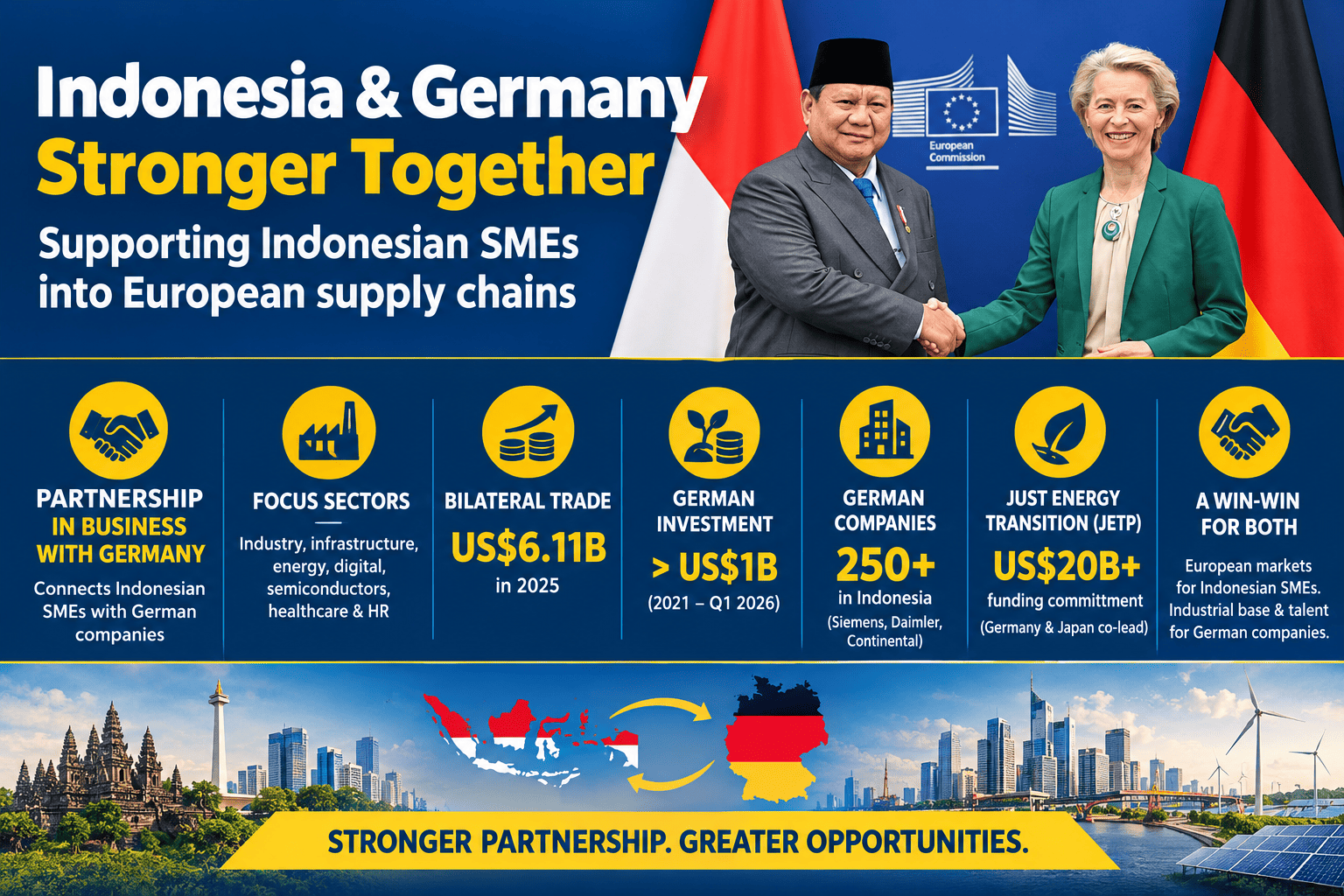
Indonesia and Germany have strengthened a strategic partnership in 2026 to help Indonesian SMEs (IKM) enter European supply chains, primarily through the Partnering in Business with Germany programme, which connects Indonesian small and medium manufacturers with German companies for trade, investment, and manufacturing collaboration. The partnership spans industry, infrastructure, energy transition, digital transformation, semiconductors, healthcare, and human resource development, building on 74 years of diplomatic relations ahead of the 75th anniversary in 2027. Key milestones include German President Frank-Walter Steinmeier’s state visit to Jakarta in June 2026, where both nations agreed to expand trade and investment, and Indonesia’s push for the swift conclusion of the Indonesia-EU Comprehensive Economic Partnership Agreement (IEU-CEPA). Bilateral trade reached approximately US6.11billionin2025,withGermany’scumulativeinvestmentinIndonesiaexceedingUS1 billion from 2021 through Q1 2026. More than 250 German multinational companies operate in Indonesia, including Siemens, Daimler, and Continental. The partnership also includes Germany’s role, alongside Japan, as co-lead of the International Partners Group under Indonesia’s Just Energy Transition Partnership (JETP), with funding commitments exceeding US$20 billion. For Indonesian SMEs, this represents a structured pathway to European markets; for German companies, it opens access to Indonesia’s growing industrial base and skilled workforce.
📅 May 20, 2026⏱ 16 min read✍️ GTsetu Editorial Team📰 News + Analysis
Partnership Type
Strategic Alliance
Indonesia-Germany partnership connecting SMEs to European supply chains
Bilateral Trade
US$6.11B
Indonesia-Germany trade in 2025, with significant growth potential
German Companies
250+
German multinationals operating in Indonesia, including Siemens, Daimler, Continental
Diplomatic Relations
74 Years
Indonesia-Germany ties, approaching 75th anniversary in 2027
Section 1, The News
1
The Full Story: Indonesia × Germany Partnership
🏭
Partnership Strengthened, May 2026
Indonesia and Germany Strengthen Strategic Partnership to Integrate Indonesian SMEs into European Supply Chains
In 2026, Indonesia and Germany deepened a strategic partnership aimed at integrating Indonesian small and medium enterprises (SMEs/IKM) into European supply chains. The centrepiece is the Partnering in Business with Germany programme, which connects Indonesian manufacturers with German companies for trade, investment, and industrial collaboration.
The partnership builds on 74 years of diplomatic relations, with 2026 marking a significant milestone ahead of the 75th anniversary in 2027. A series of high-level visits, including German President Frank-Walter Steinmeier’s state visit to Jakarta in June 2026, reaffirmed both nations’ commitment to strengthening economic cooperation, investment, energy transition, education, and employment.
Key sectors include industry, infrastructure, trade, investment, energy, digital transformation, health care, life sciences, and human resource development. Both countries are also pushing for the swift conclusion of the Indonesia-EU Comprehensive Economic Partnership Agreement (IEU-CEPA), expected to be signed in 2026 with implementation beginning in early 2027. The agreement is expected to provide broader market access, boost trade, and strengthen business engagement between Indonesia and EU member states, including Germany.
74 Years
Diplomatic relations, approaching 75th anniversary in 2027
US$6.11B
Bilateral trade in 2025, with significant growth potential
250+
German multinational companies operating in Indonesia
US$20B+
JETP funding commitments, Germany co-leads with Japan
“Looking ahead, we see significant opportunities to deepen cooperation in industry, infrastructure, trade, investment, energy, digital transformation, health care, life sciences, and human resource development.”
— Airlangga Hartarto, Coordinating Minister for Economic Affairs, Indonesia
“The strengthening and continuity of the Indonesia-Germany partnership is, of course, a priority. This visit also marks the beginning of preparations for the 75th anniversary of Indonesia-Germany bilateral relations in 2027.”
— Prabowo Subianto, President of Indonesia
💡 GTsetu Perspective
The Indonesia-Germany partnership represents a structural shift in how Indonesian SMEs access European markets. The Partnering in Business with Germany programme creates a government-backed pathway for manufacturers to connect with German companies that are actively seeking reliable supply chain partners. For Indonesian manufacturers, this is a once-in-a-generation opportunity to integrate into European supply chains. For German companies, it provides structured access to Indonesia’s growing industrial base. The companies that establish manufacturing partnerships and supply chain relationships in 2026, while the programme is being operationalised and before the IEU-CEPA is finalised, will hold preferred positions that competitors entering later will find difficult to replicate. GTsetu is where verified international manufacturing partner discovery happens systematically, connecting Indonesian manufacturers, German buyers, and technology partners across 100+ countries.
Section 2, The Anatomy
2
What Each Partner Brings to the Table
Like every successful international manufacturing partnership, the Indonesia × Germany collaboration works because each party contributes capabilities that complement the other’s needs. Indonesia provides manufacturing capacity and a skilled workforce; Germany provides technology, investment, and market access to European supply chains.
Collaboration Anatomy, Strategic Alliance for Supply Chain Integration
Indonesia
🇮🇩 Jakarta, Manufacturing Base & Skilled Workforce
What they bring
Manufacturing Capacity & Workforce
SME Network
IKM/SMEs across manufacturing sectors
Key Sectors
Industry, infrastructure, energy transition, digital
Specialty
Growing industrial base & skilled workforce
What they lack
Access to European supply chains & technology
Partnership role
Manufacturing & Supply Chain Partner
+
Strategic Alliance
Germany
🇩🇪 Berlin, Technology & European Market Access
What they bring
Technology, Investment & European Market Access
Corporate Presence
250+ German multinationals in Indonesia
Key Sectors
Industry, energy, semiconductors, digital, HR
Specialty
Technology transfer & EU market access
What they lack
Direct manufacturing capacity in Indonesia
Partnership role
Technology & Market Access Partner
🎯 Target: Integrate Indonesian SMEs into European supply chains
🏭 Partnering in Business with Germany programme
📈 IEU-CEPA expected 2026, implementation early 2027
Advanced technology, R&D, Industry 4.0 expertise, vocational training
German technology transfer upgrades Indonesian manufacturing capabilities
Investment & Financing
Investment opportunities, strategic projects, policy support
Capital, financing, JETP commitments (US$20B+), development funding
German capital and financing enable Indonesian industrial development
Human Resources
Skilled workforce, young talent, vocational education capacity
Vocational training expertise, employment opportunities in Germany
Human capital development strengthens both economies, German skills, Indonesian workforce
Section 3, The Relationship
3
The Road to Partnership: Indonesia · Germany Relationship Evolution
The Indonesia × Germany partnership for SME supply chain integration emerged from a long-standing bilateral relationship. With 74 years of diplomatic relations and a series of high-level visits in 2026, the partnership has evolved from general economic cooperation into a focused programme aimed at integrating Indonesian SMEs into European supply chains.
🤝 Indonesia × Germany, Partnership History
1952
Diplomatic Relations Established
Indonesia and Germany establish diplomatic relations, laying the foundation for decades of economic and industrial cooperation. In 2026, the two nations commemorate 74 years of diplomatic ties, approaching the 75th anniversary in 2027.
2000s–2020s
German Corporate Presence Expands
More than 250 German multinational companies establish operations in Indonesia, including Siemens, Daimler, and Continental. Germany becomes one of Indonesia’s most important economic and industrial partners, with cumulative investment exceeding US$1 billion from 2021 through Q1 2026.
2026
High-Level Visits and Strategic Dialogue
German President Frank-Walter Steinmeier visits Jakarta in June 2026, meeting with President Prabowo Subianto. Both nations agree to expand trade and investment, strengthen cooperation in energy transition, education, and employment, and push for the swift conclusion of the IEU-CEPA. Airlangga Hartarto meets with German business delegations, discussing the Joint Economic and Investment Committee, industrial and green cooperation, and human resource development.
2026–2027
Partnering in Business with Germany, SME Supply Chain Integration
The Partnering in Business with Germany programme is operationalised, connecting Indonesian SMEs (IKM) with German companies for trade, investment, and manufacturing collaboration. The programme aims to integrate Indonesian manufacturers into European supply chains, with a focus on industry, infrastructure, energy transition, digital transformation, semiconductors, and human resource development. The IEU-CEPA is expected to be signed in 2026, with implementation beginning in early 2027, providing broader market access for Indonesian SMEs and strengthening business engagement with EU member states, including Germany.
🔑 Key Lesson: Strategic Partnerships for Supply Chain Integration
The Indonesia-Germany partnership illustrates a critical principle for international manufacturing collaboration: government-backed programmes can dramatically reduce the friction of finding and qualifying international partners. The Partnering in Business with Germany programme provides a structured, trusted pathway for Indonesian SMEs to connect with German companies that are actively seeking supply chain partners. For Indonesian manufacturers, this is a once-in-a-generation opportunity to integrate into European supply chains. For German companies, it provides access to Indonesia’s growing industrial base. The lesson for manufacturers in any country: identify bilateral or multilateral cooperation programmes that can provide trusted introductions and market access. GTsetu’s platform complements these programmes by enabling verified partner discovery across 100+ countries, so your international expansion is systematic, not opportunistic.
Section 4, Why This Works
4
Why This Strategic Alliance Works for Manufacturing & Supply Chain Integration
🎯 The Core Logic
The Indonesia × Germany partnership succeeds because it is built on three interlocking strategic advantages: (1) Indonesia’s growing manufacturing base and skilled workforce need access to European markets and technology, (2) Germany’s industrial companies need reliable supply chain partners in ASEAN and access to Indonesia’s growing market, and (3) the Partnering in Business with Germany programme provides a structured, government-backed mechanism for connecting the two. The upcoming IEU-CEPA will further reduce trade barriers, creating a comprehensive framework for SME supply chain integration. Neither party could achieve the same result through unilateral action, Indonesian SMEs cannot easily access European supply chains without German market knowledge and connections, and German companies cannot easily navigate Indonesia’s industrial landscape without local partners.
Why International Manufacturing Partnerships Are Accelerating in 2026
US$6.11B
Bilateral trade in 2025, the foundation for deeper cooperation
250+
German multinationals in Indonesia, active partners for SME integration
IEU-CEPA
Expected 2026, implementation 2027, broader market access for SMEs
US$20B+
JETP commitments, Germany co-leads with Japan, financing Indonesia’s energy transition
74 Years
Diplomatic relations, trust foundation for manufacturing partnerships
IKM
Indonesian SMEs, the target beneficiaries of the Partnering in Business programme
Section 5, Indonesia SME Opportunity
5
Indonesia’s SME Opportunity, Why Now Is the Time to Integrate into European Supply Chains
🇮🇩 Indonesia SME & Manufacturing 2026–2030
Why Every Indonesian SME Should Be Engaging with the Germany Partnership Opportunity
Indonesia’s SME sector (IKM) forms the backbone of the economy, contributing significantly to GDP and employment. However, access to international markets, particularly European supply chains, has remained a persistent challenge due to trade barriers, standards requirements, and lack of direct connections to European buyers. The Indonesia-Germany partnership addresses this gap by providing a structured, government-backed pathway for SMEs to connect with German companies. With the IEU-CEPA expected to be signed in 2026 and implemented in 2027, the window for early engagement is now. SMEs that establish relationships with German companies in 2026 will have a significant first-mover advantage when the agreement comes into force.
US$6.11B
Bilateral trade in 2025, with significant growth potential through IEU-CEPA
250+
German companies in Indonesia, potential partners for SME supply chains
IEU-CEPA
Expected 2026, implementation 2027, broader market access for Indonesian SMEs
Partnering
Partnering in Business with Germany programme, structured pathway to EU supply chains
JETP
US$20B+ energy transition funding, Germany co-leads with Japan
74 Years
Diplomatic relations, trust foundation for manufacturing partnerships
🌐 GTsetu for Manufacturing & Supply Chain Partnerships
GTsetu’s verified partner network includes manufacturers, industrial suppliers, technology providers, and trade partners across Indonesia, Germany, ASEAN, Europe, and 100+ other countries. Every company on GTsetu is verified on 6 government-sourced points: Name, Address, Registration Number, Company Status, Company Type, and Date of Certificate of Incorporation. Additional capabilities like certifications, manufacturing capacity, and export experience are self-reported. If you’re an Indonesian manufacturer looking to integrate into European supply chains, or a German company seeking reliable manufacturing partners in ASEAN, GTsetu is where your partner search begins with verified profiles, not cold calls. Find manufacturing partners →
Section 6, Types of Collaboration
6
4 Types of International Manufacturing Collaboration, Which Fits Your Situation?
The Indonesia × Germany partnership is a strategic alliance for manufacturer and services collaboration, but there are multiple ways to structure international manufacturing partnerships. The right collaboration type depends on your manufacturing capabilities, target markets, and growth objectives.
01
Manufacturer / Services Partnership
One party provides manufacturing capacity; the other provides technology, market access, or services. The Indonesia-Germany model. Best when one party has production capability, the other has market access and technical expertise. Fast to execute, lower integration complexity.
🏭 Indonesia × Germany
02
Joint Venture (JV)
A new shared legal entity co-owned by both parties. Deepest integration, full profit and risk sharing. Best for permanent market anchor when both parties have substantial complementary assets and long-term commitment.
⚖️ Long-term market anchor
03
Contract Manufacturing
You own the design and brand; a partner manufactures to your specification for a per-unit fee. No equity sharing. Ideal when you need production capacity in a new geography without permanent commitment. Scalable and fully reversible.
🏭 Capacity without commitment
04
Supply Chain Integration
You become a supplier to a larger manufacturer’s supply chain, providing components or services. The Partnering in Business with Germany model. Often the first step before a deeper manufacturing agreement. Proven pathway to European supply chains.
🔗 EU supply chain access
📊 Collaboration Model Comparison, International Manufacturing
Model
Capital Required
Market Access Speed
Technology Transfer
Reversibility
Manufacturer/Services
Low–Moderate
✓ Fast
~ Moderate
High
Joint Venture
High, shared capex
Slow (12–24 months)
✓ High
Low
Contract Mfg
Minimal
~ Moderate
~ Low
High
Supply Chain
Minimal
✓ Fastest
~ Moderate
High
Section 7, How to Collaborate
7
How to Collaborate: A 5-Step Playbook for Indonesian SMEs & German Partners
The Indonesia × Germany partnership demonstrates a systematic approach to international supply chain integration that any manufacturer or SME can adapt. Here is the distilled playbook.
1
Define Your Manufacturing Capability and Target Market
Before you can engage with German partners, you need to identify exactly what you manufacture, to what quality standards, and in what volumes. Are you a Tier 1, Tier 2, or Tier 3 supplier? What certifications do you hold? What is your production capacity? Define your capability precisely, German companies are quality-focused and will expect documented evidence of your manufacturing standards.
2
Leverage Government Programmes and Verified Platforms
The Partnering in Business with Germany programme provides a structured pathway for Indonesian SMEs to connect with German companies. Beyond government programmes, GTsetu provides verified profiles of German buyers, industrial suppliers, and technology partners across 100+ countries. GTsetu verifies companies using government tie-ups on 6 key points: Name, Address, Registration Number, Company Status, Company Type, and Date of Certificate of Incorporation. Additional information like certifications, manufacturing capabilities, and export experience is self-reported and should be validated independently through your own due diligence.
3
Protect Your Intellectual Property and Manufacturing Knowhow
In international manufacturing partnerships, your process technology, product designs, and manufacturing knowhow are valuable IP. Before sharing anything sensitive, even a capability presentation, execute a mutual NDA. This is non-negotiable regardless of how well you think you know the prospective partner. GTsetu’s built-in NDA workflow handles this automatically: mutual NDA executed and countersigned before any sensitive information is shared, with a full digital audit trail.
4
Choose the Right Collaboration Structure for Your Objective
The Partnering in Business with Germany programme supports multiple collaboration structures: supply chain integration (become a supplier to a German company), contract manufacturing (manufacture to German specifications), joint venture (co-own a manufacturing operation), or manufacturer/services partnership (provide manufacturing services to German clients). Match the structure to your capability, capacity, and growth objectives.
5
Engage in 2026, Before the IEU-CEPA Comes into Force
The IEU-CEPA is expected to be signed in 2026 and implemented in early 2027. The SMEs that establish relationships with German companies in 2026, while the Partnering in Business with Germany programme is operational and before the agreement is finalised, will have a significant first-mover advantage. Once the IEU-CEPA comes into force, competition for German partnerships will intensify. GTsetu’s verified partner network enables rapid identification and engagement with the right German or European counterparty without the 12–18 months of conference circuit and government introduction that characterises traditional international business networking.
Section 8, Dos and Don’ts
8
Dos and Don’ts of International Manufacturing Partnerships
✅ Do These
✅ Leverage government programmes, the Partnering in Business with Germany programme provides trusted introductions
✅ Verify your partner’s business registration and manufacturing credentials, the right partner has documented capabilities
✅ Structure supply chain partnerships before committing to capacity expansion, win the contracts, then build for them
✅ Sign NDA before sharing process technology, product designs, or manufacturing data
✅ Choose a partner whose market access is complementary to your manufacturing capability
✅ Define the partnership scope clearly, which products, which markets, with what quality standards
✅ Run a pilot engagement (first order, initial shipment) before committing to full-scale partnership
✅ Use verified platforms like GTsetu in addition to government programmes for partner discovery
✅ Document the collaboration formally, supply agreement, manufacturing contract, or joint venture agreement
❌ Avoid These
❌ Commit to capacity expansion before securing supply chain partnerships and confirmed orders
❌ Share manufacturing process data, product designs, or pricing before NDA is countersigned
❌ Accept self-reported manufacturing capability claims without reference verification
❌ Assume that a partner’s market access is transferable without active relationship management
❌ Partner with a manufacturer who also supplies direct competitors in the same market without conflict-of-interest provisions
❌ Neglect exclusivity terms, know whether your partner can supply competing products to the same buyers
❌ Choose a partner whose capabilities duplicate yours, complementary manufacturing and market access is where value is created
❌ Start production on informal terms, supply scope, quality standards, delivery timelines must be documented
❌ Underestimate the certification and compliance requirements, European standards are rigorous and non-negotiable
❌ Build a JV when a supply chain partnership would achieve the same market access objective at lower commitment and risk
Section 9, Misconceptions
9
Common Misconceptions About International Supply Chain Integration
❌ Myth
“A government partnership programme is just a formality, the real business happens through private networks.”
✅ Reality
The Partnering in Business with Germany programme provides structured, trusted introductions to German companies that are actively seeking supply chain partners. This is not a formality, it is a government-backed pathway that de-risks the partnership formation process. For SMEs without existing German networks, this programme is the most efficient route to European supply chain integration.
❌ Myth
“We can figure out the quality standards and certification requirements after we’ve established the partnership.”
✅ Reality
European quality standards and certification requirements (ISO, CE, industry-specific standards) are non-negotiable prerequisites for supply chain integration. German companies cannot purchase from suppliers that do not meet these standards. You must audit your certifications and compliance before engaging with German partners, not after. This is the first filter in any European supply chain conversation.
❌ Myth
“A partnership with a German company automatically gives us access to the entire European market.”
✅ Reality
A partnership with one German company provides access to that company’s supply chain and potentially its network, not automatic access to the entire European market. Each European buyer has its own procurement processes, quality requirements, and supplier qualification procedures. The German partnership is a door-opener and credibility signal, not a market-wide guarantee. Plan your European market strategy as a multi-year, multi-partner initiative.
❌ Myth
“We should wait until the IEU-CEPA is fully implemented before engaging with German companies.”
✅ Reality
The IEU-CEPA is expected to be signed in 2026 and implemented in early 2027. The SMEs that establish relationships with German companies in 2026, while the Partnering in Business with Germany programme is operational and before the agreement is finalised, will have a significant first-mover advantage. Once the IEU-CEPA comes into force, competition for German partnerships will intensify dramatically. Waiting means losing the first-mover advantage.
❌ Myth
“The partnership programme is only for large manufacturers, small SMEs can’t participate.”
✅ Reality
The Partnering in Business with Germany programme is explicitly designed for SMEs (IKM), small and medium manufacturers are the target beneficiaries. The programme recognises that SMEs often lack the resources to independently establish international partnerships and provides structured support to overcome these barriers. If you are an SME with quality manufacturing capabilities and growth ambitions, you are exactly the target participant.
Section 10, GTsetu
10
How GTsetu Helps You Find the Right Manufacturing & Supply Chain Partner
The Partnering in Business with Germany programme provides a structured pathway for Indonesian SMEs. But even with government programmes, identifying the right German partner, one whose supply chain requirements match your manufacturing capabilities, requires systematic evaluation. GTsetu is the verified B2B manufacturing discovery platform that enables this evaluation at scale, across 100+ countries, before you reveal a single confidential detail.
🌐 Platform Spotlight, GTsetu
Find Verified Manufacturers, Industrial Suppliers, and Supply Chain Partners Across 100+ Countries, Anonymously, Securely, With Zero Broker Fees
Every company on GTsetu is verified using government tie-ups on 6 key points: Name, Address, Registration Number, Company Status, Company Type, and Date of Certificate of Incorporation. This is the foundation of trust. Additional information such as quality certifications (ISO, IATF, CE), manufacturing capabilities, production capacity, and export experience is self-reported by companies. You evaluate who is real before you engage. You share nothing sensitive until an NDA is countersigned. And you pay no broker commission on any collaboration formed, the deal is entirely between you and your partner.
✅
6-Point Government-Sourced VerificationName, Address, Registration Number, Company Status, Company Type, Date of Incorporation confirmed using government tie-ups.
🕵️
Anonymous DiscoveryEvaluate verified partner profiles without revealing your identity until mutual interest is confirmed.
📄
Built-In NDA WorkflowShare product designs, production specs, or commercial information only after NDA is executed, full audit trail, no external legal required.
🚫
Zero CommissionNo broker fees, your supply chain partnership, manufacturing contract, or joint venture is entirely between you and your partner.
🌍
100+ CountriesManufacturers, industrial suppliers, and trade partners across Indonesia, Germany, ASEAN, Europe, and every major market.
🔐
Encrypted CollaborationShare product specifications, quality certifications, and manufacturing documents securely between verified partners.
What the Indonesia-Germany Partnership Achieves, What GTsetu Enables For You
What the Partnership Achieves
What GTsetu Enables for You
Why This Matters
Provides government-backed introductions through the Partnering in Business with Germany programme
✓ Browse verified manufacturer and supplier profiles with government-sourced verification before engaging
You evaluate the partner’s verified legal identity and manufacturing capability, not marketing claims
Connects Indonesian SMEs with German companies actively seeking supply chain partners
✓ Filter by self-reported manufacturing capabilities, certifications, export experience, and target markets (validate independently)
Find potential partners with the specific manufacturing capabilities and quality standards your supply chain requires
Provides structured pathway for SME integration into European supply chains
✓ Built-in NDA and document workflow protects IP and commercial information from the first conversation
Your process technology, product designs, and manufacturing data are protected at every stage
Targets complementary capabilities, Indonesian manufacturing, German technology and market access
✓ Self-reported partner profiles show manufacturing capabilities, target markets, and quality certifications
Identify potential complementarity, the gap between your manufacturing capability and your partner’s market access
Zero intermediary in government partnership, direct commercial terms
✓ Zero commission on any partnership, all terms are direct between the two parties
No broker splits your margin or misaligns your commercial terms
FAQ
?
Frequently Asked Questions
Q
What exactly is the Indonesia-Germany partnership for SMEs?
Indonesia and Germany strengthened a strategic partnership in 2026 aimed at integrating Indonesian SMEs (IKM) into European supply chains, primarily through the Partnering in Business with Germany programme. The programme connects Indonesian manufacturers with German companies for trade, investment, and industrial collaboration. The partnership spans industry, infrastructure, energy transition, digital transformation, semiconductors, healthcare, and human resource development, building on 74 years of diplomatic relations. Key milestones include German President Frank-Walter Steinmeier’s state visit to Jakarta in June 2026 and Indonesia’s push for the swift conclusion of the IEU-CEPA.
Q
Why is this partnership significant for Indonesian SMEs?
Indonesia’s SME sector (IKM) forms the backbone of the economy but has historically faced barriers to accessing European supply chains. This partnership provides a structured, government-backed pathway for SMEs to connect with German companies that are actively seeking reliable supply chain partners. With the IEU-CEPA expected to be signed in 2026 and implemented in 2027, the window for early engagement is now. SMEs that establish relationships with German companies in 2026 will have a significant first-mover advantage when the agreement comes into force. More than 250 German multinational companies already operate in Indonesia, including Siemens, Daimler, and Continental.
Q
What is the difference between a manufacturer/services partnership and a supply chain partnership?
A manufacturer/services partnership is a broad collaboration where one party provides manufacturing capacity and the other provides technology, market access, or services. It may include contract manufacturing, joint ventures, or technology transfer. A supply chain partnership is more specific: you become a supplier of components or services to a larger manufacturer’s supply chain, often as a Tier 1, 2, or 3 supplier. The Indonesia-Germany partnership is structured as a manufacturer/services collaboration through the Partnering in Business with Germany programme, which often results in supply chain integration as the first concrete outcome. Use a manufacturer/services partnership when you want comprehensive collaboration; use a supply chain partnership when you have specific components or services to supply to a defined buyer.
Q
How can I find verified manufacturing or supply chain partners in Germany or Europe?
The systematic approach involves four steps: (1) Define your manufacturing capability and target market precisely, what products, quality standards, and production volumes? (2) Leverage government programmes, the Partnering in Business with Germany programme provides structured introductions to German companies. (3) Search verified platforms, GTsetu lists verified manufacturers, industrial suppliers, and trade partners across 100+ countries. GTsetu verifies companies using government tie-ups on 6 points: Name, Address, Registration Number, Company Status, Company Type, and Date of Certificate of Incorporation. Additional information like certifications, manufacturing capabilities, and export experience is self-reported and should be validated independently. (4) Execute NDA before any technical disclosure, GTsetu’s built-in NDA workflow handles this automatically before any sensitive document exchange. Cold approaches through trade shows or LinkedIn rarely surface the right supply chain partner; a structured, verified search on GTsetu does.
Q
What happens if my manufacturing partner also supplies my competitors?
This is a critical question in international manufacturing partnerships. If your manufacturing partner provides the same products to your direct competitors, your competitive advantage is compromised. Before signing any supply chain or manufacturing agreement, explicitly negotiate: (1) Exclusivity scope, are you the exclusive supplier in your product category for the target market? (2) Territory terms, which specific countries or regions are exclusive to you? (3) Conflict of interest provisions, can the partner supply competing products to the same buyers? These terms must be in the agreement before signing. In the Indonesia-Germany partnership, individual SMEs need to negotiate exclusivity terms with the specific German buyers they meet through the programme.
Q
Does GTsetu charge commission on manufacturing partnerships or supply chain collaborations formed through the platform?
No. GTsetu charges zero commission on any collaboration, whether a manufacturing partnership, supply chain agreement, joint venture, or contract manufacturing arrangement, formed through the platform. The commercial terms of your agreement are entirely between you and your partner. This is a foundational design principle: broker intermediation in manufacturing partnerships typically costs 5–15% of deal value and creates incentive misalignment between the broker and both parties. GTsetu removes the broker entirely. Learn more about GTsetu →
Ready to Integrate into European Supply Chains? Start on GTsetu.
500+ verified manufacturers, industrial suppliers, and trade partners across Indonesia, Germany, ASEAN, Europe, and 100+ countries. Zero broker fees. Anonymous discovery. Built-in NDA workflows. Your next manufacturing partnership starts with a verified profile, not a trade fair handshake.
Business Development Expert | Global Trade & International Market Development
Sarah Ann Mitchell is a Business Development Expert at GTsetu with a strong focus on global trade, international market development, and strategic business partnerships. She works with companies seeking to expand internationally by identifying collaboration opportunities, connecting with key stakeholders, and developing market access strategies.
Sarah brings expertise in cross-border business development, international trade ecosystems, partnership building, and global market intelligence. Her work at GTsetu involves supporting businesses, manufacturers, startups, and industry leaders in building relationships that accelerate growth and create long-term commercial value.
Passionate about fostering international collaboration, Sarah helps organizations navigate evolving global markets and discover new opportunities through strategic partnerships, trade networks, and ecosystem-driven growth initiatives.