India-Brazil MSME MoU: What Businesses Must Learn About India-LATAM Strategic Collaboration
🔴 BREAKINGIndia-Brazil MSME MoU signed at 12th CII India-LAC Conclave: Market Access, Technology Transfer, Green Finance◆India-LAC bilateral trade crosses US$50 billion; MSME collaboration emerges as strategic priority◆Green finance and sustainability frameworks established for MSMEs in both nations◆Find verified international business partners on GTsetu, 100+ countries, zero commission◆🔴 BREAKINGIndia-Brazil MSME MoU signed at 12th CII India-LAC Conclave: Market Access, Technology Transfer, Green Finance◆India-LAC bilateral trade crosses US$50 billion; MSME collaboration emerges as strategic priority◆Green finance and sustainability frameworks established for MSMEs in both nations◆Find verified international business partners on GTsetu, 100+ countries, zero commission◆
Home › Blog › India-Brazil MSME MoU
🔴 Breaking News🌍 International Trade🇮🇳 India🇧🇷 Brazil🌱 Green Finance
India-Brazil MSME MoU: How Strategic Alliances Are Unlocking Market Access, Technology & Green Finance
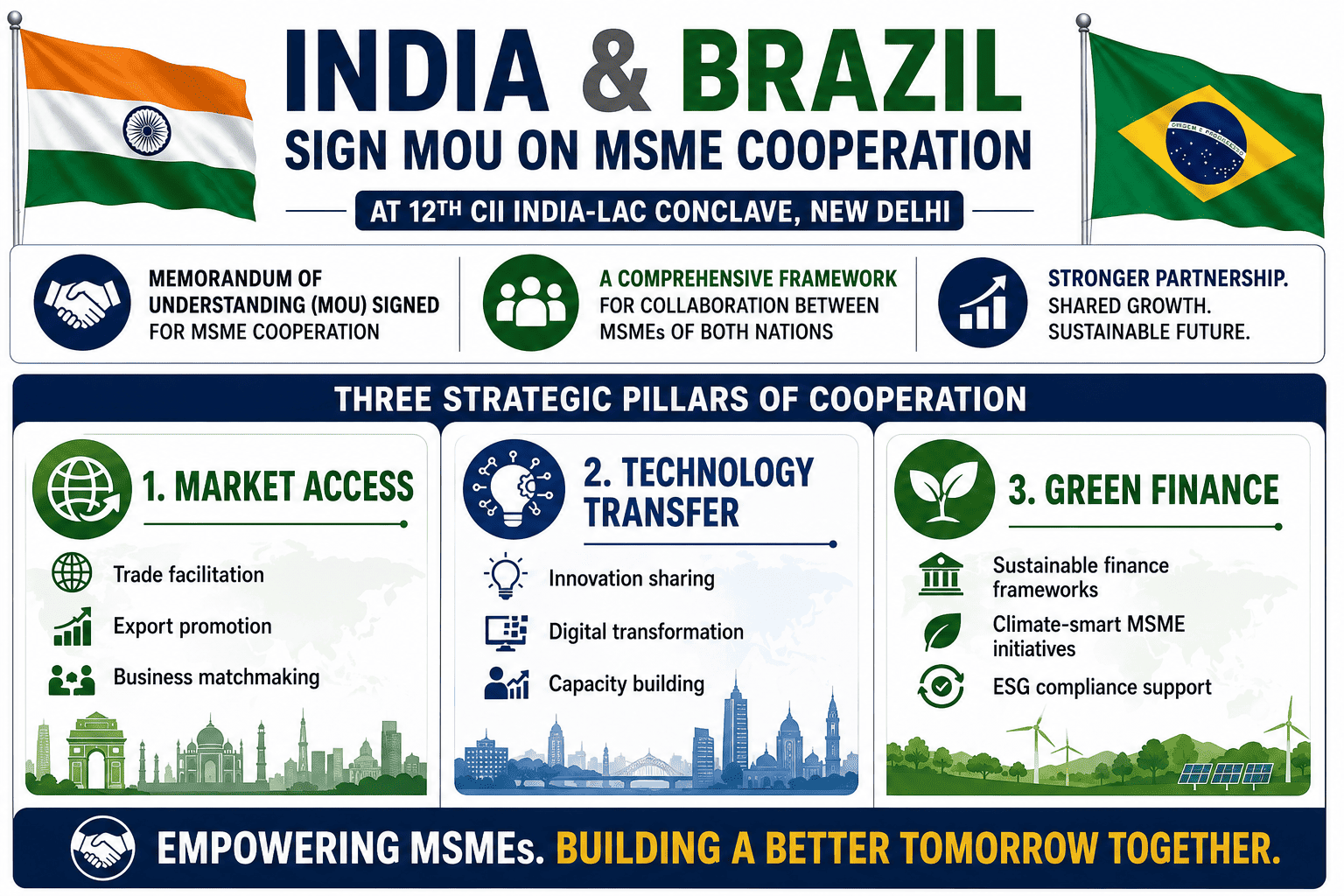
India and Brazil signed a landmark Memorandum of Understanding (MoU) on MSME cooperation at the 12th CII India-LAC Conclave in New Delhi, establishing frameworks for market access, technology transfer, and green finance. This strategic alliance opens new avenues for MSMEs in both nations to collaborate, innovate, and access sustainable finance.
🎯 Direct Answer
India and Brazil have signed a Memorandum of Understanding (MoU) on MSME cooperation at the 12th CII India-LAC (Latin America and Caribbean) Conclave in New Delhi. The MoU establishes a comprehensive framework for collaboration between MSMEs of both nations, focusing on three strategic pillars: Market Access (trade facilitation, export promotion, and business matchmaking), Technology Transfer (innovation sharing, digital transformation, and capacity building), and Green Finance (sustainable finance frameworks, climate-smart MSME initiatives, and ESG compliance support).
The partnership builds on India-LAC bilateral trade crossing US$50 billion, with MSMEs emerging as the next growth frontier. The MoU includes provisions for joint trade missions, technology demonstrations, and green finance mechanisms. This represents a significant step in deepening India’s engagement with Latin America, with Brazil as the anchor partner and gateway to the broader LATAM market.
📅 February 21, 2026⏱ 15 min read✍️ GTsetu Editorial Team📰 News + Analysis
Deal Type
Strategic Alliance
Memorandum of Understanding for MSME cooperation
Three Pillars
Market Access · Tech · Green Finance
Comprehensive framework for MSME collaboration
Bilateral Trade
US$50B+
India-LAC bilateral trade, MSMEs as next growth frontier
Event
12th CII India-LAC Conclave
Flagship event hosted in New Delhi, February 2026
Section 1, The News
1
The Full Story: India-Brazil MSME MoU at CII India-LAC Conclave
🌎
MoU Signed, February 21, 2026
India and Brazil Sign Landmark MSME MoU at 12th CII India-LAC Conclave, Unlocking Market Access, Technology Transfer, and Green Finance
At the 12th CII India-LAC (Latin America and Caribbean) Conclave held in New Delhi, India and Brazil signed a landmark Memorandum of Understanding (MoU) on MSME cooperation , establishing a comprehensive framework for collaboration between micro, small, and medium enterprises of both nations .
The MoU focuses on three strategic pillars : Market Access (trade facilitation, export promotion, and business matchmaking), Technology Transfer (innovation sharing, digital transformation, and capacity building), and Green Finance (sustainable finance frameworks, climate-smart MSME initiatives, and ESG compliance support).
This strategic alliance builds on the US$50 billion+ India-LAC bilateral trade , with MSMEs emerging as the next growth frontier . Brazil, as India’s largest trading partner in Latin America, serves as the anchor and gateway to the broader LATAM region . The MoU includes provisions for joint trade missions, technology demonstrations, and green finance mechanisms, positioning both nations to capitalise on emerging opportunities in sustainable development and digital transformation.
3 Pillars
Market Access · Technology Transfer · Green Finance
US$50B+
India-LAC bilateral trade, MSMEs next growth frontier
CII Conclave
12th edition, flagship India-LAC business event
MSME
Primary focus, cross-border collaboration and growth
“This MoU marks a significant milestone in India-Brazil relations, creating a robust framework for MSMEs to access new markets, adopt cutting-edge technologies, and embrace sustainable finance. We are building bridges of opportunity for our businesses.”
— Official Statement, Ministry of Micro, Small and Medium Enterprises, Government of India
“Brazil sees India as a strategic partner in advancing our MSME ecosystem. This MoU will facilitate knowledge exchange, technology sharing, and sustainable business practices that benefit entrepreneurs in both our countries.”
— Official Statement, Ministry of Development, Industry, Trade and Services, Brazil
💡 GTsetu Perspective
The India-Brazil MSME MoU represents a strategic pivot toward international collaboration for MSMEs, moving beyond traditional trade into market access, technology transfer, and green finance. For businesses in both nations, this creates unprecedented opportunities to find partners, access new markets, and adopt sustainable practices. GTsetu helps MSMEs and businesses in India, Brazil, and 100+ countries find verified international partners, enabling the practical realisation of strategic alliances like this MoU.
Section 2, Three Pillars
2
The Three Pillars: Market Access, Technology Transfer, Green Finance
The India-Brazil MSME MoU is structured around three strategic pillars that address the most critical barriers to MSME internationalisation and provide a comprehensive framework for sustainable growth.
🌐
Market Access
🇮🇳 India🇧🇷 Brazil
Trade facilitation mechanisms, export promotion programmes, business matchmaking events, and market intelligence sharing to enable MSMEs to access each other’s markets with reduced barriers.
Innovation sharing, digital transformation frameworks, capacity building programmes, and technology demonstration events to enable MSMEs to adopt advanced manufacturing, digital tools, and Industry 4.0 practices.
Focus: Digital literacy · R&D collaboration · Industry 4.0 adoption
🌱
Green Finance
🌿 ESG💰 Finance
Sustainable finance frameworks, climate-smart MSME initiatives, ESG compliance support, and access to green finance mechanisms to enable environmentally responsible and climate-resilient business practices.
The India-Brazil MSME MoU works because each nation contributes assets that the other cannot replicate efficiently, the foundation of successful international strategic alliances.
Collaboration Anatomy, Strategic Alliance (MoU)
🇮🇳 India
World’s Fastest-Growing Major Economy
What they bring
Scale + Technology + Market
Key Assets
IT services, manufacturing, digital economy
MSME Strength
6+ crore MSMEs, diverse sectors
What they seek
Latin American market access
Role
Technology & Scale Provider
+
Strategic Alliance
🇧🇷 Brazil
Largest Economy in Latin America
What they bring
Market Access + Green Finance
Key Assets
Agribusiness, energy, LATAM gateway
MSME Strength
Diverse MSME base, regional integration
What they seek
Technology, innovation, capacity building
Role
Market & Finance Gateway
🎯 Focus: MSME Collaboration
🌐 Region: India + Latin America
🌱 Focus: Green Finance & Sustainability
Dimension
India Contribution
Brazil Contribution
Why This Balance Works
Market Access
Access to India’s 1.4B consumer market
Access to LATAM region via Brazil gateway
Both nations unlock new markets for each other’s MSMEs
Technology
Digital capabilities, IT services, manufacturing tech
Agribusiness tech, energy innovation, sustainable practices
Complementary technology strengths, India’s digital meets Brazil’s sustainable expertise
Green Finance
ESG frameworks, sustainable finance expertise
Climate finance, green bond markets, sustainability leadership
Both nations committed to sustainable development and climate action
MSMEs as engines of economic growth in both nations
Strategic Importance
Gateway to Asia and Indian Ocean region
Gateway to LATAM and Atlantic basin
Strategic geographic complementarity opens global corridors
Section 4, Why This Works
4
Why India-LATAM MSME Collaboration Is Accelerating
🎯 The Core Logic
The India-Brazil MSME MoU succeeds because it addresses a systemic opportunity: both nations have large, dynamic MSME sectors that are seeking international growth, technology adoption, and sustainable finance. India’s strength in digital technology, manufacturing, and IT services complements Brazil’s expertise in agribusiness, energy, and sustainable practices. The US$50 billion+ India-LAC bilateral trade provides a solid foundation, while the MoU’s three pillars create a comprehensive framework for MSMEs to overcome internationalisation barriers. This is not just a trade agreement, it’s a strategic alliance that positions MSMEs as the next growth frontier in India-LATAM economic relations.
US$50B+
India-LAC bilateral trade, solid foundation for MSME collaboration
6 Cr+
India’s MSMEs, vast ecosystem ready for international collaboration
LATAM
Gateway to 650M+ consumers, Brazil as anchor to the region
Green
Sustainability and ESG, shared priority driving green finance collaboration
Digital transformation and Industry 4.0, technology transfer as strategic pillar
Section 5, India-LAC Conclave
5
The India-LAC Conclave and Bilateral Trade Context
🏛️ 12th CII India-LAC Conclave, February 2026, New Delhi
Why India’s Engagement With Latin America Is Accelerating
The India-LAC Conclave, organised annually by the Confederation of Indian Industry (CII), has emerged as the premier platform for India’s engagement with Latin America and the Caribbean . The 12th edition, held in New Delhi, brought together business leaders, policymakers, and stakeholders from both regions to explore trade and investment opportunities. India-LAC bilateral trade has crossed US$50 billion, with significant potential for growth in MSME collaboration, technology transfer, and sustainable development.
🇧🇷 Brazil
India’s largest trading partner in LATAM, gateway to the region
🇲🇽 Mexico
Growing trade and investment ties, manufacturing collaboration
🇦🇷 Argentina
Strategic partnership in agribusiness and renewable energy
🇨🇱 Chile
Mining, technology, and clean energy collaboration
🇵🇪 Peru
Infrastructure and mining, emerging MSME partnership opportunities
🇮🇳 India
Gateway to Asia, digital economy, manufacturing powerhouse
6
5 Types of International MSME Collaboration, Which Fits Your Situation?
The India-Brazil MSME MoU is a strategic alliance, but international MSME collaboration comes in many forms. The right structure depends on your business objectives, resources, and risk tolerance.
01
Strategic Alliance (MoU)
Government-to-government or business association framework for collaboration. The India-Brazil model. Establishes principles, identifies sectors, creates institutional mechanisms. Best for broad, long-term strategic engagement.
🌍 India-Brazil MSME MoU
02
Joint Venture (JV)
Shared legal entity co-owned by partners from different countries. Deepest integration, shared risk and reward. Best for market entry with substantial commitment.
⚖️ Shared ownership model
03
Export/Distribution Partnership
One party manufactures, the other distributes in their market. Lightest collaboration structure. Best for testing new markets with limited commitment.
📦 Market entry, step 1
04
Technology Transfer Agreement
One party provides technology, IP, or knowhow to another for fees or royalties. Focused on specific technology domains. Best when technology access is the primary objective.
🔬 IP and knowhow access
05
Green Finance Partnership
Collaboration on sustainable finance mechanisms, ESG frameworks, and climate-smart business practices. The India-Brazil MoU includes green finance as a strategic pillar. Best when sustainability is a shared priority.
🌱 Sustainable finance
📊 International MSME Collaboration Model Comparison
Model
Commitment Level
Time to Execute
Risk Level
Best For
Strategic Alliance
Medium
6–12 months
Low
Broad strategic engagement, government-level
Joint Venture
High
12–24 months
Medium-High
Market entry, shared ownership
Export/Distribution
Low
1–6 months
Low
Testing new markets
Technology Transfer
Medium
3–9 months
Medium
IP access, capacity building
Green Finance
Medium
6–12 months
Low-Medium
Sustainable finance, ESG compliance
Section 7, How to Build
7
How to Build an International MSME Partnership: A 5-Step Playbook
The India-Brazil MSME MoU demonstrates how strategic international collaboration can unlock market access, technology transfer, and green finance. Here is the distilled playbook for building your own international MSME partnership.
1
Identify Strategic Complementarities, Not Just Trade Opportunities
The India-Brazil MoU works because both nations have complementary strengths: India’s digital technology and manufacturing capabilities meet Brazil’s agribusiness, energy expertise, and LATAM market access. Define what each partner brings that the other cannot replicate efficiently. This complementarity principle is the foundation of successful international collaboration.
2
Find Verified International Partners, Not Just Any Business Contact
India and Brazil’s MSME ministries signed the MoU, but its success depends on verified businesses actually collaborating. GTsetu helps MSMEs, businesses, and institutions find verified international partners across 100+ countries. Every company on GTsetu is verified on 6 government-sourced points: Name, Address, Registration Number, Company Status, Company Type, and Date of Certificate of Incorporation.
3
Structure the Partnership Framework, MoU, JV, or Distribution Agreement
The India-Brazil collaboration uses an MoU framework, a strategic alliance that establishes principles and institutional mechanisms. Your partnership may require a different structure: Joint Venture for market entry, Distribution Agreement for export, or Technology Transfer Agreement for IP access. Match the structure to your objective.
4
Establish Implementation Mechanisms, Trade Missions, Tech Demonstrations, Green Finance
The India-Brazil MoU includes specific implementation mechanisms: joint trade missions, technology demonstrations, and green finance frameworks. Define how your partnership will be operationalised: regular review meetings, shared KPIs, and clear accountability structures.
5
Monitor Impact and Scale, Track MSME Outcomes and Expand Reach
The ultimate measure of the India-Brazil MoU will be the number of MSMEs that benefit, the technology transferred, and the green finance deployed. Define success metrics from day one: volume of MSME partnerships formed, technology adoption rates, and green finance disbursed. GTsetu helps you track partnership performance and identify scaling opportunities.
Section 8, Dos and Don’ts
8
Dos and Don’ts of International MSME Collaboration
✅ Do These
✅ Identify complementary strengths before seeking international partners
✅ Use verified platforms like GTsetu to find partners with proven credentials
✅ Structure agreements with clear objectives, market access, technology, or green finance
✅ Align with government and industry association initiatives like CII Conclave
✅ Leverage existing trade frameworks, US$50B+ India-LAC trade provides foundation
✅ Document the partnership formally, MoU with clear scope and governance
❌ Avoid These
❌ Approach international partnerships without understanding cultural and regulatory differences
❌ Rely solely on trade fair introductions for strategic partner identification
❌ Ignore sustainability and ESG compliance, green finance is a strategic priority
❌ Structure agreements without clear implementation and review mechanisms
❌ Underestimate the time required for institutional alignment in international partnerships
❌ Focus solely on government-level agreements without enabling business-level collaboration
❌ Assume that MSMEs in both nations have the same capacity for internationalisation
❌ Neglect capacity building, technology transfer requires training and support
❌ Ignore the broader Latin American market, Brazil is a gateway to the region
❌ Launch without clear success metrics, track MSME outcomes and impact
Section 9, Misconceptions
9
Common Misconceptions That Kill International MSME Partnerships
❌ Myth
“An MoU is just a symbolic document, it doesn’t create real business opportunities.”
✅ Reality
The India-Brazil MSME MoU establishes concrete institutional mechanisms for collaboration: trade missions, technology demonstrations, and green finance frameworks. MoUs are the foundation for strategic collaboration, they create the enabling environment for businesses to partner. The value lies in the implementation mechanisms, not just the signature. Successful MoUs have clear action plans and review processes.
❌ Myth
“MSMEs don’t need international partnerships, they should focus on local markets first.”
✅ Reality
International partnerships accelerate MSME growth by providing access to new markets, technology, and sustainable finance. The India-Brazil MoU specifically targets these barriers. MSMEs that internationalise grow faster, adopt better technologies, and build more resilient businesses. The MoU creates the enabling framework for MSMEs to overcome internationalisation barriers.
❌ Myth
“Government-level agreements don’t translate to business-level opportunities.”
✅ Reality
Government-level agreements create the trust framework and institutional mechanisms that enable business-level collaboration. The India-Brazil MoU includes specific provisions for trade missions, business matchmaking, and technology demonstrations. The CII India-LAC Conclave itself is an institutional platform connecting businesses from both regions. Government agreements signal commitment and reduce perceived risk for businesses.
❌ Myth
“Green finance is only relevant for large corporations, not MSMEs.”
✅ Reality
The India-Brazil MoU specifically includes green finance as a pillar for MSMEs . MSMEs are increasingly expected to meet ESG compliance requirements to access export markets, supply chains, and institutional finance. Green finance mechanisms help MSMEs transition to sustainable practices. This is not optional, it’s increasingly a requirement for international competitiveness.
❌ Myth
“Technology transfer requires physical presence, digital collaboration isn’t enough.”
✅ Reality
The India-Brazil MoU includes digital transformation and technology transfer as strategic pillars. Digital collaboration platforms, virtual trade missions, and online technology demonstrations enable effective technology transfer without physical presence. Platforms like GTsetu provide the secure, verified digital infrastructure for international technology collaboration. Physical presence is not always required, but verified trust is.
Section 10, GTsetu
10
How GTsetu Helps You Find the Right International MSME Partner
The India-Brazil MSME MoU demonstrates the power of strategic international collaboration. For MSMEs, businesses, and institutions seeking to realise the potential of such strategic alliances, GTsetu provides the discovery and verification infrastructure to identify the right international partners, across 100+ countries, before revealing any sensitive information.
🌐 Platform Spotlight, GTsetu
Find Verified International MSME Partners Across 100+ Countries, Anonymously, Securely, With Zero Broker Fees
Every company on GTsetu is verified using government tie-ups on 6 key points: Name, Address, Registration Number, Company Status, Company Type, and Date of Certificate of Incorporation. Beyond corporate verification, GTsetu captures international trade credentials: export capabilities, import-export experience, international certifications, and market presence. This enables a complete assessment of a potential partner’s international readiness, not just their corporate registration. Share nothing sensitive until an NDA is countersigned. And pay zero broker commission on any collaboration formed.
✅
6-Point Government-Sourced VerificationName, Address, Registration Number, Company Status, Company Type, Date of Incorporation confirmed using government tie-ups.
🌍
International Trade CredentialsSelf-reported export/import experience, international certifications, and market presence.
🕵️
Anonymous DiscoveryEvaluate verified partner profiles without revealing your identity until mutual interest is confirmed.
📄
Built-In NDA WorkflowShare partnership proposals and commercial terms only after NDA is executed.
🚫
Zero CommissionNo broker fees, your international partnership terms are entirely between you and your partner.
The India-Brazil MSME MoU is a landmark strategic alliance signed between the two nations at the 12th CII India-LAC Conclave in New Delhi. The MoU establishes a comprehensive framework for MSME collaboration focusing on three strategic pillars: Market Access (trade facilitation and business matchmaking), Technology Transfer (innovation sharing and capacity building), and Green Finance (sustainable finance frameworks and ESG compliance). The partnership aims to unlock new growth opportunities for MSMEs in both nations.
Q
What is the India-LAC Conclave and why is it important?
The India-LAC (Latin America and Caribbean) Conclave is an annual flagship event organised by the Confederation of Indian Industry (CII) that brings together business leaders, policymakers, and stakeholders from India and the Latin America-Caribbean region. The 12th edition, held in New Delhi, focused on exploring trade and investment opportunities, strengthening economic ties, and facilitating strategic partnerships. India-LAC bilateral trade has crossed US$50 billion, and the Conclave serves as the premier platform for deepening this engagement.
Q
What are the three pillars of the India-Brazil MSME MoU?
The MoU is structured around three strategic pillars: (1) Market Access, trade facilitation mechanisms, export promotion programmes, business matchmaking events, and market intelligence sharing to help MSMEs access each other’s markets. (2) Technology Transfer, innovation sharing, digital transformation frameworks, capacity building programmes, and technology demonstration events to help MSMEs adopt advanced manufacturing and digital tools. (3) Green Finance, sustainable finance frameworks, climate-smart MSME initiatives, ESG compliance support, and access to green finance mechanisms to enable environmentally responsible business practices.
Q
Why is Brazil a strategic partner for India in Latin America?
Brazil is India’s largest trading partner in Latin America and serves as the gateway to the broader LATAM region. Brazil’s strengths in agribusiness, energy, and sustainable practices complement India’s digital technology, manufacturing, and IT services capabilities. The country’s position as the largest economy in Latin America, its regional integration, and its strategic importance in global supply chains make it an ideal anchor for India’s engagement with the region.
Q
How can MSMEs benefit from the India-Brazil MSME MoU?
MSMEs can benefit through: (1) Market Access, participation in trade missions, business matchmaking events, and export promotion programmes to enter new markets. (2) Technology Transfer, access to innovation sharing, digital transformation frameworks, and capacity building programmes to adopt advanced technologies. (3) Green Finance, access to sustainable finance mechanisms, ESG compliance support, and climate-smart MSME initiatives. The MoU creates the institutional framework for these opportunities to materialise through business-level partnerships.
Q
Does GTsetu charge commission on international MSME partnerships formed through the platform?
No. GTsetu charges zero commission on any collaboration, whether an MoU-based strategic alliance, Joint Venture, distribution partnership, or any other arrangement, formed through the platform. The commercial terms of your agreement are entirely between you and your partner. This is a foundational design principle: broker intermediation in international partnerships typically costs 5–15% of deal value and creates incentive misalignment. GTsetu removes the broker entirely. Learn more about GTsetu →
Ready to Build Your International MSME Partnership? Start on GTsetu.
500+ verified businesses, MSMEs, and international partners across 100+ countries. Zero broker fees. Anonymous discovery. Built-in NDA workflows. Your next strategic alliance starts with a verified profile, not a cold introduction.
Business Development Expert | Global Trade & Cross-Border Partnerships
Lui Wang is a Business Development Expert at GTsetu, specializing in international trade, cross-border partnerships, and market expansion strategies. With extensive experience working across diverse business ecosystems, Lui helps companies identify growth opportunities, establish strategic collaborations, and navigate the complexities of global commerce.
His expertise spans manufacturing, supply chain partnerships, technology collaborations, market entry strategies, and international business development. Through GTsetu, Lui works closely with businesses, trade organizations, and industry stakeholders to facilitate meaningful connections that drive sustainable growth across regions and sectors.
Lui is particularly passionate about helping organizations build long-term international partnerships, unlock new markets, and strengthen their global competitiveness in an increasingly interconnected economy.