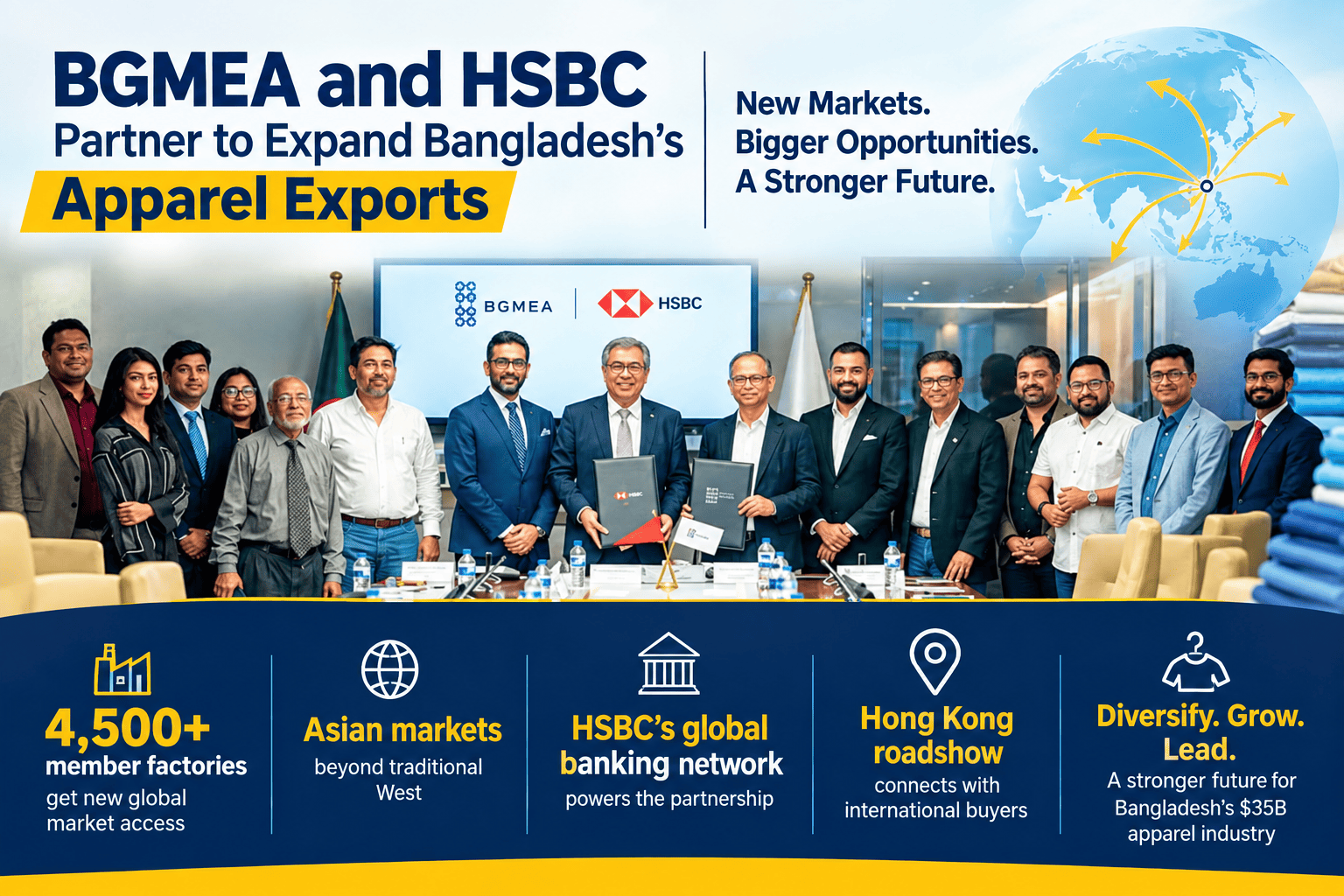
BGMEA × HSBC: How Bangladesh Apparel Manufacturers Are Using Global Banking to Power New Market Expansion
🔴 BREAKINGBGMEA × HSBC: Bangladesh garment manufacturers gain new market access through global banking network and Hong Kong roadshow◆BGMEA partners with HSBC to help 4,500+ member factories diversify exports beyond traditional markets◆Hong Kong roadshow connects Bangladesh apparel manufacturers with new international buyers◆Find verified apparel manufacturing partners on GTsetu, 100+ countries, zero commission◆🔴 BREAKINGBGMEA × HSBC: Bangladesh garment manufacturers gain new market access through global banking network and Hong Kong roadshow◆BGMEA partners with HSBC to help 4,500+ member factories diversify exports beyond traditional markets◆Hong Kong roadshow connects Bangladesh apparel manufacturers with new international buyers◆Find verified apparel manufacturing partners on GTsetu, 100+ countries, zero commission◆
BGMEA × HSBC: How a Global Banking Partnership Is Opening New Markets for Bangladesh’s Apparel Industry
Bangladesh’s apparel industry, the world’s second-largest garment exporter, has partnered with global banking giant HSBC to drive new market expansion. Through HSBC’s global network and a targeted Hong Kong roadshow, BGMEA members are gaining access to new international buyers and diversifying export markets beyond traditional destinations.
🎯 Direct Answer
The Bangladesh Garment Manufacturers and Exporters Association (BGMEA) has partnered with HSBC in a strategic trade deal to drive new market expansion for the country’s apparel industry. Announced in July 2026, the partnership leverages HSBC’s extensive global banking network and a dedicated Hong Kong roadshow to connect BGMEA’s 4,500+ member factories with new international buyers, particularly in Asian markets beyond traditional Western destinations. This distribution and channel partnership is designed to help Bangladesh’s $35 billion apparel industry diversify its export portfolio, reduce dependence on traditional markets, and capture emerging opportunities in Asia, the Middle East, and other high-growth regions. The Hong Kong roadshow serves as the initial execution vehicle, providing a direct platform for BGMEA manufacturers to showcase their capabilities to international buyers and retailers. Industry leaders describe this as a strategic pivot that could reshape the global apparel sourcing landscape by giving international buyers more direct access to one of the world’s most competitive manufacturing bases.
📅 July 12, 2026⏱ 16 min read✍️ GTsetu Editorial Team📰 News + Analysis
Deal Type
Trade & Distribution
BGMEA + HSBC partnership for market expansion and channel access
Member Reach
4,500+
BGMEA member factories gaining access to new international buyers
Direct platform connecting BGMEA manufacturers with international buyers
Section 1, The News
1
The Full Story: BGMEA × HSBC Partnership
👕
Deal Announced, July 12, 2026
BGMEA Partners with HSBC to Drive New Market Expansion for Bangladesh’s $35 Billion Apparel Industry
In July 2026, the Bangladesh Garment Manufacturers and Exporters Association (BGMEA), representing over 4,500 garment factories that form the backbone of the world’s second-largest apparel exporting nation, announced a strategic partnership with HSBC, one of the world’s largest banking and financial services organisations.
The partnership is structured as a trade and distribution collaboration designed to leverage HSBC’s extensive global network to help Bangladeshi garment manufacturers reach new international buyers and diversify their export markets. The initial execution vehicle is a Hong Kong roadshow that provides BGMEA manufacturers with a direct platform to showcase their capabilities to international buyers, retailers, and brands operating in Asian markets.
This partnership addresses a critical strategic challenge for Bangladesh’s apparel industry: over-reliance on traditional Western markets (Europe and the United States account for the majority of exports). By opening new channels in Asia, the Middle East, and other high-growth regions, BGMEA aims to build a more resilient and diversified export portfolio. Industry analysts describe this as a structural shift that could reshape global apparel sourcing by giving international buyers more direct, efficient access to one of the world’s most competitive manufacturing bases.
“This partnership marks a new chapter for Bangladesh’s apparel industry. By leveraging HSBC’s global network, we are creating unprecedented opportunities for our manufacturers to access new markets and build a more resilient, diversified export base.”
— BGMEA Spokesperson, July 2026
“The Hong Kong roadshow is just the beginning. This partnership will help Bangladesh’s apparel industry tap into new markets across Asia, the Middle East, and beyond. We are proud to support BGMEA in this strategic diversification initiative.”
— HSBC Spokesperson, July 2026
💡 GTsetu Perspective
The BGMEA-HSBC partnership represents a new model for apparel industry market expansion: trade associations leveraging global banking networks to open new distribution channels for their members. This is not about a single factory finding a single buyer, it’s about creating a systematic, scalable pathway for an entire manufacturing ecosystem to access new international markets. For garment manufacturers outside Bangladesh, similar collaboration models are emerging across Asia, Africa, and Latin America. The key question is: who will you partner with to access your next export market? GTsetu helps you find verified trade partners, distributors, and manufacturing collaborators across 100+ countries, so your market expansion is systematic, not opportunistic.
Section 2, The Anatomy
2
What Each Partner Brings to the Table
Like every successful trade and distribution partnership, the BGMEA × HSBC deal works because each party contributes capabilities that complement the other’s needs. This complementarity principle, where one party provides manufacturing scale and the other provides market access, is the foundation of any effective export collaboration.
Collaboration Anatomy, Trade & Distribution Partnership Structure
BGMEA
🇧🇩 Dhaka, Bangladesh, 4,500+ member factories
What they bring
Manufacturing Scale & Export Capacity
Member Network
4,500+ garment factories
Industry Value
$35B+ annual exports
Specialty
World-class garment manufacturing
What they lack
Diversified international buyer access
Partnership role
Manufacturing & Export Partner
+
Trade Deal
HSBC
🇬🇧 London, Global Banking, 60+ Countries
What they bring
Global Banking Network + Buyer Access
Network
60+ countries, global banking relationships
Execution Vehicle
Hong Kong roadshow & buyer platform
Specialty
International trade finance & market access
What they lack
Manufacturing capability in Bangladesh
Partnership role
Market Access & Buyer Network
🎯 Target: New export markets beyond traditional Western buyers
🌏 Asia, Middle East, high-growth regions
📈 Diversified export portfolio for 4,500+ member factories
Collaboration Dimension
What BGMEA Provides
What HSBC Provides
Why This Balance Works
Manufacturing Capacity
4,500+ factories, world-class garment production scale
Global banking network & trade finance infrastructure
HSBC’s financial infrastructure enables BGMEA’s manufacturing scale to reach new markets
Market Access
Established export relationships, primarily Western markets
Access to international buyers, particularly in Asia and emerging markets
The roadshow provides a structured, high-impact buyer engagement platform
Strategic Objective
Diversify export markets, reduce Western market dependency
Expand trade finance relationships, support client growth
Both parties benefit from BGMEA’s market diversification success
Risk
Brand reputation, member quality standards
Credit risk, reputational risk
Both sides have skin in the game, BGMEA’s members and HSBC’s brand
Section 3, The Relationship
3
The Road to Partnership: BGMEA · HSBC Relationship Evolution
The BGMEA × HSBC partnership emerged from a clear strategic need: Bangladesh’s apparel industry, while globally dominant in manufacturing, faced increasing pressure to diversify its export markets. The partnership represents a strategic response to this challenge, leveraging HSBC’s global infrastructure to create systematic market access for thousands of manufacturers.
🤝 BGMEA × HSBC, Partnership History
Phase 1
Bangladesh Apparel Industry Matures
Bangladesh establishes itself as the world’s second-largest garment exporter, with exports reaching $35B+ annually. The industry’s manufacturing capabilities are world-class, but export markets remain concentrated in Europe and the United States.
Phase 2
Diversification Imperative Emerges
BGMEA identifies market diversification as a strategic priority. Traditional Western markets are facing economic headwinds, and emerging markets in Asia and the Middle East offer significant growth potential. However, BGMEA members lack direct access to these new buyer networks.
Phase 3
HSBC Engagement Begins
BGMEA begins discussions with HSBC, one of the world’s largest banking networks with presence in 60+ countries. HSBC’s global trade finance infrastructure and extensive buyer relationships in Asian markets are identified as a potential solution to BGMEA’s diversification challenge.
Jul 2026
Trade & Distribution Partnership Announced
BGMEA and HSBC announce a strategic trade and distribution partnership in July 2026. The partnership leverages HSBC’s global network and a Hong Kong roadshow to connect BGMEA members with new international buyers. The initial focus is on Asian markets, with a longer-term objective of building a diversified export portfolio that reduces dependency on traditional Western markets.
🔑 Key Lesson: Strategic Partnerships for Market Access
The BGMEA × HSBC partnership illustrates a critical principle for manufacturers seeking to expand into new markets: the most efficient path to new buyers is often through a partner who already has the relationships you need. BGMEA could have attempted to build buyer relationships in Asia organically, but that would have taken years of trade shows, introductions, and relationship building. By partnering with HSBC, BGMEA gains immediate access to established buyer networks. The lesson for apparel manufacturers and exporters in any country: identify partners with complementary market access, and collaborate rather than build from zero. GTsetu’s platform helps you find verified trade partners, distributors, and manufacturing collaborators across 100+ countries, so your market expansion is systematic, not opportunistic.
Section 4, Why This Works
4
Why This Trade & Distribution Model Works for Apparel Manufacturing
🎯 The Core Logic
The BGMEA × HSBC partnership succeeds because it is built on three interlocking strategic advantages: (1) Bangladesh’s world-class manufacturing capacity needs market diversification, (2) HSBC’s global banking network provides immediate access to international buyers across 60+ countries, and (3) the Hong Kong roadshow provides a concrete, high-impact execution vehicle that translates the partnership from concept to commercial relationships. Neither party could have achieved the same result through any other mechanism, BGMEA cannot replicate HSBC’s global banking infrastructure, and HSBC cannot replicate BGMEA’s manufacturing network.
Why Trade & Distribution Partnerships Are Accelerating in 2026
2nd
Largest garment exporter globally, manufacturing scale ready for market diversification
60+
Countries in HSBC’s network, the buyer access platform BGMEA needs
Hong Kong
Strategic hub for Asian buyer engagement, the partnership’s execution vehicle
4,500+
BGMEA member factories, the manufacturing ecosystem ready to supply new markets
$35B
Bangladesh apparel export value, the scale of the opportunity for new market partners
Global
Apparel sourcing diversification, international buyers seeking new manufacturing partners
Section 5, Bangladesh Apparel Opportunity
5
Bangladesh’s Apparel Opportunity, Why Now Is the Time to Diversify Export Markets
🇧🇩 Bangladesh Apparel Manufacturing 2026–2030
Why Every Apparel Manufacturer and Buyer Should Be Engaging with Bangladesh’s Market Expansion Initiative
Bangladesh’s apparel industry has reached a turning point. With exports exceeding $35 billion annually and over 4,500 factories operating at world-class quality standards, the industry has the manufacturing capacity to serve any global market. However, export markets remain concentrated in Europe and the United States. The BGMEA-HSBC partnership represents the first systematic effort to diversify into Asian, Middle Eastern, and other emerging markets. For international buyers, this creates unprecedented access to one of the world’s most competitive manufacturing bases. For apparel manufacturers in other countries, it signals that trade and distribution partnerships are becoming the new standard for market expansion.
2nd
Largest garment exporter globally, behind only China
4,500+
BGMEA member factories ready to supply new international buyers
$35B+
Annual apparel export value, target for market diversification
Hong Kong
Strategic hub for connecting with Asian buyers and retailers
60+
Countries in HSBC’s network, enabling global buyer access
Asia
Primary target market for diversification, high-growth apparel demand
🌐 GTsetu for Apparel Manufacturing & Trade Partners
GTsetu’s verified partner network includes apparel manufacturers, garment factories, textile suppliers, and trade partners across Bangladesh, India, China, Vietnam, and 100+ other countries. Every company on GTsetu is verified on 6 government-sourced points: Name, Address, Registration Number, Company Status, Company Type, and Date of Certificate of Incorporation. Additional capabilities like certifications, production capacity, and export experience are self-reported. If you’re an international buyer looking for verified apparel manufacturing partners in Bangladesh, or a Bangladesh manufacturer seeking trade partners in new markets, GTsetu is where your partner search begins with verified profiles, not cold calls. Find apparel manufacturing partners →
Section 6, Types of Collaboration
6
4 Types of Trade & Distribution Collaboration, Which Fits Your Export Strategy?
The BGMEA × HSBC partnership is a trade and distribution collaboration, but there are multiple ways to structure market access relationships. The right collaboration type depends on your manufacturing capabilities, target markets, and growth objectives.
01
Trade & Distribution Partnership
One party provides manufacturing capacity; the other provides market access, buyer networks, and distribution channels. No joint entity, no equity exchange. The BGMEA × HSBC model. Fast to execute, ideal when market access is the specific need.
🌍 BGMEA × HSBC
02
Joint Venture (JV)
A new shared entity co-owned by both parties. Deepest integration, full profit and risk sharing. Best for permanent market anchor in a target region when both parties have substantial complementary assets.
⚖️ Long-term market anchor
03
Contract Manufacturing
You own the design and brand; a partner manufactures to your specification for a per-unit fee. No equity sharing. Ideal when you need production capacity in a new geography without permanent commitment. Scalable and fully reversible.
🏭 Capacity without commitment
04
Export Agency Agreement
You manufacture; an export agency represents your products in target markets, handling sales, distribution, and buyer relationships. Light form of collaboration. Often the first step before a deeper partnership in a new geography.
🌍 Market entry, step 1
📊 Collaboration Model Comparison, Trade & Distribution
Model
Capital Required
Market Access Speed
Control Over Brand & Quality
Reversibility
Trade & Distribution
Low (fees/commissions)
✓ Fast
~ Moderate
High
Joint Venture
High, shared capex
Slow (12–24 months)
✓ High
Low
Contract Mfg
Minimal
~ Moderate
✓ High
High
Export Agency
Minimal
✓ Fastest
~ Low
High
Section 7, How to Collaborate
7
How to Collaborate: A 5-Step Playbook for Apparel Exporters
The BGMEA × HSBC partnership demonstrates a systematic approach to market expansion that any apparel manufacturer or trade association can adapt. Here is the distilled playbook.
1
Define Your Market Access Gap with Precision
BGMEA knew exactly what they needed: access to new international buyers in Asian markets. They didn’t need manufacturing capability (they already had that), they needed a buyer network and a platform to connect with new customers. Define your gap that precisely. Vague needs produce vague partner searches and failed negotiations.
2
Find Verified Trade Partners, Not Just Any Buyer Network
The crucial word is “verified.” BGMEA chose HSBC because HSBC’s global network and buyer relationships are documented and proven. For exporters who don’t have a global banking partner, GTsetu provides verified profiles of trade partners, distributors, and manufacturing collaborators across 100+ countries. GTsetu verifies companies using government tie-ups on 6 key points: Name, Address, Registration Number, Company Status, Company Type, and Date of Certificate of Incorporation. Additional information like certifications, product categories, and export experience is self-reported and should be validated independently through your own due diligence.
3
Protect Your Commercial Information Before Any Disclosure
In apparel manufacturing, your product designs, customer relationships, and pricing structures are valuable commercial information. Before sharing anything sensitive, even a capabilities presentation, execute a mutual NDA. This is non-negotiable regardless of how well you think you know the prospective trade partner. GTsetu’s built-in NDA workflow handles this automatically: mutual NDA executed and countersigned before any sensitive information is shared, with a full digital audit trail.
4
Choose the Right Collaboration Structure for Your Export Objectives
BGMEA chose a trade and distribution partnership because the objective was market access, not operational integration. An export agency agreement might be right when you’re testing a new market. A joint venture might be right when you want permanent presence in a strategic region. Match the structure to the objective, not to what’s easiest to negotiate.
5
Formalise and Execute, Trade Partnership First, Capacity Expansion Second
BGMEA secured the HSBC partnership first, then will execute through the Hong Kong roadshow. The partnership opens the market access; the execution vehicle delivers the actual buyer relationships. Never commit to expanding manufacturing capacity for new markets before you have secured the trade partnership that will access those markets.
Section 8, Dos and Don’ts
8
Dos and Don’ts of Trade & Distribution Partnerships
✅ Do These
✅ Leverage existing relationships and networks for market access, BGMEA used HSBC’s global presence
✅ Verify your trade partner’s buyer network and market presence, the right partner provides documented buyer access
✅ Structure trade partnerships before committing to capacity expansion, win the access, then build for it
✅ Sign NDA before sharing product designs, pricing, or customer information
✅ Choose a trade partner whose market access is complementary to your existing customer base
✅ Define the partnership scope clearly, which markets, which buyer segments, with what exclusivity
✅ Run a pilot engagement (first roadshow, initial buyer meetings) before committing to full-scale partnership
✅ Use verified platforms like GTsetu rather than trade fair introductions for strategic trade partners
✅ Document the collaboration formally, trade partnership agreement, distribution terms, or export agency contract
❌ Avoid These
❌ Commit to manufacturing capacity expansion before securing market access partnerships
❌ Share commercial information, product designs, or customer lists before NDA is countersigned
❌ Accept self-reported buyer network claims without reference verification
❌ Assume that a trade partner’s buyer network is transferable without active relationship management
❌ Partner with a trade agent who also represents direct competitors in the same target market, conflict of interest
❌ Neglect exclusivity terms, know whether your trade partner can take competing products to the same buyers
❌ Choose a trade partner whose strengths duplicate yours, complementary market access is where value is created
❌ Start buyer engagement on informal terms, partnership scope, commission/fee structure, and territory terms must be documented
❌ Underestimate the relationship management required, trade partnerships require active engagement, not just a signed agreement
❌ Build a JV when a trade partnership would achieve the same market access objective at lower commitment and risk
Section 9, Misconceptions
9
Common Misconceptions About Export Market Expansion
❌ Myth
“A trade partnership is inferior to building our own distribution channels, we should always go direct.”
✅ Reality
BGMEA’s partnership with HSBC gives 4,500+ manufacturers immediate access to international buyers that would take years to build organically. Trade partnerships are not inferior, they are strategic accelerators. The right partner provides documented market access, buyer relationships, and trade finance infrastructure that no individual manufacturer can replicate.
❌ Myth
“We can figure out the commercial terms after the partnership starts, the relationship will guide us.”
✅ Reality
Commercial disputes are the most common reason trade partnerships collapse, and they are almost always caused by vague or absent upfront agreements. Once market access has begun on undefined commercial terms, both parties’ leverage is gone. Define territory, exclusivity, commission structure, and performance metrics before the first buyer introduction.
❌ Myth
“A trade partnership gives us automatic sales in new markets, the partner will bring all the customers.”
✅ Reality
HSBC’s network provides introductions and a platform, not guaranteed contracts. BGMEA members still need to showcase their products, meet quality standards, and close deals. The trade partnership is a door-opener, not a sales guarantee. Plan the commercial follow-up and relationship management separately from the partnership structure.
❌ Myth
“We should build our export capacity first to show international buyers we’re serious, then find trade partners.”
✅ Reality
BGMEA did the opposite, secured the HSBC trade partnership first, then will execute through the Hong Kong roadshow. Building export capacity without the market access to fill it is capital destruction. The correct sequence is always: market access partnership → buyer introductions → capacity commitment. Never invest in scale before you have the commercial pipeline to justify it.
❌ Myth
“A trade partnership with a global bank requires a large commitment, it’s only for the biggest manufacturers.”
✅ Reality
BGMEA’s partnership is structured for 4,500+ member factories of all sizes. Large manufacturers benefit from direct access; smaller manufacturers benefit from the collective platform. The partnership model scales to any manufacturer with quality products and export capacity. GTsetu’s verified trade partner network is similarly accessible to manufacturers of all sizes, you find partners that match your scale and objectives.
Section 10, GTsetu
10
How GTsetu Helps You Find the Right Trade & Manufacturing Partner
BGMEA had HSBC through a trade association-level relationship. Most apparel manufacturers and exporters are not that fortunate, and even when an existing relationship exists, identifying whether it can be extended into new markets requires systematic evaluation. GTsetu is the verified B2B manufacturing discovery platform that enables this evaluation at scale, across 100+ countries, before you reveal a single confidential detail.
🌐 Platform Spotlight, GTsetu
Find Verified Apparel Manufacturers, Trade Partners, and Distributors Across 100+ Countries, Anonymously, Securely, With Zero Broker Fees
Every company on GTsetu is verified using government tie-ups on 6 key points: Name, Address, Registration Number, Company Status, Company Type, and Date of Certificate of Incorporation. This is the foundation of trust. Additional information such as quality certifications (ISO 9001, ISO 14001), production capacity, product categories, and export experience is self-reported by companies. You evaluate who is real before you engage. You share nothing sensitive until an NDA is countersigned. And you pay no broker commission on any collaboration formed, the deal is entirely between you and your partner.
✅
6-Point Government-Sourced VerificationName, Address, Registration Number, Company Status, Company Type, Date of Incorporation confirmed using government tie-ups.
🕵️
Anonymous DiscoveryEvaluate verified partner profiles without revealing your identity until mutual interest is confirmed.
📄
Built-In NDA WorkflowShare product designs, pricing, or commercial information only after NDA is executed, full audit trail, no external legal required.
🚫
Zero CommissionNo broker fees, your trade partnership, distribution agreement, or supply contract is entirely between you and your partner.
🌍
100+ CountriesApparel manufacturers, trade partners, distributors, and buyers across Bangladesh, India, China, Vietnam, and every major apparel market.
🔐
Encrypted CollaborationShare product specifications, pricing, and commercial documents securely between verified partners.
Leveraged HSBC’s global banking network to access international buyers
✓ Browse verified trade partner profiles with government-sourced verification before engaging
You evaluate the partner’s verified legal identity and market presence, not marketing claims
Chose HSBC for their buyer network in Asian markets
✓ Filter by self-reported buyer networks, geographic market coverage, and trade experience (validate independently)
Find potential trade partners with the specific market access and buyer relationships your export strategy requires
Secured formal trade partnership before executing through Hong Kong roadshow
✓ Built-in NDA and document workflow protects commercial information from the first conversation
Your product designs, pricing, and customer relationships are protected at every stage
Targeted a trade partner whose market access was complementary (Asia vs traditional Western markets)
✓ Self-reported partner profiles show geographic market coverage, buyer segments, and industry specialisation
Identify potential complementarity, the gap between your current buyer reach and your partner’s network
Zero intermediary in the HSBC partnership, direct commercial terms
✓ Zero commission on any partnership, all terms are direct between the two parties
No broker splits your margin or misaligns your commercial terms
FAQ
?
Frequently Asked Questions
Q
What exactly did BGMEA and HSBC agree to?
BGMEA (Bangladesh Garment Manufacturers and Exporters Association) and HSBC announced a strategic trade and distribution partnership in July 2026 to drive new market expansion for Bangladesh’s apparel industry. The partnership leverages HSBC’s global banking network and a dedicated Hong Kong roadshow to connect BGMEA’s 4,500+ member factories with new international buyers, particularly in Asian markets beyond traditional Western destinations. This is a commercial collaboration focused on market access and distribution channels, not a joint venture or equity partnership.
Q
Why is this partnership significant for Bangladesh’s apparel industry?
Bangladesh is the world’s second-largest garment exporter, with over $35 billion in annual exports. However, the industry is heavily concentrated in European and US markets, creating vulnerability to economic cycles and trade policy changes. This partnership provides a systematic pathway to diversify into Asian, Middle Eastern, and other emerging markets. For 4,500+ BGMEA member factories, HSBC’s network provides immediate access to international buyers that would otherwise take years of independent relationship building.
Q
What is the difference between a trade partnership and a distribution agreement, and when should I use each?
A trade partnership is a broad collaboration where one party provides market access, buyer networks, or distribution channels to help another party reach new customers or geographic markets. It may include multiple elements: buyer introductions, trade finance, logistics support, and market intelligence. A distribution agreement is a more specific contract where one party agrees to distribute another party’s products in a defined territory, typically with exclusivity terms, commission structures, and performance metrics. BGMEA’s partnership with HSBC is a trade partnership at the association level that enables individual member factories to pursue distribution agreements with specific buyers they meet through the partnership. Use a trade partnership when you need comprehensive market access support; use a distribution agreement when you have a specific product and territory you want to assign to a defined partner.
Q
How can I find verified trade partners or distributors for my manufacturing business?
The systematic approach involves four steps: (1) Define your target markets and buyer segments precisely, which geographic markets and buyer types are you trying to reach? (2) Search verified platforms, GTsetu lists verified manufacturers, trade partners, and distributors across 100+ countries. GTsetu verifies companies using government tie-ups on 6 points: Name, Address, Registration Number, Company Status, Company Type, and Date of Certificate of Incorporation. Additional information like market coverage, buyer networks, and trade experience is self-reported and should be validated independently. (3) Evaluate anonymously first, review verified profiles and self-reported capability data before revealing your identity or product requirements. (4) Execute NDA before any commercial disclosure, GTsetu’s built-in NDA workflow handles this automatically before any sensitive document exchange. Cold approaches through trade shows or LinkedIn rarely surface the right trade partner; a structured, verified search on GTsetu does.
Q
What happens if my trade partner also represents my competitors in the same market?
This is a critical question that is often overlooked in trade partnerships. If your trade partner brings competing products to the same buyers, your competitive advantage is compromised. Before signing any trade partnership agreement, explicitly negotiate: (1) Exclusivity scope, are you the exclusive manufacturer in your product category for the target market? (2) Territory terms, which specific countries or regions are exclusive to you? (3) Conflict of interest provisions, can the trade partner represent competing manufacturers in the same product category? These terms must be in the agreement before signing. In the BGMEA case, the partnership is at the association level, so individual member factories need to negotiate exclusivity terms with the specific buyers they meet through the partnership.
Q
Does GTsetu charge commission on trade partnerships or manufacturing collaborations formed through the platform?
No. GTsetu charges zero commission on any collaboration, whether a trade partnership, distribution agreement, joint venture, or contract manufacturing arrangement, formed through the platform. The commercial terms of your agreement are entirely between you and your partner. This is a foundational design principle: broker intermediation in trade partnerships typically costs 5–15% of deal value and creates incentive misalignment between the broker and both parties. GTsetu removes the broker entirely. Learn more about GTsetu →
Ready to Find Your Trade & Manufacturing Partner? Start on GTsetu.
500+ verified apparel manufacturers, trade partners, distributors, and manufacturing collaborators across Bangladesh, India, China, Vietnam, and 100+ countries. Zero broker fees. Anonymous discovery. Built-in NDA workflows. Your next trade partnership starts with a verified profile, not a trade fair handshake.
Business Development Expert | International Trade & Strategic Partnerships
Daniel Carter is a Business Development Expert at GTsetu, specializing in global trade, international business expansion, and strategic partnership development. With extensive experience working across multiple industries and markets, Daniel helps organizations identify growth opportunities, build commercial relationships, and expand their international footprint.
His expertise includes cross-border collaborations, market entry strategies, supply chain partnerships, manufacturing ecosystems, and business matchmaking. Through his work at GTsetu, Daniel supports companies seeking to establish meaningful connections with partners, distributors, investors, and industry stakeholders across global markets.
Daniel is committed to helping businesses unlock new opportunities through collaboration-driven growth and practical international trade strategies.