UAE’s Emirates Growth Fund × ADNOC: Building Industrial Supply-Chain Opportunities for SMEs – GTsetu
🔴 BREAKINGUAE’s Emirates Growth Fund × ADNOC: New strategic alliance localises critical industrial capabilities and integrates UAE SMEs into energy supply chains◆Target: 1,000+ UAE industrial SMEs to be integrated into ADNOC’s domestic supply chain by 2028◆Focus sectors: manufacturing, engineering services, maintenance, and advanced materials◆Find verified industrial manufacturing partners on GTsetu, 100+ countries, zero commission◆🔴 BREAKINGUAE’s Emirates Growth Fund × ADNOC: New strategic alliance localises critical industrial capabilities and integrates UAE SMEs into energy supply chains◆Target: 1,000+ UAE industrial SMEs to be integrated into ADNOC’s domestic supply chain by 2028◆Focus sectors: manufacturing, engineering services, maintenance, and advanced materials◆Find verified industrial manufacturing partners on GTsetu, 100+ countries, zero commission◆
Home › Blog › EGF × ADNOC Industrial Supply-Chain
🔴 Breaking News⚡ Energy & Resources🇦🇪 UAE🏭 Supply Chain Localisation
UAE’s Emirates Growth Fund × ADNOC: How a Strategic Industrial Alliance Is Localising Supply Chains for UAE SMEs
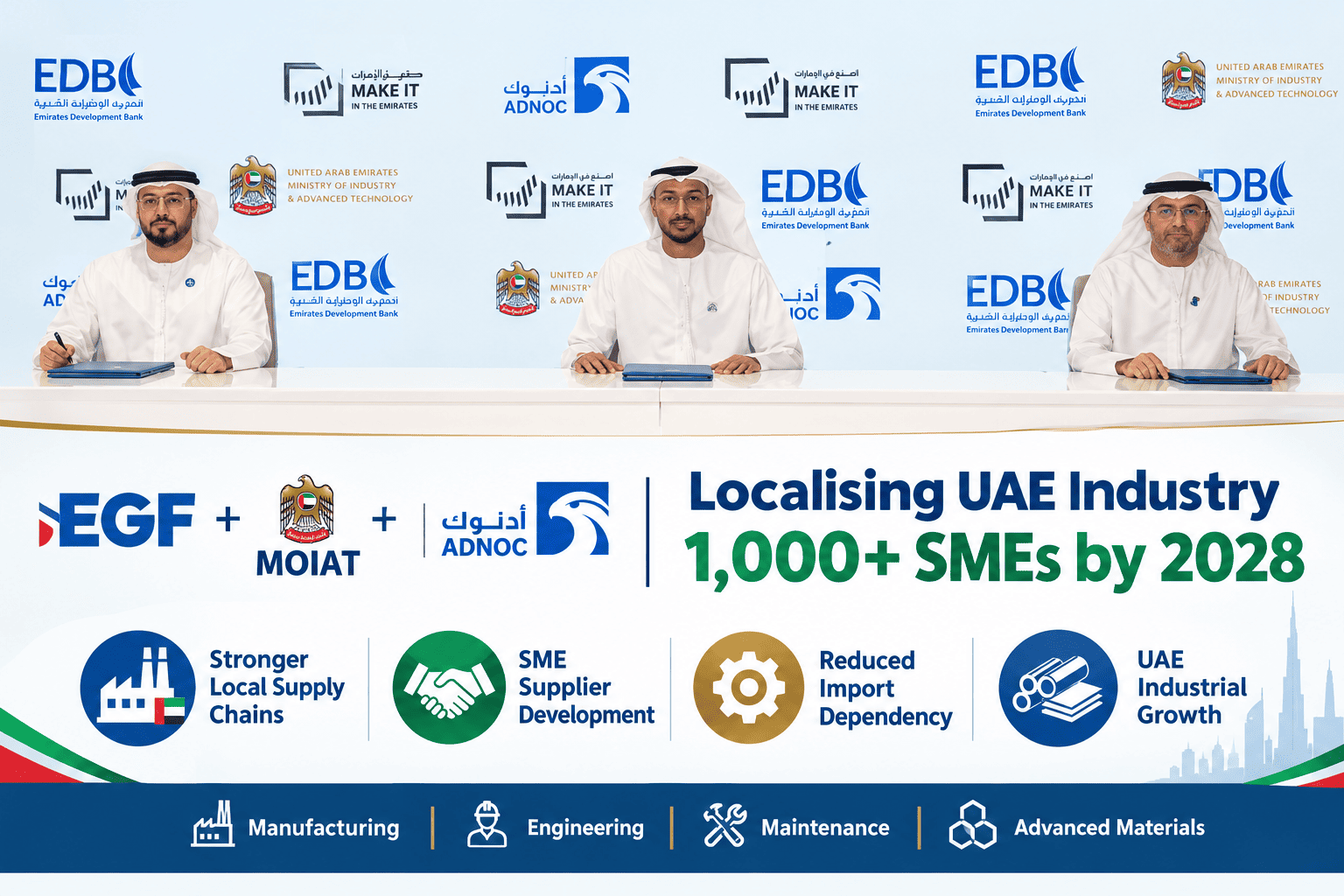
The Emirates Growth Fund (EGF), in collaboration with the Ministry of Industry and Advanced Technology (MOIAT) and ADNOC, is working to localise critical industrial capabilities and integrate UAE industrial SMEs into domestic supply chains. The initiative targets 1,000+ SMEs by 2028, focusing on manufacturing, engineering services, maintenance, and advanced materials.
🎯 Direct Answer
The Emirates Growth Fund (EGF), in partnership with the Ministry of Industry and Advanced Technology (MOIAT) and ADNOC, is leading a strategic initiative to localise critical industrial capabilities and integrate UAE industrial SMEs into domestic supply chains. This strategic alliance focuses on creating manufacturing partnerships, supplier development programs, and industrial localisation opportunities in the energy sector. The initiative targets 1,000+ UAE industrial SMEs to be integrated into ADNOC’s domestic supply chain by 2028, with a focus on manufacturing, engineering services, maintenance, and advanced materials. EGF, MOIAT, and ADNOC are working together to identify capability gaps, develop SME suppliers, and create a sustainable industrial ecosystem that reduces import dependency and strengthens the UAE’s industrial base.
📅 May 5, 2026⏱ 16 min read✍️ GTsetu Editorial Team📰 News + Analysis
Gulf Cooperation Council · UAE industrial ecosystem anchor
Section 1, The News
1
The Full Story: Emirates Growth Fund × ADNOC Strategic Alliance
🏭
Strategic Alliance Announced, May 2026
Emirates Growth Fund, MOIAT, and ADNOC Partner to Localise Industrial Supply Chains for 1,000+ UAE SMEs
In May 2026, the Emirates Growth Fund (EGF), in collaboration with the Ministry of Industry and Advanced Technology (MOIAT) and ADNOC, announced a strategic initiative to localise critical industrial capabilities and integrate UAE industrial SMEs into domestic supply chains. The alliance is specifically designed to create manufacturing partnerships, supplier development programs, and industrial localisation opportunities in the energy sector.
The initiative targets 1,000+ UAE industrial SMEs to be integrated into ADNOC’s domestic supply chain by 2028, focusing on manufacturing, engineering services, maintenance, and advanced materials. The partnership leverages ADNOC’s extensive procurement needs, MOIAT’s industrial policy framework, and EGF’s financing and capability-building support to create a sustainable industrial ecosystem.
This strategic alliance is a key component of the UAE’s Operation 300bn industrial strategy, which aims to increase the industrial sector’s contribution to GDP and reduce import dependency. By localising critical industrial capabilities, the initiative aims to strengthen the UAE’s industrial base, create high-value jobs, and position the country as a regional manufacturing hub.
1,000+
UAE industrial SMEs targeted for supply-chain integration by 2028
GCC focus: UAE industrial ecosystem anchor for the region
“EGF, MOIAT, and ADNOC are working to localise critical industrial capabilities and integrate UAE industrial SMEs into domestic supply chains. This strategic alliance is a catalyst for the UAE’s industrial transformation, creating a sustainable ecosystem where local SMEs are the backbone of the energy sector’s supply chain.”
— Joint Statement by EGF, MOIAT, and ADNOC, May 2026
💡 GTsetu Perspective
The EGF × ADNOC strategic alliance represents a structural shift in UAE industrial policy. For industrial SMEs, this is a government-backed pathway to become strategic suppliers to the energy sector. For international manufacturers, this is access to the UAE’s growing industrial ecosystem. The question is no longer whether to engage with UAE industrial localisation, but with whom and how fast. GTsetu connects you to verified industrial partners across the UAE, GCC, and 100+ countries, so you can access these opportunities before your competitors do.
Section 2, SME Target
2
1,000+ SMEs: The Localisation Target and Execution Plan
The EGF × ADNOC initiative is built on a clear, measurable target: integrate 1,000+ UAE industrial SMEs into ADNOC’s domestic supply chain by 2028. The execution plan is structured across three phases.
🇦🇪 Industrial SME Localisation Pipeline, 1,000+ UAE SMEs
Phase 1
Capability Mapping
2026 Identification
Phase 2
Supplier Development
2026-2027 ● Live
Phase 3
1,000+ SMEs Integrated
2028 Target
⚙️ Why Localisation Is the Critical First Step
The EGF × ADNOC initiative correctly identifies localisation as the foundational requirement for supply-chain resilience. UAE industrial SMEs need capability mapping, supplier development, and quality certification to access ADNOC’s procurement. The initiative provides these through a structured program, creating a sustainable pipeline of local suppliers. The sequence, capability first, integration second, is the right order for any industrial localisation initiative.
Section 3, The Anatomy
3
What Each Partner Brings to the Table
Like every successful industrial collaboration, the EGF × ADNOC strategic alliance works because each party contributes assets that the others cannot efficiently replicate. This complementarity principle is the foundation of any industrial partnership worth entering.
EGF builds the pipeline, ADNOC provides the demand
Financing
SME financing, capability-building grants
Procurement contracts, payment terms
EGF enables SME readiness, ADNOC provides revenue
Quality Standards
Capability development, certification support
ADNOC’s supplier quality requirements
EGF helps SMEs meet ADNOC’s standards
Localisation
Industrial capability mapping, gap analysis
Critical industrial capability requirements
Systematic localisation of critical capabilities
Risk
Investment risk, SME development risk
Supply chain risk, quality risk
EGF manages SME development, ADNOC manages supply chain
Section 4, Why This Works
4
Why This Collaboration Model Works for Industrial Localisation
🎯 The Core Logic
The EGF × ADNOC strategic alliance succeeds because it addresses a structural market failure: UAE industrial SMEs have capabilities but lack the financing, supplier development, and quality certification to access major energy sector procurement. ADNOC has procurement demand but lacks the capacity to develop SME suppliers at scale. By combining EGF’s financing and capability-building with ADNOC’s procurement and supply chain infrastructure, the alliance creates a structured, scalable pathway for industrial localisation that neither party could have built alone.
Why UAE Industrial Localisation Is Accelerating in 2026
300bn
AED 300bn Operation 300bn, UAE’s industrial strategy target by 2031
Local
Localisation is the critical priority, reducing import dependency in the energy sector
SME
SMEs are the backbone of UAE industry, 95%+ of businesses, 60%+ of employment
GCC
GCC industrial integration creates a regional market for UAE manufacturers
Energy
Energy sector is the anchor, ADNOC’s procurement creates the demand pull
EGF
Emirates Growth Fund provides the financing and capability-building engine
Section 5, UAE Opportunity
5
UAE’s Industrial Localisation Opportunity, Why Now Is the Time to Partner
🇦🇪 UAE Industrial Localisation 2026–2030
Why Every Industrial Company Should Be Looking at UAE Supply-Chain Localisation
The UAE’s Operation 300bn industrial strategy aims to increase the industrial sector’s contribution to GDP from AED 133bn to AED 300bn by 2031. Localisation is a critical priority, with the energy sector as the anchor. ADNOC’s procurement creates the demand pull, EGF provides the financing and capability building, and MOIAT provides the policy framework. The EGF × ADNOC strategic alliance is the mechanism that connects all three.
300bn
AED 300bn industrial GDP target, the scale of the opportunity
1,000+
SMEs targeted by EGF × ADNOC, a scalable localisation model
6
4 Types of Industrial & Manufacturing Partnerships, Which Fits Your Situation?
The EGF × ADNOC strategic alliance is a manufacturer and services partnership model. But industrial collaborations come in many forms. The right structure depends on your role in the ecosystem, your capabilities, and your objectives.
01
Manufacturer & Services Partnership
One party provides manufacturing capabilities, industrial capacity, or specialised services to another party’s supply chain or operations. The EGF × ADNOC model. Best when one party has procurement demand and the other has manufacturing capability. Fast to execute, scalable.
🏭 EGF × ADNOC
02
Supply Chain Integration
Cross-border or cross-industry supply chain coordination where manufacturers integrate their operations with suppliers or customers. Deep integration, shared forecasting, and joint planning. Best for building resilient, localised supply chains.
🔗 Supply chain
03
Co-Development & Technology Transfer
Joint development of new products, processes, or technologies. Includes technology transfer agreements where advanced manufacturing capabilities are shared. Best when localisation requires new capabilities.
⚙️ Tech transfer
04
Joint Venture & Co-Manufacturing
Co-owned manufacturing operations where partners share equity, governance, and risk. Deepest integration, highest commitment. Best when long-term strategic alignment and permanent local presence are required.
⚖️ Joint venture
Section 7, How to Build
7
How to Build an Industrial Supply-Chain Partnership: A 5-Step Playbook
The EGF × ADNOC strategic alliance demonstrates how industrial companies and government entities can collaborate to build local supply chains. Here is the distilled playbook for building your own industrial partnership.
1
Define the Capability Gap and Target Industrial Sector
EGF, MOIAT, and ADNOC identified the specific gap: UAE industrial SMEs need capability development, financing, and quality certification to access ADNOC’s procurement. Define your industrial gap with precision: Which capabilities are missing? What are the procurement requirements? What is the target sector? Vague gaps produce vague partnerships.
2
Find Verified Industrial Partners, Not Just Any Supplier
EGF, MOIAT, and ADNOC are established, credible national entities. For businesses seeking industrial partnerships, the crucial word is “verified.” GTsetu provides verified company profiles across the UAE, GCC, and 100+ countries. Every company is verified on 6 government-sourced points: Name, Address, Registration Number, Company Status, Company Type, and Date of Certificate of Incorporation. Additional information like industrial certifications and procurement approvals is self-reported and should be validated independently.
3
Structure the Partnership Agreement
The EGF × ADNOC alliance is a strategic partnership with clear roles: EGF provides financing and capability building, ADNOC provides procurement and supply chain access, MOIAT provides policy framework. Every industrial partnership needs formal documentation: supplier agreement, partnership MoU, or strategic alliance framework. GTsetu’s collaboration workspace supports this with secure document exchange and encrypted communications.
4
Implement Supplier Development and Quality Certification
The partnership includes capability mapping, supplier development, and quality certification programs. Define the SME onboarding process: How will capabilities be mapped? What supplier development programs will be provided? How will quality certification be achieved? The sequence is capability first, integration second.
5
Launch, Monitor, and Scale, Track Localisation Impact
The partnership targets 1,000+ SMEs by 2028. Define success metrics: number of SMEs integrated, value of local procurement, quality improvement, localisation of critical capabilities. GTsetu helps you track partnership performance and identify opportunities for scaling into new sectors or regions.
Section 8, Dos and Don’ts
8
Dos and Don’ts of Industrial Supply-Chain Collaboration
✅ Do These
✅ Partner with established, credible entities like EGF, MOIAT, and ADNOC
✅ Define target SME numbers and sectors before launching the initiative
✅ Include capability mapping and supplier development as core components
✅ Structure the partnership with formal agreements and clear roles
✅ Focus on specific sectors where SMEs have existing capabilities
✅ Include quality certification programs to meet procurement standards
✅ Verify your partner’s registration and credentials before engaging
✅ Use verified platforms like GTsetu for industrial partner discovery
✅ Measure success by SME integration and localisation impact
❌ Avoid These
❌ Announce a partnership without a clear implementation plan and timeline
❌ Ignore capability building, SMEs need development before integration
❌ Partner with an entity without verifying its credentials or track record
❌ Focus only on procurement without providing SME development support
❌ Ignore quality standards, ADNOC’s procurement has specific requirements
❌ Sign an MoU without clear commercial terms or implementation mechanisms
❌ Assume that a strategic alliance automatically creates localisation, it needs execution
❌ Fail to measure outcomes, partnerships without metrics cannot be scaled
Section 9, Misconceptions
9
Common Misconceptions That Kill Industrial Supply-Chain Partnerships
❌ Myth
“A strategic alliance is enough, localisation will happen naturally.”
✅ Reality
The EGF × ADNOC alliance is the framework, not the localisation itself. Capability mapping, supplier development, and quality certification are the execution mechanisms that create actual localisation. A partnership without an implementation plan is just a press release. The target of 1,000+ SMEs and the phased rollout demonstrate that execution is the priority.
❌ Myth
“Procurement demand is the most important thing, SMEs just need orders.”
✅ Reality
Procurement demand is important, but capability building is the critical first step. SMEs need capability mapping, supplier development, and quality certification to actually meet ADNOC’s procurement standards. The EGF × ADNOC initiative correctly prioritises capability building alongside procurement access. Without capability development, procurement orders don’t translate into sustainable localisation.
❌ Myth
“Any industrial company can partner with any other, it’s just a supplier agreement.”
✅ Reality
EGF, MOIAT, and ADNOC are complementary entities with proven track records, EGF has financing and capability building, ADNOC has procurement and supply chain infrastructure. The alliance works because the capabilities are complementary and the entities are credible. Partnering with an entity that lacks your counterpart’s capability or credibility is a waste of time. Verify credentials and capabilities before signing.
❌ Myth
“SMEs will naturally develop capabilities if they have procurement contracts.”
✅ Reality
Capability development requires structured programs, financing, and ongoing support. The EGF × ADNOC initiative includes capability mapping, supplier development, and quality certification precisely because procurement contracts alone are insufficient. SMEs need to be developed, financed, and supported through their first procurement contracts.
❌ Myth
“Localisation partnerships in the UAE will follow the same model as other countries.”
✅ Reality
The EGF × ADNOC model is replicable but requires adaptation to the UAE’s specific context. The UAE has a unique combination of government-led industrial strategy, energy sector anchor, and SME ecosystem. Different countries have different industrial policies, procurement requirements, and SME capabilities. A successful localisation model must be customised for each country’s specific conditions.
Section 10, GTsetu
10
How GTsetu Helps You Find the Right Industrial Partner in the UAE and Beyond
EGF, MOIAT, and ADNOC are established national entities. Most industrial companies are not that fortunate, and even when a government initiative exists, identifying whether it can connect you to the right supply chain opportunity requires systematic evaluation. GTsetu is the verified B2B industrial discovery platform that enables this evaluation at scale, across 100+ countries, before you reveal a single confidential detail.
🌐 Platform Spotlight, GTsetu
Find Verified Industrial Manufacturers, Suppliers, and Technology Partners Across 100+ Countries, Anonymously, Securely, With Zero Broker Fees
Every company on GTsetu is verified using government tie-ups on 6 key points: Name, Address, Registration Number, Company Status, Company Type, and Date of Certificate of Incorporation. This is the foundation of trust. Additional information such as industrial certifications, procurement approvals, manufacturing capabilities, and supply chain experience is self-reported by companies. You evaluate who is real before you engage. You share nothing sensitive until an NDA is countersigned. And you pay no broker commission on any collaboration formed, the deal is entirely between you and your partner.
✅
6-Point Government-Sourced VerificationName, Address, Registration Number, Company Status, Company Type, Date of Incorporation confirmed using government tie-ups.
🕵️
Anonymous DiscoveryEvaluate verified partner profiles without revealing your identity until mutual interest is confirmed.
📄
Built-In NDA WorkflowShare industrial specifications only after NDA is executed, full audit trail, no external legal required.
🚫
Zero CommissionNo broker fees, your supply agreement, manufacturing partnership, or strategic alliance is entirely between you and your partner.
🌍
100+ CountriesUAE, GCC, India, Japan, Germany, South Korea, find industrial partners in every manufacturing hub.
🔐
Encrypted CollaborationShare industrial specifications, capability data, and partnership terms securely between verified partners.
What EGF × ADNOC Achieved, What GTsetu Enables For You
What EGF × ADNOC Achieved
What GTsetu Enables for You
Why This Matters
Partnered with established, credible national entities with proven track records
✓ Browse verified company profiles with government-sourced verification before engaging
You evaluate the partner’s verified legal identity, not marketing claims
Targeted 1,000+ SMEs with specific sector focus (manufacturing, engineering, maintenance, advanced materials)
✓ Filter by self-reported industrial capabilities, certifications, and procurement approvals (validate independently)
Find partners with the specific industrial capabilities and certifications your supply chain requires
Structured a strategic alliance covering capability mapping, supplier development, and quality certification
✓ Built-in NDA and document workflow protects your partnership terms from the first conversation
Your partnership structure and commercial terms are protected at every stage
Combined EGF’s financing and capability-building with ADNOC’s procurement and supply chain infrastructure
✓ Self-reported partner profiles show geographic coverage, industrial capabilities, and supply chain experience
Identify complementary capabilities, the gap between your capabilities and theirs
Zero intermediary in the EGF-ADNOC relationship, direct strategic alliance
✓ Zero commission on any partnership, all terms are direct between the two parties
No broker splits your margin or misaligns your commercial terms
FAQ
?
Frequently Asked Questions
Q
What exactly is the EGF × ADNOC strategic alliance?
The Emirates Growth Fund (EGF), in collaboration with the Ministry of Industry and Advanced Technology (MOIAT) and ADNOC, announced a strategic initiative in May 2026 to localise critical industrial capabilities and integrate UAE industrial SMEs into domestic supply chains. The alliance focuses on creating manufacturing partnerships, supplier development programs, and industrial localisation opportunities in the energy sector. The initiative targets 1,000+ UAE industrial SMEs to be integrated into ADNOC’s domestic supply chain by 2028, focusing on manufacturing, engineering services, maintenance, and advanced materials.
Q
Why is this partnership important for UAE industrial localisation?
The partnership addresses a systemic gap in UAE industrial development: SMEs have capabilities but lack the financing, supplier development, and quality certification to access major energy sector procurement. ADNOC has procurement demand but lacks the capacity to develop SME suppliers at scale. By combining EGF’s financing and capability-building with ADNOC’s procurement and supply chain infrastructure, the alliance creates a structured, scalable pathway for industrial localisation that neither party could have built alone. This is a replicable model for industrial development across the GCC.
Q
What is a manufacturer and services partnership, and when should I use it?
A manufacturer and services partnership is a strategic alliance where one party provides manufacturing capabilities, industrial capacity, or specialised services to another party’s supply chain or operations. In the EGF × ADNOC context, it’s about integrating UAE SMEs into the energy sector’s supply chain through localisation and capability building. Use this model when you have procurement demand and need to develop local suppliers, or when you have manufacturing capability and need market access. It’s faster to execute than joint ventures and provides a scalable pathway for localisation.
Q
How can I find an industrial partner for supply-chain localisation?
The systematic approach involves four steps: (1) Define your industrial gap precisely, what specific manufacturing capabilities, engineering services, or maintenance support do you need? (2) Search verified platforms, GTsetu lists verified industrial manufacturers, suppliers, and technology partners across the UAE, GCC, and 100+ countries. GTsetu verifies companies using government tie-ups on 6 points: Name, Address, Registration Number, Company Status, Company Type, and Date of Certificate of Incorporation. Additional information like industrial certifications and procurement approvals is self-reported and should be validated independently. (3) Evaluate anonymously first, review verified profiles and self-reported capability data before revealing your identity or procurement requirements. (4) Structure the partnership formally, supplier agreement, strategic alliance framework, or manufacturing partnership.
Q
How do I ensure my industrial partnership actually creates localisation?
A strategic alliance is the framework, not the localisation itself. Execution is the priority. Ensure your partnership includes: (1) a clear implementation plan with specific timelines, (2) capability mapping and supplier development programs, (3) quality certification and standards compliance, (4) financing and investment support, (5) clear success metrics (number of SMEs integrated, value of local procurement, localisation of critical capabilities). The EGF × ADNOC initiative’s target of 1,000+ SMEs by 2028 demonstrates that measurement and accountability are essential.
Q
Does GTsetu charge commission on industrial partnerships formed through the platform?
No. GTsetu charges zero commission on any partnership, whether a supply agreement, manufacturing partnership, strategic alliance, or joint venture, formed through the platform. The commercial terms of your agreement are entirely between you and your partner. This is a foundational design principle: broker intermediation in industrial partnerships typically costs 5–15% of deal value and creates incentive misalignment between the broker and both parties. GTsetu removes the broker entirely. Learn more about GTsetu →
Ready to Find Your Industrial Partner in the UAE? Start on GTsetu.
500+ verified industrial manufacturers, suppliers, and technology partners across the UAE, GCC, and 100+ countries. Zero broker fees. Anonymous discovery. Built-in NDA workflows. Your next industrial supply-chain partnership starts with a verified profile, not a cold introduction.
Business Development Expert | Global Markets & Trade Intelligence
Lucas Bennett is a Business Development Expert at GTsetu with a focus on international trade, market intelligence, and cross-border business development. He works closely with organizations looking to expand into new markets, develop strategic alliances, and strengthen their position within global business ecosystems.
Lucas brings expertise in market research, international partnership development, trade opportunities, and business growth strategies. At GTsetu, he contributes insights on emerging market trends, global collaboration opportunities, and industry developments that help businesses make informed expansion decisions.
Passionate about connecting organizations across geographies, Lucas helps companies navigate international markets and build partnerships that drive sustainable growth and long-term success.