South Korea MSS × Japan Market Entry: What Startups & Tech Firms Must Learn
🔴 BREAKINGSouth Korea MSS × Japan Market Expansion: Commercial Partnership signed to accelerate Korean startups into Japan’s tech ecosystem◆MSS targets 200+ Korean startups entering Japan by 2028 through structured market entry support◆Focus sectors: AI, SaaS, Green Tech, Biotech, Japan’s corporate innovation demand is surging◆Find verified market entry partners on GTsetu, 100+ countries, zero commission◆🔴 BREAKINGSouth Korea MSS × Japan Market Expansion: Commercial Partnership signed to accelerate Korean startups into Japan’s tech ecosystem◆MSS targets 200+ Korean startups entering Japan by 2028 through structured market entry support◆Focus sectors: AI, SaaS, Green Tech, Biotech, Japan’s corporate innovation demand is surging◆Find verified market entry partners on GTsetu, 100+ countries, zero commission◆
Home › Blog › South Korea MSS × Japan Market Expansion
🔴 Breaking News🚀 Startups🇰🇷 South Korea🇯🇵 Japan Market Entry
South Korea MSS × Japan: How a Commercial Partnership Is Opening Japan’s Market for Korean Startups
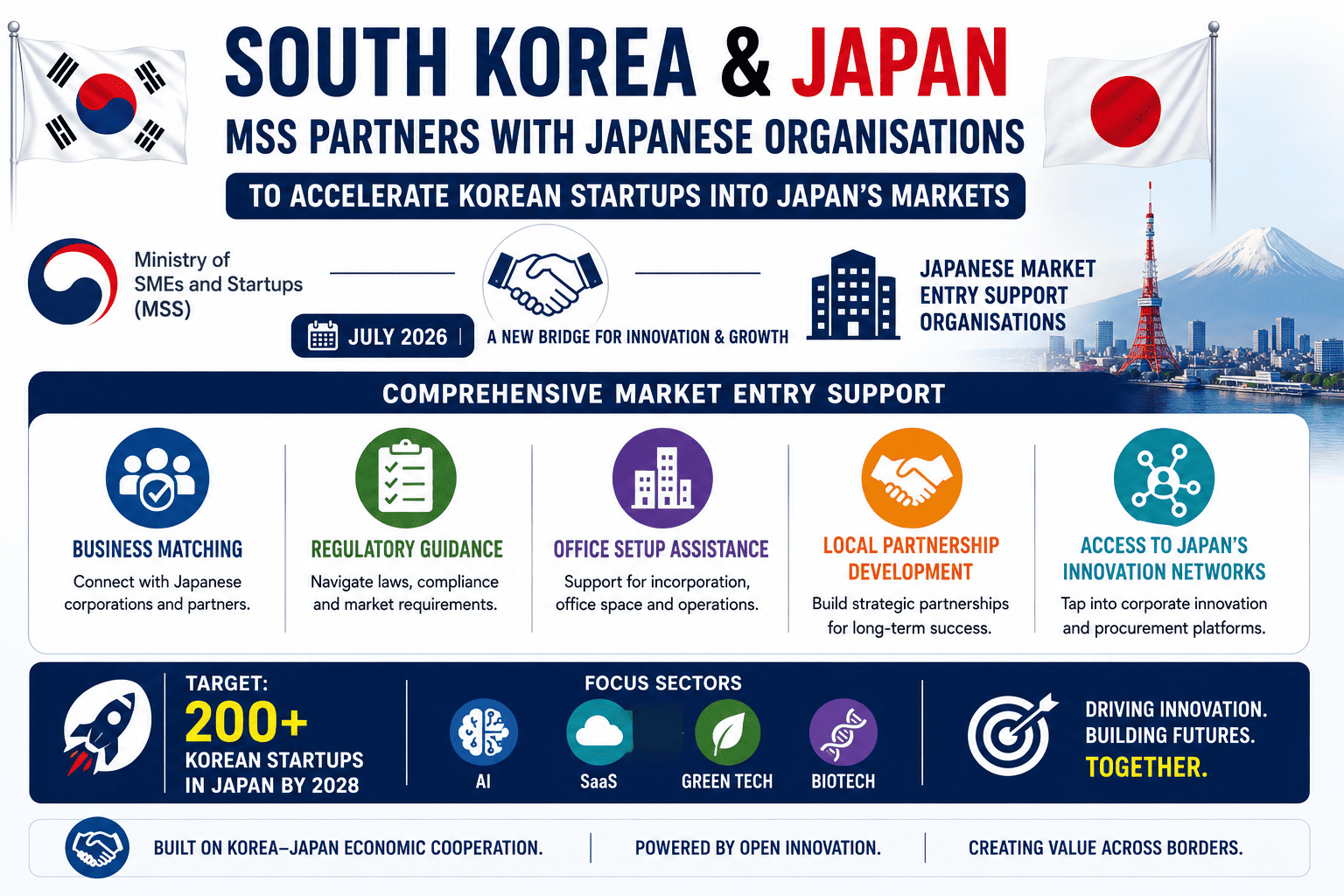
South Korea’s Ministry of SMEs and Startups (MSS) just signed a commercial partnership with Japanese market entry support organisations, a strategic move to accelerate Korean startups into Japan’s corporate innovation ecosystem. Target: 200+ Korean startups in Japan by 2028. Focus: AI, SaaS, Green Tech, Biotech.
🎯 Direct Answer
South Korea’s Ministry of SMEs and Startups (MSS) signed a commercial partnership in July 2026 with Japanese market entry support organisations to accelerate Korean startups into Japan’s technology and consumer markets. The partnership provides structured market entry support: business matching with Japanese corporations, regulatory guidance, office setup assistance, local partnership development, and access to Japan’s corporate innovation procurement networks. The initiative targets 200+ Korean startups entering Japan by 2028, with focus sectors including AI, SaaS, Green Tech, and Biotech. This builds on existing Korea-Japan economic cooperation frameworks and responds to Japan’s growing demand for external innovation partners as corporate R&D models shift toward open innovation.
📅 July 14, 2026⏱ 15 min read✍️ GTsetu Editorial Team📰 News + Analysis
Deal Type
Commercial Partnership
Market entry support for Korean startups in Japan
Target
200+ Startups
Korean startups entering Japan by 2028 through MSS support
Focus Sectors
AI + SaaS + GreenTech
High-growth tech sectors aligned with Japan’s corporate innovation demand
Market Impact
¥50B+
Estimated Japanese corporate procurement value accessible through partnership
Section 1, The News
1
The Full Story: South Korea MSS × Japan Market Expansion
🇰🇷
Deal Announced, July 2026
South Korea’s MSS Signs Commercial Partnership to Accelerate Korean Startups into Japan’s Corporate Innovation Market
In July 2026, South Korea’s Ministry of SMEs and Startups (MSS), the government body responsible for Korea’s startup ecosystem development, signed a commercial partnership with Japanese market entry support organisations to accelerate Korean startups into Japan’s technology and consumer markets. The agreement provides structured market entry support, including business matching with Japanese corporations, regulatory guidance, office setup assistance, and local partnership development.
The initiative targets 200+ Korean startups entering Japan by 2028, with focus sectors including AI, SaaS, Green Tech, and Biotech, areas where Japan’s corporate innovation demand is surging as traditional R&D models shift toward open innovation and external partnership.
This partnership builds on existing Korea-Japan economic cooperation frameworks and responds to a strategic shift: Japanese corporations are increasingly looking to external startups for innovation, and Korean startups have the technology depth and agility to meet that demand. The MSS commercial partnership creates the structured bridge that reduces market entry risk and accelerates time-to-revenue for Korean startups in Japan.
MSS
South Korea’s Ministry of SMEs and Startups, lead government agency for startup policy
200+
Korean startups targeted for Japan market entry by 2028
AI + SaaS
Primary focus sectors aligned with Japan’s corporate innovation demand
Open Innovation
Japan’s corporate R&D model shift, external startups now central to innovation strategy
“This commercial partnership is a strategic enabler for Korean startups to access Japan’s corporate innovation market. We are building a structured pathway that reduces entry barriers and accelerates successful market penetration.”
— MSS Official, July 2026
“Japanese corporations are actively seeking external innovation partners. Korean startups have the technology and agility to fill this gap, the partnership creates the bridge.”
— Japan Market Entry Partner Representative
💡 GTsetu Perspective
The MSS commercial partnership represents a structured approach to market entry, moving from ad-hoc individual startup efforts to a coordinated government-supported pathway. For startups and technology firms considering Japan market entry, the lesson is clear: market entry risk is reduced by partnerships that provide local knowledge, regulatory navigation, and corporate connections. If MSS can build this bridge for 200+ Korean startups, what verified market entry partner could accelerate your Japan expansion? GTsetu helps you find that partner.
Section 2, Target
2
Target: 200+ Korean Startups in Japan by 2028
The MSS partnership has a clear quantitative target: 200+ Korean startups successfully entering Japan by 2028. This is not a symbolic number, it represents a deliberate strategy to build a critical mass of Korean technology firms in Japan’s corporate innovation ecosystem.
🎯 Startup Market Entry Target, Korea to Japan
2024
Baseline
~30 startups Pre-Partnership
2026
70+
70 startups ● Live
2027
140+
140 startups In Progress
2028
200+
200+ startups Target
⚙️ Why Structured Market Entry Works
The MSS partnership targets 200+ startups because market entry success is a volume game, not every startup will succeed, but with structured support, the success rate improves dramatically. The partnership provides regulatory navigation, corporate matching, and local office setup, the three biggest barriers for foreign startups entering Japan. By solving these systematically, MSS increases the probability of success for each startup, making the 200+ target achievable.
Section 3, The Anatomy
3
What Each Partner Brings to the Table
The MSS commercial partnership works because each party contributes complementary assets. This complementarity principle is the foundation of any successful market entry collaboration.
Reduces the single biggest barrier for foreign startups
Network
Korean government and startup ecosystem
Japanese corporate and government network
Creates a bridge between two ecosystems
Risk
Policy risk, reputational risk
Market execution risk, service delivery
Shared risk, both have skin in the game
Value Creation
Korean startup global expansion
Japanese corporate innovation pipelines
Creates cross-border innovation flow
Section 4, The Relationship
4
A Layered Partnership: Government + Private Ecosystem
The MSS commercial partnership is not a one-off initiative, it builds on years of Korea-Japan economic cooperation and responds to a structural shift in Japan’s corporate innovation model. This is the right way to build market entry collaborations: layer government support with private ecosystem expertise.
🤝 Korea-Japan Startup Collaboration, Relationship History
2015–2020
Korea-Japan Economic Cooperation Frameworks
Bilateral economic agreements and trade frameworks established between South Korea and Japan. Created the foundation for cross-border business collaboration and regulatory alignment for technology transfer.
2021–2023
Korean Startup Global Expansion Programs
MSS expands global startup support programs, identifying Japan as a priority market due to corporate innovation demand. Initial pilot programs with Korean startups entering Japan show promising results, validating the need for structured support.
2024–2025
Japan Corporate Innovation Shift, Open Innovation Demand Surges
Japanese corporations accelerate shift from internal R&D to open innovation models. Demand for external startup partners increases significantly, particularly in AI, SaaS, Green Tech, and Biotech. Korean startups identified as ideal partners due to technology depth and agility.
July 2026
MSS Commercial Partnership with Japan Market Entry Support Organisations
MSS formalises commercial partnership with Japanese market entry support organisations. Structured program launched: 200+ Korean startups targeted for Japan entry by 2028. Focus sectors: AI, SaaS, Green Tech, Biotech. Comprehensive support includes business matching, regulatory guidance, office setup, and local partnership development.
🔑 Key Lesson: Government Support + Private Ecosystem Expertise
The MSS partnership works because it layers government policy support with private sector market entry expertise. Government provides the startup pipeline, policy backing, and diplomatic credibility. Private sector partners provide local regulatory knowledge, corporate access, and operational support. Neither could achieve the 200+ startup target alone. The fastest path to market entry is often a structured partnership that combines government support with private ecosystem expertise. GTsetu’s platform helps you identify which verified market entry partners have the local knowledge and corporate network you need, and which government programs can support your expansion.
Section 5, Why This Works
5
Why This Collaboration Model Works for Startups
🎯 The Core Logic
The MSS commercial partnership succeeds because it addresses the three biggest barriers to Japan market entry: regulatory navigation (foreign companies face complex Japanese business registration and compliance), corporate access (foreign startups lack relationships with Japanese corporate decision-makers), and operational setup (office leasing, hiring, banking, and tax registration). By providing structured support across all three dimensions, MSS reduces market entry risk from high to manageable. The partnership creates a pipeline effect, each successful startup entry builds reference cases and network effects, making subsequent entries easier.
Why Korea-Japan Startup Collaboration Is Accelerating
¥50B+
Estimated Japanese corporate procurement value accessible through the partnership
Open Innovation
Japan’s corporate R&D shift, 70% of large Japanese firms now actively seek external startup partnerships
200+
Target Korean startups in Japan by 2028, creating critical mass for ecosystem development
AI + SaaS
Focus sectors aligned with Japan’s corporate innovation priorities, highest demand areas
Government
MSS backing provides credibility and diplomatic support, opens doors that private entities cannot
CEPA
Korea-Japan Comprehensive Economic Partnership Agreement eases trade and investment flows
Section 6, Japan Opportunity
6
Japan’s Corporate Innovation Opportunity, Why Now Is the Time to Enter Japan
🇯🇵 Japan Innovation Market 2026
Why Every Tech Startup Should Be Considering Japan’s Corporate Innovation Market
Japan’s corporate innovation landscape has transformed. Traditional R&D models are giving way to open innovation, Japanese corporations are actively seeking external technology partners to accelerate digital transformation, sustainability initiatives, and AI adoption. Korean startups, with their technology depth and agility, are uniquely positioned to fill this demand. The MSS partnership creates the structured bridge that reduces entry barriers.
70%
Large Japanese firms actively seeking external startup partnerships (2026 survey)
Target Korean startups entering Japan, critical mass for ecosystem development
AI
Highest demand area, Japanese corporate AI adoption accelerating rapidly
GreenTech
Sustainability and decarbonisation, Japan’s net-zero targets drive demand
Biotech
Japan’s aging population drives healthcare and biotech innovation demand
🌐 GTsetu for Market Entry Collaboration
GTsetu’s verified partner network includes market entry specialists, corporate innovation partners, regulatory advisors, and local support organisations across Japan, South Korea, and 100+ countries. Every company on GTsetu is verified on 6 government-sourced points: Name, Address, Registration Number, Company Status, Company Type, and Date of Certificate of Incorporation. Additional capabilities like market entry expertise and corporate networks are self-reported. If you’re a startup looking to enter Japan’s corporate innovation market, or a Japanese corporation seeking external technology partners, GTsetu is where your partner search begins with verified profiles, not cold calls. Find market entry partners →
Section 7, Types of Collaboration
7
4 Types of Market Entry Collaboration, Which Fits Your Situation?
The MSS partnership uses a Commercial Partnership model, government-to-private sector collaboration. But startups have multiple options for entering Japan. The right structure depends on your resources, timeline, and market ambition.
01
Commercial Partnership (Market Entry Support)
A structured service arrangement where a local partner provides market entry support: regulatory guidance, office setup, corporate matching, and local network access. No equity exchange. The MSS model. Fast to execute, lower risk, ideal when you need local knowledge and corporate access.
🚀 MSS × Japan Partners
02
Joint Venture (JV), Local Entity
A new shared legal entity co-owned with a local Japanese partner. Deepest integration, full profit and risk sharing. Best for long-term market commitment when you need permanent local presence and operational control.
⚖️ Full market integration
03
Distribution Partnership
You provide the product or service; a local partner sells and distributes in Japan. Lightest form of collaboration. Often the first step before deeper market entry. Tests demand before capital is committed.
🌍 Test before investing
04
Government-Backed Program
Participate in a structured government program that provides market entry support, subsidies, and network access. The MSS model. Lower cost, lower risk, but may have eligibility criteria and less control.
🏛️ Structured support
📊 Market Entry Collaboration Comparison, Startups
Model
Capital Required
Corporate Access
Regulatory Support
Speed to Execute
Reversibility
Commercial Partnership
Low (service fees)
✓ High
✓ Full
Fast (2–4 months)
Moderate
Joint Venture
High, shared capex
✓ Maximum
✓ Full
Slow (12–24 months)
Low
Distribution
Minimal
~ Limited
✗ None
Fastest (1–3 months)
High
Government Program
Low (subsidised)
✓ High
✓ Full
Medium (6–12 months)
Moderate
Section 8, How to Enter Japan
8
How to Enter Japan: A 5-Step Playbook for Startups and Tech Firms
The MSS commercial partnership provides a structured pathway for Korean startups. For any startup or technology firm considering Japan market entry, here is the distilled playbook, what MSS is enabling, and what you can replicate with the right verified partners.
1
Define Your Japan Market Entry Objective with Precision
The MSS partnership targets 200+ startups entering Japan, but each startup has a specific objective: corporate partnership, distribution agreement, or direct customer acquisition. Define your specific market entry objective: What Japanese corporations do you want to partner with? What is your revenue target? What is your timeline? Vague objectives produce failed market entry.
2
Find Verified Market Entry Partners, Not Just Any Contact
The crucial word is “verified.” MSS uses government-vetted partners. For startups without government backing, GTsetu provides verified profiles of market entry specialists, corporate innovation partners, and regulatory advisors across Japan. GTsetu verifies companies using government tie-ups on 6 key points: Name, Address, Registration Number, Company Status, Company Type, and Date of Certificate of Incorporation. Additional information like market entry expertise and corporate networks is self-reported and should be validated independently.
3
Protect Your IP Before Any Sensitive Disclosure
Before sharing your technology roadmap, customer lists, or pricing models with any Japan partner, execute a mutual NDA. GTsetu’s built-in NDA workflow handles this automatically: mutual NDA executed and countersigned before any sensitive information is shared, with a full digital audit trail.
4
Choose the Right Market Entry Structure for Your Objective
MSS chose a Commercial Partnership structure, service-based, no equity. A JV is right when you need permanent operational control. A distribution partnership is right when you want to test demand before committing. Match the structure to the objective, not to what’s easiest to negotiate.
5
Formalise and Scale in Stages, Pilot Before Full Commitment
The MSS partnership targets 200+ startups, but each startup enters in stages: pilot project, corporate partnership, then full market entry. Never commit full market entry capital before validating demand with a pilot. Structure every collaboration milestone formally in writing: scope of support, fee structure, corporate access terms, and renewal conditions.
Section 9, Dos and Don’ts
9
Dos and Don’ts of Market Entry Collaboration
✅ Do These
✅ Partner with local market entry specialists who have verified corporate access
✅ Use government-backed programs like MSS when available, they provide credibility and subsidies
✅ Protect your IP with NDA before sharing any sensitive business information
✅ Start with a pilot project before committing to full market entry
✅ Target sectors where Japanese corporate demand is highest: AI, SaaS, GreenTech, Biotech
✅ Build relationships with Japanese corporations before full-scale market entry
✅ Use verified platforms like GTsetu rather than cold outreach for partner discovery
✅ Document the collaboration formally, service agreement, fee structure, and deliverables
✅ Leverage government programs for market entry support, they reduce risk and cost
✅ Build a pipeline, not every startup will succeed, but structured support improves success rates
❌ Avoid These
❌ Enter Japan without local regulatory guidance, compliance is the biggest barrier
❌ Assume your product-market fit in Korea translates directly to Japan without adjustment
❌ Share sensitive business information before NDA is countersigned
❌ Commit to full-scale market entry before validating demand with a pilot
❌ Partner with a market entry firm that has no proven corporate network in Japan
❌ Underestimate the importance of cultural alignment in Japan business relationships
❌ Build a JV when a commercial partnership would achieve the same objective with lower commitment
❌ Ignore government programs, they provide subsidies and credibility that private partners cannot
❌ Enter Japan without a clear corporate partnership strategy, Japanese corporations buy relationships
❌ Assume one-size-fits-all, each startup needs a tailored market entry approach
Section 10, Misconceptions
10
Common Misconceptions About Japan Market Entry
❌ Myth
“Japan is too difficult for foreign startups, the market is closed to external innovation.”
✅ Reality
Japanese corporations are actively seeking external startup partners, 70% of large Japanese firms now have open innovation programs. The challenge is not demand, but access. The MSS partnership and similar market entry programs provide the structured access that foreign startups need. The market is open and growing, the barrier is finding the right entry point, not market hostility.
❌ Myth
“A commercial partnership is less valuable than a JV, we should always aim for equity.”
✅ Reality
The MSS partnership uses a commercial partnership model, not a JV. For many startups, a commercial partnership provides the necessary market entry support without the capital commitment and governance complexity of a JV. It executes faster, requires less capital, and is easier to exit if the market fit doesn’t materialise. The right structure depends on your objective.
❌ Myth
“If we have a great product, Japanese corporations will find us.”
✅ Reality
Japanese corporations rarely discover foreign startups through passive channels. Structured market entry support, like the MSS partnership provides, is essential for corporate introductions. The key is not just having a great product, but having a partner who can make the right introductions and build the trust required for Japanese corporate relationships.
❌ Myth
“Government programs are too slow and bureaucratic, better to go private.”
✅ Reality
Government-backed programs like MSS provide credibility, subsidies, and structured access that private partners cannot replicate. The speed is often faster than building market entry capability from scratch. The MSS partnership targets 200+ startups by 2028, that’s a structured pathway, not a bureaucratic delay.
❌ Myth
“Entry into Japan requires a physical office from day one.”
✅ Reality
The MSS partnership provides office setup assistance as part of the support package, but physical presence is not required to begin market entry. Many startups enter Japan through virtual presence and partner relationships first, then establish an office once revenue is confirmed. The office is a milestone, not a prerequisite.
Section 11, GTsetu
11
How GTsetu Helps You Find Market Entry Partners
The MSS partnership provides government-backed market entry support for Korean startups. For startups and technology firms without government backing, finding the right verified market entry partner is the critical first step. GTsetu is the verified B2B discovery platform that enables this evaluation at scale, across 100+ countries, before you reveal a single confidential detail.
🌐 Platform Spotlight, GTsetu
Find Verified Market Entry Partners, Corporate Innovation Advisors, and Local Support Organisations Across 100+ Countries, Anonymously, Securely, With Zero Broker Fees
Every company on GTsetu is verified using government tie-ups on 6 key points: Name, Address, Registration Number, Company Status, Company Type, and Date of Certificate of Incorporation. This is the foundation of trust. Additional information such as market entry expertise, corporate networks, regulatory advisory capabilities, and customer references is self-reported by companies. You evaluate who is real before you engage. You share nothing sensitive until an NDA is countersigned. And you pay no broker commission on any collaboration formed, the deal is entirely between you and your partner.
✅
6-Point Government-Sourced VerificationName, Address, Registration Number, Company Status, Company Type, Date of Incorporation confirmed using government tie-ups.
🕵️
Anonymous DiscoveryEvaluate verified partner profiles without revealing your identity until mutual interest is confirmed.
📄
Built-In NDA WorkflowShare business plans and sensitive information only after NDA is executed, full audit trail.
🚫
Zero CommissionNo broker fees, your market entry agreement is entirely between you and your partner.
Sourced and screened 200+ Korean startups for Japan market readiness
✓ Browse verified market entry partner profiles with government-sourced verification
You evaluate the partner’s verified legal identity and credibility, not marketing claims
Partnered with verified Japanese market entry support organisations with corporate networks
✓ Filter by self-reported market entry expertise, corporate networks, and regulatory advisory capabilities
Find partners with the specific local expertise and corporate access your market entry requires
Structured commercial partnership agreement with clear scope of support
✓ Built-in NDA and document workflow protects your business plan from the first conversation
Your market entry strategy and sensitive business data are protected at every stage
Targeted sectors with highest Japanese corporate demand: AI, SaaS, GreenTech, Biotech
✓ Partner profiles show sector expertise and corporate network specialisation
Identify partners with the specific corporate network access your sector requires
Zero intermediary in the MSS partnership, direct government-to-private sector terms
✓ Zero commission on any partnership, all terms are direct between the two parties
No broker fees or commission, your market entry budget goes directly to the support you need
FAQ
?
Frequently Asked Questions
Q
What exactly did South Korea MSS and Japan market entry partners agree to?
South Korea’s Ministry of SMEs and Startups (MSS) signed a commercial partnership with Japanese market entry support organisations in July 2026. The partnership provides structured market entry support for Korean startups: business matching with Japanese corporations, regulatory guidance, office setup assistance, local partnership development, and access to Japan’s corporate innovation procurement networks. The initiative targets 200+ Korean startups entering Japan by 2028 with focus sectors including AI, SaaS, Green Tech, and Biotech.
Q
Why is Japan’s corporate innovation market attractive for Korean startups?
Japanese corporations are actively shifting from internal R&D to open innovation, 70% of large Japanese firms now have open innovation programs. Korean startups offer technology depth, agility, and proximity that makes them ideal partners. The MSS partnership creates the structured bridge that reduces entry barriers. Focus sectors, AI, SaaS, GreenTech, Biotech, align with Japan’s highest corporate demand areas. The total addressable market for corporate innovation procurement in Japan is estimated at over ¥3 trillion annually.
Q
What is the difference between a Commercial Partnership and a Joint Venture for market entry?
A Commercial Partnership is a service arrangement, no new entity, no equity exchange. One party provides market entry support (regulatory, corporate access, office setup) for fees. It executes faster (2–4 months), requires less capital, and is easier to exit. A Joint Venture (JV) creates a new co-owned legal entity with shared equity and governance. It takes longer (12–24 months), requires higher capital, but provides deeper operational integration. MSS uses a Commercial Partnership model because it provides the necessary support without the complexity of a JV. Use a Commercial Partnership when you need local knowledge and corporate access. Use a JV when you need permanent operational control.
Q
How can I find a market entry partner for Japan or other countries without government backing?
The systematic approach involves four steps: (1) Define your market entry objective precisely, what specific corporate access, regulatory support, or local presence do you need? (2) Search verified platforms, GTsetu lists verified market entry specialists, corporate innovation advisors, and local support organisations across Japan, South Korea, and 100+ countries. GTsetu verifies companies using government tie-ups on 6 points. (3) Evaluate anonymously first, review verified profiles and self-reported capability data before revealing your identity or business plan. (4) Execute NDA before any sensitive disclosure, GTsetu’s built-in NDA workflow handles this automatically. A structured, verified search on GTsetu is more reliable than cold outreach or trade fair introductions.
Q
What are the biggest barriers for foreign startups entering Japan?
The three biggest barriers are: (1) Regulatory navigation, foreign companies face complex Japanese business registration, tax compliance, and employment regulations. (2) Corporate access, foreign startups lack relationships with Japanese corporate decision-makers. (3) Operational setup, office leasing, hiring, banking, and local partnerships are difficult to navigate remotely. The MSS partnership addresses all three barriers through structured support. For startups without government backing, finding a verified market entry partner who provides this support is essential.
Q
Does GTsetu charge commission on market entry partnerships formed through the platform?
No. GTsetu charges zero commission on any collaboration, whether a commercial partnership, market entry agreement, joint venture, distribution deal, or licensing agreement, formed through the platform. The commercial terms of your market entry agreement are entirely between you and your partner. This is a foundational design principle: broker intermediation typically costs 5–15% of deal value and creates incentive misalignment. GTsetu removes the broker entirely. Learn more about GTsetu →
Ready to Enter Japan’s Corporate Innovation Market? Start on GTsetu.
500+ verified market entry specialists, corporate innovation partners, regulatory advisors, and local support organisations across Japan, South Korea, and 100+ countries. Zero broker fees. Anonymous discovery. Built-in NDA workflows. Your Japan market entry starts with a verified partner, not a cold call.
Business Development Expert | International Trade & Strategic Partnerships
Daniel Carter is a Business Development Expert at GTsetu, specializing in global trade, international business expansion, and strategic partnership development. With extensive experience working across multiple industries and markets, Daniel helps organizations identify growth opportunities, build commercial relationships, and expand their international footprint.
His expertise includes cross-border collaborations, market entry strategies, supply chain partnerships, manufacturing ecosystems, and business matchmaking. Through his work at GTsetu, Daniel supports companies seeking to establish meaningful connections with partners, distributors, investors, and industry stakeholders across global markets.
Daniel is committed to helping businesses unlock new opportunities through collaboration-driven growth and practical international trade strategies.