India-France Year of Innovation 2026: What Businesses Must Learn About India-France Strategic Tech Collaboration
🔴 BREAKINGIndia-France Year of Innovation 2026 launched: Defense, Space, Energy, Climate, AI, Startups, strategic tech alliance unveiled◆€2 billion joint innovation fund announced; 100+ startup exchange slots per year across six sectors◆India-France strategic partnership deepens with landmark Year of Innovation program◆Find verified technology partners on GTsetu, 100+ countries, zero commission◆🔴 BREAKINGIndia-France Year of Innovation 2026 launched: Defense, Space, Energy, Climate, AI, Startups, strategic tech alliance unveiled◆€2 billion joint innovation fund announced; 100+ startup exchange slots per year across six sectors◆India-France strategic partnership deepens with landmark Year of Innovation program◆Find verified technology partners on GTsetu, 100+ countries, zero commission◆
Home › Blog › India-France Year of Innovation 2026
🔴 Breaking News🚀 Innovation🇮🇳 India🇫🇷 France🛡️ Defense🤖 AI
India-France Year of Innovation 2026: How Strategic Tech Alliances Are Shaping the Future of Defense, Space, AI & Climate
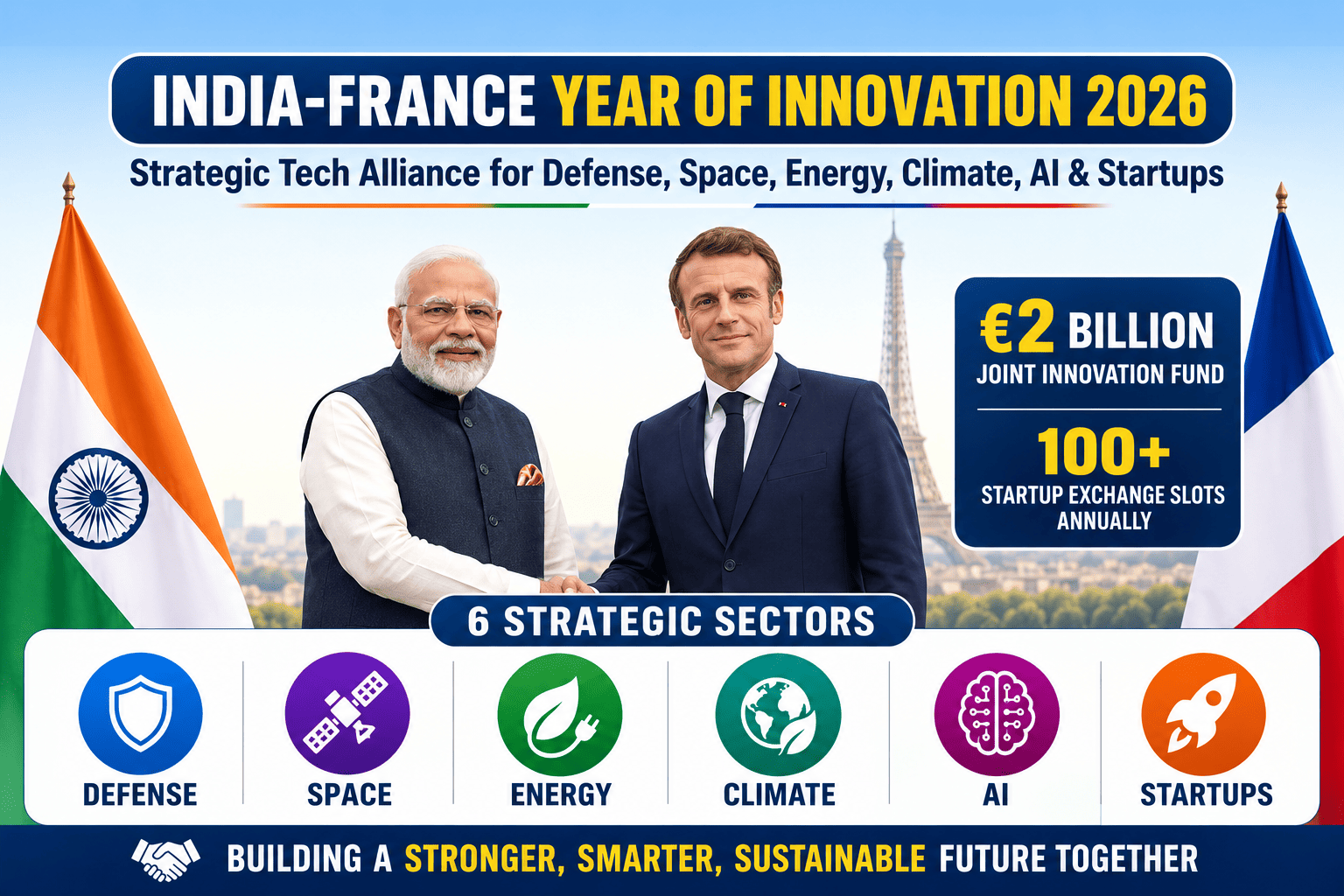
India and France launched the Year of Innovation 2026, a landmark strategic alliance establishing comprehensive frameworks for collaboration across Defense, Space, Energy, Climate, AI, and Startups. With a €2 billion joint innovation fund and 100+ startup exchange slots annually, this represents a new model for international technology cooperation.
🎯 Direct Answer
India and France have launched the Year of Innovation 2026, a landmark strategic alliance establishing comprehensive frameworks for collaboration across six critical sectors: Defense (joint development, co-production, and technology sharing), Space (satellite development, space exploration, and commercial space partnerships), Energy (renewable energy, nuclear cooperation, and energy transition technologies), Climate (climate tech, adaptation strategies, and sustainable development), AI (artificial intelligence research, talent exchange, and ethical AI frameworks), and Startups (innovation challenges, startup exchange programmes, and venture capital co-investment).
The program includes a €2 billion joint innovation fund and 100+ startup exchange slots annually, creating unprecedented opportunities for collaboration between Indian and French innovators. This builds on the existing strategic partnership between the two nations, deepening cooperation in areas of mutual strategic interest and positioning India and France as global leaders in innovation and technology.
📅 February 2026⏱ 18 min read✍️ GTsetu Editorial Team📰 News + Analysis
Program Type
Year of Innovation
Strategic Alliance across 6 critical technology sectors
Innovation Fund
€2B
Co-investment fund for joint research and commercialisation
Startup Exchange
100+ / yr
Annual startup exchange slots across six sectors
Sectors Covered
6 Domains
Defense · Space · Energy · Climate · AI · Startups
Section 1, The News
1
The Full Story: India-France Year of Innovation 2026
🚀
Program Launched, February 2026
India and France Launch Year of Innovation 2026, Establishing Strategic Tech Alliance Across Defense, Space, Energy, Climate, AI, and Startups
In a landmark move to deepen the strategic partnership between the two nations, India and France launched the Year of Innovation 2026 , establishing a comprehensive framework for collaboration across six critical sectors: Defense, Space, Energy, Climate, AI, and Startups .
The program includes a €2 billion joint innovation fund to finance collaborative research projects, startup scaling initiatives, and technology commercialisation pathways . It also establishes 100+ annual startup exchange slots , enabling Indian and French startups to access each other’s innovation ecosystems, research facilities, and market networks .
This collaboration builds on the existing strategic partnership between India and France, which has been strengthened through decades of cooperation in defense, space, and nuclear energy . The Year of Innovation 2026 represents a quantum leap in this relationship, expanding cooperation into emerging technology sectors like AI and climate tech, and creating a new model for international innovation collaboration.
€2B
Joint innovation fund for research and commercialisation
100+
Annual startup exchange slots between India and France
6 Sectors
Defense · Space · Energy · Climate · AI · Startups
2026
Year-long program of events, initiatives, and collaborations
“The Year of Innovation 2026 marks a new chapter in the India-France strategic partnership. By collaborating across defense, space, energy, climate, AI, and startups, we are building a future of shared innovation and prosperity.”
— Official Statement, Government of India
“France and India share a vision of strategic autonomy and technological sovereignty. The Year of Innovation 2026 will deepen our collaboration in critical technologies and create new pathways for innovation.”
— Official Statement, Government of France
💡 GTsetu Perspective
The India-France Year of Innovation 2026 represents a paradigm shift in international technology collaboration, moving from sector-specific agreements to a comprehensive innovation ecosystem partnership spanning six critical domains. For technology companies, research institutions, and startups in both nations, this creates unprecedented opportunities for collaboration, funding, and market access. GTsetu helps you find verified innovation partners across Defense, Space, Energy, Climate, AI, and Startups, enabling the practical realisation of strategic collaborations like this Year of Innovation program.
Section 2, Six Sectors
2
The Six Sectors: Defense, Space, Energy, Climate, AI, Startups
The India-France Year of Innovation 2026 is structured around six strategic sectors where both nations have complementary strengths and significant growth potential.
🛡️
Defense
🇮🇳 India🇫🇷 France
Joint development, co-production, and technology sharing in defense systems, aerospace, naval systems, and strategic technologies. Building on existing cooperation in fighter aircraft and submarines.
Satellite development, space exploration, and commercial space partnerships. Joint missions, shared infrastructure, and commercial space industry collaboration.
Focus: Satellite development · Space exploration · Commercial space
⚡
Energy
☀️ Renewable☢️ Nuclear
Renewable energy, nuclear cooperation, and energy transition technologies. Building on existing civil nuclear cooperation and expanding into green hydrogen, solar, and energy storage.
Focus: Renewables · Nuclear · Energy transition
🌿
Climate
🌍 Climate Tech♻️ Sustainable
Climate tech, adaptation strategies, and sustainable development. Joint research on climate resilience, carbon capture, and sustainable agriculture.
Focus: Climate tech · Adaptation · Sustainable development
🤖
Artificial Intelligence
🧠 AI Research🤝 Talent
Artificial intelligence research, talent exchange, and ethical AI frameworks. Joint research centres, startup programmes, and policy coordination.
Focus: AI research · Talent exchange · Ethical AI
🚀
Startups
💡 Innovation💰 VC
Innovation challenges, startup exchange programmes, and venture capital co-investment. 100+ annual exchange slots and access to each other’s innovation ecosystems.
The India-France Year of Innovation 2026 succeeds because each nation contributes assets that the other cannot replicate efficiently, the foundation of successful strategic technology alliances.
Collaboration Anatomy, Year of Innovation Program
🇮🇳 India
World’s Fastest-Growing Major Economy
What they bring
Scale + Talent + Market
Key Assets
Space programme, AI talent, digital economy
Innovation Strength
ISRO, IT services, startup ecosystem
What they seek
Deep tech IP, research infrastructure
Role
Scale & Commercialisation Engine
+
Strategic Alliance
🇫🇷 France
Global Deep Tech & Innovation Leader
What they bring
Deep Tech IP + Research
Key Assets
Defense, aerospace, nuclear, AI research
Innovation Strength
CNES, Dassault, EDF, research institutes
What they seek
Scale, talent, market access
Role
Technology & Innovation Engine
🎯 Focus: 6 Innovation Sectors
💰 Joint Fund: €2B
🔄 Startup Exchange: 100+/year
Sector
India Contribution
France Contribution
Why This Balance Works
Defense
Large defence market, manufacturing scale
Advanced defence tech, proven systems
Co-production and technology sharing
Space
ISRO launch capability, satellite expertise
CNES, advanced space tech, Ariane
Joint missions, commercial space collaboration
Energy
Renewable energy scale, nuclear expertise
EDF, nuclear tech, energy transition
Civil nuclear cooperation, green energy
Climate
Climate tech scale, adaptation needs
Climate research, tech innovation
Joint research on climate resilience
AI
AI talent pool, digital economy scale
AI research, ethical frameworks
Talent exchange, joint research
Startups
Large startup ecosystem, market access
Deep tech startups, VC ecosystem
Innovation exchange, co-investment
Section 4, Why This Works
4
Why India-France Innovation Collaboration Is Accelerating
🎯 The Core Logic
The India-France Year of Innovation 2026 succeeds because it addresses a systemic opportunity: both nations have deep strategic partnerships, complementary technological strengths, and shared values of strategic autonomy. India’s strengths in scale, talent, and digital economy complement France’s deep tech expertise in defense, space, nuclear energy, and AI. The €2 billion joint innovation fund provides the financial backbone, while the 100+ startup exchange slots ensure talent and idea flow. This is not just a government program, it’s a comprehensive innovation ecosystem partnership that positions India and France as global leaders in strategic technologies.
€2B
Joint innovation fund, financial backbone of collaboration
Decades of strategic partnership, trust and institutional alignment
Deep Tech
France’s deep tech expertise meets India’s scale and talent
2026
Year-long program of events, initiatives, and collaborations
Section 5, Strategic Context
5
The India-France Strategic Partnership Context
🤝 Strategic Partnership, Decades of Cooperation
Why India-France Collaboration Is a Model for Strategic Technology Alliances
The India-France strategic partnership has been built over decades of cooperation in defense, space, and nuclear energy. The Year of Innovation 2026 represents the next evolution of this relationship, expanding from sector-specific cooperation to a comprehensive innovation ecosystem partnership. Both nations share values of strategic autonomy, democratic governance, and a commitment to technological sovereignty. This alignment of values and interests provides the foundation for deep, sustained collaboration across six critical technology sectors.
🛡️ Defense
Rafale, Scorpene, joint development, deep defense ties
🛰️ Space
ISRO-CNES collaboration, satellite joint development
☢️ Nuclear
Civil nuclear cooperation, Jaitapur project
🤖 AI
Joint AI research, ethical frameworks, talent exchange
6
5 Types of Innovation Collaboration, Which Fits Your Situation?
The India-France Year of Innovation 2026 is a comprehensive strategic alliance, but innovation collaboration comes in many forms. The right structure depends on your objectives, resources, and risk tolerance.
01
Strategic Alliance (Year of Innovation)
Government-to-government framework for multi-sector innovation collaboration. The India-France model. Establishes principles, identifies sectors, creates institutional mechanisms. Best for broad, long-term strategic engagement.
🚀 India-France Model
02
Joint Research Collaboration
Universities, research institutions, or corporate R&D centres partner on specific research projects. Shared publications, shared IP, shared funding. Often the precursor to broader ecosystem partnerships.
🔬 Research collaboration
03
Startup Exchange Programme
Startups from one ecosystem access the other ecosystem’s market, mentors, investors, and infrastructure. The India-France model includes 100+ annual exchange slots. Best for building talent pipelines and commercialisation pathways.
🚀 100+ slots/year
04
Co-Investment Fund
Joint fund structure where both parties contribute capital and jointly decide on investment allocation. The India-France model includes a €2B fund. Best when both parties need to share financial risk and reward in long-term innovation projects.
💰 €2B joint fund
05
Technology Transfer Agreement (TAA)
One party provides technology, IP, or knowhow to another for fees or royalties. Focused on specific technology domains. Best when technology access is the primary objective.
🔬 IP and knowhow
📊 Innovation Collaboration Model Comparison
Model
Capital Required
Technology Access
Talent Exchange
Speed to Execute
Best For
Strategic Alliance
Medium
✓ Full
✓ High
6–12 months
Broad strategic engagement
Research
Moderate
~ Shared IP
✓ Researcher exchange
6–12 months
Early-stage R&D
Startup
Low (programme costs)
~ Market access
✓ High
3–9 months
Talent pipeline, early-stage
Co-Investment
High
~ Investment access
✗ Limited
3–12 months
Shared risk, long-term projects
TAA
Low (fees/royalties)
✓ Full IP access
✗ Limited
3–6 months
Manufacturing, industrial tech
Section 7, How to Build
7
How to Build Innovation Collaboration: A 5-Step Playbook
The India-France Year of Innovation 2026 demonstrates how strategic technology collaboration can unlock innovation and growth. Here is the distilled playbook for building your own innovation collaboration.
1
Identify Strategic Technology Gaps and Complementarities
The India-France Year of Innovation identifies six sectors where both nations have complementary strengths. Define your technology gaps with precision: Which strategic technologies do you need access to? Where does your partner have unique capabilities that you cannot replicate? Complementarity is the foundation of successful innovation collaboration.
2
Find Verified Innovation Partners, Not Just Any Technology Company
France’s deep tech expertise and India’s scale are valuable only if the right partners connect. GTsetu helps technology companies, research institutions, and startups find verified innovation partners across Defense, Space, Energy, Climate, AI, and Startups. Every company on GTsetu is verified on 6 government-sourced points.
3
Structure the Collaboration Framework, Joint Fund, Research, or Exchange
The India-France Year of Innovation uses multiple collaboration mechanisms: joint research, startup exchange, and co-investment fund. Define which mechanism fits your objectives. GTsetu’s collaboration workspace supports this structuring with secure document exchange, encrypted communications, and compliance tracking.
4
Establish Implementation Mechanisms, Projects, Programmes, and Timelines
The Year of Innovation includes specific initiatives: innovation challenges, startup bootcamps, research collaborations, and policy dialogues. Define how your collaboration will be operationalised: specific projects, milestones, governance structures, and review mechanisms.
5
Monitor Impact and Scale, Track Innovation Outcomes
The ultimate measure of the Year of Innovation will be the technology breakthroughs, startups scaled, and strategic partnerships formed. Define success metrics from day one: joint research projects, startup exits, technology commercialised, and IP created. GTsetu helps you track partnership performance and identify scaling opportunities.
Section 8, Dos and Don’ts
8
Dos and Don’ts of Innovation Collaboration
✅ Do These
✅ Identify strategic technology gaps and complementarities
✅ Use verified platforms like GTsetu to find partners with proven credentials
✅ Structure agreements with clear sector focus, Defense, Space, Energy, etc.
✅ Align with government and institutional initiatives like Year of Innovation
❌ Ignore the broader strategic context, India-France partnership is decades in the making
❌ Launch without clear success metrics, track innovation outcomes
Section 9, Misconceptions
9
Common Misconceptions That Kill Innovation Partnerships
❌ Myth
“Government innovation programs are just symbolic, they don’t create real business opportunities.”
✅ Reality
The India-France Year of Innovation 2026 establishes concrete institutional mechanisms for collaboration: €2B joint fund, 100+ startup exchange slots, and specific sector initiatives. Government programs create the enabling environment for business-level innovation partnerships. The value lies in the implementation mechanisms, not just the announcement.
❌ Myth
“Innovation partnerships require physical presence in both countries to succeed.”
✅ Reality
The Year of Innovation includes digital collaboration, virtual innovation challenges, and remote research partnerships. Digital platforms enable effective innovation collaboration without physical presence. Platforms like GTsetu provide the secure, verified digital infrastructure for international innovation collaboration. Physical presence is not always required, but verified trust is.
❌ Myth
“Startup exchanges are nice-to-have, they don’t drive strategic technology outcomes.”
✅ Reality
Talent exchange, through startup programmes, researcher secondments, and corporate rotations, is the primary mechanism for knowledge transfer in innovation partnerships. The Year of Innovation’s 100+ annual startup exchange slots are not symbolic; they are the operational engine of the partnership. Without talent exchange, innovation partnerships become static agreements, not dynamic collaborations.
❌ Myth
“Co-investment funds are too complex to manage, they slow down innovation.”
✅ Reality
The €2B joint innovation fund is the financial backbone of the Year of Innovation, enabling long-term research, startup scaling, and technology commercialisation. Co-investment funds share risk and reward, aligning incentives across both nations. While governance is complex, the fund structure ensures sustainability and strategic alignment, essential for decade-long innovation partnerships.
❌ Myth
“Strategic technology partnerships are only for large corporations, MSMEs and startups don’t benefit.”
✅ Reality
The Year of Innovation explicitly targets startups and MSMEs through the 100+ startup exchange slots, innovation challenges, and VC co-investment mechanisms. Startups are the engine of innovation, they bring agility, fresh ideas, and breakthrough technologies. The program is designed to ensure MSMEs and startups are primary beneficiaries, not spectators.
Section 10, GTsetu
10
How GTsetu Helps You Find the Right Innovation Partner
The India-France Year of Innovation 2026 demonstrates the power of strategic technology collaboration. For technology companies, research institutions, and startups seeking to realise the potential of such strategic alliances, GTsetu provides the discovery and verification infrastructure to identify the right innovation partners, across 100+ countries, before revealing any sensitive information.
🌐 Platform Spotlight, GTsetu
Find Verified Innovation Partners Across 100+ Countries, Anonymously, Securely, With Zero Broker Fees
Every company on GTsetu is verified using government tie-ups on 6 key points: Name, Address, Registration Number, Company Status, Company Type, and Date of Certificate of Incorporation. Beyond corporate verification, GTsetu captures innovation credentials: research partnerships, startup incubator programmes, government innovation grants, and commercialisation track records. This enables a complete assessment of a potential partner’s innovation ecosystem position, not just their corporate registration. Share nothing sensitive until an NDA is countersigned. And pay zero broker commission on any collaboration formed.
✅
6-Point Government-Sourced VerificationName, Address, Registration Number, Company Status, Company Type, Date of Incorporation confirmed using government tie-ups.
🚀
Innovation Ecosystem CredentialsResearch partnerships, incubator programmes, and self-reported commercialisation track records.
🕵️
Anonymous DiscoveryEvaluate verified partner profiles without revealing your identity until mutual interest is confirmed.
📄
Built-In NDA WorkflowShare research plans, technology roadmaps, and commercialisation strategies only after NDA is executed.
🚫
Zero CommissionNo broker fees, your innovation partnership terms are entirely between you and your partners.
🌍
100+ CountriesFrance, India, Europe, Asia, Americas, find innovation partners globally.
Q
What is the India-France Year of Innovation 2026?
The India-France Year of Innovation 2026 is a landmark strategic alliance launched by the Governments of India and France, establishing a comprehensive framework for collaboration across six critical sectors: Defense (joint development and co-production), Space (satellite development and exploration), Energy (renewable and nuclear cooperation), Climate (climate tech and adaptation), AI (research and ethical frameworks), and Startups (innovation challenges and exchange programmes). The program includes a €2 billion joint innovation fund and 100+ annual startup exchange slots.
Q
What is the India-France Year of Innovation program?
The India-France Year of Innovation is a year-long program of events, initiatives, and collaborations designed to deepen the strategic partnership between India and France. It includes innovation challenges, startup bootcamps, research collaborations, policy dialogues, and joint investment mechanisms across six sectors. The program is designed to create lasting institutional mechanisms for innovation collaboration that extend beyond the year itself.
Q
What are the six sectors covered by the Year of Innovation?
The Year of Innovation covers six strategic sectors: (1) Defense, joint development, co-production, and technology sharing in defense systems and aerospace. (2) Space, satellite development, space exploration, and commercial space partnerships. (3) Energy, renewable energy, nuclear cooperation, and energy transition technologies. (4) Climate, climate tech, adaptation strategies, and sustainable development. (5) AI, artificial intelligence research, talent exchange, and ethical AI frameworks. (6) Startups, innovation challenges, startup exchange programmes, and venture capital co-investment.
Q
How does the €2 billion joint innovation fund work?
The €2 billion joint innovation fund is the financial engine of the Year of Innovation, co-financed by both governments and jointly governed. It finances collaborative research projects, startup scaling initiatives, and technology commercialisation pathways. The fund is structured as a co-investment mechanism, both governments contribute capital and jointly decide on allocation through a shared investment committee. This shared governance model ensures alignment of strategic objectives and creates a sustainable financial basis for the partnership.
Q
How can technology companies and startups benefit from the Year of Innovation?
Companies and startups can benefit through: (1) Startup Exchange Programme, 100+ annual slots to access each other’s innovation ecosystems, mentors, and investors. (2) Joint Research, collaborative R&D projects with French and Indian research institutions. (3) Innovation Challenges, sector-specific challenges with funding and commercialisation support. (4) Co-Investment, access to the €2B joint innovation fund for scaling and commercialisation. (5) Market Access, entry into each other’s markets through institutional mechanisms. The program creates unprecedented opportunities for cross-border technology collaboration.
Q
Does GTsetu charge commission on innovation partnerships formed through the platform?
No. GTsetu charges zero commission on any collaboration, whether an innovation partnership, strategic alliance, Joint Venture, or any other arrangement, formed through the platform. The commercial terms of your agreement are entirely between you and your partner. This is a foundational design principle: broker intermediation in innovation partnerships typically costs 5–15% of deal value and creates incentive misalignment. GTsetu removes the broker entirely. Learn more about GTsetu →
Ready to Build Your Innovation Partnership? Start on GTsetu.
500+ verified technology companies, research institutions, and innovation partners across 100+ countries. Zero broker fees. Anonymous discovery. Built-in NDA workflows. Your next innovation partnership starts with a verified profile, not a cold introduction.
Business Development Expert | International Trade & Strategic Partnerships
Daniel Carter is a Business Development Expert at GTsetu, specializing in global trade, international business expansion, and strategic partnership development. With extensive experience working across multiple industries and markets, Daniel helps organizations identify growth opportunities, build commercial relationships, and expand their international footprint.
His expertise includes cross-border collaborations, market entry strategies, supply chain partnerships, manufacturing ecosystems, and business matchmaking. Through his work at GTsetu, Daniel supports companies seeking to establish meaningful connections with partners, distributors, investors, and industry stakeholders across global markets.
Daniel is committed to helping businesses unlock new opportunities through collaboration-driven growth and practical international trade strategies.