BRICS PartNIR Forum Agra 2026: What Global Manufacturers Must Learn From This Mega Strategic Alliance
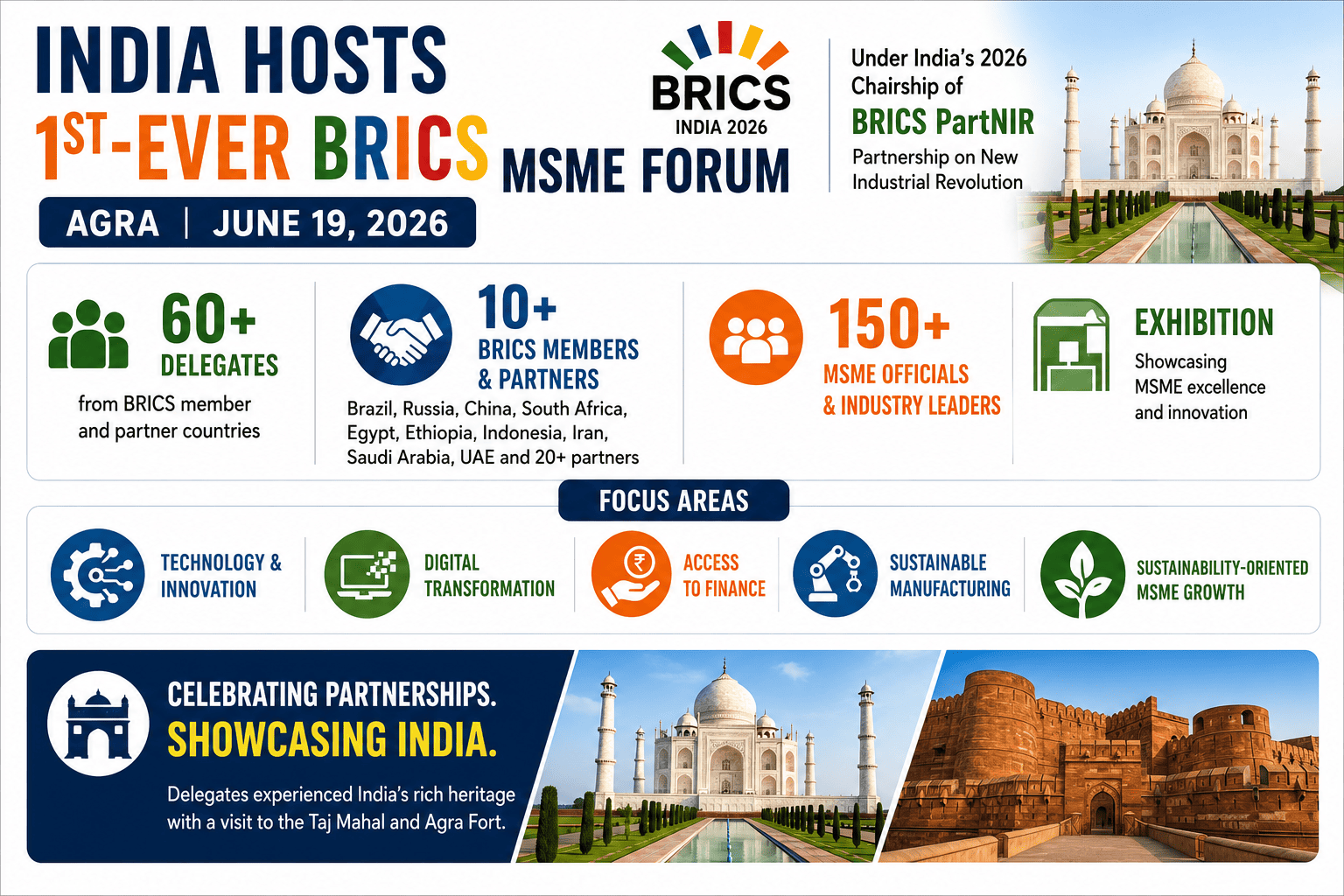
🔴 BREAKINGIndia hosts first-ever BRICS MSME Forum in Agra on June 19, 2026, mega strategic alliance under PartNIR chairship◆60+ delegates from BRICS nations and 150 MSME officials gather in Agra for technology, innovation, and digital transformation dialogue◆New collaboration opportunities for manufacturers, tech innovators, and MSMEs across BRICS nations◆Find verified manufacturing and tech partners on GTsetu, 100+ countries, zero commission◆🔴 BREAKINGIndia hosts first-ever BRICS MSME Forum in Agra on June 19, 2026, mega strategic alliance under PartNIR chairship◆60+ delegates from BRICS nations and 150 MSME officials gather in Agra for technology, innovation, and digital transformation dialogue◆New collaboration opportunities for manufacturers, tech innovators, and MSMEs across BRICS nations◆Find verified manufacturing and tech partners on GTsetu, 100+ countries, zero commission◆
BRICS PartNIR Forum Agra 2026: A Mega Strategic Alliance Reshaping Technology, Innovation, and Manufacturing Across BRICS Nations
On June 19, 2026, India hosts the first-ever BRICS MSME Forum in Agra, a mega strategic alliance event under the BRICS Partnership on New Industrial Revolution (PartNIR). Bringing together 60+ delegates and 150 MSME officials from BRICS member and partner countries, the forum focuses on technology, innovation, digital transformation, and sustainable manufacturing across the Global South.
🎯 Direct Answer
On June 19, 2026, India hosted the first-ever BRICS MSME Forum in Agra, marking a historic milestone under India’s 2026 chairship of the BRICS Partnership on New Industrial Revolution (PartNIR). The mega strategic alliance event brought together 60+ delegates from BRICS member and partner countries, including Brazil, Russia, China, South Africa, Egypt, Ethiopia, Indonesia, Iran, Saudi Arabia, UAE, and 20+ partner nations, alongside 150 MSME officials and industry leaders. The forum focused on technology, innovation, digital transformation, and sustainable manufacturing, with dedicated sessions on access to finance, technology adoption, and sustainability-oriented MSME growth. The event also featured an exhibition showcasing MSME excellence and concluded with delegates visiting the Taj Mahal and Agra Fort, highlighting India’s cultural heritage alongside its manufacturing ambitions.
📅 June 19, 2026⏱ 15 min read✍️ GTsetu Editorial Team📰 News + Analysis
Event Type
Mega Strategic Alliance
First-ever BRICS MSME Forum under PartNIR
Delegates
60+
Delegates from BRICS member and partner countries
Sectors
Tech + Innovation
Digital transformation, AI, sustainable manufacturing
Countries
20+
BRICS members and partner nations participating
Date
June 19, 2026
Landmark event under India’s BRICS chairship
Section 1, The News
1
The Full Story: BRICS PartNIR Forum Agra 2026
🌍
Forum Held, June 19, 2026
India Hosts First-Ever BRICS MSME Forum in Agra, A Mega Strategic Alliance for Technology, Innovation, and Digital Transformation
On June 19, 2026, India achieved a historic milestone by hosting the first-ever BRICS MSME Forum in Agra, Uttar Pradesh, under the BRICS Partnership on New Industrial Revolution (PartNIR). This mega strategic alliance event brought together 60+ delegates from BRICS member and partner countries, including Brazil, Russia, China, South Africa, Egypt, Ethiopia, Indonesia, Iran, Saudi Arabia, UAE, Belarus, Bolivia, Cuba, Kazakhstan, Malaysia, Nigeria, Thailand, Uganda, Uzbekistan, Vietnam, and India, alongside 150 MSME officials and industry leaders [citation:3][citation:8].
The day-long programme commenced with the inauguration of an exhibition showcasing MSME excellence, followed by the Third SME Working Group meeting of BRICS members on the theme “Building MSME Ecosystem – Sustainable Roots to Global Routes” [citation:3]. Concurrently, private sector stakeholders from BRICS industry associations deliberated on three critical themes: Access to Finance for MSME, Technology Access for MSME, and Growth of Sustainability-Oriented MSME [citation:3].
The forum focused on strengthening cooperation among BRICS countries in technology adoption, sustainable manufacturing, digital transformation, skilling, and market access for MSMEs [citation:8]. Delegates also discussed measures to promote innovation, employment generation, and inclusive economic growth across member countries. The event concluded with delegates visiting the Taj Mahal and Agra Fort, showcasing India’s cultural heritage alongside its manufacturing ambitions [citation:8].
This forum is part of India’s 2026 chairship of the BRICS PartNIR, advancing the agenda for strengthening MSME cooperation among BRICS nations [citation:11]. The initiative builds on the broader BRICS PartNIR framework, which has already facilitated 138 cooperation projects with investments exceeding 62 billion yuan ($9.1 billion) through the BRICS PartNIR Innovation Center (BPIC) [citation:6].
20+
BRICS member and partner countries represented
60+
Delegates from BRICS nations participating
150+
MSME officials and industry leaders in attendance
3 Themes
Access to Finance, Technology, Sustainability
“The First BRICS MSME Forum Meeting in Agra is a historic milestone for India’s chairship, bringing together policymakers, industry leaders, and entrepreneurs to strengthen global MSME ecosystems and foster technology innovation across the Global South.”
— GTsetu Editorial Analysis
💡 GTsetu Perspective
The BRICS PartNIR Forum in Agra is the latest signal that multi-regional strategic alliances are reshaping global manufacturing and technology collaboration. From India-Japan automotive partnerships to India-EU trade frameworks and BRICS cooperation, the manufacturing landscape is being reshaped by alliances that bridge developed and developing economies. The question for manufacturers and tech innovators: who is your BRICS partner for the next decade?
Section 2, What Each BRICS Nation Brings
2
What Each BRICS Nation Brings to the Table
The BRICS PartNIR alliance works because each member nation contributes unique capabilities that create genuine synergies across technology, manufacturing, and innovation.
3
Why This Strategic Alliance Model Works for Manufacturing Collaboration
🎯 The Core Logic
The BRICS PartNIR strategic alliance succeeds because it is built on three interlocking advantages: a multi-regional framework that connects developing economies across 4 continents, complementary technology and manufacturing strengths across member nations, and a shared MSME development agenda that aligns with global supply chain resilience. Unlike single-nation partnerships, BRICS creates economies of scale in technology adoption, innovation, and market access for MSMEs across the Global South.
Why BRICS Manufacturing Collaboration Is Accelerating
11
BRICS member countries, unified technology and innovation agenda
$9.1B
BPIC investment, 138 projects across BRICS nations
MSME
First-ever BRICS MSME Forum, building inclusive industrial growth
4.0
Industry 4.0 adoption, AI, robotics, industrial internet transformation
20+
Partner countries, expanding the Global South collaboration network
Digital
Cross-border digital transformation, sovereign AI and data governance
Section 4, Global Context
4
Global Context, BRICS Alliances Reshaping Manufacturing and Technology
The BRICS PartNIR Forum in Agra is part of a broader trend of multi-regional strategic alliances reshaping global manufacturing, technology, and innovation. From India-EU FTA to India-New Zealand FTA and US-UK FTA, countries are forming alliances to secure supply chains and access technology.
GTsetu’s verified partner network includes manufacturers, technology providers, and MSMEs across BRICS nations and 100+ countries. Every company on GTsetu is verified on 6 government-sourced points. If you’re looking to participate in BRICS PartNIR collaboration opportunities, GTsetu is where your partner search begins with verified profiles, not cold calls. Find manufacturing partners →
Section 5, BRICS Opportunities
5
BRICS Collaboration Opportunities for Manufacturers and Tech Innovators
🌍 BRICS Collaboration Opportunities 2026–2030
Where Manufacturers and Tech Companies Should Focus Their Collaboration Efforts
The BRICS PartNIR Forum in Agra opens specific collaboration opportunities across technology, innovation, and digital transformation. Companies that identify and pursue these opportunities early will have first-mover advantage in emerging BRICS supply chains.
6
4 Types of BRICS Manufacturing and Technology Collaboration
The BRICS PartNIR framework enables multiple collaboration structures. The right model depends on your specific goals, resources, and strategic timeline.
01
Strategic Alliance
Non-equity collaboration with shared goals and coordinated activities. The BRICS PartNIR itself is a strategic alliance enabling multiple private collaborations across member nations.
🤝 BRICS Framework
02
Technical Assistance Agreement (TAA)
One party transfers technical knowhow and process IP to another. Fast to execute, lower risk. Similar to Wheels India × Topy model.
⚙️ Technology transfer
03
Joint Venture (JV)
A new shared legal entity co-owned by both parties. Deepest integration, full profit and risk sharing. Similar to Renault-Geely Brazil model.
⚖️ Equity partnership
04
MSME Ecosystem Partnership
Multi-stakeholder collaboration across MSMEs, government, and industry associations. The Agra Forum model, building inclusive industrial growth through BRICS MSME cooperation.
🔗 Ecosystem approach
📊 Collaboration Model Comparison, BRICS Manufacturing
Model
Capital Required
Technology Access
Market Access
Speed to Execute
Strategic Alliance
Minimal
~ Variable
✓ Broad
6–12 months
TAA
Low (fees)
✓ Full
~ Moderate
Fast (3–6 months)
Joint Venture
High, shared capex
✓ Co-developed
✓ Maximum
Slow (12–24 months)
MSME Ecosystem
~ Variable
~ Shared
✓ High
3–12 months
Section 7, How to Collaborate
7
How to Collaborate: A 5-Step Playbook for Manufacturers and Tech Innovators
The BRICS PartNIR Forum in Agra creates a structured framework for collaboration. Here is a practical playbook for manufacturers and tech innovators looking to participate.
1
Identify Your BRICS Market or Technology Gap
Define precisely what you need: access to BRICS supply chains? Technology transfer from a specific member nation? Digital transformation expertise? The Agra Forum highlighted three key MSME themes, finance, technology, and sustainability, that can guide your focus.
2
Find Verified Partners Through Trusted Platforms
GTsetu provides verified profiles of manufacturers, technology providers, and MSMEs across BRICS nations and 100+ countries. GTsetu verifies companies using government tie-ups on 6 key points. Additional information like certifications and OEM approvals is self-reported and should be validated independently.
3
Protect IP with NDA Before Technical Disclosure
Before sharing any sensitive manufacturing process data, design specifications, or technology IP, execute a mutual NDA. GTsetu’s built-in NDA workflow handles this automatically with a full digital audit trail.
4
Choose the Right Collaboration Structure
Select from strategic alliances, TAAs, JVs, or MSME ecosystem partnerships based on your objective. The BRICS PartNIR framework supports all structures, MSME cooperation requires different approaches than large-scale JVs.
5
Formalise and Execute in Stages
Start with pilot projects or technology validation phases before committing to full-scale production. Document every stage formally, scope of collaboration, IP ownership, quality standards, and commercial terms.
Section 8, Dos and Don’ts
8
Dos and Don’ts of BRICS Manufacturing and Technology Collaboration
✅ Do These
✅ Leverage BRICS PartNIR frameworks for collaboration support
✅ Verify partner credentials through platforms like GTsetu before engaging
✅ Execute NDA before sharing technical specifications or business data
✅ Start with pilot projects to validate technology transfer and quality standards
❌ Ignore exclusivity terms, know if your partner can work with competitors in other BRICS nations
❌ Choose a partner whose strengths duplicate yours, complementarity is the key to BRICS success
Section 9, Misconceptions
9
Common Misconceptions About BRICS Manufacturing and Technology Partnerships
❌ Myth
“BRICS partnerships are only for large corporations, MSMEs can’t participate.”
✅ Reality
The BRICS MSME Forum in Agra was specifically designed for MSMEs, 8.6 crore enterprises in India alone, contributing 31.1% of GDP. The forum focused on access to finance, technology adoption, and sustainability for MSMEs. MSMEs are the primary beneficiaries of BRICS PartNIR collaboration frameworks [citation:3].
❌ Myth
“Technology transfer within BRICS is automatic, just join the alliance.”
✅ Reality
Technology transfer requires active knowledge sharing, engineer-to-engineer collaboration, and ongoing quality monitoring. The PartNIR framework provides the enabling environment, but execution still requires structured collaboration agreements, clear IP terms, and operational integration. Wheels India’s TAA with Topy demonstrates this: the framework enabled transfer, but execution required structured engagement.
❌ Myth
“BRICS partnerships are less valuable than OECD country partnerships.”
✅ Reality
BRICS partnerships offer unique advantages: access to the world’s fastest-growing markets, complementary manufacturing strengths, and economies of scale that OECD-only partnerships cannot replicate. The PartNIR framework has already facilitated 138 projects with $9.1B in investment [citation:6]. BRICS nations represent 40%+ of the world’s population and 25%+ of global GDP.
❌ Myth
“You need to be based in a BRICS country to participate in the PartNIR framework.”
✅ Reality
The BRICS PartNIR framework includes 10+ partner countries beyond the 11 member nations [citation:3]. Companies from outside BRICS can participate through partnerships with BRICS-based companies. India-EU FTA and US-UK FTA frameworks also provide entry points for non-BRICS companies to access the BRICS market.
Section 10, GTsetu
10
How GTsetu Helps You Find the Right BRICS Partner
The BRICS PartNIR Forum in Agra creates the context. GTsetu provides the platform to find verified manufacturing and technology partners across BRICS nations and 100+ countries, before you reveal a single confidential detail.
🌐 Platform Spotlight, GTsetu
Find Verified Manufacturing and Technology Partners Across BRICS Nations and 100+ Countries, Anonymously, Securely, With Zero Broker Fees
Every company on GTsetu is verified using government tie-ups on 6 key points: Name, Address, Registration Number, Company Status, Company Type, and Date of Certificate of Incorporation. Additional information such as quality certifications (ISO, IATF), OEM approval lists, manufacturing capabilities, and trade references is self-reported by companies. You evaluate who is real before you engage. You share nothing sensitive until an NDA is countersigned. And you pay no broker commission on any collaboration formed, the deal is entirely between you and your partner.
✅
6-Point Government-Sourced VerificationName, Address, Registration Number, Company Status, Company Type, Date of Incorporation confirmed using government tie-ups.
🕵️
Anonymous DiscoveryEvaluate verified partner profiles without revealing your identity until mutual interest is confirmed.
📄
Built-In NDA WorkflowShare specifications only after NDA is executed, full audit trail, no external legal required.
🚫
Zero CommissionNo broker fees, your collaboration agreement is entirely between you and your partner.
🌍
BRICS + 100+ CountriesIndia, China, Brazil, Russia, South Africa, and every precision manufacturing hub.
🔐
Encrypted CollaborationShare technical specifications and manufacturing data securely between verified partners.
What the BRICS PartNIR Forum Enables, What GTsetu Facilitates
BRICS PartNIR Provides
GTsetu Enables
Why This Combination Works
Multi-regional framework and policy alignment
Verified profiles of companies across BRICS nations
You discover real companies within the framework, not cold leads
Technology and innovation collaboration programs
Filter by capabilities, certifications, and MSME focus
Find partners with the specific technology and market access your project requires
MSME ecosystem strengthening
Built-in NDA and document workflow protects IP from the first conversation
Your business data and IP are protected at every stage
Cross-border market access
Anonymous discovery before revealing identity or requirements
Evaluate potential partners without commercial exposure
$9.1B+ invested in BRICS PartNIR projects
Zero commission on any partnership formed
All value goes to collaboration, not broker fees
FAQ
?
Frequently Asked Questions
Q
What is the BRICS PartNIR Forum in Agra 2026?
The BRICS PartNIR Forum in Agra 2026 was the first-ever BRICS MSME Forum, hosted by India on June 19, 2026, under India’s 2026 chairship of the BRICS Partnership on New Industrial Revolution (PartNIR) [citation:3]. The mega strategic alliance event brought together 60+ delegates from BRICS member and partner countries, 150 MSME officials, and industry leaders to strengthen global MSME ecosystems, foster technology innovation, and enhance digital transformation across the Global South [citation:3][citation:8].
Q
What sectors does the BRICS PartNIR Forum cover?
The forum covers technology, innovation, and digital transformation across multiple sectors including AI, robotics, industrial internet, smart manufacturing, digital economy, clean energy, and MSME development. Key themes included access to finance for MSMEs, technology access, and sustainability-oriented growth [citation:3]. The forum also addressed BRICS MSME cooperation and cross-border supply chain resilience.
Q
What is the difference between BRICS PartNIR and other BRICS initiatives?
The BRICS Partnership on New Industrial Revolution (PartNIR) is a specialized framework focused on industrial cooperation, technology transfer, and innovation among BRICS nations. Unlike the broader BRICS economic forum, PartNIR specifically targets Industry 4.0 adoption, smart manufacturing, and digital transformation. The BRICS PartNIR Innovation Center (BPIC) in Xiamen, China, has already facilitated 138 projects with over $9.1B in investment [citation:6].
Q
How can my company participate in BRICS PartNIR collaborations?
The systematic approach: (1) Define your BRICS market or technology gap, what specific capability or market access do you need? (2) Search verified platforms, GTsetu lists verified manufacturers and technology partners across BRICS nations and 100+ countries. (3) Evaluate anonymously first, review verified profiles before revealing your identity. (4) Execute NDA before any technical disclosure, GTsetu’s built-in NDA workflow handles this automatically.
Q
Does GTsetu charge commission on partnerships formed through the platform?
No. GTsetu charges zero commission on any collaboration formed through the platform, whether a strategic alliance, TAA, JV, or MSME ecosystem partnership. The commercial terms of your agreement are entirely between you and your partner. This removes broker intermediation and ensures all collaboration value stays with the partners. Learn more about GTsetu →
Ready to Participate in BRICS PartNIR Collaboration Opportunities?
500+ verified manufacturing and technology partners across BRICS nations and 100+ countries. Zero broker fees. Anonymous discovery. Built-in NDA workflows. Your BRICS collaboration starts with a verified profile, not a cold call.
Business Development Expert | Global Trade & International Market Development
Sarah Ann Mitchell is a Business Development Expert at GTsetu with a strong focus on global trade, international market development, and strategic business partnerships. She works with companies seeking to expand internationally by identifying collaboration opportunities, connecting with key stakeholders, and developing market access strategies.
Sarah brings expertise in cross-border business development, international trade ecosystems, partnership building, and global market intelligence. Her work at GTsetu involves supporting businesses, manufacturers, startups, and industry leaders in building relationships that accelerate growth and create long-term commercial value.
Passionate about fostering international collaboration, Sarah helps organizations navigate evolving global markets and discover new opportunities through strategic partnerships, trade networks, and ecosystem-driven growth initiatives.