US Strategic Vendor Program Opens Supply-Chain Opportunities for Smaller Manufacturers – GTsetu
🔴 BREAKINGHanwha Philadelphia Shipyard Expansion to Rely on 1,000+ US Suppliers — New Strategic Vendor Program Targets Smaller Manufacturers◆Supply-Chain Opportunity: Defense & Maritime Manufacturing Opens to Smaller US Businesses◆Find Verified Manufacturing Partners on GTsetu — 100+ Countries, Zero Commission◆🔴 BREAKINGHanwha Philadelphia Shipyard Expansion to Rely on 1,000+ US Suppliers — New Strategic Vendor Program Targets Smaller Manufacturers◆Supply-Chain Opportunity: Defense & Maritime Manufacturing Opens to Smaller US Businesses◆Find Verified Manufacturing Partners on GTsetu — 100+ Countries, Zero Commission◆
US Strategic Vendor Program Opens Supply-Chain Opportunities for Smaller Manufacturers
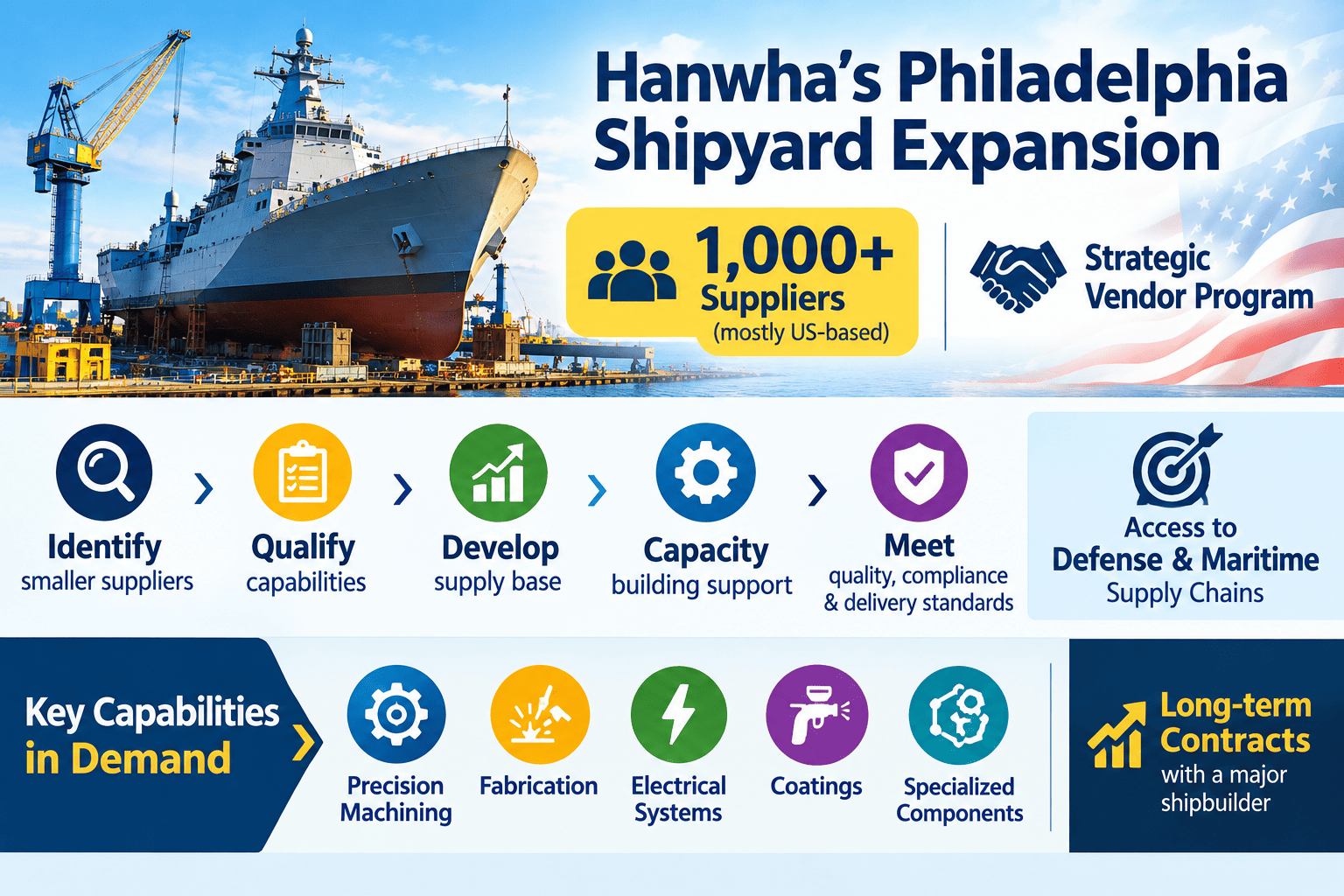
Hanwha’s Philadelphia shipyard expansion is expected to rely on more than 1,000 suppliers, mostly US-based, while a new Strategic Vendor Program is being developed to help smaller businesses scale into defense and maritime supply chains. The program targets manufacturers capable of meeting the quality, compliance, and capacity requirements of large-scale shipbuilding.
🎯 Direct Answer
Hanwha’s Philadelphia shipyard expansion is expected to rely on more than 1,000 suppliers, mostly US-based, while a new Strategic Vendor Program is being developed to help smaller businesses scale into supply chains. The program is designed to identify, qualify, and develop smaller US manufacturers capable of supplying components, services, and subsystems for large-scale shipbuilding and defense projects. This initiative represents a significant opportunity for smaller manufacturers to enter defense and maritime supply chains that have historically been difficult to access. The Strategic Vendor Program provides supplier development support, qualification pathways, and capacity-building assistance to help smaller businesses meet the rigorous quality, compliance, and delivery standards required by large defense contractors. For manufacturers with relevant capabilities — precision machining, fabrication, electrical systems, coatings, and specialized components — this program opens a route to long-term contracts with a major shipbuilder.
📅 August 11, 2026⏱ 16 min read✍️ GTsetu Editorial Team📰 News + Analysis
Supplier Network
1,000+
US-based suppliers expected for Hanwha Philadelphia expansion
Program Focus
Smaller Manufacturers
Strategic Vendor Program designed for smaller business scale-up
Sector Focus
Defense & Maritime
Shipbuilding, defense manufacturing, and industrial supply chains
Tie-Up Type
Manufacturer / Services
Supplier development and services partnerships
Section 1 — The News
1
The Full Story: 1,000+ Suppliers & the Strategic Vendor Program
🏭
News Announced — August 11, 2026
US Strategic Vendor Program Opens Supply-Chain Opportunities for Smaller Manufacturers
Hanwha’s Philadelphia shipyard expansion is expected to rely on more than 1,000 suppliers, mostly US-based, while a new Strategic Vendor Program is being developed to help smaller businesses scale into supply chains. The program represents a significant opportunity for smaller US manufacturers to enter defense and maritime supply chains that have historically been difficult to access.
The Strategic Vendor Program is designed to identify, qualify, and develop smaller US manufacturers capable of supplying components, services, and subsystems for large-scale shipbuilding and defense projects. It provides supplier development support, qualification pathways, and capacity-building assistance to help smaller businesses meet the rigorous quality, compliance, and delivery standards required by large defense contractors.
For manufacturers with relevant capabilities — precision machining, fabrication, electrical systems, coatings, and specialized components — this program opens a route to long-term contracts with a major shipbuilder. The 1,000+ supplier network creates a substantial supply chain ecosystem that smaller manufacturers can enter through the Strategic Vendor Program.
1,000+
US suppliers expected to support Hanwha Philadelphia expansion
SVP
Strategic Vendor Program for smaller manufacturer scale-up
Defense
Maritime and defense supply chain opportunity for US manufacturers
US-Based
Mostly US-based supplier network for domestic manufacturing
“The Strategic Vendor Program is designed to help smaller manufacturers scale into our supply chain. We need suppliers who can meet defense-grade quality and delivery standards, and we’re willing to invest in developing that capability.”
— Hanwha Philadelphia Shipyard Representative, August 2026
“For smaller US manufacturers, this is a once-in-a-generation opportunity to enter the defense supply chain. The program provides a structured pathway that didn’t exist before.”
— US Manufacturing Supply Chain Expert, August 2026
The Strategic Vendor Program represents a structural shift in how large defense contractors engage with smaller manufacturers. Instead of requiring suppliers to already meet all requirements, the program invests in developing supplier capability. For smaller manufacturers, this is an opportunity to enter a supply chain that has historically been closed to them. For large contractors, it builds a more resilient, domestic supplier base. GTsetu connects manufacturers with verified supply chain partners across 100+ countries, enabling the kind of supplier development and qualification that programs like the Strategic Vendor Program require. Find verified manufacturing partners →
Section 2 — The Anatomy
2
What Each Partner Brings to the Table
Like every successful supply chain partnership, the Strategic Vendor Program works because each party contributes what the other cannot efficiently replicate. This complementarity principle is the foundation of any supplier development program worth entering.
🏭 Target: 1,000+ US-based suppliers for shipyard expansion
📋 Program: Strategic Vendor Program for smaller manufacturers
🇺🇸 Focus: Domestic supply chain resilience and manufacturing
Section 3 — Why This Works
3
Why This Supplier Development Model Works
🎯 The Core Logic
The Strategic Vendor Program succeeds because it addresses three systemic barriers that have historically prevented smaller manufacturers from entering defense supply chains: (1) Qualification complexity — defense-grade quality and compliance requirements are difficult for smaller manufacturers to navigate alone; (2) Capacity gaps — smaller manufacturers often lack the production capacity or systems to meet large-scale demand; and (3) Access barriers — without existing relationships, smaller manufacturers struggle to get noticed by large contractors. By providing structured supplier development support, qualification pathways, and capacity-building assistance, the program de-risks the supplier qualification process for both parties and creates a pipeline of qualified smaller suppliers for the shipyard.
Why US Defense & Maritime Supply Chain Development Is Accelerating
1,000+
US suppliers expected for Hanwha Philadelphia expansion
Resilience
Domestic supply chain resilience is a national priority
Smaller manufacturers targeted for supplier development
Shipbuilding
Maritime and shipbuilding supply chain expansion
Program
Strategic Vendor Program creates structured qualification pathway
Section 4 — US Supply Chain Opportunity
4
US Defense & Maritime Supply Chain Opportunity
🇺🇸 US Manufacturing & Defense Supply Chain 2026
Why Smaller US Manufacturers Should Engage with the Strategic Vendor Program Now
The Hanwha Philadelphia shipyard expansion represents one of the largest shipbuilding supply chain opportunities in the US in decades. With 1,000+ suppliers needed, mostly US-based, the program creates a substantial pipeline for smaller manufacturers with relevant capabilities. Defense and maritime supply chains have historically been difficult for smaller manufacturers to enter — the qualification requirements, compliance standards, and relationship barriers are significant. The Strategic Vendor Program addresses these barriers directly, creating a structured pathway for smaller manufacturers to qualify and scale into the supply chain. For manufacturers with precision machining, fabrication, electrical systems, coatings, and specialized component capabilities, this is a significant opportunity to enter a long-term, high-value supply chain.
1,000+
US-based suppliers expected for the Philadelphia shipyard expansion
SVP
Strategic Vendor Program for smaller manufacturer scale-up
Defense
Defense-grade quality and compliance requirements
Resilience
Domestic supply chain resilience as a national priority
SMEs
Smaller manufacturers targeted for supplier development
Shipbuilding
Maritime and shipbuilding supply chain expansion
🏭 GTsetu for Manufacturing & Supply Chain Collaboration
GTsetu’s verified partner network includes manufacturers, industrial service providers, and supply chain partners across the US and 100+ countries. Every company on GTsetu is verified on 6 government-sourced points: Name, Address, Registration Number, Company Status, Company Type, and Date of Certificate of Incorporation. If you’re a smaller manufacturer seeking supply chain opportunities, or a large contractor seeking qualified suppliers, GTsetu is where your partner search begins with verified profiles, not cold calls. Find manufacturing partners →
Section 5 — Types of Collaboration
5
4 Types of Manufacturer / Services Partnerships — Which Fits Your Situation?
The Strategic Vendor Program is a Manufacturer / Services Partnership model — a large contractor developing smaller suppliers to meet its production needs. But manufacturer and services partnerships come in many forms. The right structure depends on what you need, what you can invest, and what market you’re targeting.
01
Manufacturer / Services Partnership
A large manufacturer or contractor partners with smaller suppliers to meet production or service needs. The Hanwha Strategic Vendor Program model. Best when a large contractor needs to develop a domestic supplier base and smaller manufacturers need supply chain access.
🏭 Hanwha Strategic Vendor Program
02
Supplier Development Program
A structured program to identify, qualify, and develop smaller suppliers. The Strategic Vendor Program specifically. Best when a large contractor wants to expand its supplier base with smaller, agile manufacturers.
📋 Supplier development
03
Contract Manufacturing
A large contractor engages a smaller manufacturer to produce components or subsystems to specification. Best when the contractor needs specialized manufacturing capability without developing it in-house.
⚙️ Production partnership
04
Supply Chain Integration
Smaller manufacturers integrate into a larger contractor’s supply chain as qualified suppliers. The outcome of successful supplier development. Best when the supplier has demonstrated capability and wants long-term supply relationships.
🔗 Supply chain integration
📊 Collaboration Model Comparison — Manufacturer / Services Partnerships
Model
Capital Required
Capability Development
Supply Chain Access
Speed to Execute
Reversibility
Manufacturer/Services
Low (qualification costs)
✓ High
✓ High
Moderate (6–12 months)
Moderate
Supplier Development
Moderate (program investment)
✓ Maximum
✓ High
Slow (12–24 months)
Low
Contract Mfg
Low (tooling/production)
~ Moderate
✓ High
Fast (3–6 months)
High
Supply Chain Integration
Low (ongoing supply)
~ Moderate
✓ Maximum
Moderate (6–12 months)
Moderate
Section 6 — How to Become a Strategic Vendor
6
How to Become a Strategic Vendor: A 5-Step Playbook
The Strategic Vendor Program demonstrates how large contractors and smaller manufacturers can collaborate to build supply chain capacity. Here is the distilled playbook for smaller manufacturers seeking to become strategic vendors.
1
Assess Your Capability and Fit for the Supply Chain
Before engaging, assess your manufacturing capability against the requirements of the shipyard supply chain. Do you have precision machining, fabrication, electrical systems, coatings, or specialized component capabilities? What is your production capacity? Can you meet defense-grade quality and delivery standards? Define your capability gap precisely: what do you need to develop to qualify? GTsetu’s partner discovery process starts with this capability mapping.
2
Engage with the Strategic Vendor Program
The crucial first step is engaging with the Strategic Vendor Program. Identify the program’s entry points: supplier registration portals, qualification events, industry days, or direct engagement with the shipyard’s supplier development team. The program provides structured pathways for smaller manufacturers to begin the qualification process. Early engagement is critical — the 1,000+ supplier slots are being filled now.
3
Protect Your IP and Commercial Information
Supply chain qualification involves sharing sensitive commercial information: pricing, capacity data, process specifications, and proprietary manufacturing methods. Before sharing anything sensitive, execute a mutual NDA. GTsetu’s built-in NDA workflow handles this automatically: mutual NDA executed and countersigned before any sensitive information is shared, with a full digital audit trail.
4
Complete the Qualification and Development Process
The Strategic Vendor Program provides supplier development support and qualification pathways. This may include: capability assessments, quality system audits, process certifications, capacity-building support, and production trials. Engage actively with the program’s development resources — the goal is to help you meet the required standards, not to filter you out. Document your progress and address any non-conformities promptly.
5
Move Now — Supply Chain Positions Are Being Allocated
The supply chain opportunity is largest for manufacturers that enter the qualification process early, before the 1,000+ supplier slots are filled and preferred supplier statuses are established. For smaller manufacturers, early engagement provides more time for capability development before contracts are awarded. The companies that wait for the supply chain to be fully established before engaging will find that early movers have already secured preferred supplier positions. GTsetu’s verified partner network enables rapid identification and engagement with the right manufacturing counterparty.
Section 7 — Dos and Don’ts
7
Dos and Don’ts of Supplier Qualification
✅ Do These
✅ Engage early with the Strategic Vendor Program — supplier slots are being filled now
✅ Assess your capability gap honestly and identify what development you need
✅ Execute NDA before sharing pricing, capacity data, or process specifications
✅ Invest in quality system certifications and defense-grade compliance
✅ Use the program’s development resources — they are designed to help you qualify
✅ Document your quality system and production records thoroughly
✅ Use verified platforms like GTsetu to find manufacturing partners and supply chain connections
✅ Build relationships with prime contractors and Tier 1 suppliers in the shipyard supply chain
❌ Avoid These
❌ Assume your current capability is sufficient without assessing against defense requirements
❌ Share sensitive commercial information before NDA is executed
❌ Neglect quality system documentation — it is essential for defense-grade qualification
❌ Wait until the supply chain is fully established to begin the qualification process
❌ Underestimate the compliance and quality requirements of defense supply chains
❌ Rely on unverified intermediaries who cannot demonstrate their supply chain connections
❌ Ignore capacity constraints — the shipyard needs suppliers who can scale with demand
❌ Overlook the importance of domestic content and Buy American requirements
Section 8 — Misconceptions
8
Common Misconceptions That Kill Supply Chain Deals
❌ Myth
“Defense supply chains are only for large manufacturers — smaller businesses can’t compete.”
✅ Reality
The Strategic Vendor Program is specifically designed for smaller manufacturers. Defense supply chains need agile, specialized suppliers, and programs like this provide the qualification and development pathways that smaller manufacturers need to enter. The 1,000+ supplier network creates substantial opportunities for businesses of all sizes.
❌ Myth
“If I have a good product, I don’t need to worry about qualification programs.”
✅ Reality
Defense supply chains require documented quality systems, compliance certifications, and qualification processes. A good product is necessary but not sufficient. The Strategic Vendor Program provides the structured pathway that connects product capability with supply chain requirements.
❌ Myth
“I can enter the supply chain later — the opportunity will still be there.”
✅ Reality
Supply chain positions are being allocated now. Early movers will establish preferred supplier status, making it harder for late entrants to compete for contracts. The qualification process takes time — starting early provides more opportunity for capability development before contracts are awarded.
❌ Myth
“Qualification is a one-time process — once I’m approved, I’m in.”
✅ Reality
Supplier qualification requires ongoing compliance and performance. Quality systems must be maintained, audits passed, and delivery performance sustained. The Strategic Vendor Program supports development, but ongoing compliance is the supplier’s responsibility.
❌ Myth
“I don’t need to worry about IP protection when dealing with a large contractor.”
✅ Reality
Supply chain qualification involves sharing sensitive commercial and technical information. Always execute a mutual NDA before sharing pricing, process specifications, or proprietary manufacturing methods. GTsetu’s built-in NDA workflow protects your IP from the first conversation.
Section 9 — GTsetu
9
How GTsetu Helps You Find Manufacturing & Supply Chain Partners
The Strategic Vendor Program connects smaller manufacturers to a large contractor’s supply chain. Most manufacturers are not that fortunate — and even when opportunities exist, identifying the right manufacturing partner or supply chain connection requires systematic evaluation. GTsetu is the verified B2B manufacturing discovery platform that enables this evaluation at scale, across 100+ countries, before you share a single confidential detail.
🌐 Platform Spotlight — GTsetu
Find Verified Manufacturers, Industrial Service Providers, and Supply Chain Partners Across 100+ Countries — Anonymously, Securely, With Zero Broker Fees
Every company on GTsetu is verified using government tie-ups on 6 key points: Name, Address, Registration Number, Company Status, Company Type, and Date of Certificate of Incorporation. This is the foundation of trust. Additional information such as manufacturing capabilities, certifications, production capacity, and supply chain experience is self-reported by companies. You evaluate who is real before you engage. You share nothing sensitive until an NDA is countersigned. And you pay no broker commission on any collaboration formed — the deal is entirely between you and your partner.
✅
6-Point Government-Sourced VerificationName, Address, Registration Number, Company Status, Company Type, Date of Incorporation confirmed using government tie-ups.
🕵️
Anonymous DiscoveryEvaluate verified partner profiles without revealing your identity until mutual interest is confirmed.
📄
Built-In NDA WorkflowShare manufacturing specs and production data only after NDA is executed — full audit trail, no external legal required.
🚫
Zero CommissionNo broker fees — your manufacturing partnership, services agreement, or supply chain collaboration is entirely between you and your partner.
🌍
100+ CountriesUSA, Europe, Asia, and beyond — find manufacturing partners and service providers in every ecosystem.
🔐
Encrypted CollaborationShare manufacturing specifications, production data, and contract terms securely between verified partners.
The Strategic Vendor Program is a supplier development initiative being developed in connection with Hanwha’s Philadelphia shipyard expansion. It aims to help smaller US businesses scale into the shipyard’s supply chain, which is expected to rely on more than 1,000 suppliers, mostly US-based. The program provides supplier development support, qualification pathways, and capacity-building assistance to help smaller manufacturers meet defense-grade quality, compliance, and delivery standards.
Q
How can smaller manufacturers participate in the Hanwha Philadelphia supply chain?
Smaller manufacturers can participate by qualifying for the Strategic Vendor Program, which provides supplier development support. Companies need to demonstrate manufacturing capabilities relevant to shipbuilding and defense, meet quality and compliance standards, and engage with the program’s supplier qualification process. Early engagement is critical — the 1,000+ supplier slots are being filled now. Manufacturers with precision machining, fabrication, electrical systems, coatings, and specialized component capabilities are particularly well-positioned.
Q
What capabilities are needed to qualify as a supplier?
The specific capabilities depend on the components or services required. Key capability areas include: precision machining, metal fabrication, electrical systems and wiring, coatings and surface treatment, specialized components, and assembly services. Suppliers must also meet defense-grade quality and compliance requirements, including quality management system certifications, production capacity sufficient for large-scale demand, and delivery reliability. The Strategic Vendor Program provides development support to help smaller manufacturers build these capabilities.
Q
How can manufacturers find supply chain partners and opportunities?
The systematic approach involves four steps: (1) Assess your manufacturing capability and fit for the supply chain; (2) Search verified platforms — GTsetu lists verified manufacturers, industrial service providers, and supply chain partners across the US and 100+ countries; (3) Evaluate anonymously first — review verified profiles and self-reported capabilities before revealing your identity; (4) Execute NDA before any sensitive disclosure — GTsetu’s built-in NDA workflow protects your manufacturing data.
Q
Is the Strategic Vendor Program model replicable in other defense supply chains?
Yes. The Strategic Vendor Program model — large contractor develops smaller suppliers through structured qualification and capacity-building — is replicable across defense supply chains. The key elements are: (1) A large contractor with significant supply chain demand; (2) A structured supplier development program with qualification pathways; (3) Capacity-building support for smaller manufacturers; and (4) A commitment to domestic supply chain resilience. This model is increasingly relevant as defense contractors seek to expand and diversify their supplier bases.
Q
Does GTsetu charge commission on manufacturing partnerships formed through the platform?
No. GTsetu charges zero commission on any collaboration — whether a manufacturing partnership, supplier agreement, supply chain collaboration, or services contract — formed through the platform. The commercial terms of your agreement are entirely between you and your partner. Learn more about GTsetu →
Ready to Find Your Manufacturing Partner? Start on GTsetu.
500+ verified manufacturers, industrial service providers, and supply chain partners across the US and 100+ countries. Zero broker fees. Anonymous discovery. Built-in NDA workflows. Your next manufacturing partnership starts with a verified profile — not a cold call.
Business Development Expert | Global Trade & Cross-Border Partnerships
Lui Wang is a Business Development Expert at GTsetu, specializing in international trade, cross-border partnerships, and market expansion strategies. With extensive experience working across diverse business ecosystems, Lui helps companies identify growth opportunities, establish strategic collaborations, and navigate the complexities of global commerce.
His expertise spans manufacturing, supply chain partnerships, technology collaborations, market entry strategies, and international business development. Through GTsetu, Lui works closely with businesses, trade organizations, and industry stakeholders to facilitate meaningful connections that drive sustainable growth across regions and sectors.
Lui is particularly passionate about helping organizations build long-term international partnerships, unlock new markets, and strengthen their global competitiveness in an increasingly interconnected economy.