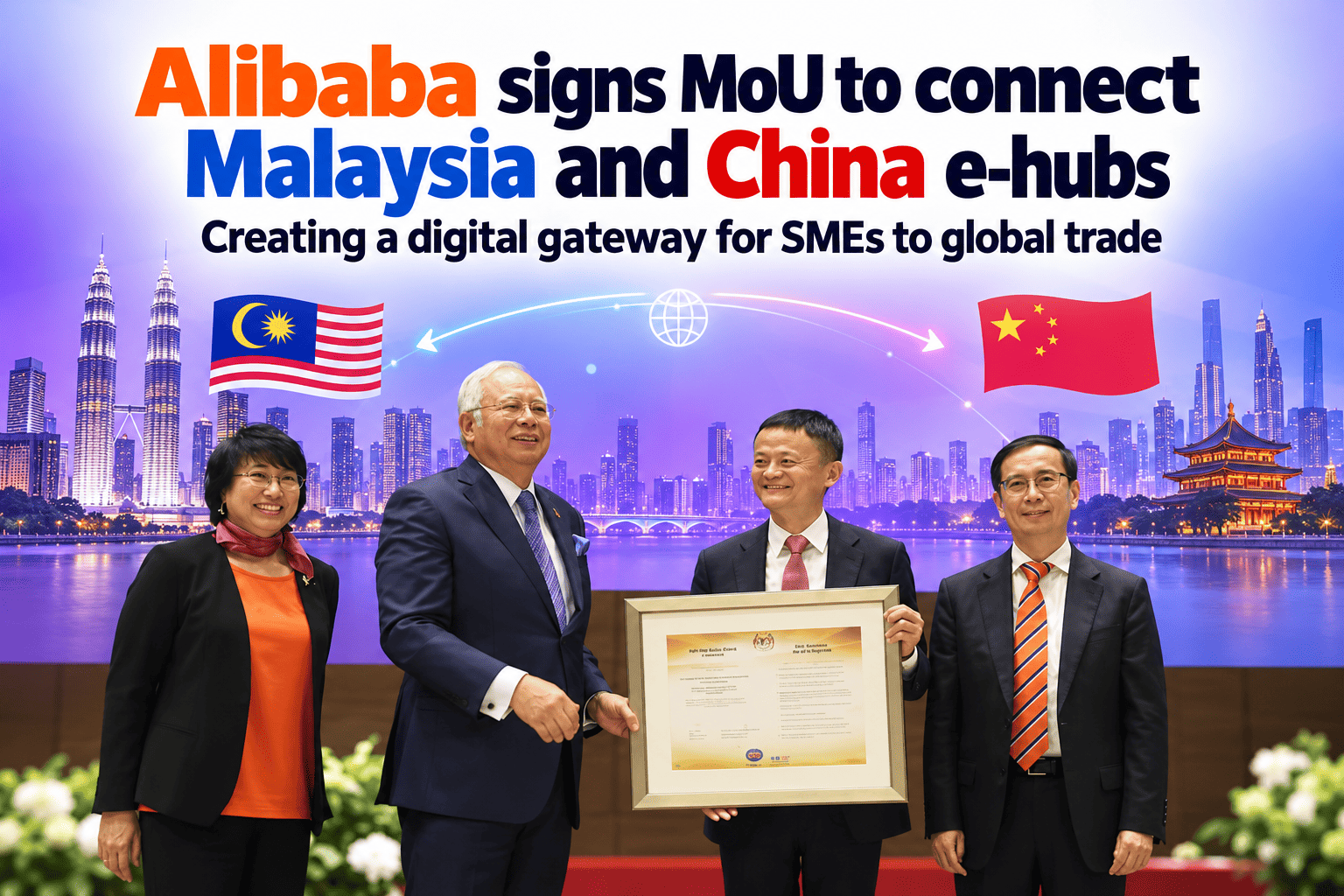
MDEC × Alibaba × Hangzhou: Malaysia’s SMEs Get a Digital Gateway to China’s E-Commerce Ecosystem
🔴 BREAKINGMDEC × Alibaba × Hangzhou: MoU signed to connect Malaysia’s DFTZ with China’s e-commerce pilot zone under eWTP◆Malaysia becomes first country outside China to establish an eWTP e-hub, a digital gateway to global trade for SMEs◆Alibaba Cloud opens Malaysia data centre; Cainiao + Lazada + Pos Malaysia build regional e-fulfilment hub near KLIA◆Find verified cross-border trade and technology partners on GTsetu, 100+ countries, zero commission◆🔴 BREAKINGMDEC × Alibaba × Hangzhou: MoU signed to connect Malaysia’s DFTZ with China’s e-commerce pilot zone under eWTP◆Malaysia becomes first country outside China to establish an eWTP e-hub, a digital gateway to global trade for SMEs◆Alibaba Cloud opens Malaysia data centre; Cainiao + Lazada + Pos Malaysia build regional e-fulfilment hub near KLIA◆Find verified cross-border trade and technology partners on GTsetu, 100+ countries, zero commission◆
Home › Blog › MDEC × Alibaba × Hangzhou Collaboration
🔴 Breaking News💻 Electronics & Technology🌏 ASEAN Maritime🇨🇳 China Cross-Border
MDEC × Alibaba × Hangzhou: How a Trilateral MoU Is Building Malaysia’s Digital Gateway to China’s E-Commerce Ecosystem
Malaysia’s Digital Economy Corporation, Alibaba Group, and the Hangzhou Municipal Government signed a Memorandum of Understanding to connect the China (Hangzhou) Cross-Border E-Commerce Comprehensive Pilot Zone with Malaysia’s Digital Free Trade Zone (DFTZ). Under the Electronic World Trade Platform (eWTP), Malaysian SMEs gain seamless access to China’s e-commerce ecosystem, easier customs clearance, streamlined permits, and a digital gateway to global markets.
🎯 Direct Answer
Alibaba Group has signed a Memorandum of Understanding (MoU) with the Malaysia Digital Economy Corporation (MDEC) and the Hangzhou Municipal Government to connect the first e-hubs in Malaysia and China under the Electronic World Trade Platform (eWTP) initiative. The MoU links China’s (Hangzhou) Cross-Border E-Commerce Comprehensive Pilot Zone, which Alibaba helped establish, with Malaysia’s Digital Free Trade Zone (DFTZ), established by Alibaba and MDEC in March 2017. By leveraging Alibaba’s internet and data technologies, the parties will facilitate cooperation between public and private enterprises in Hangzhou and Malaysia to provide easier access to customs clearance, inspection, and permit issuance for SMEs doing cross-border trade. This marks Malaysia as the first country outside China to establish an eWTP e-hub, creating a digital gateway to global trade for Malaysian SMEs. The eWTP initiative was proposed by Jack Ma in 2016 and was accepted as a major policy recommendation of the Business 20 (B20), officially included in the 2016 G20 Leaders’ Communique.
📅 May 12, 2017 (Announced) / May 2026 (Updated Analysis)⏱ 15 min read✍️ GTsetu Editorial Team📰 News + Analysis
Deal Type
MoU
Trilateral Memorandum of Understanding under the eWTP framework
e-Hub Status
1st Overseas
Malaysia is the first country outside China to establish an eWTP e-hub
Partners
3-Way
MDEC + Alibaba Group + Hangzhou Municipal Government
SME Onboarded
1,998
Malaysian SMEs onboarded through Alibaba.com platform initiative
Section 1, The News
1
The Full Story: MDEC × Alibaba × Hangzhou
🌏
MoU Signed, May 12, 2017, Hangzhou, China
Alibaba Signs MoU with MDEC and Hangzhou Municipal Government to Connect Malaysia’s DFTZ with China’s E-Commerce Pilot Zone Under eWTP
In May 2017, Alibaba Group announced the signing of a Memorandum of Understanding with Malaysia Digital Economy Corporation (MDEC) and the Hangzhou Municipal Government to connect the first e-hubs in the two countries under the Electronic World Trade Platform (eWTP).
The agreement aims to connect China (Hangzhou) Cross-Border E-Commerce Comprehensive Pilot Zone, the first domestic e-hub, which Alibaba Group played a key role in establishing, with the Digital Free Trade Zone (DFTZ) in Malaysia, established by Alibaba and MDEC in March 2017 as pilot implementation towards building an e-road for global trade.
By leveraging Alibaba’s internet and data technologies, the parties will facilitate cooperation between public and private enterprises in Hangzhou and Malaysia to provide easier access to customs clearance, inspection, and permit issuance for SMEs to do cross-border trade. The MoU was witnessed by the Prime Minister of Malaysia, Dato’ Sri Mohd Najib Tun Abdul Razak, Secretary of the Communist Party of China’s Zhejiang Provincial Committee, Che Jun, and Alibaba Group Executive Chairman Jack Ma.
May 2017
Tripartite MoU signed in Hangzhou, witnessed by PM Najib and Jack Ma
1st Overseas
Malaysia is the first country outside China to establish an eWTP e-hub
eWTP
Electronic World Trade Platform, a B20 recommendation included in 2016 G20 Communique
DFTZ
Malaysia’s Digital Free Trade Zone, established by Alibaba and MDEC in March 2017
“Fostering closer partnership with China is imperative to sustaining our economic growth, and e-business and commerce is clearly the future of global trade. It is therefore exciting to witness the forming of a partnership between government and reputable private enterprises, who will work together to lay the foundation for a more efficient conduct of cross-border trade in the Internet age, to the benefit of all.”
— Dato’ Sri Mohd Najib Tun Abdul Razak, Prime Minister of Malaysia
“E-commerce is becoming increasingly globalized and it is transforming the way commerce is conducted. With the creation of eWTP, we and partners will build the infrastructure to empower SMEs and young entrepreneurs to succeed in this era of data technology. Today’s announcement has opened up a gateway to global success for small businesses in the two countries.”
— Jack Ma, Executive Chairman, Alibaba Group
💡 GTsetu Perspective
This collaboration represents the gold standard of cross-border digital trade partnerships: a government agency (MDEC) providing institutional credibility and regulatory access, a technology giant (Alibaba) providing the platform, logistics, cloud, and payment infrastructure, and a municipal government (Hangzhou) providing access to China’s largest cross-border e-commerce pilot zone. For Malaysian SMEs, this means more than just a faster customs process, it means direct access to China’s massive consumer market through Alibaba’s ecosystem. For manufacturers and exporters across ASEAN, this is the model to study: how do you find a technology partner with the platform, relationships, and infrastructure to unlock an entirely new market?
The Electronic World Trade Platform (eWTP) is not just a trade agreement, it is a fundamentally different approach to enabling global commerce for small businesses. Proposed by Jack Ma in 2016, it was accepted as a major policy recommendation of the Business 20 (B20) and officially included in the 2016 G20 Leaders’ Communique.
🌐 eWTP, Guiding Principles
📉
Lower Trade Barriers
Removing regulatory and procedural obstacles for smaller firms and emerging nations to participate in global trade.
🔗
Shorter Supply Chains
Direct connections between producers and consumers reduce costs and increase efficiency for SMEs.
⚡
Increased Efficiencies
Digital infrastructure streamlines customs clearance, inspection, permit issuance, and payment processes.
🤝
Public-Private Partnership
Governments and private enterprises work together to build the infrastructure for inclusive global trade.
🌍
Complementing WTO
eWTP works alongside the World Trade Organization, not replacing it, reducing barriers that WTO cannot address at the SME level.
📊
Data Technology
Leveraging cloud computing, big data, and IoT to empower SMEs with enterprise-grade capabilities.
⚙️ Why SMEs Need eWTP
The benefits of increased trade and globalization have not reached smaller enterprises and developing countries as much as they have reached large corporations. SMEs face disproportionate barriers: complex customs procedures, limited access to logistics infrastructure, difficulty securing trade financing, and lack of market intelligence. The eWTP directly addresses these barriers through digital infrastructure that levels the playing field. For Malaysian SMEs, this means they can compete in global markets using the same platform, logistics, and payment rails as large corporations, without needing to build their own international infrastructure.
Section 3, Infrastructure
3
The Infrastructure: From Cloud to Fulfilment
The MoU is not a standalone agreement, it is the connective tissue for a comprehensive infrastructure build-out that spans cloud computing, logistics, payment, and talent development. Understanding this stack is essential to understanding the collaboration’s real value.
🏗️ The eWTP Infrastructure Stack, Malaysia Deployment
Cloud
Alibaba Cloud Data Centre, Malaysia
Alibaba Cloud established a local data centre in Malaysia, becoming the first global public cloud platform in the country. The centre provides enterprises in Malaysia and the region with scalable, cost-effective cloud capabilities to support global expansion. Alibaba Cloud also participates in the Malaysia Multimedia Super Corridor initiatives and offers certification programs for local tech talent.
Logistics
Regional E-Fulfilment Hub near KLIA
A logistics hub situated near Kuala Lumpur International Airport functions as a centralized customs clearance, warehousing, and fulfilment facility for Malaysia and the region. Developed by Malaysia Airports Holdings Berhad and Cainiao (Alibaba’s logistics affiliate) through a joint venture, it delivers faster clearance for imports and exports. Lazada and Pos Malaysia also collaborate on a regional e-commerce distribution centre.
Platform
One-Stop Cross-Border Trading Services Platform
Connected to Alibaba’s OneTouch platform, it links Malaysia directly to the e-commerce pilot area in Hangzhou, China, enabling SMEs to trade conveniently and efficiently between the two countries. A Malaysia Pavilion on Alibaba.com promotes quality Malaysian products to global buyers.
Payments
E-Payment & Financing Cooperation
Ant Financial expanded partnerships to six local banks and financial institutions for e-payment, initially focusing on inbound Chinese tourism and promoting trade by Malaysian SMEs. Alipay+ has since become the dominant cross-border payment platform in Malaysia, processing over 80% of inbound QR payments through DuitNow QR.
Talent
E-Talent Development Programs
Alibaba Business School established the Alibaba Netpreneur Training Programme in collaboration with MDEC, Matrade, and SME Corp Malaysia. The 10-day program conducted at Alibaba’s headquarters in Hangzhou provides Malaysian entrepreneurs with fundamental understanding of the digital economy and insights on Alibaba’s ecosystem evolution. Over 1,000 students from Malaysian universities have participated in B2B ecommerce curriculum, and almost 140 faculty members have completed Train the Trainers programs.
🔑 Key Insight: The Power of Full-Stack Collaboration
What makes the MDEC × Alibaba × Hangzhou collaboration powerful is that it is not a single-point agreement. It is a full-stack deployment, cloud infrastructure, logistics, platform, payments, and talent development, all integrated under a single strategic framework. Each layer reinforces the others: the cloud enables the platform, the platform enables the logistics, the logistics enables the trade, the payments facilitate the transactions, and the talent programs ensure sustainability. This is the blueprint for any serious cross-border trade collaboration: don’t just sign one agreement, build an integrated infrastructure stack.
Section 4, The Anatomy
4
What Each Partner Brings to the Table
Like every successful multi-party collaboration, the MDEC × Alibaba × Hangzhou deal works because each party contributes what the others cannot efficiently replicate. This complementarity principle is the foundation of any collaboration worth entering.
Collaboration Anatomy, Trilateral MoU Structure
MDEC
🇲🇾 Malaysia
Role
Gov Agency
Brings
Regulatory access + DFTZ
Lacks
Platform & logistics tech
+
Alibaba
🇨🇳 China
Role
Tech Provider
Brings
Platform + cloud + logistics + payments
Lacks
Regulatory authority in Malaysia
+
Hangzhou
🇨🇳 China
Role
Gov Partner
Brings
Pilot Zone access
Lacks
Global platform reach
🎯 Target: Seamless Malaysia-China cross-border e-commerce for SMEs
🏗️ First eWTP e-hub outside China
📈 Full-stack infrastructure deployment
Collaboration Dimension
MDEC Provides
Alibaba Provides
Hangzhou Provides
Regulatory Access
Malaysia digital economy policy & DFTZ governance
Platform compliance frameworks
China cross-border pilot zone regulatory framework
Technology Infrastructure
Digital economy development framework
Cloud, e-commerce platform, logistics, payments
E-commerce pilot zone infrastructure
Market Access
Malaysian SME network & export promotion
Global buyer network via Alibaba.com
China market access via Hangzhou pilot zone
Talent Development
Local training coordination with SME Corp
Alibaba Business School programs
Hangzhou training facilities & expertise
Credibility
Government endorsement for Malaysian SMEs
Global platform trust & track record
Municipal government backing for trade infrastructure
5
Why This Collaboration Model Works for Cross-Border Digital Trade
🎯 The Core Logic
The MDEC × Alibaba × Hangzhou collaboration succeeds because it is built on three interlocking strategic advantages: government-backed regulatory access, full-stack technology infrastructure, and market-timing alignment with ASEAN’s accelerating digital economy. Neither party could have achieved the same result through any other mechanism, MDEC cannot independently build a global e-commerce platform, and Alibaba cannot independently navigate Malaysia’s regulatory and trade landscape. The trilateral structure ensures both public-sector legitimacy and private-sector innovation.
Why Malaysia-China Digital Trade Collaboration Is Accelerating
RM8.24B
Alipay+ transaction value in Malaysia in 2025, up 89.6% from RM4.35B in 2024
80%+
Share of cross-border inbound QR payments in Malaysia processed through Alipay+ via DuitNow QR
1,998
Malaysian SMEs onboarded through Alibaba.com platform joint initiative
2.5M+
DuitNow QR acceptance points across Malaysia enabled for cross-border payments
15 apps
International payment apps now work via DuitNow QR for inbound travelers in Malaysia
35.6M
Target international visitors for Visit Malaysia 2026, driving SME digital payment volume
Section 6, Malaysia Digital Trade
6
Malaysia’s Digital Trade Opportunity, Why Now Is the Time to Collaborate
🇲🇾 Malaysia Digital Economy 2026
Why Every SME and Manufacturer Should Be Building Digital Trade Capabilities Now
Malaysia’s digital economy is accelerating rapidly, driven by government initiatives like MDEC’s digital transformation programs, Alibaba’s eWTP infrastructure, and Ant International’s payment ecosystem expansion. The collaboration between MDEC, Alibaba, and Hangzhou is not just a historical agreement, it is an active infrastructure that continues to generate value for Malaysian SMEs today. From cloud computing to cross-border payments, the digital rails are built. The question for SMEs and manufacturers is: are you using them?
Digital
Malaysia’s digital economy is a key pillar of national transformation under MDEC
Alipay+
Cross-border payment platform with over 80% share of inbound QR payments in Malaysia
DFTZ
Digital Free Trade Zone, Malaysia’s national platform for cross-border e-commerce
KLIA
Location of the regional e-fulfilment hub connecting Malaysia to global trade routes
SME
Malaysian SMEs are the primary beneficiaries of the eWTP infrastructure build-out
Hangzhou
China’s e-commerce capital, home to Alibaba HQ and the cross-border pilot zone
🌐 GTsetu for Digital Trade Collaboration
GTsetu’s verified partner network includes technology platforms, e-commerce enablers, logistics providers, payment solution companies, and digital infrastructure partners across Malaysia, China, and 100+ other countries. Every company on GTsetu is verified using government tie-ups on 6 key points: Name, Address, Registration Number, Company Status, Company Type, and Date of Certificate of Incorporation. If you’re a Malaysian SME looking to build cross-border trade capabilities, or a technology company seeking partners in ASEAN’s digital economy, GTsetu is where your partner search begins with verified profiles, not cold calls. Find digital trade partners →
7
4 Types of Cross-Border Collaboration, Which Fits Your Situation?
MDEC, Alibaba, and Hangzhou used a trilateral MoU, but the right collaboration structure depends on your objectives, resources, and risk tolerance. Here are the four primary models for cross-border digital trade and technology partnerships.
01
Platform / API Integration
One party integrates its systems with another’s platform via APIs, enabling data flow and process automation. The MDEC × Alibaba model, connecting DFTZ with Alibaba’s OneTouch platform. Fast to deploy, low capital, high scalability. Ideal when you need access to an existing ecosystem rather than building your own.
🔌 MDEC × Alibaba × Hangzhou
02
Joint Venture (JV)
A new shared legal entity co-owned by both parties. Deepest integration, full profit and risk sharing. The Cainiao × Malaysia Airports model for the e-fulfilment hub. Best for long-term infrastructure when both parties have large complementary assets and want permanent shared ownership.
🏗️ Cainiao × MAHB e-Fulfilment Hub
03
Distribution Partnership
You manufacture; a local partner sells and services in their market. Lightest form of cross-border collaboration. Often the first step before a deeper manufacturing or platform agreement in a new geography. Tests demand before capital is committed.
🌍 Market entry, step 1
04
Talent & Knowledge Partnership
A structured program for training, certification, and knowledge transfer. The Alibaba Business School × MDEC Netpreneur model. Builds long-term capability and ecosystem sustainability. Often complements other collaboration types.
📚 Alibaba Netpreneur Training
📊 Collaboration Model Comparison, Cross-Border Digital Trade
8
How to Collaborate: A 5-Step Playbook for Cross-Border Digital Trade
The MDEC × Alibaba × Hangzhou deal followed a deliberate progression, from initial partnership to full infrastructure deployment. Here is the distilled playbook for SMEs and manufacturers seeking cross-border digital trade collaboration.
1
Define Your Market Gap with Precision
MDEC knew exactly what Malaysian SMEs needed: access to China’s e-commerce ecosystem without building their own platform, logistics, or payment infrastructure. They didn’t need to become an e-commerce company, they needed a partner who already had the platform, the cloud, the logistics, and the relationships. Define your gap that precisely. Vague needs produce vague partner searches and failed negotiations.
2
Find Verified Technology Partners, Not Just Any Partner
The crucial word is “verified.” Alibaba was not a random contact, MDEC approached the company with a proven track record in e-commerce, cloud computing, logistics, and payments. For SMEs and manufacturers who don’t have an existing relationship to build on, GTsetu provides verified profiles of technology platforms, e-commerce enablers, and digital infrastructure partners across China, ASEAN, and 100+ countries. GTsetu verifies companies using government tie-ups on 6 key points: Name, Address, Registration Number, Company Status, Company Type, and Date of Certificate of Incorporation. Additional information like certifications and platform capabilities is self-reported and should be validated through your own due diligence.
3
Protect Your Data and IP Before Any Technical Disclosure
In cross-border digital trade, your customer data, transaction patterns, and proprietary processes are valuable assets. Before sharing anything sensitive, even a capability requirements document, execute a mutual NDA. GTsetu’s built-in NDA workflow handles this automatically: mutual NDA executed and countersigned before any sensitive information is shared, with a full digital audit trail.
4
Choose the Right Collaboration Structure for Your Objective
MDEC chose a platform/API integration model for the DFTZ connection, a JV for the e-fulfilment hub, and a knowledge partnership for talent development, different structures for different objectives. A platform integration is right when you need access to an existing ecosystem without building your own. A JV is right when you want a permanent shared entity for infrastructure. A knowledge partnership is right when you need capability building. Match the structure to the objective, not to what’s easiest to negotiate.
5
Formalise and Scale in Stages, Infrastructure First, Volume Second
MDEC secured the MoU and built the infrastructure stack, cloud, logistics, platform, payments, talent, before expecting massive SME onboarding volumes. The infrastructure enables the volume; the volume justifies the infrastructure investment. Never commit to scale before you have the rails in place. Structure every collaboration milestone formally in writing: scope of technology transfer, fee structure, quality audit rights, exclusivity terms, and renewal conditions.
Section 9, Dos and Don’ts
9
Dos and Don’ts of Cross-Border Digital Trade Collaboration
✅ Do These
✅ Build on existing government relationships, MDEC already had trust with Malaysian SMEs before approaching Alibaba
✅ Verify your partner’s platform capabilities and market track record, the right partner opens ecosystems, not just provides software
✅ Build the infrastructure stack before expecting volume, cloud, logistics, payments, talent first
✅ Sign NDA before sharing customer data, transaction patterns, or proprietary processes
✅ Choose a partner whose market reach is complementary to yours, Alibaba had China; MDEC had Malaysia
✅ Define the integration scope clearly, what data flows, in which direction, with what privacy protections
✅ Run a pilot batch of SMEs through the new infrastructure before scaling onboarding targets
✅ Build in data audit rights, both parties must be able to verify compliance with data governance terms
✅ Use verified platforms like GTsetu rather than trade fair introductions for strategic tech partners
✅ Document the collaboration formally, MoU, platform agreement, or JV agreement before integration begins
❌ Avoid These
❌ Invest in platform integration before securing the market access that will justify it
❌ Share customer data or transaction patterns before NDA is countersigned
❌ Accept self-reported platform capability claims without reference verification
❌ Assume that platform integration alone solves trade barriers, customs, logistics, and payment are separate challenges
❌ Partner with a platform provider who also serves your direct competitors, conflict of interest risk
❌ Neglect data governance terms, know where your customer data resides and who can access it
❌ Choose a partner whose strengths duplicate yours, the gap is where value is created
❌ Start onboarding SMEs on informal terms, platform scope, fees, and data ownership must be documented before launch
❌ Underestimate the cultural alignment required, China-ASEAN collaboration requires explicit communication protocols
❌ Build a JV when a platform/API integration would achieve the same objective at lower commitment and risk
Section 10, Misconceptions
10
Common Misconceptions That Kill Cross-Border Digital Trade Collaborations
❌ Myth
“A platform integration alone is enough, once we’re on Alibaba’s platform, the SME onboarding will take care of itself.”
✅ Reality
Platform integration is the beginning, not the end. The full eWTP infrastructure includes cloud computing, logistics (e-fulfilment hub), payment systems, and talent development. Without the logistics and payment rails, a platform connection alone cannot deliver seamless cross-border trade. MDEC and Alibaba built the complete stack, not just the front-end platform. SMEs need the full infrastructure to actually transact.
❌ Myth
“We can figure out data governance and IP ownership terms after integration starts, the relationship will guide us.”
✅ Reality
Data governance disputes are among the most common reasons cross-border technology collaborations fail. Once data is flowing through an integrated system, both parties’ leverage is gone. In digital trade, customer data, transaction patterns, and platform analytics are valuable assets. Define data ownership, access rights, and privacy protections before the first API call is made.
❌ Myth
“The technology partner’s market access automatically becomes our market access.”
✅ Reality
A platform integration gives you technical access to a market, not automatic sales. Alibaba’s platform connects Malaysian SMEs to global buyers, but those SMEs still need to market their products, meet buyer requirements, handle logistics, and manage customer relationships. Platform access is a door-opener, not a guarantee. Plan the commercial development separately from the technical integration.
❌ Myth
“We should sign the MoU first, then figure out the infrastructure deployment details later.”
✅ Reality
The MDEC × Alibaba × Hangzhou MoU was accompanied by concrete, parallel announcements, Alibaba Cloud data centre opening, e-fulfilment hub groundbreaking with MAHB and Cainiao, payment partnership expansion to six local banks, and talent program launches. The MoU was not a vague statement of intent; it was the framework for an already-planned infrastructure deployment. Sign the agreement with the implementation roadmap already defined.
❌ Myth
“A collaboration with a Chinese technology partner requires physical presence in China to manage effectively.”
✅ Reality
The MDEC × Alibaba collaboration is managed from Kuala Lumpur and Hangzhou with structured technical support and periodic review sessions, not permanent presence. Alibaba opened a national office in Malaysia, but the collaboration model works through clear protocols for technical documentation, scheduled engineering reviews, and quality audit rights. What matters is structured communication, not physical proximity. GTsetu’s encrypted collaboration workspace supports exactly this structured cross-border working relationship.
Section 11, GTsetu
11
How GTsetu Helps You Find the Right Cross-Border Digital Trade Partner
MDEC had Alibaba through a government-to-corporate relationship. Most SMEs and manufacturers are not that fortunate, and even when an existing relationship exists, identifying whether it can be extended into a new market or product segment requires systematic evaluation. GTsetu is the verified B2B manufacturing discovery platform that enables this evaluation at scale, across 100+ countries, before you reveal a single confidential detail.
🌐 Platform Spotlight, GTsetu
Find Verified Digital Trade Partners, Technology Platforms, and E-Commerce Enablers Across 100+ Countries, Anonymously, Securely, With Zero Broker Fees
Every company on GTsetu is verified using government tie-ups on 6 key points: Name, Address, Registration Number, Company Status, Company Type, and Date of Certificate of Incorporation. This is the foundation of trust. Additional information such as platform capabilities, certifications, and market coverage is self-reported by companies. You evaluate who is real before you engage. You share nothing sensitive until an NDA is countersigned. And you pay no broker commission on any collaboration formed, the deal is entirely between you and your partner.
✅
6-Point Government-Sourced VerificationName, Address, Registration Number, Company Status, Company Type, Date of Incorporation confirmed using government tie-ups.
🕵️
Anonymous DiscoveryEvaluate verified partner profiles without revealing your identity until mutual interest is confirmed.
📄
Built-In NDA WorkflowShare design specs only after NDA is executed, full audit trail, no external legal required.
🚫
Zero CommissionNo broker fees, your platform integration, JV, or distribution agreement is entirely between you and your partner.
🌍
100+ CountriesChina, Malaysia, Singapore, India, Japan, Germany, find technology partners in every major digital economy.
🔐
Encrypted CollaborationShare transaction data, customer insights, and platform specs securely between verified partners.
Built on a government-to-corporate relationship with Alibaba to extend trust into a new market
✓ Browse verified company profiles with government-sourced verification before engaging
You evaluate the partner’s verified legal identity, not marketing claims
Chose Alibaba for their platform, cloud, logistics, and payment infrastructure
✓ Filter by self-reported capabilities, certifications, and market coverage (validate independently)
Find potential partners with the specific platform and infrastructure your market entry requires
Secured formal MoU documentation before beginning infrastructure deployment
✓ Built-in NDA and document workflow protects data and IP from the first conversation
Your customer data and proprietary processes are protected at every stage
Targeted a partner whose market reach was complementary (China vs Malaysia)
✓ Self-reported partner profiles show market coverage and geographic reach
Identify potential complementarity, the gap between your market reach and theirs
Zero intermediary in the Alibaba relationship, direct commercial terms
✓ Zero commission on any partnership, all terms are direct between the two parties
No broker splits your margin or misaligns your commercial terms
FAQ
?
Frequently Asked Questions
Q
What exactly did MDEC, Alibaba, and Hangzhou agree to?
MDEC, Alibaba Group, and the Hangzhou Municipal Government signed a Memorandum of Understanding (MoU) to connect the first e-hubs in Malaysia and China under the Electronic World Trade Platform (eWTP). The MoU links China’s (Hangzhou) Cross-Border E-Commerce Comprehensive Pilot Zone with Malaysia’s Digital Free Trade Zone (DFTZ). Under the agreement, the parties will facilitate cooperation between public and private enterprises in Hangzhou and Malaysia to provide easier access to customs clearance, inspection, and permit issuance for SMEs doing cross-border trade. This is part of a comprehensive infrastructure deployment that includes cloud computing, logistics, payments, and talent development.
Q
Why is this collaboration significant for Malaysian SMEs?
Malaysia is the first country outside China to establish an eWTP e-hub. This gives Malaysian SMEs direct access to China’s e-commerce ecosystem, the world’s largest e-commerce market, without needing to build their own platform, logistics, or payment infrastructure. The infrastructure includes an e-fulfilment hub near KLIA, a one-stop cross-border trading services platform, e-payment cooperation with local banks, and talent training programs. Over 1,000 students from Malaysian universities have already participated in B2B ecommerce curriculum, and almost 140 faculty members have completed Train the Trainers programs. By 2026, Alipay+ alone processed RM8.24 billion in transactions in Malaysia, up 89.6% from RM4.35 billion in 2024.
Q
What is the Electronic World Trade Platform (eWTP)?
The Electronic World Trade Platform (eWTP) is an initiative proposed by Alibaba Group Executive Chairman Jack Ma in 2016 to lower trade barriers and provide more equitable access to global markets for SMEs and young people. It was accepted as a major policy recommendation of the Business 20 (B20) and officially included in the 2016 G20 Leaders’ Communique. The eWTP seeks to fundamentally change international trade through cost reductions, shortened supply chains, and increased efficiencies, complementing the work of the WTO. It operates through a network of e-hubs, digital free trade zones that connect markets around the world and enable SMEs to participate in global trade.
Q
How can I find a technology partner for cross-border e-commerce expansion?
The systematic approach involves four steps: (1) Define your market gap precisely, what specific market access, platform capability, or logistics infrastructure do you need? (2) Search verified platforms, GTsetu lists verified technology platforms, e-commerce enablers, and logistics providers across China, ASEAN, and 100+ countries. GTsetu verifies companies using government tie-ups on 6 points: Name, Address, Registration Number, Company Status, Company Type, and Date of Certificate of Incorporation. Additional information like platform capabilities and certifications is self-reported and should be validated independently. (3) Evaluate anonymously first, review verified profiles and self-reported capability data before revealing your identity or market requirements. (4) Execute NDA before any technical disclosure, GTsetu’s built-in NDA workflow handles this automatically before any sensitive document exchange. Cold approaches through trade fairs rarely surface the right technology partner; a structured, verified search on GTsetu does.
Q
What happens if my platform partner also serves my competitors?
This is one of the most important and most frequently overlooked questions in technology collaboration. If your platform partner provides the same capabilities to your direct competitors, your collaboration advantage evaporates. Before signing any platform integration or licensing agreement, explicitly negotiate: (1) Exclusivity scope, is the platform capability exclusive to you in your market segment? (2) Competitive supply terms, can the platform provider serve competitors during the agreement period? (3) Data segregation, are your transaction data and customer insights segregated from competitors’ data? These terms must be in the agreement before signing. In the MDEC case, Alibaba’s platform serves multiple countries and merchants, the value comes from network effects, not exclusivity. Understand where exclusivity matters and where it doesn’t.
Q
Does GTsetu charge commission on partnerships formed through the platform?
No. GTsetu charges zero commission on any collaboration, whether a platform integration, Joint Venture, licensing deal, distribution agreement, or talent partnership, formed through the platform. The commercial terms of your agreement are entirely between you and your partner. This is a foundational design principle: broker intermediation in cross-border technology partnerships typically costs 5–15% of deal value and creates incentive misalignment between the broker and both parties. GTsetu removes the broker entirely. Learn more about GTsetu →
Ready to Find Your Alibaba? Start on GTsetu.
500+ verified manufacturers, technology platforms, e-commerce enablers, logistics providers, and digital infrastructure partners across China, ASEAN, India, Japan, and 100+ countries. Zero broker fees. Anonymous discovery. Built-in NDA workflows. Your next cross-border collaboration starts with a verified profile, not a trade fair handshake.
Business Development Expert | International Trade & Strategic Partnerships
Daniel Carter is a Business Development Expert at GTsetu, specializing in global trade, international business expansion, and strategic partnership development. With extensive experience working across multiple industries and markets, Daniel helps organizations identify growth opportunities, build commercial relationships, and expand their international footprint.
His expertise includes cross-border collaborations, market entry strategies, supply chain partnerships, manufacturing ecosystems, and business matchmaking. Through his work at GTsetu, Daniel supports companies seeking to establish meaningful connections with partners, distributors, investors, and industry stakeholders across global markets.
Daniel is committed to helping businesses unlock new opportunities through collaboration-driven growth and practical international trade strategies.