GTsetu

Korean SMEs Partner With Global Corporations: Inside the 2026 Corporate Partnership for Overseas Expansion Program
🔴 BREAKING Korean SMEs partner with global corporations: 2026 Corporate Partnership for Overseas Expansion Program now open ◆ KRW 16.9 billion allocated to support 50 collaborative projects connecting SMEs to corporate distribution channels ◆ Olive Young × K-beauty SMEs and MegazoneCloud × AI firms show the model in action ◆ Find verified distribution and channel partners on GTsetu — 100+ countries, zero commission ◆ 🔴 BREAKING Korean SMEs partner with global corporations: 2026 Corporate Partnership for Overseas Expansion Program now open ◆ KRW 16.9 billion allocated to support 50 collaborative projects connecting SMEs to corporate distribution channels ◆ Olive Young × K-beauty SMEs and MegazoneCloud × AI firms show the model in action ◆ Find verified distribution and channel partners on GTsetu — 100+ countries, zero commission ◆
Home  ›  Blog  ›  Korean SMEs Corporate Partnership Overseas Expansion
🔴 Breaking News 🌏 East Asia 🤝 Strategic Alliances 📦 Distribution Partnerships

Korean SMEs × Global Corporations: How a Government-Backed Program Is Opening Corporate Distribution Channels to Smaller Firms

Korea’s Ministry of SMEs and Startups is backing 50 collaborative projects worth KRW 16.9 billion in 2026 to connect SMEs with large corporations’ global distribution channels, platforms and supply chains. Olive Young’s K-beauty program and MegazoneCloud’s AI export initiatives show how the model works in practice — and why it matters for SMEs everywhere.

🎯 Direct Answer

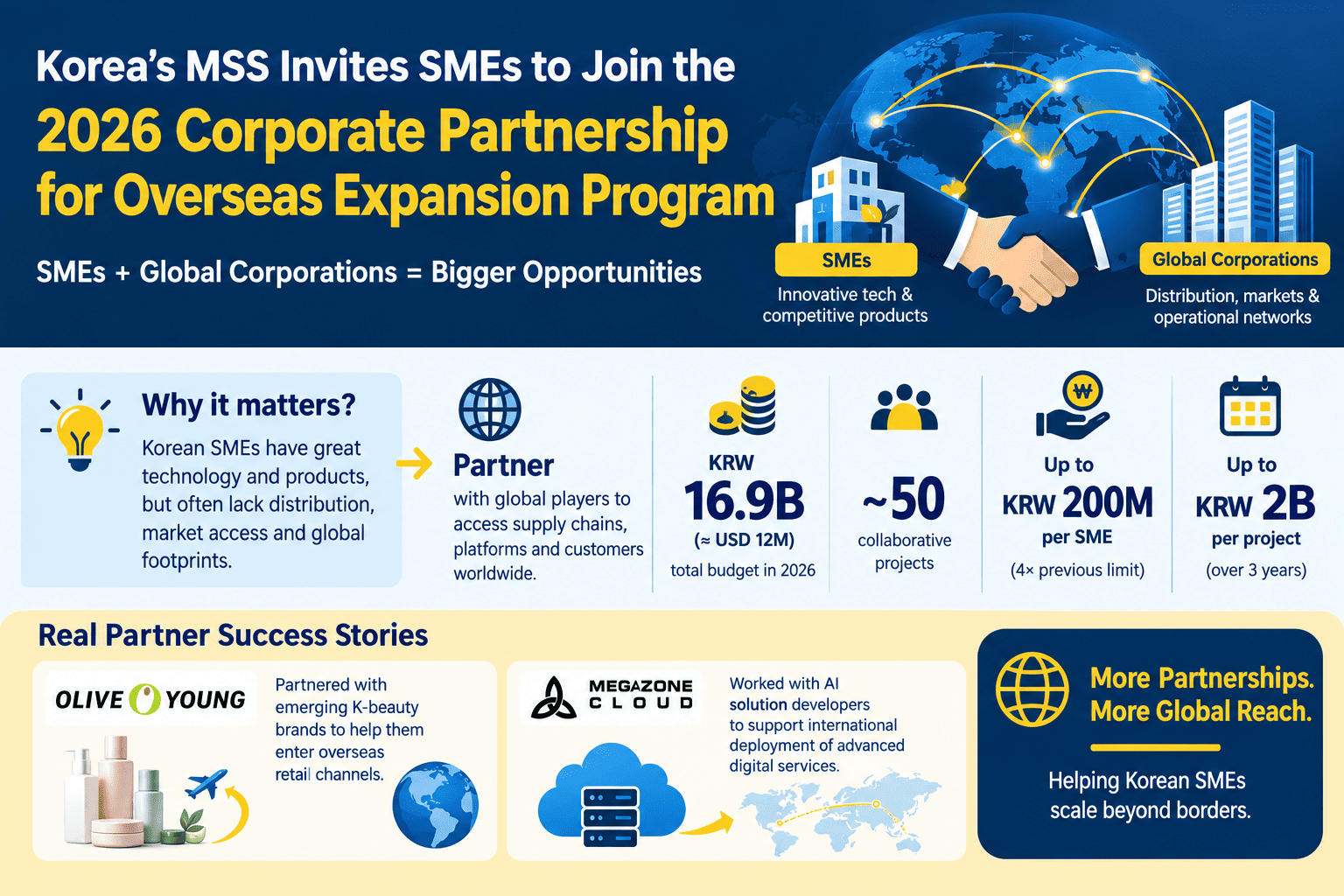
Korea’s Ministry of SMEs and Startups (MSS) is inviting SMEs to join the 2026 Corporate Partnership for Overseas Expansion Program, an initiative that links innovative smaller firms with the global infrastructure and networks of industry-leading companies [citation:1][citation:6]. The program is built on a simple but practical idea: while many Korean SMEs have strong technologies and competitive products, they often lack the distribution channels, market access, or operational footholds needed to scale internationally. By partnering with corporations that already operate across global markets, SMEs can tap into established supply chains, platforms, and customer networks to accelerate their entry abroad. MSS plans to allocate KRW 16.9 billion (approximately USD 12 million) in 2026, supporting around 50 collaborative projects in total [citation:1][citation:6]. Support for each SME can now reach up to KRW 200 million, four times the previous limit, while project budgets may run up to KRW 2 billion over three years [citation:1][citation:6]. The program includes real-world examples: Olive Young has partnered with emerging K-beauty brands to help them enter overseas retail channels, and MegazoneCloud has worked with AI solution developers to support international deployment of advanced digital services [citation:2][citation:3].

📅 March 10, 2026 ⏱ 16 min read ✍️ GTsetu Editorial Team 📰 News + Analysis
Program Budget
KRW 16.9B
Approximately USD 12 million allocated for 2026 support programs
Projects
50
Collaborative projects supported across two selection rounds in 2026
Per SME Support
KRW 200M
Maximum support per SME — four times the previous limit
Key Sectors
K-Beauty · AI
Globally competitive sectors with expanded support in 2026
Section 1 — The News

1 The Full Story: 2026 Corporate Partnership for Overseas Expansion

🌏
Program Announced — March 10, 2026

Korea’s MSS Opens 2026 Corporate Partnership Program: 50 Projects, KRW 16.9 Billion, and a New Model for SME Global Expansion

In March 2026, Korea’s Ministry of SMEs and Startups (MSS) announced the opening of the 2026 Corporate Partnership for Overseas Expansion Program, inviting SMEs to join collaborative projects with large corporations that have established global infrastructure [citation:1][citation:6].

The program addresses a persistent challenge: Korean SMEs often have strong technologies and competitive products, but lack the distribution channels, market access, or operational footholds needed to scale internationally [citation:1]. By partnering with corporations that already operate across global markets — retailers, digital platforms, broadcasters — SMEs can tap into established supply chains, platforms, and customer networks.

The 2026 program is administered by the Korea Foundation for Cooperation of Large & Small Business, Rural Affairs (KOFCA). MSS plans to allocate KRW 16.9 billion this year, supporting around 50 collaborative projects. A second round of project selection is scheduled for May 2026 [citation:1][citation:6]. The program includes real-world examples from Olive Young in K-beauty and MegazoneCloud in AI and software [citation:2][citation:3].

Mar 2026
MSS opens first round of SME recruitment for 2026 projects
25 Projects
Selected in first round; 25 more expected in second round (May 2026)
KRW 16.9B
Total 2026 budget, supporting approximately 50 collaborative projects
K-Beauty · AI
Expanded focus sectors combining corporate know-how with SME innovation
“Over time, this program has become one of Korea’s most effective models of collaboration between large companies and SMEs. By combining the global reach of leading corporations with the innovation of smaller firms, we aim to help Korean SMEs continue building momentum in international markets.”
— Lee Soon-Bae, Director General for Global Growth Policy, MSS
💡 GTsetu Perspective

What makes this program distinctive is that it solves the core problem SMEs face in global expansion: not product quality, but market access. Korean SMEs have demonstrated they can build world-class products — from K-beauty cosmetics to AI software. What they lack is the distribution infrastructure that large corporations have spent decades building. By connecting SMEs to corporate distribution channels, platforms, and supply chains, the program compresses years of relationship-building into a structured, government-backed framework. For SMEs in other markets that cannot access such programs, verified partner discovery platforms like GTsetu provide an alternative pathway: finding, evaluating, and engaging with potential distribution and channel partners systematically, before revealing confidential details.

🔗

Related reading: International Wholesale Distributors — how to find and evaluate distribution partners in new markets.

Section 2 — What Changed in 2026

2 What Changed in 2026: Three Structural Shifts

The 2026 program introduces three significant structural changes designed to deepen collaboration between corporations and SMEs — and to address the limitations of previous models.

01

Multi-Corporate Consortiums

For the first time, multiple corporations — retailers, digital platforms, broadcasters — can form a consortium instead of a single leading company working with SMEs [citation:1][citation:6]. Each partner contributes its own expertise at different stages of market entry. For example, content companies and distribution networks may jointly support Korean creative firms seeking to reach overseas consumers. This enables a more integrated approach to global expansion.

🔗 Multi-partner collaboration
02

Expanded Long-Term Support

Strategic projects requiring sustained investment — such as building overseas production bases or relocating supply chains to third countries — now receive larger funding ceilings [citation:1][citation:6]. Support for each SME can reach up to KRW 200 million, four times the previous limit, while project budgets may run up to KRW 2 billion over three years. The scope also includes “P-turn” strategies, where companies shift production to third-country bases to strengthen global competitiveness.

💰 4x funding ceiling increase
03

Focus on Globally Competitive Sectors

Initiatives in industries such as K-beauty and artificial intelligence are being expanded [citation:1][citation:6]. These partnerships combine the global operational know-how of large companies with the innovation capacity of SMEs, and may include joint marketing campaigns, cross-border platform integration, and inbound promotion targeting international buyers and consumers. The focus on sectors where Korea already has global competitive advantage maximizes the program’s impact.

🎯 K-Beauty & AI focus
⚙️ Why These Changes Matter

The 2026 structural changes address three limitations of previous programs. Multi-corporate consortiums solve the problem of single partners having incomplete capabilities — one partner may have distribution but not marketing, another may have content but not retail channels. Expanded funding ceilings solve the problem of insufficient capital for projects that require real investment, like overseas production bases. And the sector focus solves the problem of spreading resources too thin — by concentrating on K-beauty and AI, where Korea has demonstrated global competitiveness, the program creates concentrated impact rather than diffuse effort.

🔗

Related reading: Partnership Evaluation Criteria — a framework for assessing potential corporate partners before you commit.

Section 3 — Case Study: Olive Young

3 Case Study: Olive Young × K-Beauty SMEs

The most mature example of the corporate-SME partnership model in action is Olive Young’s K-Super Rookie with Young program, now in its third year. The program demonstrates how a major retailer can provide structured market access to emerging brands.

K-Super Rookie with Young — Program Evolution

Olive Young’s K-Super Rookie with Young program, launched in 2024, selects promising K-beauty SMEs and provides them with structured access to Olive Young’s retail infrastructure — both domestic and international [citation:2][citation:7].

Year 1 (2024)
20
Brands selected in first cohort, from 180 applicants
Year 3 (2026)
30
Brands selected in third cohort, linked to MSS export strategy
Offline Validation
23
Olive Young stores where products are tested for market response
Global Focus
10
Top brands selected for focused support including global mall access

How the Program Works

1

Selected brands are placed in “Olive Young New Arrivals” sections across 23 major stores nationwide for 6 weeks, testing real customer response and sales data [citation:7][citation:11].

2

Based on customer response, sales, and growth potential, the top 10 brands are selected for intensive support [citation:2][citation:7].

3

Top 10 brands receive integrated online and offline sales support, including access to Olive Young’s Global Mall for cross-border e-commerce, live commerce, and marketing content production [citation:2][citation:15].

4

After the program, brands receive customized growth strategy consulting based on accumulated sales data [citation:2][citation:15].

Documented Outcome

House of B, a premium homecare brand selected in 2025, expanded its sales channels to Olive Young domestic stores and Global Mall, and entered the US market through the Pasadena store opened in May 2026 [citation:2][citation:11]. The Pasadena store carries approximately 400 brands and 5,000 products, with over 80% K-beauty and wellness brands [citation:11].

🔗

Related reading: Global Market Research for Manufacturers — how to assess new markets before committing resources.

Section 4 — Case Study: MegazoneCloud

4 Case Study: MegazoneCloud × AI Firms

While Olive Young represents the retail and consumer goods model, MegazoneCloud demonstrates how the partnership program works for technology and B2B sectors. Working with the Korea AI & Software Industry Association (KOSA), MegazoneCloud has supported Korean AI and software companies in entering ASEAN and Japanese markets [citation:3][citation:8].

MegazoneCloud × KOSA — AI & Software Export Support

MegazoneCloud, a cloud managed service provider, has partnered with KOSA to operate the Korea Industrial AX Pavilion at major technology exhibitions, providing Korean AI and software companies with a platform to showcase their solutions to international buyers [citation:3][citation:12].

Companies Supported
10
AI/SW companies per cohort selected for market entry support
Target Markets
ASEAN · Japan
Primary focus regions for Korean AI/software market entry
Key Events
Tech Week SG
Major exhibition platform for AI infrastructure and industry solutions
Program Years
3rd
Current year of the MegazoneCloud-KOSA partnership program

How the Technology Model Works

1

Korean AI/SW companies participate in international exhibitions through a shared pavilion, reducing individual cost and increasing visibility [citation:3][citation:12].

2

MegazoneCloud’s local presence and relationships facilitate one-on-one business meetings with potential customers — local telecom companies, data center operators, financial institutions, and global IT companies [citation:12].

3

In Japan, MegazoneCloud organizes seminars on market demand and regulatory response, and facilitates meetings between Korean companies and Japanese system integrators with pre-matched technical interests [citation:8][citation:16].

4

KOSA and MegazoneCloud continue supporting follow-up negotiations after exhibitions, aiming to convert leads into actual contracts and business results [citation:3][citation:12].

Participating Companies (Singapore 2026)

The Korea Industrial AX Pavilion featured 10 companies across three segments: AI infrastructure (Rebellions, Lablup, HyperExcel), enterprise solutions (Madras Check, Sionic AI, Kiwon Tech), and industry-specific solutions (Watta AI, PFC Technologies, Christine Company, Kobaltix) [citation:12]. Companies demonstrated technologies spanning AI semiconductors, digital twins, IT observability, smart logistics, and security.

🔗

Related reading: International Business Development Consulting — how to structure cross-border market entry programs.

Section 5 — The Anatomy

5 What Each Partner Brings to the Table

Like every successful collaboration, the Corporate Partnership for Overseas Expansion Program works because each party contributes what the other cannot efficiently replicate. This complementarity principle is the foundation of any collaboration worth entering.

Collaboration Anatomy — Corporate-SME Partnership
SME
🇰🇷 Korea
What they bring
Innovation + Product
Strengths
Agility + Technology
What they lack
Distribution + Market access
Program role
Innovation Provider
+
Partnership
Corporation
🇰🇷 Korea / Global
What they bring
Distribution + Platform + Network
Strengths
Scale + Market knowledge
What they lack
Innovation agility
Program role
Market Access Provider
🎯 Target: Global market entry for innovative Korean SMEs
🤝 Government-backed structured collaboration
📈 KRW 16.9B supporting 50 projects in 2026
Collaboration Dimension SME Provides Corporation Provides Government Provides
Market AccessCompetitive products with innovationDistribution channels, platforms, retail presenceFunding, program administration, policy support
Capability BuildingTechnology and product expertiseGlobal operational know-how, market intelligenceExport strategy consulting, business matching
Risk SharingProduct development riskChannel investment, brand reputationFinancial support reduces SME exposure
ScalingAgility and speed to marketVolume capacity, logistics infrastructureLong-term project funding for infrastructure
CredibilityInnovation credentialsBrand association, market validationGovernment endorsement and program legitimacy
🔗

Related reading: Cross-Border Business Partnerships — a comprehensive guide to structuring and managing international partnerships.

Section 6 — Why This Works

6 Why This Collaboration Model Works for SME Global Expansion

🎯 The Core Logic

The Corporate Partnership for Overseas Expansion Program succeeds because it is built on three interlocking strategic advantages: complementary capabilities between SMEs and corporations, government-backed structure that reduces risk and provides legitimacy, and a deliberate focus on sectors where Korea already has global competitive advantage. Neither party could have achieved the same result through any other mechanism — SMEs cannot independently build global distribution infrastructure, and corporations cannot independently discover and integrate innovative small brands at scale. The government’s role as facilitator and funder bridges the gap.

Why Korea’s SME Export Model Is Accelerating

$64B
SME exports reached record USD 64 billion in first half of 2026 [citation:5]
K-Beauty
K-beauty and e-commerce exports are emerging as important new growth sources [citation:5]
50
Collaborative projects supported in 2026 across two selection rounds [citation:1]
4x
Increase in per-SME support ceiling — from KRW 50M to KRW 200M [citation:1]
3 Years
Maximum project duration for long-term strategic initiatives [citation:1]
P-Turn
New support for shifting production to third-country bases [citation:1]
🔗

Related reading: Risk Allocation in Cross-Border Deals — how to structure contracts that protect both parties.

Section 7 — Korea’s Opportunity

7 Korea’s SME Export Opportunity — Why Now Is the Time to Collaborate

🇰🇷 Korea SME Exports 2026

Why Every SME Should Be Building Corporate Partnership Capabilities Now

Korea’s SME exports reached a record USD 64 billion in the first half of 2026, with K-beauty products and e-commerce exports emerging as important new sources of growth [citation:5]. The government has introduced a new export strategy built around four priorities: helping more SMEs enter overseas markets, developing new export opportunities in consumer goods and advanced industrial products, using diplomatic partnerships to open doors in emerging markets, and making government export programs easier to navigate [citation:5]. The Corporate Partnership for Overseas Expansion Program is a central component of this strategy — and the window to participate is now.

$64B
Record SME exports in first half of 2026 [citation:5]
Global 500
New initiative to support 500 SMEs with strong export potential [citation:5]
Export ON 2000
Program to help 2,000 young entrepreneurs and micro enterprises [citation:5]
India Hub
New overseas business hub in India with office, exhibition, warehouse space [citation:5]
Brazil Focus
K-beauty expansion through online and offline channels in Brazil [citation:5]
Singapore Hub
New startup hub and K-Global Venture Fund [citation:5]
🌐 GTsetu for Corporate-SME Collaboration

GTsetu’s verified partner network includes corporations, distributors, retailers, technology platforms, and manufacturing partners across Korea, Japan, ASEAN, and 100+ other countries. Every company on GTsetu is verified using government tie-ups on 6 key points: Name, Address, Registration Number, Company Status, Company Type, and Date of Certificate of Incorporation. If you’re an SME looking to access corporate distribution channels, or a corporation looking to discover innovative SME partners, GTsetu is where your partner search begins with verified profiles, not cold calls. Find distribution and channel partners →

🔗

Related reading: Commercial Due Diligence — how to verify a partner’s financial and operational capacity before committing.

Section 8 — Types of Collaboration

8 4 Types of Corporate-SME Collaboration — Which Fits Your Situation?

The Korean program includes multi-corporate consortiums and supplier development models, but the right collaboration structure depends on your objectives, resources, and risk tolerance. Here are the four primary models for corporate-SME engagement.

01

Distribution Partnership

You manufacture; a corporate partner distributes in their market. The Olive Young model — SMEs gain access to established retail channels and customer networks without building their own distribution infrastructure. Lightest form of collaboration, fastest to execute, ideal for testing market demand.

📦 Olive Young × K-beauty brands
02

Platform / Channel Integration

Your products or services are integrated into a corporate partner’s digital platform or channel. The MegazoneCloud model — AI/SW companies gain access to international markets through a cloud provider’s platform and local relationships. Requires technical integration but offers scalable market access.

☁️ MegazoneCloud × AI firms
03

Multi-Corporate Consortium

Multiple corporations form a consortium, each contributing expertise at different stages. The 2026 Korean program introduces this for the first time — for example, content companies and distribution networks jointly supporting creative firms. More complex to manage but enables integrated market entry.

🔗 New in 2026
04

Mentorship & Capability Building

A structured program for training, certification, and knowledge transfer without immediate commercial commitment. Builds long-term capability and ecosystem sustainability. Often complements other collaboration types and serves as a precursor to supply or distribution agreements.

📚 K-Super Rookie program structure
🔗

Related reading: Manufacturing Certifications for International Trade — essential for entering regulated markets.

Section 9 — How to Collaborate

9 How to Collaborate: A 5-Step Playbook for Corporate-SME Partnerships

The Korean Corporate Partnership program did not emerge overnight — it has evolved over multiple years, with Olive Young’s program now in its third iteration and MegazoneCloud’s partnership in its third year. Here is the distilled playbook for SMEs and corporations seeking similar collaboration.

1

Identify Your Corporate Partnership Alignment

The Korean program focuses on K-beauty and AI — sectors where Korea has demonstrated global competitiveness. Which corporate partner aligns with your product category and growth objectives? If you’re a beauty brand, Olive Young is a natural fit. If you’re an AI software company, MegazoneCloud provides the right channel. Define where your capabilities meet the corporate’s strategic priorities before you engage.

2

Find Verified Corporate Partners — Not Just Any Partner

The crucial word is “verified.” The Korean program screens participating corporations and SMEs — government backing provides legitimacy that reduces risk for both parties. For SMEs that cannot access a government program, GTsetu provides verified profiles of corporations, distributors, and platform partners across Korea, Japan, ASEAN, and 100+ countries. GTsetu verifies companies using government tie-ups on 6 key points: Name, Address, Registration Number, Company Status, Company Type, and Date of Certificate of Incorporation. Additional information like certifications and market reach is self-reported and should be validated independently.

3

Protect Your IP and Data Before Any Technical Disclosure

In corporate-SME collaboration, your product formulations, technology, and customer data are valuable IP. Before sharing anything sensitive — even a capability requirements document — execute a mutual NDA. GTsetu’s built-in NDA workflow handles this automatically: mutual NDA executed and countersigned before any sensitive information is shared, with a full digital audit trail.

4

Choose the Right Collaboration Structure for Your Objective

The Korean program supports multiple structures — distribution partnerships, platform integration, multi-corporate consortiums, and mentorship programs. A distribution agreement is right when you need market access without capital commitment. A platform integration is right when you need scalable reach. A consortium is right when you need multiple capabilities. A mentorship program is right when you need capability building. Match the structure to the objective.

5

Start with a Pilot — Then Scale

Olive Young’s program starts with 6 weeks of offline market testing before selecting top 10 brands for intensive support. MegazoneCloud starts with a single exhibition and scales from there. The Korean program itself evolved from 20 to 30 brands over three years. Start small, demonstrate capability, then scale. Never commit to large-scale production or distribution before validating market response.

Section 10 — Dos and Don’ts

10 Dos and Don’ts of Corporate-SME Collaboration

✅ Do These
  • ✅ Build on structured government programs — they provide legitimacy and reduce risk for both parties
  • ✅ Verify your corporate partner’s track record — the right partner opens doors, not just provides contracts
  • ✅ Build capability before expecting contracts — market access requires quality, compliance, and readiness
  • ✅ Sign NDA before sharing formulations, technology, or customer data
  • ✅ Choose a corporate partner whose market reach is complementary to your product category
  • ✅ Define the collaboration scope clearly — what support is provided, on what timeline, with what commercial expectations
  • ✅ Start with a pilot batch or test market before committing to capacity expansion
  • ✅ Build in quality audit rights — corporate partners must be able to verify compliance
  • ✅ Use verified platforms like GTsetu rather than trade fair introductions for strategic corporate partners
  • ✅ Document the collaboration formally — distribution agreement, supply contract, or MoU before trade begins
❌ Avoid These
  • ❌ Invest in capacity expansion before securing a commercial agreement
  • ❌ Share product formulations or technology before NDA is countersigned
  • ❌ Accept self-reported corporate capability claims without reference verification
  • ❌ Assume that a development program guarantees a contract — capability building is necessary but not sufficient
  • ❌ Partner with a corporate whose existing suppliers are your direct competitors — conflict of interest risk
  • ❌ Neglect exclusivity terms — know whether your corporate partner can source from or sell to your competitors
  • ❌ Choose a partner whose needs duplicate your capabilities — the gap is where value is created
  • ❌ Start supply on informal terms — quality standards, delivery timelines, and payment terms must be documented
  • ❌ Underestimate compliance requirements — corporate supply chains have strict audit and ESG standards
  • ❌ Build a JV when a distribution or supply agreement would achieve the same objective at lower commitment and risk
🔗

Related reading: Breach of Contract — what happens when a partnership agreement is not honoured, and how to protect yourself.

Section 11 — Misconceptions

11 Common Misconceptions That Kill Corporate-SME Collaborations

❌ Myth

“A corporate partnership program is just CSR — it won’t lead to real contracts.”

✅ Reality

Structured corporate partnership programs are commercial pipelines, not charity. Olive Young participates because it needs innovative brands to keep its shelves fresh. MegazoneCloud participates because it needs AI solutions to offer its customers. The Korean government funds these programs because they generate export revenue. SMEs that perform well in the program are positioned for commercial agreements. The program is the front end of procurement and distribution, not a separate CSR activity.

❌ Myth

“We can figure out the commercial terms after the program — the relationship will guide us.”

✅ Reality

Commercial disputes are a common reason corporate-SME collaborations fail. Once supply has started on undefined terms, both parties’ leverage is gone. In K-beauty and technology, quality standards, delivery timelines, payment terms, and volume commitments must be defined before the first commercial order. The program provides the capability and market validation; the commercial agreement provides the operational framework. Define both upfront.

❌ Myth

“The corporate partner’s market access automatically becomes our market access.”

✅ Reality

A partnership gives you exposure to a corporate channel, not automatic sales. The corporate still evaluates your product quality, pricing, and market fit against other suppliers. Program participation is a door-opener, not a guarantee. Olive Young validates market response through 6-week store trials before selecting top 10 brands — the majority of participants do not receive intensive support. Plan the commercial pursuit separately from the capability building.

❌ Myth

“We should build our production capacity first to show corporate partners we’re serious.”

✅ Reality

Olive Young and MegazoneCloud did the opposite — they built the program first, then invited SMEs to participate. Building capacity without knowing whether a corporate will distribute your product is capital destruction. The correct sequence is always: capability validation → corporate engagement → commercial agreement → capacity investment. Never invest in scale before you have the commercial pipeline to justify it.

❌ Myth

“A collaboration with a major corporation requires physical presence in their headquarters country to manage effectively.”

✅ Reality

The Olive Young and MegazoneCloud programs are managed from Korea with structured product testing, scheduled review sessions, and clear contractual frameworks — not permanent presence. What matters is clear protocols for quality documentation, scheduled audits, and commercial reviews, not physical proximity. GTsetu’s encrypted collaboration workspace supports exactly this structured cross-border working relationship.

🔗

Related reading: Material Breach — understanding when a contract violation justifies termination.

Section 12 — GTsetu

12 How GTsetu Helps You Find the Right Corporate Partnership Partner

Korea’s SMEs have the Ministry of SMEs and Startups and KOFCA. Most SMEs in other markets do not have a government program to facilitate corporate partnerships — and even when they do, identifying which corporate partners are the right fit requires systematic evaluation. GTsetu is the verified B2B manufacturing discovery platform that enables this evaluation at scale, across 100+ countries, before you reveal a single confidential detail.

🌐 Platform Spotlight — GTsetu

Find Verified Corporate Partners, Distributors, and Channel Partners Across 100+ Countries — Anonymously, Securely, With Zero Broker Fees

Every company on GTsetu is verified using government tie-ups on 6 key points: Name, Address, Registration Number, Company Status, Company Type, and Date of Certificate of Incorporation. This is the foundation of trust. Additional information such as certifications, market reach, and distribution capabilities is self-reported by companies. You evaluate who is real before you engage. You share nothing sensitive until an NDA is countersigned. And you pay no broker commission on any collaboration formed — the deal is entirely between you and your partner.

✅
6-Point Government-Sourced VerificationName, Address, Registration Number, Company Status, Company Type, Date of Incorporation confirmed using government tie-ups.
🕵️
Anonymous DiscoveryEvaluate verified partner profiles without revealing your identity until mutual interest is confirmed.
📄
Built-In NDA WorkflowShare design specs only after NDA is executed — full audit trail, no external legal required.
🚫
Zero CommissionNo broker fees — your distribution agreement, supply contract, or JV is entirely between you and your partner.
🌍
100+ CountriesKorea, Japan, ASEAN, United States, Europe — find distribution and channel partners in every major market.
🔐
Encrypted CollaborationShare product specs, pricing, and contract terms securely between verified partners.
Find Verified Partners → Browse the Network

What Korea’s MSS Is Doing — What GTsetu Enables For You

What Korea’s MSS Is Doing What GTsetu Enables for You Why This Matters
Connects SMEs with corporations’ global infrastructure and networks✓ Browse verified company profiles with government-sourced verification before engagingYou find the partner before your competitors do, first-mover advantage
Allocated KRW 16.9 billion to support 50 collaborative projects✓ Filter by self-reported capabilities, certifications, and market reach (validate independently)Find potential partners with the specific distribution or platform capabilities your product requires
Introduced multi-corporate consortiums for the first time in 2026✓ Built-in NDA and document workflow protects your product data and technology from the first conversationYour formulations, technology, and customer data are protected at every stage
Expanded funding to KRW 200M per SME, 4x previous limit✓ Self-reported partner profiles show market coverage, distribution channels, and export experienceIdentify partners positioned to serve your target market — and beyond
Focuses on K-beauty, AI, and globally competitive sectors✓ Zero commission on any partnership — all commercial terms are direct between the two partiesNo broker splits your margin or misaligns your commercial terms
FAQ

? Frequently Asked Questions

Q What is the 2026 Corporate Partnership for Overseas Expansion Program?
The Corporate Partnership for Overseas Expansion Program is a Korean government initiative administered by the Ministry of SMEs and Startups (MSS) and the Korea Foundation for Cooperation of Large & Small Business, Rural Affairs (KOFCA). It connects innovative SMEs with the global infrastructure and networks of large corporations — including distribution channels, platforms, and supply chains — to accelerate their entry into overseas markets [citation:1][citation:6]. The program addresses a persistent challenge: Korean SMEs often have strong technologies and competitive products, but lack the distribution channels, market access, or operational footholds needed to scale internationally.
Q How much funding is allocated to the program?
The Ministry of SMEs and Startups plans to allocate KRW 16.9 billion (approximately USD 12 million) in 2026, supporting around 50 collaborative projects in total [citation:1][citation:6]. Support for each SME can reach up to KRW 200 million, four times the previous limit, while project budgets may run up to KRW 2 billion over three years [citation:1][citation:6]. The program includes a second round of project selection scheduled for May 2026.
Q What is Olive Young’s K-Super Rookie with Young program?
K-Super Rookie with Young is Olive Young’s program to support emerging K-beauty brands, now in its third year. The program selects 30 brands and places them in “Olive Young New Arrivals” sections across 23 major stores nationwide for 6 weeks, testing real customer response and sales data [citation:2][citation:7]. Based on performance, the top 10 brands are selected for intensive support including access to Olive Young’s Global Mall for cross-border e-commerce, live commerce, and marketing content production [citation:2][citation:15]. A documented outcome: House of B, selected in 2025, expanded to Olive Young Global Mall and entered the US market through the Pasadena store opened in May 2026 [citation:2][citation:11].
Q How does MegazoneCloud support Korean AI companies in overseas expansion?
MegazoneCloud, working with the Korea AI & Software Industry Association (KOSA), operates the Korea Industrial AX Pavilion at major technology exhibitions [citation:3][citation:12]. Korean AI/SW companies participate through a shared pavilion, reducing individual cost and increasing visibility. MegazoneCloud’s local presence and relationships facilitate one-on-one business meetings with potential customers — local telecom companies, data center operators, financial institutions, and global IT companies [citation:12]. In Japan, MegazoneCloud organizes seminars on market demand and regulatory response, and facilitates meetings between Korean companies and Japanese system integrators with pre-matched technical interests [citation:8][citation:16].
Q What are the key structural changes in the 2026 program?
The 2026 program introduces three significant changes: (1) Multi-corporate consortiums — for the first time, multiple corporations (retailers, digital platforms, broadcasters) can form a consortium, each contributing expertise at different stages [citation:1][citation:6]. (2) Expanded long-term support — per-SME support can reach KRW 200 million (4x previous limit), with project budgets up to KRW 2 billion over three years; “P-turn” strategies for shifting production to third-country bases are now included [citation:1][citation:6]. (3) Focus on K-beauty and AI — expanded support for sectors where Korea has demonstrated global competitiveness [citation:1][citation:6].
Q Does GTsetu charge commission on partnerships formed through the platform?
No. GTsetu charges zero commission on any collaboration — whether a distribution agreement, supply contract, Joint Venture, licensing deal, or mentorship program — formed through the platform. The commercial terms of your agreement are entirely between you and your partner. This is a foundational design principle: broker intermediation in corporate-SME partnerships typically costs 5–15% of deal value and creates incentive misalignment between the broker and both parties. GTsetu removes the broker entirely. Learn more about GTsetu →

Ready to Find Your Corporate Partnership Partner? Start on GTsetu.

500+ verified manufacturers, distributors, corporations, and channel partners across Korea, Japan, ASEAN, and 100+ countries. Zero broker fees. Anonymous discovery. Built-in NDA workflows. Your next corporate partnership starts with a verified profile — not a cold call.

Find Verified Partners Free → Browse the Network