GTsetu

Korean SMEs Join Global R&D Partnerships With Fraunhofer, TNO, CSEM – GTsetu
🔴 BREAKING Korean SMEs join global R&D partnerships with Fraunhofer, TNO, CSEM and North American institutions (Mar 24, 2026) ◆ Korean SMEs can co-develop technologies and receive technology transfer and overseas commercialisation support ◆ Find verified R&D partners, research institutions & technology integrators on GTsetu, 100+ countries, zero commission ◆ 🔴 BREAKING Korean SMEs join global R&D partnerships with Fraunhofer, TNO, CSEM and North American institutions (Mar 24, 2026) ◆ Korean SMEs can co-develop technologies and receive technology transfer and overseas commercialisation support ◆ Find verified R&D partners, research institutions & technology integrators on GTsetu, 100+ countries, zero commission ◆
Home  ›  Blog  ›  Korean SME Global R&D Partnerships
🔴 Breaking News 💡 Innovation & R&D 🇰🇷 East Asia 🔬 Electronics & Tech 🌍 Global

Korean SMEs Join Global R&D Partnerships With Fraunhofer, TNO, CSEM and North American Institutions

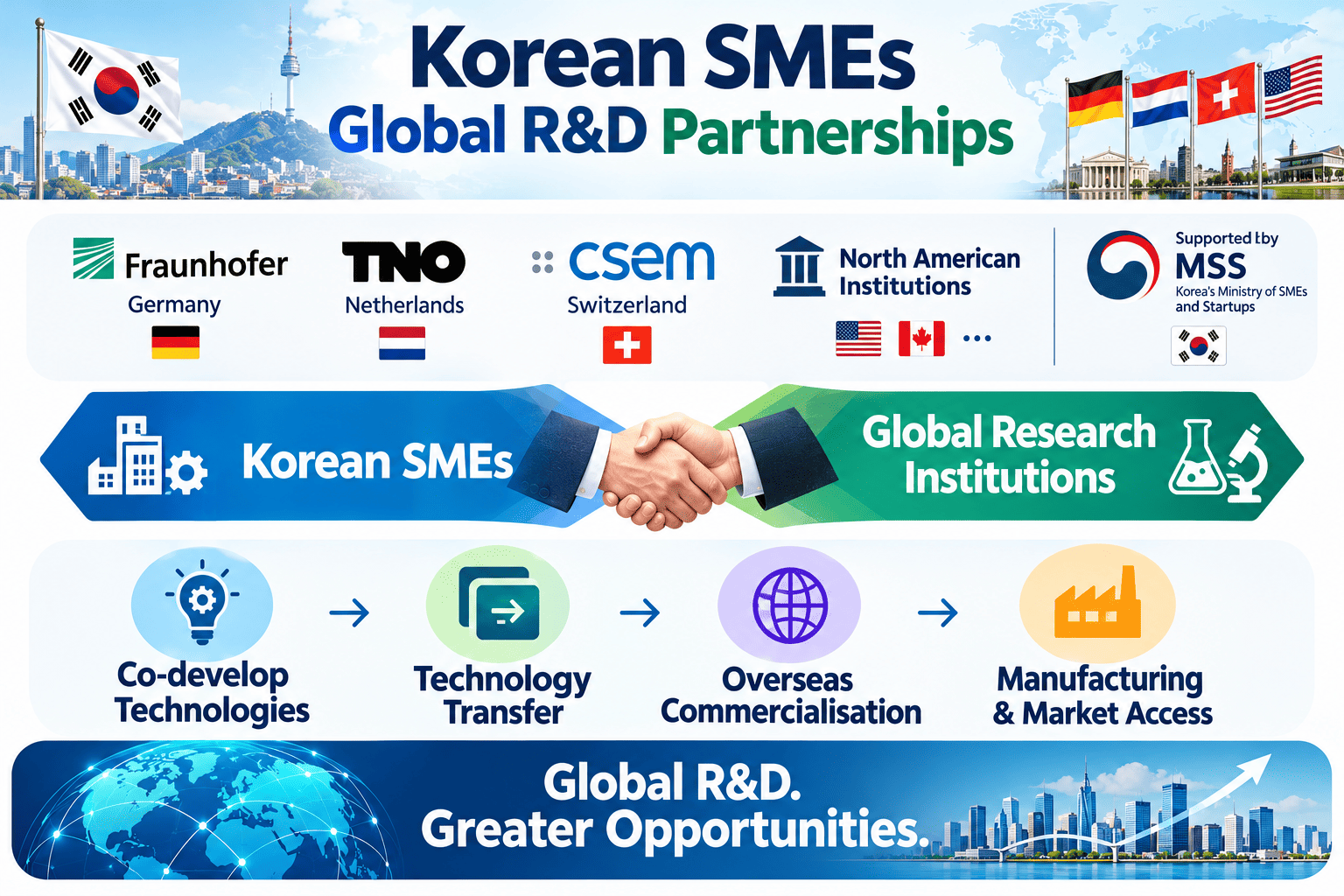
Korean SMEs are joining global R&D partnerships with leading international research institutions, including Fraunhofer (Germany), TNO (Netherlands), CSEM (Switzerland), and North American institutions. The programme, supported by Korea’s Ministry of SMEs and Startups (MSS), enables Korean SMEs to co-develop technologies with major research partners and receive structured support for technology transfer and overseas commercialisation.

🎯 Direct Answer

Korean SMEs are joining global R&D partnerships with Fraunhofer (Germany), TNO (Netherlands), CSEM (Switzerland), and North American institutions under a programme supported by Korea’s Ministry of SMEs and Startups (MSS), announced March 24, 2026. The programme allows Korean SMEs to co-develop technologies with major international research institutions and receive support for technology transfer and overseas commercialisation. The partnerships pair Korean SMEs, who bring applied product development and manufacturing capability in electronics and technology, with research institutions, who bring fundamental research capability, laboratory infrastructure, and technology transfer expertise. The model gives Korean SMEs access to world-class R&D capability without building it in-house, while giving research institutions a route to commercialise their technology through Korean manufacturing and market access.

📅 March 24, 2026 ⏱ 15 min read ✍️ GTsetu Editorial Team 📰 News + Analysis
Programme Type
R&D Partnership
Global R&D co-development programme, MSS-supported, announced Mar 24, 2026
Focus
Co-Development
Joint R&D, technology transfer, and overseas commercialisation for SMEs
Sector
Electronics
Electronics and technology, advanced materials, precision engineering
Key Objective
Tech Transfer
Technology transfer and overseas commercialisation support for Korean SMEs
Section 1, The News

1 The Full Story: Korean SME Global R&D Partnerships

🔬
Programme Announced, March 24, 2026

Korean SMEs Join Global R&D Partnerships With Fraunhofer, TNO, CSEM and North American Institutions

On March 24, 2026, Korea’s Ministry of SMEs and Startups (MSS) announced a programme enabling Korean SMEs to join global R&D partnerships with leading international research institutions, including Fraunhofer (Germany), TNO (Netherlands), CSEM (Switzerland), and North American institutions.

Through the programme, Korean SMEs can co-develop technologies with major research institutions and receive structured support for technology transfer and overseas commercialisation. The partnerships are designed to pair Korean SMEs, who bring applied product development and manufacturing capability in electronics and technology, with research institutions, who bring fundamental research capability, laboratory infrastructure, and technology transfer expertise.

The programme reflects a broader shift in how SMEs access frontier technology: rather than building research capability in-house, they partner with institutions that already have it, and focus their own resources on commercialisation, manufacturing, and market access. For Korean SMEs in electronics and technology, this creates a direct route to co-developed IP and overseas market entry.

MSS
Korea’s Ministry of SMEs and Startups supports the programme
Fraunhofer
Germany’s leading applied research organisation
TNO
Netherlands Organisation for Applied Scientific Research
CSEM
Swiss Center for Electronics and Microtechnology
“Korean SMEs do not need to build world-class research capability in-house to access it. Through global R&D partnerships, they can co-develop technology with institutions like Fraunhofer, TNO, and CSEM, then commercialise the results through their own manufacturing and market access. This is how SME innovation scales in 2026.”
— Ministry of SMEs and Startups (MSS), Republic of Korea
“Research institutions like Fraunhofer, TNO, and CSEM have always needed industrial partners to translate laboratory results into products. Korean SMEs, with their manufacturing depth and speed to market, are exceptionally strong commercialisation partners, provided the IP framework and technology transfer terms are structured correctly from the start.”
— GTsetu Innovation & R&D Partnerships Team
💡 GTsetu Perspective

The Korean SME global R&D programme is a template for how SME technology development is actually happening in 2026: partnership-led, IP-aware, and commercialisation-focused rather than capital-intensive and vertically integrated. Korean SMEs that establish co-development relationships with Fraunhofer, TNO, CSEM, and North American institutions in 2026 will hold technology positions that competitors entering later will find difficult to replicate. GTsetu is where verified R&D partner discovery happens systematically, connecting SMEs with research institutions, technology integrators, and co-development partners across East Asia, Europe, North America, and 100+ countries. See our guide to cross-border business partnerships for the strategic context.

Section 2, The Anatomy

2 What Each Partner Brings to the Table

Like every successful R&D collaboration, the Korean SME global R&D partnerships work because each party contributes what the other cannot efficiently replicate. This complementarity principle is the foundation of any co-development partnership worth building. For the full evaluation framework, see our guide to partnership evaluation criteria.

Collaboration Anatomy, R&D Co-Development Structure
Korean SME
🇰🇷 South Korea, Electronics & Tech
What they bring
Applied Development & Manufacturing
Role
Product Development & Commercialisation
Expertise
Electronics, technology, precision engineering
What they lack
Frontier research capability & lab infrastructure
Agreement role
Industrial Co-Development Partner
+
R&D / IP
Research Institution
🇩🇪🇳🇱🇨🇭🇺🇸🇨🇦 Europe & North America
What they bring
Frontier Research & Lab Infrastructure
Role
Research & Technology Transfer
Expertise
Applied research, microtechnology, electronics, materials
What they lack
Manufacturing scale & market access
Agreement role
Research & Technology Transfer Partner
🔬 Target: Co-developed technology and overseas commercialisation
📄 R&D and Co-Development Partnerships
🚀 Technology transfer, IP structuring, market access
Collaboration Dimension What the Korean SME Provides What the Research Institution Provides Why This Balance Works
Technology DevelopmentApplied product development, engineering, and manufacturing scale-upFrontier research, laboratory infrastructure, scientific expertiseResearch meets commercialisation, creating a complete innovation pipeline
IP & Technology TransferIndustrial application of IP, product integration, manufacturing know-howPatent portfolios, technology transfer offices, licensing frameworksIP moves from laboratory to product with clear ownership and licensing terms
Market AccessKorean and Asian market access, manufacturing supply chain, OEM relationshipsEuropean and North American research networks, industry consortiaBoth parties unlock new geographies for co-developed technology
FundingMSS programme support, internal R&D budget, commercialisation investmentResearch grants, institutional funding, laboratory resourcesPublic programme support reduces R&D cost and risk for both parties
KnowledgeManufacturing expertise, quality systems, market intelligenceScientific publications, research methodology, technology roadmapsKnowledge-sharing accelerates co-development and de-risks commercialisation
Section 3, Why This Works

3 Why This R&D Co-Development Model Works

🎯 The Core Logic

The Korean SME global R&D programme succeeds because it is built on three interlocking strategic advantages: an industrial partner with applied development and manufacturing capability (the Korean SME), a research partner with frontier research capability and laboratory infrastructure (Fraunhofer, TNO, CSEM, North American institutions), and public programme support that reduces the cost and risk of international co-development. Neither party could have achieved the same result through any other mechanism, the SME cannot independently build world-class research capability, and the research institution cannot replicate the SME’s manufacturing scale and market access.

Why International R&D Partnerships Are Accelerating for SMEs

Fraunhofer
Germany’s leading applied research organisation, a global benchmark for industry-research collaboration
TNO
Netherlands Organisation for Applied Scientific Research, strong in electronics, materials, and energy
CSEM
Swiss Center for Electronics and Microtechnology, precision electronics and microtechnology expertise
North America
US and Canadian institutions bring deep-tech research and North American market access
SMEs
SMEs use R&D partnerships to access frontier technology without building it in-house
MSS
Korea’s MSS supports technology transfer and overseas commercialisation for SMEs
Section 4, East Asia & Global Opportunity

4 East Asia & Global R&D Opportunity, Why Now Is the Time to Partner

🇰🇷 Global SME R&D Ecosystem 2026–2030

Why Korean SMEs Should Be Pursuing Global R&D Partnerships Through Fraunhofer, TNO, CSEM and North American Institutions

Korea’s electronics and technology sector is one of the world’s most advanced, but frontier research capability is globally distributed, Fraunhofer and TNO in Europe, CSEM in Switzerland, and leading institutions in the United States and Canada. The MSS-supported global R&D programme creates a structured route for Korean SMEs to access that capability, co-develop technology, and commercialise it overseas. For the research groundwork behind this type of partnership, see global market research for manufacturers.

Fraunhofer
Germany’s applied research powerhouse, a global model for industry collaboration
TNO
Netherlands applied research, strong in electronics, materials, and energy
CSEM
Swiss precision electronics and microtechnology research
US & Canada
North American institutions bring deep-tech research and market access
Co-Develop
SMEs co-develop technology rather than licensing it off the shelf
MSS Support
Technology transfer and overseas commercialisation support for SMEs
🌐 GTsetu for Innovation & R&D Partnerships

GTsetu’s verified partner network includes research institutions, technology integrators, R&D service providers, and co-development partners across South Korea, Germany, the Netherlands, Switzerland, the United States, Canada, and 100+ other countries. Every company on GTsetu is verified on 6 government-sourced points: Name, Address, Registration Number, Company Status, Company Type, and Date of Certificate of Incorporation. Additional capabilities like research expertise, technology transfer experience, and co-development track record are self-reported. If you’re a Korean SME seeking international R&D partners, or a research institution looking to commercialise technology with industrial partners, GTsetu is where your partner search begins with verified profiles, not cold calls. See cross-border business partnerships and partnership evaluation criteria for the strategic context. Find R&D partners →

Section 5, Types of Collaboration

5 4 Types of R&D Collaboration, Which Fits Your Situation?

The Korean SME global R&D programme used an R&D and co-development partnership model. But R&D collaborations come in many forms. The right structure depends on what you need, what you can invest, and how deeply you want to integrate. For the commercial framework, see cross-border business partnerships.

01

R&D and Co-Development Partnership

Joint development of new technology, products, or processes with a research institution, sharing research effort, IP rights, and commercial outcomes. The Korean SME global R&D model. Best where you need frontier research capability you cannot build in-house. See cross-border manufacturing partnerships.

🔬 Korean SME global R&D
02

Technology Licensing & Transfer

License technology from a research institution or another company under a formal technology transfer agreement. Revenue to the licensor through royalties; faster than co-development but less control over the technology roadmap. Requires careful IP and field-of-use structuring. See warranty clause.

📄 Technology transfer
03

Joint Venture or Research Consortium

Shared ownership or formal consortium with research and industry partners for a defined technology programme. Best for large, multi-party research programmes where no single partner has all the capability required. Requires careful governance, IP, and exit structuring. See partnership evaluation criteria.

🤝 Research consortium
04

Contract Research & Testing

Commission a research institution to perform specific research, testing, or certification work on a fee-for-service basis. Lowest commitment, fastest to set up, no shared IP. Often the first step before deeper co-development. Best for validation and compliance work. See manufacturing certifications.

📊 Contract research, step 1
📊 R&D Collaboration Model Comparison
Model Investment Required IP Ownership Technology Access Speed to Launch Reversibility
R&D Co-Development Medium-High (research effort, staff time) ✓ Shared (negotiated) ✓ Frontier research Slow (12–36 months) Low
Technology Licensing Medium (royalties, upfront fees) Licensor retains ownership ✓ Immediate access Fast (3–9 months) Moderate
Joint Venture / Consortium High (capital, legal, governance) Shared equity / governance Deep, multi-party Slow (12–24 months) Low
Contract Research Low-Medium (fee-for-service) Client owns results (typical) ~ Specific testing / validation Fastest (1–3 months) ✓ High
Section 6, How to Build

6 How to Build an R&D Co-Development Partnership: A 5-Step Playbook

The Korean SME global R&D programme did not happen by accident. It followed a deliberate progression from identifying the right research capability to structuring IP to commercialising the results. Here is the distilled playbook.

1

Define the Research Gap with Precision

Korean SMEs on the programme knew exactly what they needed: a research partner with frontier capability in a specific technology area (electronics, materials, microtechnology) and a route to technology transfer and overseas commercialisation. They didn’t need to build a research laboratory, they needed access to one. Define your gap that precisely. Vague needs produce vague partner searches and failed collaborations. Start with global market research for manufacturers to identify where your technology roadmap and research capability intersect.

2

Find Verified R&D Partners, Not Just Any Institution

The crucial word is “verified.” Fraunhofer, TNO, and CSEM are not random research organisations, they are established institutions with proven industry collaboration and technology transfer track records. For businesses that don’t have an existing research network, GTsetu provides verified profiles of research institutions, technology integrators, and R&D service providers across South Korea, Europe, North America, and 100+ countries. GTsetu verifies companies using government tie-ups on 6 key points: Name, Address, Registration Number, Company Status, Company Type, and Date of Certificate of Incorporation. Additional information like research expertise and co-development track record is self-reported and should be validated through commercial due diligence.

3

Protect Your IP and Technology Before Any Disclosure

In R&D co-development partnerships, your technology roadmap, invention disclosures, and commercial strategy are valuable IP. Before sharing anything sensitive, execute a mutual NDA. This is non-negotiable regardless of how well you think you know the research institution. GTsetu’s built-in NDA workflow handles this automatically: mutual NDA executed and countersigned before any sensitive information is shared, with a full digital audit trail. For the IP framework, see asset purchase agreement and warranty clause for the commercial terms.

4

Choose the Right Collaboration Structure for Your Objective

The Korean SME global R&D programme chose an R&D and co-development partnership model with technology transfer support. This is right when you need frontier research capability and shared IP. A technology licensing arrangement is right when you need faster access to existing technology. A research consortium is right for large, multi-party programmes. Contract research is right for specific testing or validation work. Match the structure to the objective, not to what’s easiest to negotiate. For certification groundwork, see manufacturing certifications for international trade.

5

Formalise and Commercialise in Stages, IP First, Scale Second

The Korean SME global R&D programme structured IP and technology transfer terms first, and the overseas commercialisation followed, in that order. The co-development agreement unlocks the partnership opportunity; the technology transfer and commercialisation capitalise on it. Never commit to full-scale R&D investment before you have the IP framework and technology transfer terms in place. Structure every collaboration milestone formally in writing: research scope, IP ownership, licensing terms, commercialisation rights, and performance metrics. For risk allocation, see risk allocation in cross-border deals and material breach.

Section 7, Dos and Don’ts

7 Dos and Don’ts of R&D Partnerships

✅ Do These
  • ✅ Target research partners whose capability complements your applied development, frontier research meets commercialisation
  • ✅ Verify your R&D partner’s institutional credentials and technology transfer track record
  • ✅ Sequence IP framework before commercialisation, define ownership before you develop
  • ✅ Sign NDA before sharing technology roadmaps, invention disclosures, or commercial strategy
  • ✅ Choose a partner whose strengths complement yours, research capability met manufacturing scale
  • ✅ Define IP ownership, licensing terms, and field-of-use clearly in the co-development agreement
  • ✅ Run a pilot research project before committing to a full multi-year programme
  • ✅ Build in milestone reviews and go/no-go decision points, R&D needs structured governance
  • ✅ Use verified platforms like GTsetu rather than conference introductions for strategic R&D partners
  • ✅ Document the partnership formally, NDA, co-development agreement, and commercialisation plan before launch
❌ Avoid These
  • ❌ Start co-development before IP ownership and licensing terms are documented
  • ❌ Share technology roadmaps or invention disclosures before NDA is countersigned
  • ❌ Accept self-reported research credentials without reference and publication verification
  • ❌ Assume a research MoU delivers commercial rights, require explicit licensing terms
  • ❌ Partner with a research institution that doesn’t have a professional technology transfer office
  • ❌ Neglect field-of-use and exclusivity terms, know whether your partner can license the same IP to competitors
  • ❌ Choose a partner whose research focus overlaps your internal R&D, the gap is where value is created
  • ❌ Start research on informal terms, scope, IP, and deliverables must be documented
  • ❌ Underestimate the cultural and language alignment required for international R&D partnerships
  • ❌ Commit to a full multi-year programme before validating the collaboration with a pilot project
Section 8, Misconceptions

8 Common Misconceptions About Global R&D Partnerships

❌ Myth

“An R&D partnership is just a research grant, the real work will happen without the formal agreement.”

✅ Reality

The Korean SME global R&D programme structured IP ownership, technology transfer terms, and commercialisation rights before any research began. The co-development agreement is the foundation for all subsequent work. Without it, there is no clarity on IP ownership, no licensing terms, and no commercialisation pathway. The agreement is not the end of the work, it’s the beginning of the research and commercialisation programme.

❌ Myth

“The research institution’s IP automatically becomes our IP.”

✅ Reality

A co-development partnership with Fraunhofer, TNO, or CSEM gives you access to research capability and a route to technology transfer, not automatic ownership of the institution’s background IP. IP ownership must be explicitly negotiated: background IP, foreground IP, field-of-use, licensing terms, and commercialisation rights. The research institution’s IP is a door-opener, not a guarantee. Plan the IP and licensing framework separately from the research agreement.

❌ Myth

“We should build our own research capability to maintain control.”

✅ Reality

Korean SMEs on the programme did the opposite, they leveraged research institutions’ existing capability instead of building it in-house. Building a world-class research laboratory would take years and require resources no SME has. The partnership model provides immediate access to frontier research. The correct sequence is: partnership → co-development → commercialisation. Never build research infrastructure before you have validated the technology through a research partnership.

❌ Myth

“An international R&D partnership requires permanent co-location to manage effectively.”

✅ Reality

The Korean SME global R&D partnerships are managed through structured governance mechanisms and scheduled review sessions rather than permanent co-location. What matters is clear protocols for research milestones, IP disclosure, and commercialisation decisions, not permanent proximity. GTsetu’s encrypted collaboration workspace supports exactly this structured working relationship.

❌ Myth

“We can figure out the IP ownership and licensing terms after the research starts.”

✅ Reality

IP disputes are the most common reason R&D partnerships collapse, and they are almost always caused by vague or absent upfront agreements. Once research results exist on undefined IP terms, both parties’ leverage is gone. In R&D co-development partnerships, technology roadmaps and invention disclosures are critical assets. Define IP ownership, licensing terms, field-of-use, and commercialisation rights before the first research milestone is agreed. For the wider contractual framework, see master services agreement and termination for convenience.

Section 9, GTsetu

9 How GTsetu Helps You Find the Right R&D Partner

Korean SMEs on the global R&D programme had the advantage of an MSS-supported initiative with curated research institution matchmaking. Most SMEs and technology providers are not that fortunate, and even when a research connection exists, identifying whether it can be extended into a commercial co-development partnership requires systematic evaluation. GTsetu is the verified B2B partner discovery platform that enables this evaluation at scale, across 100+ countries, before you reveal a single confidential detail. For the consulting dimension, see international business development consulting.

🌐 Platform Spotlight, GTsetu

Find Verified Research Institutions, Technology Integrators and R&D Partners Across South Korea, Europe, North America, and 100+ Countries, Anonymously, Securely, With Zero Broker Fees

Every company on GTsetu is verified using government tie-ups on 6 key points: Name, Address, Registration Number, Company Status, Company Type, and Date of Certificate of Incorporation. This is the foundation of trust. Additional information such as research expertise, technology transfer experience, and co-development track record is self-reported by companies. You evaluate who is real before you engage. You share nothing sensitive until an NDA is countersigned. And you pay no broker commission on any partnership formed, the deal is entirely between you and your partner.

✅
6-Point Government-Sourced VerificationName, Address, Registration Number, Company Status, Company Type, Date of Incorporation confirmed using government tie-ups.
🕵️
Anonymous DiscoveryEvaluate verified partner profiles without revealing your identity until mutual interest is confirmed.
📄
Built-In NDA WorkflowShare technology roadmaps and invention disclosures only after NDA is executed, full audit trail, no external legal required.
🚫
Zero CommissionNo broker fees, your R&D partnership, co-development agreement, or technology transfer deal is entirely between you and your partner.
🌍
100+ CountriesSouth Korea, Germany, Netherlands, Switzerland, USA, Canada, find R&D partners in every major research hub.
🔐
Encrypted CollaborationShare research data, IP disclosures, and commercialisation terms securely between verified partners.
Find Verified Partners → Browse the Network

What the Korean SME Global R&D Programme Did, What GTsetu Enables For You

What the Programme Did What GTsetu Enables for You Why This Matters
Connected Korean SMEs with Fraunhofer, TNO, CSEM and North American institutions✓ Browse verified research institutions and R&D partners with government-sourced verification before engagingYou evaluate the partner’s verified legal identity and research credentials, not marketing claims
Chose partners with complementary capabilities, applied development met frontier research✓ Filter by self-reported research expertise, technology transfer experience, and co-development track record (validate independently)Find potential partners with the specific research capability your technology roadmap requires
Secured IP and technology transfer terms before research began✓ Built-in NDA and document workflow protects your technology roadmap and invention disclosures from the first conversationYour research data, IP disclosures, and commercial strategy are protected at every stage
Targeted partners whose capabilities were complementary (research vs. commercialisation)✓ Self-reported partner profiles show research expertise, technology transfer experience, and co-development focusIdentify potential complementarity, the gap between your applied capability and the partner’s research capability
Zero intermediary in the R&D partnership, direct MSS-supported co-development✓ Zero commission on any partnership, all terms are direct between the two partiesNo broker splits your partnership value or misaligns your research and commercialisation objectives
FAQ

? Frequently Asked Questions

Q What exactly are the Korean SME global R&D partnerships?
Announced on March 24, 2026 by Korea’s Ministry of SMEs and Startups (MSS), the programme enables Korean SMEs to join global R&D partnerships with leading international research institutions, including Fraunhofer (Germany), TNO (Netherlands), CSEM (Switzerland), and North American institutions. Through the programme, Korean SMEs can co-develop technologies with these research partners and receive structured support for technology transfer and overseas commercialisation. The programme pairs Korean SMEs, who bring applied product development and manufacturing capability, with research institutions, who bring frontier research capability and laboratory infrastructure.
Q Why is this programme important for Korean SMEs?
Korea’s electronics and technology sector is one of the world’s most advanced, but frontier research capability is globally distributed, Fraunhofer and TNO in Europe, CSEM in Switzerland, and leading institutions in the United States and Canada. Many Korean SMEs face challenges in accessing this capability independently because building world-class research infrastructure in-house is prohibitively expensive. The programme addresses this gap by combining access to international research institutions with structured support for technology transfer and overseas commercialisation. This enables Korean SMEs to co-develop technology with world-class partners while focusing their own resources on manufacturing and market access.
Q What is an R&D and co-development partnership, and how does it work?
An R&D and co-development partnership is a collaboration where two or more organizations jointly develop new technology, products, or processes, sharing research effort, IP rights, and commercial outcomes. In the Korean SME global R&D case, the partnership works by: (1) defining the research scope and technology objectives; (2) structuring IP ownership, background and foreground IP, field-of-use, and licensing terms; (3) conducting joint research with the institution’s laboratory infrastructure and the SME’s applied development capability; (4) transferring the co-developed technology to the SME for commercialisation; and (5) supporting overseas market entry through the SME’s manufacturing and market access. The result is a co-developed technology that the SME can commercialise globally.
Q How can I find a verified R&D partner for my Korean SME?
The systematic approach involves four steps: (1) Define your research gap precisely, which technology area and which research capability do you need? (2) Search verified platforms, GTsetu lists verified research institutions, technology integrators, and R&D service providers across South Korea, Europe, North America, and 100+ countries. GTsetu verifies companies using government tie-ups on 6 points: Name, Address, Registration Number, Company Status, Company Type, and Date of Certificate of Incorporation. Additional information like research expertise and co-development track record is self-reported and should be validated independently. (3) Evaluate anonymously first, review verified profiles and self-reported capability data before revealing your identity or technology roadmap. (4) Execute NDA before any technical disclosure, GTsetu’s built-in NDA workflow handles this automatically before any sensitive document exchange.
Q What happens if my R&D partner also works with my competitors?
This is one of the most important and most frequently overlooked questions in R&D partnerships. If your research partner licenses the same co-developed IP to your direct competitors, your competitive advantage evaporates. Before signing any co-development agreement, explicitly negotiate: (1) Exclusivity scope, is the co-developed technology exclusive to you in your field-of-use or market? (2) Field-of-use restrictions, can the research institution license the same IP to competitors in other fields? (3) IP ownership, who owns the background IP, foreground IP, and any improvements? These terms must be in the agreement before signing. In the Korean SME global R&D case, the MSS-supported programme provides a degree of structure and oversight that most SMEs forming R&D partnerships don’t have. For the wider contractual framework, see warranty clause and material breach.
Q Does GTsetu charge commission on R&D partnerships formed through the platform?
No. GTsetu charges zero commission on any collaboration, whether an R&D partnership, co-development agreement, technology transfer deal, or research consortium, formed through the platform. The commercial terms of your agreement are entirely between you and your partner. This is a foundational design principle: broker intermediation in R&D partnerships typically costs 5-15% of deal value and creates incentive misalignment between the broker and both parties. GTsetu removes the broker entirely. Learn more about GTsetu →

📚 Related Content & Context

⚖️ Risk Allocation in Cross-Border Deals → 🌍 Global Market Research for Manufacturers → 📋 Manufacturing Certifications for International Trade → 🏭 Cross-Border Manufacturing Partnerships → 🤝 Cross-Border Business Partnerships → 📦 International Wholesale Distributors → 📊 Partnership Evaluation Criteria → 💼 International Business Development Consulting → 🔬 Maharashtra FTI & Quantum Technology → ⚖️ Breach of Contract → 💰 Consequential Damages → 🔍 Commercial Due Diligence → 📄 What Is an Asset Purchase Agreement? → 🛡️ Warranty Clause → ⚠️ Material Breach → 🚪 Termination for Convenience → 📑 Master Services Agreement (MSA) → 🚢 Incoterms 2020 → 📦 FCA (Free Carrier) → 🍽️ NSF Sanitation Certification → 🔒 ISO 22301 Certification → 🇨🇿 Expand Manufacturing & Automation to Czech Republic →

Ready to Find Your R&D Partner? Start on GTsetu.

500+ verified research institutions, technology integrators, and R&D partners across South Korea, Europe, North America, and 100+ countries. Zero broker fees. Anonymous discovery. Built-in NDA workflows. Your next R&D partnership starts with a verified profile, not a cold introduction.

Find Verified Partners Free → Browse the Network