India-GCC MSME Template: What Manufacturers Must Learn About Cross-Border SME Scaling
🔴 BREAKINGIndia-GCC MSME Template signed Jan 14, 2026, Operating System Framework for cross-border SME scaling across Indian Subcontinent + GCC◆UAE and Saudi Arabia lead GCC implementation, standardized protocols for SME joint ventures, supply chains, and market access◆Manufacturers gain streamlined partnership pathways, reduced compliance complexity, faster market entry across 7+ countries◆Find verified B2B manufacturing partners across India, GCC, and 100+ countries on GTsetu, zero commission◆🔴 BREAKINGIndia-GCC MSME Template signed Jan 14, 2026, Operating System Framework for cross-border SME scaling across Indian Subcontinent + GCC◆UAE and Saudi Arabia lead GCC implementation, standardized protocols for SME joint ventures, supply chains, and market access◆Manufacturers gain streamlined partnership pathways, reduced compliance complexity, faster market entry across 7+ countries◆Find verified B2B manufacturing partners across India, GCC, and 100+ countries on GTsetu, zero commission◆
Home › Blog › India-GCC MSME Template
🔴 Breaking News🇮🇳🇦🇪 India-GCC Trade🏭 MSME Scaling⚙️ OS Framework
India-GCC MSME Template: How an Operating System Framework Is Revolutionising Cross-Border SME Scaling
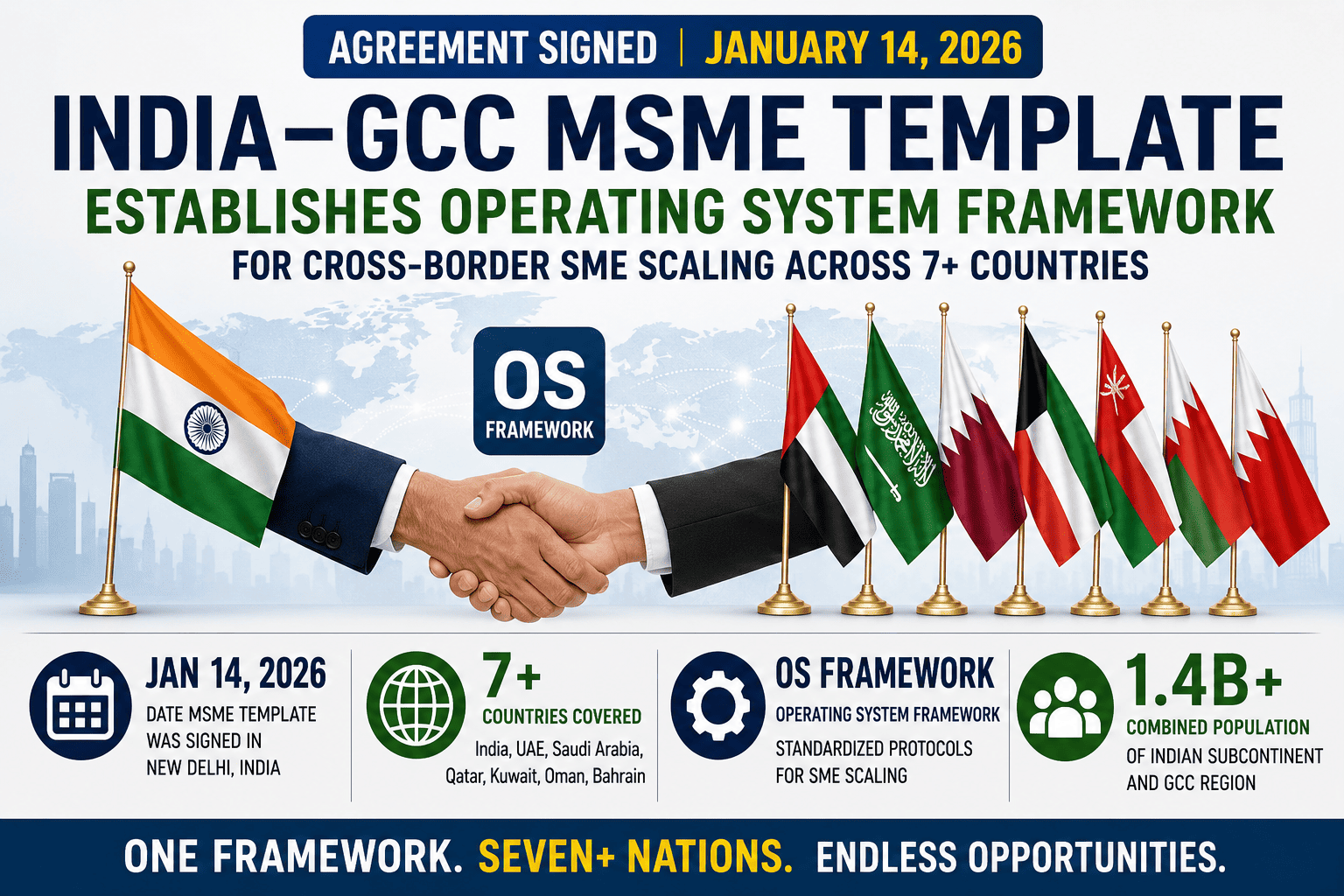
India and GCC nations signed a landmark MSME Template on January 14, 2026, establishing an Operating System Framework for cross-border SME scaling across the Indian Subcontinent and Gulf Cooperation Council. The agreement creates standardized protocols for SME cooperation, joint ventures, supply chain integration, and market access across 7+ countries.
🎯 Direct Answer
India and GCC nations signed the MSME Template on January 14, 2026, establishing an Operating System Framework for cross-border SME scaling. The agreement creates standardized commercial partnership protocols between India, UAE, Saudi Arabia, and other GCC nations. Key provisions include standardized partnership agreements, quality benchmarks, logistics protocols, compliance harmonization, and dispute resolution mechanisms. The framework is designed to reduce the complexity of cross-border SME cooperation, making it easier for manufacturers in the Indian Subcontinent and GCC to form joint ventures, integrate supply chains, and access new markets. UAE and Saudi Arabia are leading the GCC implementation, with the framework now operational for manufacturers in both regions.
📅 January 14, 2026⏱ 16 min read✍️ GTsetu Editorial Team📰 News + Analysis
Agreement Type
OS Framework
Operating System Framework for cross-border SME scaling, signed Jan 14, 2026
Countries
7+
India + GCC nations, UAE, Saudi Arabia, Qatar, Kuwait, Oman, Bahrain
Sector
MSME Scaling
Cross-border SME growth, joint ventures, supply chain integration, market access
Region
Indian Subcontinent + GCC
Connecting 1.4B+ people across South Asia and the Arabian Gulf
Section 1, The News
1
The Full Story: India-GCC MSME Template
🌏
Agreement Signed, January 14, 2026
India-GCC MSME Template Establishes Operating System Framework for Cross-Border SME Scaling Across 7+ Countries
On January 14, 2026, India and Gulf Cooperation Council nations signed the landmark MSME Template, establishing an Operating System Framework for cross-border SME scaling across the Indian Subcontinent and GCC. The agreement was finalized in a ceremony in New Delhi, with representatives from UAE, Saudi Arabia, and other GCC nations in attendance.
The framework creates standardized protocols for SME cooperation, including standardized partnership agreements, quality benchmarks, logistics protocols, compliance harmonization, and dispute resolution mechanisms. UAE and Saudi Arabia are leading the GCC implementation, with the framework already operational for manufacturers in both regions.
For manufacturers, this represents a fundamental shift in how cross-border SME cooperation works. Instead of navigating different legal systems, compliance requirements, and commercial practices in each country, the OS Framework provides a unified operational structure. The agreement is expected to accelerate SME joint ventures, supply chain integration, and market access across the combined 1.4B+ population of the Indian Subcontinent and GCC region.
Jan 14, 2026
Date MSME Template was signed in New Delhi, India
7+
Countries covered, India, UAE, Saudi Arabia, Qatar, Kuwait, Oman, Bahrain
OS Framework
Operating System Framework, standardized protocols for SME scaling
1.4B+
Combined population of Indian Subcontinent and GCC region
“The MSME Template is the operating system for cross-border SME growth. It removes the friction that has historically prevented small manufacturers from scaling across borders. This is not a trade agreement, it’s a practical framework for doing business together.”
— India’s Minister of Commerce and Industry, New Delhi, January 14, 2026
“UAE is proud to lead GCC implementation of this framework. Our manufacturers will benefit from standardized partnership agreements, reduced compliance complexity, and faster market entry across the region. This is the future of cross-border SME cooperation.”
— UAE Minister of Economy, January 14, 2026
💡 GTsetu Perspective
The India-GCC MSME Template represents a paradigm shift in cross-border manufacturing cooperation. For decades, SMEs faced insurmountable barriers, different legal systems, varying compliance standards, inconsistent quality benchmarks. The OS Framework solves this by providing a unified operational structure. The question for manufacturers is no longer if they can cross borders, but with whom and how fast. GTsetu connects you to verified manufacturing partners across India, GCC, and 100+ countries, so you can scale your SME before your competitors do.
Section 2, OS Framework
2
The Operating System Framework, What It Means for Manufacturers
The Operating System Framework is the core innovation of the India-GCC MSME Template. Unlike traditional trade agreements that focus on tariffs, this framework provides the operational protocols that make cross-border SME cooperation practical.
📋
Standardized Agreements
Pre-approved partnership agreement templates that work across all signatory countries, eliminating the need for country-specific legal drafting.
⚖️ Legal harmonization
✅
Quality Benchmarks
Common quality standards and certification frameworks that are recognized across all signatory countries, reducing duplication of compliance efforts.
🔍 Mutual recognition
🚚
Logistics Protocols
Standardized shipping, warehousing, and distribution protocols that streamline cross-border supply chains and reduce logistics costs.
📦 Supply chain efficiency
🛡️
Dispute Resolution
Standardized mediation and arbitration mechanisms that apply across all signatory countries, providing predictable dispute resolution.
⚖️ Cross-border justice
Section 3, The Anatomy
3
What Each Region Brings to the Framework
Like every successful cross-border framework, the India-GCC MSME Template works because each region contributes unique strengths that complement the others. This complementarity is the foundation of the Operating System Framework.
Combined market access covers 1.4B+ people across regions
Workforce
Large, skilled workforce, engineering talent
Specialized expertise, management talent
Combined workforce of 1.4B+ creates unmatched human capital
Logistics
Ports, rail network, domestic distribution
Global logistics hubs (Dubai, Dammam), air cargo
India’s distribution meets GCC’s global logistics connectivity
Regulatory Framework
MSME-friendly policies, export incentives
Business-friendly regulations, free zones
The OS Framework harmonizes regulatory differences
Section 4, Implementation
4
Implementation Roadmap, 2026 and Beyond
The India-GCC MSME Template is built on a clear, phased implementation roadmap. UAE and Saudi Arabia are leading GCC implementation, with the framework now operational for manufacturers in both regions.
📊 India-GCC MSME Template Implementation Roadmap
Phase 1
Jan 2026, Template Signed + Framework Launch
Agreement signed in New Delhi. OS Framework established. UAE and Saudi Arabia confirmed as lead GCC implementers. Standardized partnership templates released.
Phase 2
2026, Pilot Implementation + SME Onboarding
Pilot programs in UAE and Saudi Arabia. SME onboarding through trade promotion agencies. Standardized agreements piloted with 100+ SME partnerships.
Phase 3
2027, Full GCC Rollout + Supply Chain Integration
Framework extended to all GCC nations. Supply chain integration protocols activated. Joint venture facilitation mechanisms fully operational.
Phase 4
2028+, Full Operating System Operational
Full OS Framework operational across all signatory countries. Standardized agreements, quality benchmarks, logistics protocols, and dispute resolution fully implemented. Cross-border SME scaling accelerated.
🔑 Key Lesson: SME Access to Operating System Frameworks
The India-GCC MSME Template represents a fundamental shift: cross-border SME cooperation is no longer limited to large corporations. The OS Framework provides standardized protocols that make SME partnerships practical across 7+ countries. For manufacturers, this means government-backed pathways to cross-border scaling that previously required significant legal and compliance resources. The question is not whether you qualify, it’s whether you act before your competitors do. GTsetu’s platform connects you to verified partners across India, GCC, and 100+ countries, so you can access these opportunities through the right counterparty.
Section 5, Why This Works
5
Why This Framework Works for MSME Scaling
🎯 The Core Logic
The India-GCC MSME Template succeeds because it is built on three interlocking strategic advantages: (1) Complementary regional strengths, India’s manufacturing scale and cost efficiency meets GCC’s capital and premium market access; (2) Standardized operational protocols, the OS Framework removes the friction that has historically prevented SME cross-border cooperation; (3) Phased implementation with clear ownership, UAE and Saudi Arabia leading GCC implementation ensures accountability and momentum.
Why Cross-Border SME Scaling Is Accelerating in 2026
1.4B+
Combined population of Indian Subcontinent and GCC, the world’s largest SME market
63M+
MSMEs in India alone, the backbone of the country’s manufacturing ecosystem
OS
Operating System Framework, standardized protocols that make cross-border SME scaling practical
GCC
Gulf Cooperation Council, high-value markets with significant capital and demand
7+
Countries covered, India, UAE, Saudi Arabia, Qatar, Kuwait, Oman, Bahrain
2026
The year the Operating System Framework went live, the year of cross-border SME scaling
Section 6, Indian Subcontinent-GCC Opportunity
6
The Indian Subcontinent-GCC Opportunity, Why 2026 Is the Year to Act
🌏 Indian Subcontinent + GCC 2026–2030
Why Manufacturers Across the Indian Subcontinent and GCC Should Act Now
The India-GCC MSME Template is the most significant cross-border SME framework in a decade. It creates a unified Operating System for SME scaling across 7+ countries, connecting India’s manufacturing scale with GCC’s capital and market access. For manufacturers in both regions, the opportunity is unprecedented.
1.4B+
Combined population, the largest SME market in the world
OS
Operating System Framework, standardized protocols that reduce SME cross-border barriers
7+
Countries covered, India, UAE, Saudi Arabia, Qatar, Kuwait, Oman, Bahrain
UAE
Leading GCC implementation, Dubai’s logistics and financial hub accessible to Indian SMEs
Saudi
Vision 2030 creates manufacturing opportunities, Indian SMEs can partner in Saudi’s industrial transformation
2026
The year the framework went live, first-mover advantage for manufacturers who act now
🌐 GTsetu for India-GCC Manufacturing Collaboration
GTsetu’s verified partner network includes manufacturers, SMEs, and technology providers across India, UAE, Saudi Arabia, and 100+ other countries. Every company on GTsetu is verified on 6 government-sourced points: Name, Address, Registration Number, Company Status, Company Type, and Date of Certificate of Incorporation. Additional capabilities like certifications, manufacturing capacity, and export experience are self-reported. If you’re a manufacturer looking to leverage the India-GCC MSME Template, whether for joint ventures, supply chain integration, or market access, GTsetu is where your partner search begins with verified profiles, not cold calls. Find India-GCC manufacturing partners →
Section 7, Types of Cross-Border SME Partnerships
7
4 Types of Cross-Border SME Partnerships, Which Fits Your Strategy?
The India-GCC MSME Template enables multiple types of cross-border partnership. The right structure depends on your sector, your objectives, and your existing capabilities.
01
Joint Ventures
Co-owned manufacturing operations between Indian SMEs and GCC partners. The OS Framework provides standardized JV agreements that work across all signatory countries.
🏭 India-GCC joint manufacturing
02
Supply Chain Integration
Cross-border supply chain coordination, Indian manufacturing inputs to GCC production or GCC logistics to Indian distribution. Standardized logistics protocols reduce friction.
🔗 India-GCC supply chains
03
Market Access Partnerships
GCC partners provide market access and distribution; Indian partners provide manufacturing. The OS Framework standardizes market entry and distribution agreements.
📦 GCC market entry
04
Technology & Capability Transfer
GCC partners bring advanced technology, automation, or management expertise; Indian partners provide scale and cost-effective production. Standardized protocols for IP protection and capability transfer.
⚙️ India-GCC capability building
📊 Cross-Border SME Partnership Comparison
Model
Investment Required
OS Framework Support
Speed to Execute
Scalability
Risk Level
Joint Venture
High
✓ Standardized templates
Medium (8–16 months)
High
Moderate
Supply Chain Integration
Moderate
✓ Logistics protocols
Fast (4–10 months)
High
Low
Market Access
Low
✓ Market entry protocols
Fastest (2–6 months)
Moderate
Low
Technology Transfer
Moderate
✓ IP & capability protocols
Medium (6–14 months)
High
Moderate
Section 8, How to Leverage the Template
8
How to Leverage the Template: A 5-Step Playbook for SMEs
The India-GCC MSME Template is operational. Here is the distilled playbook for accessing cross-border SME scaling opportunities.
1
Identify Your Partnership Objective
Are you an Indian SME seeking GCC market access, investment, or technology? Or a GCC SME seeking Indian manufacturing scale, cost efficiency, or supply chain integration? The MSME Template supports all four types of partnership. Define your specific objective before you begin partner discovery.
2
Find Verified Partners Across India and GCC
The crucial word is “verified.” GTsetu provides verified company profiles across India, UAE, Saudi Arabia, and 100+ countries. Every company is verified on 6 government-sourced points: Name, Address, Registration Number, Company Status, Company Type, and Date of Certificate of Incorporation. Additional information like certifications, manufacturing capabilities, and export experience is self-reported and should be validated independently through your own due diligence.
3
Use the OS Framework’s Standardized Templates
The Operating System Framework provides pre-approved partnership agreement templates that work across all signatory countries. These templates cover JV structures, supply chain integration, market access agreements, and technology transfer protocols. Using these templates reduces legal costs and speeds up execution significantly.
4
Protect Your IP Before Sharing Sensitive Information
In cross-border SME cooperation, your manufacturing processes, product designs, and commercial terms are valuable IP. Before sharing anything sensitive, even a capability requirements document, execute a mutual NDA. GTsetu’s built-in NDA workflow handles this automatically: mutual NDA executed and countersigned before any sensitive information is shared, with a full digital audit trail.
5
Engage with Implementation Partners
UAE and Saudi Arabia are leading GCC implementation. Identify trade promotion agencies, SME associations, and business councils in both regions that are actively promoting the MSME Template. Use GTsetu to find verified partners who are already engaged with the framework implementation.
Section 9, Dos and Don’ts
9
Dos and Don’ts of Cross-Border SME Collaboration
✅ Do These
✅ Map your SME capabilities to the OS Framework’s standardized agreement templates
✅ Verify partner credentials before negotiating, GTsetu verifies legal identity and company status
✅ Start with market access partnerships, they’re the fastest way to test cross-border cooperation
✅ Leverage UAE and Saudi Arabia as the lead GCC implementation countries
✅ Use the OS Framework’s quality benchmarks, they’re recognized across all signatory countries
✅ Understand each country’s regulatory environment, the OS Framework harmonizes compliance
✅ Build relationships before full implementation, first-mover advantage is significant
✅ Document all partnership terms formally, the OS Framework provides standard templates
✅ Use verified platforms like GTsetu for structured partner discovery across both regions
✅ Monitor implementation milestones, the OS Framework is phased over 2026-2028
❌ Avoid These
❌ Wait for perfect conditions before acting, the OS Framework is already operational
❌ Share sensitive business data or product specs before NDA is countersigned
❌ Assume the template works the same in every GCC nation, understand country-specific implementation
❌ Neglect to verify partner credentials, self-reported claims are not legal verification
❌ Focus only on one partnership type, the OS Framework supports joint ventures, supply chains, market access, and technology transfer
❌ Ignore the logistical protocols, they’re designed to reduce cross-border supply chain friction
❌ Underestimate cultural and business practice differences between India and GCC nations
❌ Start production on informal terms, the OS Framework requires documented agreements
❌ Pursue all partnership types simultaneously, focus on your strongest fit first
❌ Sign agreements without cross-border legal review, international SME partnerships require specialist advice
Section 10, Misconceptions
10
Common Misconceptions About Operating System Frameworks
❌ Myth
“The MSME Template is just another trade agreement, it won’t change how SMEs actually do business.”
✅ Reality
The Operating System Framework is fundamentally different from a trade agreement. It provides standardized operational protocols, partnership templates, quality benchmarks, logistics protocols, and dispute resolution mechanisms, that directly reduce the friction of cross-border SME cooperation. This is the operational infrastructure that makes SME scaling practical, not just a government document.
❌ Myth
“Only large corporations can benefit from cross-border SME frameworks.”
✅ Reality
The MSME Template is specifically designed for SMEs. The OS Framework simplifies the operational complexity that has historically made cross-border cooperation too expensive for small manufacturers. Standardized templates reduce legal costs; quality benchmarks reduce compliance duplication; logistics protocols reduce shipping friction. The barrier is no longer size, it’s action.
❌ Myth
“The framework is only for manufacturers, service SMEs can’t use it.”
✅ Reality
While the framework is named for MSMEs, its protocols apply to any SME engaged in cross-border commercial activity. Standardized partnership agreements, quality benchmarks, and dispute resolution mechanisms benefit service SMEs too, including logistics, technology services, consulting, and trade facilitation. The OS Framework is sector-agnostic.
❌ Myth
“UAE and Saudi Arabia implementing the framework doesn’t mean other GCC nations will follow.”
✅ Reality
The MSME Template is a GCC-wide framework, UAE and Saudi Arabia are leading implementation because of their regional economic weight, but the framework applies to all GCC nations. Phase 3 of the roadmap (2027) explicitly covers full GCC rollout. Manufacturers who wait for full GCC implementation will miss the first-mover advantage available through UAE and Saudi Arabia now.
❌ Myth
“The OS Framework will replace existing legal and compliance requirements.”
✅ Reality
The OS Framework harmonizes and simplifies, it doesn’t replace. National laws, tax regimes, and regulatory requirements still apply. The framework provides standardized protocols that make compliance less complex by reducing duplication and providing clear pathways. It’s an operating system, not a legal rewrite. GTsetu helps you navigate partner verification within this framework.
Section 11, GTsetu
11
How GTsetu Helps You Find the Right Cross-Border SME Partner
India and GCC nations have the MSME Template. You need the execution partners. GTsetu is the verified B2B manufacturing discovery platform that connects you to verified partners across India, GCC, and 100+ countries, before you share a single confidential detail.
🌐 Platform Spotlight, GTsetu
Find Verified Manufacturing Partners Across India, GCC, and 100+ Countries, Anonymously, Securely, With Zero Broker Fees
Every company on GTsetu is verified using government tie-ups on 6 key points: Name, Address, Registration Number, Company Status, Company Type, and Date of Certificate of Incorporation. This is the foundation of trust. Additional information such as quality certifications, manufacturing capabilities, and export experience is self-reported by companies. You evaluate who is real before you engage. You share nothing sensitive until an NDA is countersigned. And you pay no broker commission on any partnership formed, the deal is entirely between you and your partner.
✅
6-Point Government-Sourced VerificationName, Address, Registration Number, Company Status, Company Type, Date of Incorporation confirmed using government tie-ups.
🕵️
Anonymous DiscoveryEvaluate verified partner profiles without revealing your identity until mutual interest is confirmed.
📄
Built-In NDA WorkflowShare commercial terms and specifications only after NDA is executed, full audit trail, no external legal required.
🚫
Zero CommissionNo broker fees, your joint venture, supply contract, or market access agreement is entirely between you and your partner.
🌍
100+ CountriesIndia, UAE, Saudi Arabia, USA, Germany, China, UK, find partners in every manufacturing hub.
🔐
Encrypted CollaborationShare product specifications, quality requirements, and manufacturing data securely between verified partners.
What India-GCC Is Doing, What GTsetu Enables For You
What India-GCC Is Doing
What GTsetu Enables for You
Why This Matters
Creates OS Framework for SME scaling across 7+ countries
✓ Browse verified company profiles across India and GCC with government-sourced verification before engaging
You find the partner before the framework is fully implemented, first-mover advantage
UAE and Saudi Arabia leading GCC implementation
✓ Filter by self-reported capabilities, certifications, and export experience (validate independently)
Find potential partners already active in the lead implementation countries
Provides standardized partnership templates and protocols
✓ Built-in NDA and document workflow protects your business data from the first conversation
Your product specifications, pricing, and commercial terms are protected at every stage
Connects 1.4B+ people across the Indian Subcontinent and GCC
✓ Self-reported partner profiles show geographic reach, manufacturing capabilities, and export markets
Identify partners positioned to serve the entire India-GCC corridor and beyond
Creates government-backed SME scaling mechanisms
✓ Zero commission on any partnership, all commercial terms are direct between the two parties
No broker splits your margin or misaligns your commercial terms
FAQ
?
Frequently Asked Questions
Q
What is the India-GCC MSME Template?
The India-GCC MSME Template is a landmark commercial partnership framework signed on January 14, 2026, establishing an Operating System Framework for cross-border SME scaling between India and Gulf Cooperation Council nations (UAE, Saudi Arabia, Qatar, Kuwait, Oman, Bahrain). The agreement creates standardized protocols for SME cooperation, joint ventures, supply chain integration, and market access across the Indian Subcontinent and GCC region.
Q
What is an Operating System Framework in commercial partnerships?
An Operating System Framework (OS Framework) is a standardized structure for cross-border commercial cooperation that defines common protocols, compliance standards, documentation requirements, and operational procedures. Unlike a traditional trade agreement that focuses primarily on tariffs, an OS Framework provides the operational “software” that enables businesses to collaborate across borders efficiently, including standardized partnership agreements, quality benchmarks, logistics protocols, and dispute resolution mechanisms.
Q
Which countries are covered by the India-GCC MSME Template?
The template covers 7+ countries: India on the Indian Subcontinent side, and GCC nations including UAE, Saudi Arabia, Qatar, Kuwait, Oman, and Bahrain. UAE and Saudi Arabia are leading the GCC implementation phase, with full GCC rollout expected in 2027. The combined population of these countries exceeds 1.4 billion people.
Q
How can SMEs in India and GCC benefit from this framework?
SMEs can benefit through multiple pathways: (1) Joint Ventures, co-owned manufacturing operations using standardized JV agreements; (2) Supply Chain Integration, cross-border coordination with standardized logistics protocols; (3) Market Access, GCC partners providing distribution; Indian partners providing manufacturing; (4) Technology Transfer, capability building with standardized IP protection. The OS Framework reduces legal costs, compliance complexity, and operational friction for all four partnership types.
Q
Does GTsetu charge commission on partnerships formed through the platform?
No. GTsetu charges zero commission on any partnership, whether joint ventures, supply contracts, market access agreements, or technology transfer arrangements, formed through the platform. The commercial terms of your agreement are entirely between you and your partner. This is a foundational design principle: broker intermediation creates incentive misalignment and typically costs 5–15% of deal value. GTsetu removes the broker entirely. Learn more about GTsetu →
Q
How can I find verified manufacturing partners in India or GCC?
The systematic approach involves four steps: (1) Define your partnership objective, joint venture, supply chain, market access, or technology transfer; (2) Search verified platforms, GTsetu lists verified manufacturers and SMEs across India, UAE, Saudi Arabia, and 100+ countries. GTsetu verifies companies using government tie-ups on 6 points: Name, Address, Registration Number, Company Status, Company Type, and Date of Certificate of Incorporation. Additional information like certifications and manufacturing capabilities is self-reported and should be validated independently. (3) Evaluate anonymously first, review verified profiles and self-reported capability data before revealing your identity or requirements. (4) Execute NDA before any sensitive disclosure, GTsetu’s built-in NDA workflow handles this automatically before any document exchange.
Ready to Scale Your SME Across India and GCC? Start on GTsetu.
500+ verified manufacturers, SMEs, and technology partners across India, UAE, Saudi Arabia, and 100+ countries. Zero broker fees. Anonymous discovery. Built-in NDA workflows. Your next cross-border SME partnership starts with a verified profile, not a cold email.
Business Development Expert | Global Trade & International Market Development
Sarah Ann Mitchell is a Business Development Expert at GTsetu with a strong focus on global trade, international market development, and strategic business partnerships. She works with companies seeking to expand internationally by identifying collaboration opportunities, connecting with key stakeholders, and developing market access strategies.
Sarah brings expertise in cross-border business development, international trade ecosystems, partnership building, and global market intelligence. Her work at GTsetu involves supporting businesses, manufacturers, startups, and industry leaders in building relationships that accelerate growth and create long-term commercial value.
Passionate about fostering international collaboration, Sarah helps organizations navigate evolving global markets and discover new opportunities through strategic partnerships, trade networks, and ecosystem-driven growth initiatives.