Egypt-Turkiye Trade Partnership: What MENA Manufacturers Must Learn About Bilateral Strategic Alliances
🔴 BREAKINGEgypt-Turkiye Trade Partnership: Strategic Alliance signed June 7, 2026, Textiles, Automotive, Chemicals, Renewable Energy sectors to benefit◆Bilateral trade target: $15 billion annual volume within 5 years, up from current $6.5 billion◆MENA manufacturers gain preferential access: Textile quotas eased, automotive parts tariffs reduced, renewable energy tech transfer accelerated◆Find verified B2B manufacturing partners across MENA, Europe, and 100+ countries on GTsetu, zero commission◆🔴 BREAKINGEgypt-Turkiye Trade Partnership: Strategic Alliance signed June 7, 2026, Textiles, Automotive, Chemicals, Renewable Energy sectors to benefit◆Bilateral trade target: $15 billion annual volume within 5 years, up from current $6.5 billion◆MENA manufacturers gain preferential access: Textile quotas eased, automotive parts tariffs reduced, renewable energy tech transfer accelerated◆Find verified B2B manufacturing partners across MENA, Europe, and 100+ countries on GTsetu, zero commission◆
Home › Blog › Egypt-Turkiye Trade Partnership
🔴 Breaking News🌍 MENA Manufacturing🇪🇬 Egypt Trade🇹🇷 Turkiye Cooperation
Egypt-Turkiye Trade Partnership: How a Bilateral Strategic Alliance Is Reshaping MENA Manufacturing
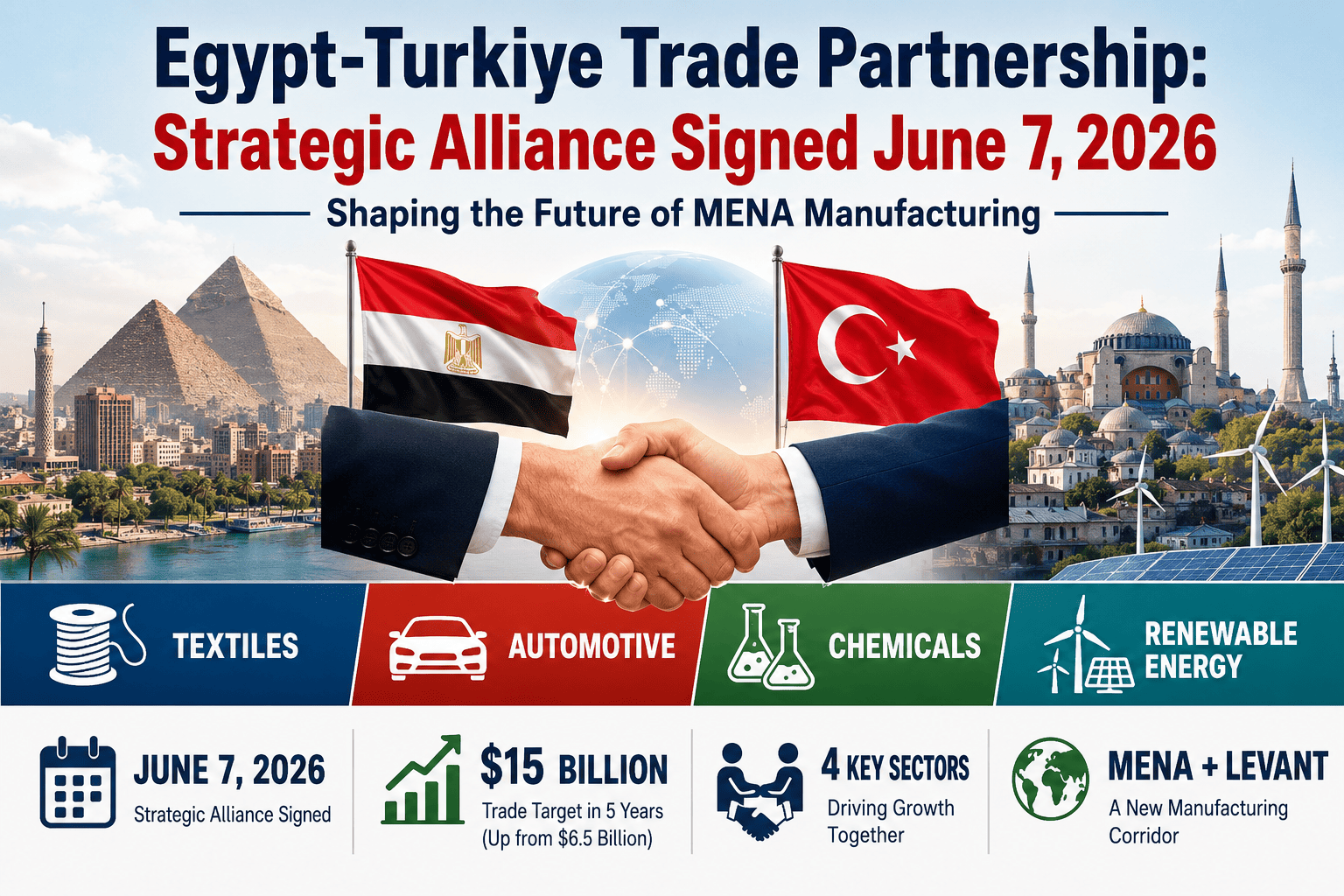
Egypt and Turkiye signed a landmark Strategic Alliance on June 7, 2026, establishing a comprehensive bilateral cooperation framework spanning Textiles, Automotive, Chemicals, and Renewable Energy. The agreement aims to increase bilateral trade from $6.5 billion to $15 billion within five years, creating unprecedented opportunities for manufacturers across the MENA region and the Levant.
🎯 Direct Answer
Egypt and Turkiye have signed a Strategic Alliance, a comprehensive bilateral cooperation agreement, on June 7, 2026, covering Textiles, Automotive, Chemicals, and Renewable Energy sectors. The agreement establishes a framework for trade facilitation, investment promotion, technology transfer, and supply chain integration between the two nations. Key provisions include tariff reductions on automotive parts, eased textile export quotas, accelerated renewable energy technology transfer, and joint chemical industry development. This builds on existing trade relations (currently $6.5 billion annually) with a target of reaching $15 billion in bilateral trade within five years. The alliance positions both countries as manufacturing hubs connecting the MENA region, the Levant, and European markets.
📅 June 7, 2026⏱ 18 min read✍️ GTsetu Editorial Team📰 News + Analysis
Partnership Type
Strategic Alliance
Comprehensive bilateral cooperation framework signed June 7, 2026
Trade Target
$15B
Annual bilateral trade target within 5 years, up from $6.5 billion currently
Non-GCC Middle East, Levant, North Africa, the new manufacturing corridor
Section 1, The News
1
The Full Story: Egypt-Turkiye Strategic Alliance
🌍
Deal Announced, June 7, 2026
Egypt and Turkiye Sign Strategic Alliance, $15 Billion Trade Target, 4 Priority Sectors Reshaping MENA Manufacturing
On June 7, 2026, Egypt and Turkiye announced a landmark Strategic Alliance, a comprehensive bilateral cooperation agreement spanning Textiles, Automotive, Chemicals, and Renewable Energy. The agreement establishes a formal framework for trade facilitation, investment promotion, technology transfer, and supply chain integration between the two nations.
The alliance builds on existing bilateral trade which currently stands at $6.5 billion annually and targets $15 billion within five years. Key provisions include tariff reductions on automotive components, eased textile export quotas between the two countries, accelerated renewable energy technology transfer, and joint chemical industry development. The agreement also includes provisions for SME integration, cross-border investment protection, and regulatory alignment.
The alliance positions both countries as manufacturing hubs connecting the MENA region, the Levant, and European markets. Egypt’s access to African markets through the African Continental Free Trade Area (AfCFTA) and Turkiye’s customs union with the EU create a strategic manufacturing corridor that spans three continents. For manufacturers in the region, this represents a once-in-a-generation opportunity to integrate supply chains across the Egypt-Turkiye corridor.
June 7, 2026
Date Strategic Alliance was signed in Cairo, Egypt
Target annual bilateral trade volume within 5 years
3 Continents
Connecting Africa, Europe, and Asia through the Egypt-Turkiye corridor
“This Strategic Alliance represents a new chapter in our economic relations. We are not just opening markets; we are building integrated supply chains that will make the Egypt-Turkiye corridor a manufacturing hub for the entire MENA region and beyond.”
— Egyptian Minister of Trade and Industry, Cairo Press Conference, June 7, 2026
“Turkiye and Egypt together can create a manufacturing powerhouse. Our textile industry, automotive supply chains, chemical expertise, and renewable energy ambitions complement each other perfectly. This is the alliance the region has been waiting for.”
— Turkish Minister of Trade, Ankara, June 7, 2026
💡 GTsetu Perspective
The Egypt-Turkiye Strategic Alliance signals a fundamental shift in MENA manufacturing. For decades, the region’s supply chains have been fragmented. This bilateral cooperation creates a unified manufacturing corridor, from Istanbul’s automotive cluster to Cairo’s textile hub, from Alexandria’s chemical facilities to the renewable energy projects across both nations. For manufacturers, the question is no longer whether to integrate into this corridor, but with whom and how fast. GTsetu connects you to verified manufacturing partners across Egypt, Turkiye, and 100+ countries, so you can act on this opportunity before your competitors do.
Section 2, The 4 Priority Sectors
2
The 4 Priority Sectors, Textiles, Automotive, Chemicals, Renewable Energy
The Egypt-Turkiye Strategic Alliance identifies four priority sectors for cooperation. These are not arbitrary choices, they represent complementary industrial strengths where each country brings unique capabilities that the other needs.
🧵
Textiles
Egypt’s cotton expertise + Turkiye’s textile manufacturing scale. Quotas eased, supply chains integrated. Target: become the region’s textile hub.
🇪🇬🇹🇷 Egyptian Cotton + Turkish Manufacturing
🚗
Automotive
Turkiye’s automotive assembly capacity + Egypt’s parts manufacturing. Tariff reductions on components, joint production agreements expected.
🚘 Turkish Assembly + Egyptian Parts
🧪
Chemicals
Egypt’s petrochemicals + Turkiye’s chemical processing. Joint development of fertilizer, polymer, and specialty chemical production.
⚗️ Egyptian Petrochemicals + Turkish Processing
☀️
Renewable Energy
Solar/wind potential of Egypt + Turkish renewable technology. Accelerated tech transfer, joint projects, and investment facilitation.
🌞 Egyptian Resources + Turkish Tech
Section 3, The Anatomy
3
What Each Country Brings to the Alliance
Like every successful bilateral cooperation, the Egypt-Turkiye Strategic Alliance works because each country contributes what the other cannot efficiently replicate. This complementarity principle is the foundation of any strategic alliance worth entering.
Tech transfer accelerates Egypt’s industrial upgrading; Turkiye gains scale
Workforce
Young, large workforce (110M+ population)
Skilled engineers, technicians, 85M+ population
Combined workforce of 195M+ creates a manufacturing powerhouse
Investment Capital
Free zones, investment incentives, sovereign wealth funds
Private sector capital, development finance institutions
Joint investment framework reduces risk for both sides
Regulatory Framework
Trade facilitation, customs modernization
EU-aligned standards, customs union experience
Regulatory alignment reduces barriers to trade and investment
Section 4, The Roadmap
4
From $6.5B to $15B, The Bilateral Trade Roadmap
The Egypt-Turkiye Strategic Alliance is built on a clear, phased roadmap with specific milestones. This structured approach distinguishes this alliance from less successful bilateral agreements that lack implementation mechanisms.
📊 Egypt-Turkiye Bilateral Trade Roadmap, 2026 to 2031
2026
Strategic Alliance Signed, Framework Established
June 7, 2026: Agreement signed in Cairo. Priority sectors identified. Joint committee established for implementation. Current bilateral trade: $6.5 billion.
2027
Tariff Reductions Implemented, Phase 1
Automotive parts tariffs reduced. Textile quotas eased for priority products. Joint investment promotion campaigns launched. Target: $9 billion bilateral trade.
2028–29
Sector-Specific Agreements, Phase 2
Automotive assembly agreements with Egyptian parts suppliers. Textile supply chain integration. Renewable energy joint ventures launched. Chemicals sector coordination. Target: $12 billion.
2030–31
Full Integration, $15B Target Achieved
Comprehensive supply chain integration across all 4 sectors. Regulatory alignment complete. Egypt-Turkiye manufacturing corridor fully operational, connecting Africa, Europe, and Asia. Target: $15 billion bilateral trade.
🔑 Key Lesson: Phased Implementation
The Egypt-Turkiye Strategic Alliance is not a one-time agreement, it’s a phased roadmap with clear milestones. This matters for manufacturers. Each phase creates new opportunities: Phase 1 opens tariff benefits, Phase 2 creates joint production agreements, Phase 3 enables full supply chain integration. Companies that enter early can position themselves to capture value at each stage. Waiting until Phase 3 means missing the easiest market entry and the highest-margin early contracts. GTsetu’s platform connects you to verified partners in both countries today, so you can start before the tariff reductions hit full implementation.
Section 5, Why This Works
5
Why This Alliance Works for Manufacturing
🎯 The Core Logic
The Egypt-Turkiye Strategic Alliance succeeds because it is built on three interlocking strategic advantages: complementary industrial strengths where each country leads in different sectors, market access expansion (AfCFTA + EU Customs Union), and a phased implementation framework that builds momentum. Neither country could have achieved the same result alone, Egypt cannot replace Turkiye’s 50+ years of automotive assembly expertise, and Turkiye cannot replicate Egypt’s 110-million-person market and African trade access.
Why MENA+Levant Manufacturing Collaboration Is Accelerating
195M+
Combined population of Egypt and Turkiye, a massive domestic market
AfCFTA
Egypt grants access to Africa’s 1.3-billion-person market through the African Continental Free Trade Area
EU CU
Turkiye’s EU Customs Union provides tariff-free access to 27 European markets
3 Continents
The Egypt-Turkiye corridor connects Africa, Europe, and Asia, unique logistics advantage
$6.5B → $15B
Bilateral trade target, more than double within 5 years, driven by this alliance
4 Sectors
Focused cooperation in Textiles, Automotive, Chemicals, and Renewable Energy
Section 6, MENA Opportunity
6
The MENA+Levant Manufacturing Opportunity, Why Now Is the Time to Act
🌍 MENA + Levant Manufacturing 2026–2031
Why Manufacturers Across the Middle East, North Africa, and the Levant Should Act Now
The MENA region is undergoing a manufacturing renaissance. Supply chains are regionalising, trade barriers are falling, and major economies are prioritising industrial integration. The Egypt-Turkiye Strategic Alliance is the most significant bilateral manufacturing agreement in the region in a decade, creating a corridor that connects the Levant, the Gulf, North Africa, and Europe. For manufacturers in Textiles, Automotive, Chemicals, or Renewable Energy, the opportunity is unprecedented.
$15B
Target bilateral trade by 2031, up from $6.5B in 2026, 130%+ growth
1.8B
Population reach, Africa (1.3B) + Europe (500M) through combined market access
Combined domestic market population of Egypt and Turkiye alone
Tariff
Reductions on automotive parts, textiles, chemicals, direct cost advantage for manufacturers
Levant
The Jordan, Lebanon, Syria, Palestine corridor becomes a strategic manufacturing link in this alliance
🌐 GTsetu for MENA Manufacturing Collaboration
GTsetu’s verified partner network includes manufacturers, suppliers, and technology partners across Egypt, Turkiye, and 100+ other countries. Every company on GTsetu is verified on 6 government-sourced points: Name, Address, Registration Number, Company Status, Company Type, and Date of Certificate of Incorporation. Additional capabilities like certifications and export experience are self-reported. If you’re a manufacturer looking to leverage the Egypt-Turkiye Strategic Alliance, whether to source textiles, supply automotive parts, enter the chemicals sector, or partner on renewable energy projects, GTsetu is where your partner search begins with verified profiles, not cold calls. Find MENA manufacturing partners →
Section 7, Types of Bilateral Cooperation
7
4 Types of Bilateral Cooperation, Which Fits Your Manufacturing Strategy?
The Egypt-Turkiye Strategic Alliance is a comprehensive framework, but within it, manufacturers can pursue different types of cooperation. The right structure depends entirely on your sector, your objectives, and your existing capabilities.
01
Trade Facilitation
Tariff reductions, streamlined customs procedures, and eased export quotas. The most accessible form of cooperation. Ideal for manufacturers looking to export to partner markets without establishing local production.
📦 Egypt-Turkiye tariff reductions
02
Investment Facilitation
Cross-border investment protections, joint venture facilitation, and incentives for manufacturing FDI. Ideal for manufacturers establishing production facilities in the partner country.
🏭 Joint manufacturing investments
03
Technology Transfer
Access to advanced manufacturing processes, renewable energy technology, and industrial R&D. Vital for upgrading manufacturing capabilities and achieving higher value-added production.
⚙️ Egyptian-Turkish tech collaboration
04
Supply Chain Integration
Full supply chain coordination across borders, raw materials from Egypt, manufacturing in Turkiye, distribution across Africa and Europe. The deepest form of bilateral cooperation.
🔗 Egypt-Turkiye corridor integration
📊 Bilateral Cooperation Model Comparison, Manufacturing Sectors
Model
Investment Required
Market Access
Technology Transfer
Speed to Execute
Scalability
Trade Facilitation
Minimal
✓ High
✗ Low
Fast (3–6 months)
Moderate
Investment Facilitation
High, FDI commitment
✓ Maximum
✓ Moderate
Slow (12–24 months)
High
Technology Transfer
Moderate
~ Moderate
✓ High
Medium (6–12 months)
High
Supply Chain Integration
High, full coordination
✓ Full
✓ High
Slow (12–36 months)
Maximum
Section 8, How to Leverage This Alliance
8
How to Leverage This Alliance: A 5-Step Playbook for MENA Manufacturers
The Egypt-Turkiye Strategic Alliance is a once-in-a-generation opportunity, but only for manufacturers who act deliberately. Here is the distilled playbook for capturing value from this bilateral cooperation.
1
Identify Your Specific Alliance Opportunity
The alliance covers four sectors. Are you in textiles looking for Egyptian cotton supply or Turkish manufacturing capacity? Automotive parts seeking Turkish assembly plants or Egyptian market access? Chemicals needing Egyptian raw materials or Turkish processing? Renewable energy requiring Egyptian land and solar resources or Turkish technology? Define your specific vector into the alliance.
2
Find Verified Partners in Egypt and Turkiye
The crucial word is “verified.” GTsetu provides verified company profiles in Egypt, Turkiye, and 100+ countries. Every company is verified on 6 government-sourced points: Name, Address, Registration Number, Company Status, Company Type, and Date of Certificate of Incorporation. Additional information like certifications, manufacturing capabilities, and export experience is self-reported and should be validated independently through your own due diligence.
3
Protect Your IP Before Sharing Sensitive Information
In bilateral cooperation, your manufacturing processes, product designs, and supply chain data are valuable IP. Before sharing anything sensitive, even a capability requirements document, execute a mutual NDA. GTsetu’s built-in NDA workflow handles this automatically: mutual NDA executed and countersigned before any sensitive information is shared, with a full digital audit trail.
4
Choose the Right Cooperation Structure
Trade facilitation is fastest (tariff benefits) but offers limited integration. Investment facilitation requires capital but gives market control. Technology transfer upgrades your capabilities. Supply chain integration is deepest but slowest. Match the structure to your objective, not to what’s easiest. Egypt and Turkiye offer all four pathways.
5
Formalise and Execute in Phases
The alliance itself is phased over 5 years. Your entry should be phased too. Start with trade facilitation (tariff benefits on exports), then investment (if you need local production), then technology transfer (if you need capability upgrade), then supply chain integration (if you want full corridor leverage). Structure every phase formally: scope, investment, timeline, IP terms, and renewal conditions.
Section 9, Dos and Don’ts
9
Dos and Don’ts of Bilateral Trade Cooperation
✅ Do These
✅ Map the alliance to your specific sector, textiles, automotive, chemicals, or renewables
✅ Verify partner credentials before negotiating, GTsetu verifies legal identity and company status
✅ Start with tariff benefits, they’re the fastest way to test the market before committing capital
✅ Structure phased entry, trade first, investment later, integration last
✅ Leverage Egypt’s AfCFTA access and Turkiye’s EU Customs Union together
✅ Explore technology transfer provisions, they’re specifically designed for industrial upgrading
✅ Build relationships before tariffs are fully implemented, first-mover advantage is significant
✅ Document all cooperation terms formally, scope, investment, IP, timeline
✅ Use verified platforms like GTsetu for structured partner discovery
✅ Monitor implementation milestones, the alliance is phased; you need to track progress
❌ Avoid These
❌ Wait for full implementation before taking action, first-mover advantages are significant
❌ Share sensitive manufacturing data or product specs before NDA is countersigned
❌ Assume tariff benefits automatically apply, you need to understand product-specific provisions
❌ Neglect to verify partner credentials, self-reported claims are not legal verification
❌ Start with the deepest integration before testing the partnership with simple trade
❌ Ignore the Levant connection, Jordan, Lebanon, Syria, Palestine are strategic links in this corridor
❌ Neglect customs documentation, preferential tariffs require proof of origin
❌ Assume the alliance automatically eliminates all trade barriers, it’s a framework, not a magic wand
❌ Pursue all four sectors simultaneously, focus on your strongest fit first
❌ Sign agreements without legal review, cross-border commercial law requires specialist advice
Section 10, Misconceptions
10
Common Misconceptions About Bilateral Strategic Alliances
❌ Myth
“A Strategic Alliance is just a Free Trade Agreement by another name.”
✅ Reality
A Strategic Alliance is broader and deeper than an FTA. FTAs primarily focus on tariff reduction. The Egypt-Turkiye Strategic Alliance includes tariff reduction plus investment protection, technology transfer provisions, supply chain integration, regulatory alignment, and joint industrial development. It’s a comprehensive framework for industrial cooperation, not just a trade agreement.
❌ Myth
“The benefits will reach all manufacturers equally once the agreement is signed.”
✅ Reality
Benefits are phased and sector-specific. Manufacturers who understand their sector’s timeline and have established relationships in both countries will benefit first and most. The alliance is a framework, how you use it determines your benefit. First-movers in textiles, automotive parts, chemicals, and renewables will capture early-mover advantages.
❌ Myth
“Small and medium manufacturers can’t benefit from bilateral alliances.”
✅ Reality
The Egypt-Turkiye Alliance specifically includes SME integration provisions. SMEs can benefit through: (1) simpler customs procedures for smaller shipments, (2) access to supply chain opportunities from larger manufacturers in both countries, (3) joint industrial zones, and (4) technology transfer programs. The real barrier is finding the right counterparty, GTsetu solves this by connecting verified SMEs across both countries.
❌ Myth
“The Levant region is irrelevant to this alliance.”
✅ Reality
The Levant (Jordan, Lebanon, Syria, Palestine) is strategically central to the Egypt-Turkiye corridor. It connects the two countries geographically and provides transit routes. Manufacturers in the Levant can act as supply chain links between Egyptian raw materials and Turkish manufacturing, or as assembly and distribution hubs. The alliance explicitly mentions Levant integration in its strategic vision.
❌ Myth
“If I’m not a textile or automotive manufacturer, this alliance doesn’t affect me.”
✅ Reality
The alliance covers four major industrial sectors but the economic impact will ripple across the entire manufacturing ecosystem. Chemical manufacturers supply automotive and textile producers. Renewable energy projects need steel, concrete, electronics, and logistics. Packaging, logistics, engineering services, and maintenance will all see increased demand. The multiplier effect of a $15 billion bilateral trade increase is significant across the entire supply chain.
Section 11, GTsetu
11
How GTsetu Helps You Find the Right MENA Manufacturing Partner
Egypt and Turkiye have the alliance framework. You need the execution partners. GTsetu is the verified B2B manufacturing discovery platform that connects you to verified partners in Egypt, Turkiye, and 100+ countries, before you share a single confidential detail.
🌐 Platform Spotlight, GTsetu
Find Verified Manufacturing Partners Across Egypt, Turkiye, MENA, and 100+ Countries, Anonymously, Securely, With Zero Broker Fees
Every company on GTsetu is verified using government tie-ups on 6 key points: Name, Address, Registration Number, Company Status, Company Type, and Date of Certificate of Incorporation. This is the foundation of trust. Additional information such as quality certifications, manufacturing capabilities, export experience, and trade references is self-reported by companies. You evaluate who is real before you engage. You share nothing sensitive until an NDA is countersigned. And you pay no broker commission on any partnership formed, the deal is entirely between you and your partner.
✅
6-Point Government-Sourced VerificationName, Address, Registration Number, Company Status, Company Type, Date of Incorporation confirmed using government tie-ups.
🕵️
Anonymous DiscoveryEvaluate verified partner profiles without revealing your identity until mutual interest is confirmed.
📄
Built-In NDA WorkflowShare commercial terms and specifications only after NDA is executed, full audit trail, no external legal required.
🚫
Zero CommissionNo broker fees, your supply contract, investment, or cooperation agreement is entirely between you and your partner.
🌍
100+ CountriesEgypt, Turkiye, Germany, India, China, UAE, Saudi Arabia, find partners in every manufacturing hub.
🔐
Encrypted CollaborationShare product specifications, quality requirements, and manufacturing data securely between verified partners.
What Egypt and Turkiye Did, What GTsetu Enables For You
What the Alliance Does
What GTsetu Enables for You
Why This Matters
Creates tariff reduction framework across 4 priority sectors
✓ Browse verified company profiles in Egypt and Turkiye with government-sourced verification before engaging
You find the partner before the tariff benefits are fully implemented, first-mover advantage
Provides investment protection and joint venture facilitation
✓ Filter by self-reported capabilities, certifications, and export experience (validate independently)
Find potential partners with the specific manufacturing capabilities and market experience your investment requires
Enables technology transfer across sectors
✓ Built-in NDA and document workflow protects your technology IP from the first conversation
Your manufacturing process data and product specifications are protected at every stage
Builds a manufacturing corridor across Africa, Europe, and Asia
✓ Self-reported partner profiles show geographic reach, export markets, and logistics capabilities
Identify partners positioned to serve the full Egypt-Turkiye corridor and beyond
Eliminates broker intermediation in government-level cooperation
✓ Zero commission on any partnership, all commercial terms are direct between the two parties
No broker splits your margin or misaligns your commercial terms
FAQ
?
Frequently Asked Questions
Q
What exactly did Egypt and Turkiye agree to on June 7, 2026?
Egypt and Turkiye signed a Strategic Alliance, a comprehensive bilateral cooperation agreement covering Textiles, Automotive, Chemicals, and Renewable Energy. The agreement establishes a framework for tariff reductions, investment protection, technology transfer, supply chain integration, and regulatory alignment. Current bilateral trade is $6.5 billion with a target of $15 billion within five years. The alliance also includes provisions for SME integration and cross-border investment protection.
Q
Which sectors are covered by the Egypt-Turkiye Strategic Alliance?
The alliance prioritises four sectors: (1) Textiles, Egyptian cotton combined with Turkish manufacturing scale, with eased quotas and supply chain integration; (2) Automotive, Turkish assembly capacity with Egyptian parts manufacturing, with tariff reductions on components; (3) Chemicals, Egyptian petrochemicals with Turkish processing expertise; (4) Renewable Energy, Egyptian solar/wind resources with Turkish technology transfer and joint project development.
Q
What is the difference between a Strategic Alliance and a Free Trade Agreement?
A Free Trade Agreement (FTA) primarily focuses on reducing tariffs and eliminating quotas on goods traded between countries. A Strategic Alliance is broader and deeper, it includes tariff reduction plus investment protection, technology transfer provisions, supply chain integration, regulatory alignment, and joint industrial development. While an FTA is about trade, a Strategic Alliance is about industrial cooperation. The Egypt-Turkiye agreement is explicitly a Strategic Alliance, not just an FTA.
Q
How can manufacturers in the Levant region benefit from this alliance?
The Levant (Jordan, Lebanon, Syria, Palestine) is strategically central to the Egypt-Turkiye corridor. Manufacturers in the Levant can: (1) act as supply chain links between Egyptian raw materials and Turkish manufacturing, (2) establish assembly and distribution hubs serving both markets, (3) leverage transit routes connecting Africa, Europe, and Asia, (4) access preferential tariffs through the alliance, and (5) participate in joint industrial zones being developed under the alliance framework.
Q
Does GTsetu charge commission on partnerships formed through the platform?
No. GTsetu charges zero commission on any partnership, whether supply contracts, joint ventures, technology transfer agreements, or investment partnerships, formed through the platform. The commercial terms of your agreement are entirely between you and your partner. This is a foundational design principle: broker intermediation creates incentive misalignment and typically costs 5–15% of deal value. GTsetu removes the broker entirely. Learn more about GTsetu →
Q
How can I find verified manufacturing partners in Egypt or Turkiye?
The systematic approach involves four steps: (1) Define your sector and requirement, textiles, automotive parts, chemicals, renewables, or supporting sectors; (2) Search verified platforms, GTsetu lists verified manufacturers and technology holders across Egypt, Turkiye, and 100+ countries. GTsetu verifies companies using government tie-ups on 6 points: Name, Address, Registration Number, Company Status, Company Type, and Date of Certificate of Incorporation. Additional information like certifications and export experience is self-reported and should be validated independently. (3) Evaluate anonymously first, review verified profiles and self-reported capability data before revealing your identity or product requirements. (4) Execute NDA before any technical disclosure, GTsetu’s built-in NDA workflow handles this automatically before any sensitive document exchange.
Ready to Capture the Egypt-Turkiye Opportunity? Start on GTsetu.
500+ verified manufacturers, technology partners, and suppliers across Egypt, Turkiye, MENA, and 100+ countries. Zero broker fees. Anonymous discovery. Built-in NDA workflows. Your next bilateral partnership starts with a verified profile, not a cold email.
Business Development Expert | Global Trade & International Market Development
Sarah Ann Mitchell is a Business Development Expert at GTsetu with a strong focus on global trade, international market development, and strategic business partnerships. She works with companies seeking to expand internationally by identifying collaboration opportunities, connecting with key stakeholders, and developing market access strategies.
Sarah brings expertise in cross-border business development, international trade ecosystems, partnership building, and global market intelligence. Her work at GTsetu involves supporting businesses, manufacturers, startups, and industry leaders in building relationships that accelerate growth and create long-term commercial value.
Passionate about fostering international collaboration, Sarah helps organizations navigate evolving global markets and discover new opportunities through strategic partnerships, trade networks, and ecosystem-driven growth initiatives.