Canada–Mexico Trade Mission: B2B Expansion Opportunities for SMEs – GTsetu
🔴 BREAKINGCanada–Mexico trade mission (Feb 15–20, 2026): pre-arranged B2B meetings for SMEs in manufacturing, clean tech, ICT, food & agritech◆Trade deals and distribution & channel partnerships open North American expansion for Canadian SMEs◆Find verified distributors, manufacturers & channel partners on GTsetu, 100+ countries, zero commission◆🔴 BREAKINGCanada–Mexico trade mission (Feb 15–20, 2026): pre-arranged B2B meetings for SMEs in manufacturing, clean tech, ICT, food & agritech◆Trade deals and distribution & channel partnerships open North American expansion for Canadian SMEs◆Find verified distributors, manufacturers & channel partners on GTsetu, 100+ countries, zero commission◆
Home › Blog › Canada–Mexico Trade Mission
🔴 Breaking News🏭 Manufacturing🇨🇦🇲🇽 North America🤝 Trade Deals📦 Distribution
Canada–Mexico Trade Mission: B2B Expansion Opportunities for SMEs
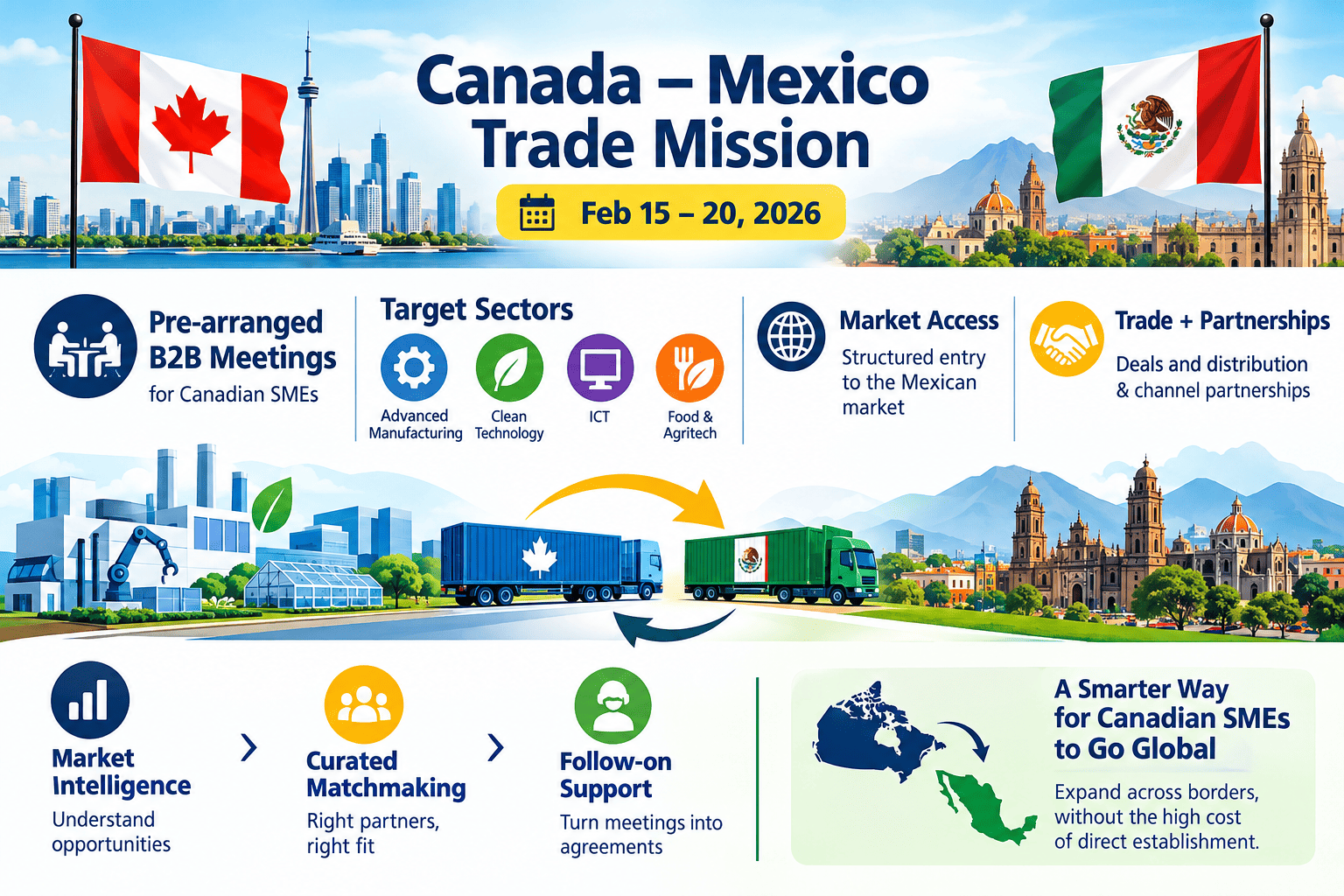
A Canada–Mexico trade mission (February 15–20, 2026) gave Canadian SMEs access to pre-arranged B2B meetings in advanced manufacturing, clean technology, information and communications technology (ICT), and food and agritech. The mission was designed to help Canadian SMEs enter the Mexican market through structured matchmaking, market intelligence, and distribution and channel partnership opportunities.
🎯 Direct Answer
A Canada–Mexico trade mission held February 15–20, 2026 created pre-arranged B2B meetings for Canadian SMEs in advanced manufacturing, clean technology, ICT, food and agritech, giving them structured access to the Mexican market. The mission combined trade deals and distribution & channel partnerships to help Canadian SMEs enter Mexico through local distributors, resellers, systems integrators, and manufacturing partners. The programme included market intelligence, curated matchmaking, and follow-on support designed to convert B2B meetings into commercial agreements. The mission reflects a broader North American trend: SMEs are using trade missions and verified partner discovery to expand across borders without the capital cost of direct establishment.
📅 February 20, 2026⏱ 14 min read✍️ GTsetu Editorial Team📰 News + Analysis
Event Type
Trade Mission
Canada–Mexico trade mission, Feb 15–20, 2026, pre-arranged B2B meetings
Focus
SME Expansion
B2B meetings, market entry, and distribution partnerships for SMEs
Pre-arranged B2B meetings to enter the Mexican market through channel partners
Section 1, The News
1
The Full Story: Canada–Mexico Trade Mission
🇨🇦🇲🇽
Trade Mission, February 15–20, 2026
Canada–Mexico Trade Mission Creates Pre-Arranged B2B Meetings for SMEs in Manufacturing, Clean Tech, ICT and Agritech
Between February 15 and 20, 2026, a Canada–Mexico trade mission gave Canadian SMEs access to pre-arranged B2B meetings in advanced manufacturing, clean technology, ICT, food and agritech, the four sectors identified as offering the strongest near-term demand in the Mexican market.
The mission was structured around distribution and channel partnerships: Canadian SMEs were matched with Mexican distributors, resellers, systems integrators, and manufacturing partners who could represent their products locally, accelerating market entry without the capital cost of direct establishment.
The programme combined market intelligence, curated matchmaking, and follow-on support designed to convert B2B meetings into commercial agreements. It reflects a broader North American trend, SMEs are using trade missions and verified partner discovery to expand across borders, move up global value chains, and reduce dependence on any single market.
Pre-arranged B2B meetings designed to convert to commercial agreements
SMEs
Canadian SMEs targeting Mexican market entry and channel expansion
Channel
Distribution and channel partnerships as the primary market entry route
“Trade missions like this one give Canadian SMEs something they cannot easily buy: pre-qualified introductions to the right partners in the right sectors at the right moment. The meetings are structured, the counterparts are screened, and the follow-on support is designed to convert conversations into contracts.”
— Trade Commissioner Service, Canada
“Mexico is not a single market, it is a set of regional industrial clusters, each with its own buyer preferences, certification requirements, and channel structures. A trade mission compresses years of market learning into a single week of structured meetings, provided the SME arrives prepared to ask the right questions.”
— GTsetu Cross-Border Partnerships Team
💡 GTsetu Perspective
The Canada–Mexico trade mission is a template for how SME internationalisation is actually happening in 2026: structured, verified, and channel-led rather than capital-heavy and direct. Canadian SMEs that convert their B2B meetings into signed distribution agreements will hold preferred positions in the Mexican market that later entrants will find difficult to replicate. GTsetu is where verified distribution partner discovery happens systematically, connecting SMEs with the right distributors, resellers, and manufacturing partners across North America and 100+ countries. See our guide to international wholesale distributors for the commercial framework behind these partnerships.
Section 2, The Anatomy
2
What Each Side Brings to the Table
Like every successful cross-border collaboration, the Canada–Mexico trade mission works because each party contributes what the other cannot efficiently replicate. This complementarity principle is the foundation of any distribution partnership worth building. For the full evaluation framework, see our guide to partnership evaluation criteria.
End-to-end logistics across the border with clear Incoterms allocation
Knowledge
Technical product expertise, training, after-sales support capability
Local buyer preferences, industry contacts, regulatory navigation
Knowledge-sharing initiatives build local capabilities and resilience
Section 3, Why This Works
3
Why This Distribution Model Works for SMEs
🎯 The Core Logic
The Canada–Mexico trade mission succeeds because it is built on three interlocking strategic advantages: a verified exporter with a market-ready product (the Canadian SME), a curated local partner with the customer relationships and compliance knowledge the exporter lacks (the Mexican distributor), and structured matchmaking that compresses years of market learning into a single week. Neither party could have achieved the same result through any other mechanism, the SME cannot independently build a Mexican channel, and the Mexican partner cannot replicate Canadian product IP.
Why Distribution-Led Market Entry Is Accelerating in North America
USMCA
USMCA gives Canadian and Mexican SMEs preferential access to each other’s markets
Nearshoring
Nearshoring is driving North American manufacturers to source and sell regionally
Channel
Channel partnerships let SMEs enter new markets without capital-heavy direct establishment
SMEs
SMEs account for the vast majority of businesses and employment in both economies
4 Sectors
Advanced manufacturing, clean tech, ICT, food and agritech are the priority sectors
Scale
Channel partnerships combine product strength with local market access to scale faster
Section 4, North America Opportunity
4
North America SME Trade Opportunity, Why Now Is the Time to Partner
🇨🇦🇲🇽 Canada–Mexico SME Trade Ecosystem 2026–2030
Why Every Canadian SME Should Be Pursuing Distribution-Led Expansion Into Mexico
Mexico is one of the most attractive near-shore markets for Canadian SMEs: USMCA market access, a deep industrial base across advanced manufacturing and clean tech, a rapidly digitising ICT sector, and a food and agritech value chain that increasingly sources from North America. The Canada–Mexico trade mission creates a structured entry route for SMEs that would otherwise struggle to identify and verify the right local partners. For the research groundwork behind this type of expansion, see global market research for manufacturers.
USMCA
Preferential trade access across Canada, Mexico, and the United States
Nearshoring
North American supply chains are being rebuilt regionally, creating new partner demand
4 Sectors
Advanced manufacturing, clean tech, ICT, food and agritech lead demand
Channel
Distribution and channel partnerships provide the fastest route to revenue
B2B
Pre-arranged B2B meetings compress market learning into a single week
Scale
Trade missions plus verified partner discovery help SMEs scale across borders
🌐 GTsetu for Cross-Border Partnerships & SME Expansion
GTsetu’s verified partner network includes distributors, resellers, systems integrators, manufacturers, and channel partners across Canada, Mexico, the United States, and 100+ other countries. Every company on GTsetu is verified on 6 government-sourced points: Name, Address, Registration Number, Company Status, Company Type, and Date of Certificate of Incorporation. Additional capabilities like distribution reach, sector expertise, and channel experience are self-reported. If you’re a Canadian SME seeking distribution partners in Mexico, or a Mexican distributor looking to represent Canadian products, GTsetu is where your partner search begins with verified profiles, not cold calls. See cross-border business partnerships and cross-border manufacturing partnerships for the strategic context. Find cross-border partners →
Section 5, Types of Collaboration
5
4 Types of Cross-Border Collaboration, Which Fits Your Situation?
The Canada–Mexico trade mission used a distribution and channel partnership model. But cross-border collaborations come in many forms. The right structure depends on what you need, what you can invest, and how deeply you want to integrate. For the commercial framework, see cross-border business partnerships.
01
Distribution & Channel Partnership
Appoint a local distributor, reseller, or systems integrator to sell, support, and represent your products in the target market. The Canada–Mexico trade mission model. Fastest route to revenue, lowest capital commitment, requires a well-structured distribution agreement. See international wholesale distributors.
📦 Canada–Mexico trade mission
02
Cross-Border Manufacturing Partnership
Contract manufacturing, joint production, or supply chain integration across borders. Best for manufacturers seeking to localise production, reduce tariffs, or meet regional content requirements. Requires robust IP and quality governance. See cross-border manufacturing partnerships.
🏭 Localised production
03
Joint Venture or Strategic Alliance
Shared ownership or formal alliance with a local partner for a defined market or project. Best where local relationships, licences, or government procurement access are critical. Requires careful structuring of IP, governance, and exit provisions. See partnership evaluation criteria.
🤝 Shared ownership
04
Trade Mission / Market Development
Structured market entry programmes with pre-arranged meetings, market intelligence, and follow-on support. Often the first step before a deeper channel or manufacturing partnership. Tests market readiness before full commitment. Fastest to launch and lowest capital.
📣 Market development, step 1
📊 Cross-Border Collaboration Model Comparison
Model
Investment Required
Market Access
Control
Speed to Launch
Reversibility
Distribution & Channel
Low (stock, marketing, training)
✓ Broad
Moderate (shared with partner)
Fast (3–6 months)
High
Cross-Border Manufacturing
Medium-High (tooling, inventory)
✓ Regional
Shared (contract-governed)
Medium (6–12 months)
Low-Medium
Joint Venture / Alliance
High (capital, legal, governance)
Deep, targeted
Shared equity / governance
Slow (9–18 months)
Low
Trade Mission
Minimal (travel, time)
~ Introductions, not sales
Full (you control follow-up)
Fastest (1–3 months)
✓ High
Section 6, How to Build
6
How to Build a Distribution Partnership: A 5-Step Playbook
The Canada–Mexico trade mission did not happen by accident. It followed a deliberate progression from identifying the right target market to screening partners to converting B2B meetings into signed distribution agreements. Here is the distilled playbook.
1
Define the Market Gap with Precision
The Canada–Mexico trade mission targeted four sectors because those were the sectors where Mexican demand and Canadian supply matched. It didn’t try to cover everything. Define your gap that precisely. Vague needs produce vague partner searches and failed negotiations. Start with global market research for manufacturers to identify where demand and capability intersect.
2
Find Verified Distribution Partners, Not Just Any Partner
The crucial word is “verified.” A Mexican distributor that looks credible on a website may lack the licensing, financial standing, or customer relationships to perform. For businesses that don’t have an existing trade mission connection, GTsetu provides verified profiles of distributors, resellers, systems integrators, and manufacturers across Canada, Mexico, and 100+ countries. GTsetu verifies companies using government tie-ups on 6 key points: Name, Address, Registration Number, Company Status, Company Type, and Date of Certificate of Incorporation. Additional information like distribution reach and sector expertise is self-reported and should be validated through commercial due diligence.
3
Protect Your IP and Commercial Terms Before Disclosure
In cross-border distribution partnerships, your product specifications, pricing, customer lists, and commercial strategy are valuable IP. Before sharing anything sensitive, execute a mutual NDA. This is non-negotiable regardless of how well the trade mission screened the counterpart. GTsetu’s built-in NDA workflow handles this automatically: mutual NDA executed and countersigned before any sensitive information is shared, with a full digital audit trail. For the contract framework, see Incoterms 2020 and FCA (Free Carrier) for delivery terms.
4
Choose the Right Collaboration Structure for Your Objective
The Canada–Mexico trade mission chose a distribution and channel partnership model. This is right when you need rapid market access without entity establishment. A cross-border manufacturing partnership is right when you need localised production or regional content compliance. A joint venture is right where local licences or government procurement access are critical. Match the structure to the objective, not to what’s easiest to negotiate. For certification groundwork, see manufacturing certifications for international trade.
5
Formalise and Scale in Stages, Agreement First, Volume Second
The Canada–Mexico trade mission produced meetings first, and the distribution agreements followed, in that order. The B2B meeting unlocks the partnership opportunity; the signed agreement capitalises on it. Never commit to full-scale market entry investment before you have a distribution agreement and pilot order in place. Structure every collaboration milestone formally in writing: territory scope, pricing, volume commitments, IP provisions, service levels, and termination terms. For risk allocation, see risk allocation in cross-border deals.
Section 7, Dos and Don’ts
7
Dos and Don’ts of Cross-Border Partnerships
✅ Do These
✅ Target sectors where your product matches local demand, the trade mission focused on four sectors, not all
✅ Verify your distribution partner’s legal identity and trading credentials before engagement
✅ Sequence B2B meetings before signed agreements, use meetings to qualify, not to commit
✅ Sign an NDA before sharing pricing, product specs, or customer lists
✅ Choose a partner whose capabilities complement yours, product met channel in this trade mission
✅ Define territory, pricing, and volume commitments clearly in the distribution agreement
✅ Run a pilot order or pilot region before scaling to full national distribution
✅ Build in performance metrics and review points, distribution partnerships need accountability
✅ Use verified platforms like GTsetu rather than trade fair introductions for strategic partners
✅ Document the partnership formally, NDA, distribution agreement, and implementation plan before launch
❌ Avoid These
❌ Appoint a distributor before verifying its legal identity and trading record
❌ Share pricing or product IP before NDA is countersigned
❌ Accept self-reported distribution reach without reference verification
❌ Assume a B2B meeting converts automatically, require a written agreement, not just a handshake
❌ Partner with a distributor that doesn’t have the technical capability to support your product
❌ Neglect exclusivity terms, know whether your distributor can represent competing products
❌ Choose a partner whose strengths duplicate yours, the gap is where value is created
❌ Start shipping on informal terms, territory, pricing, and Incoterms must be documented
❌ Underestimate the cultural and language alignment required for cross-border channel partnerships
❌ Commit to full national distribution before validating the model with a pilot region
Section 8, Misconceptions
8
Common Misconceptions About Trade Missions
❌ Myth
“A trade mission is just a networking event, the real work happens after you get home.”
✅ Reality
The Canada–Mexico trade mission spent months identifying sectors, screening counterparts, and structuring B2B meetings before any Canadian SME travelled. The mission is the foundation for follow-up commercial work. Without it, there is no pre-qualification, no sector targeting, and no curated counterpart list. The mission is not the end of the work, it’s the beginning of the commercial follow-up.
❌ Myth
“The distributor we meet automatically becomes our distributor.”
✅ Reality
A B2B meeting gives you access to a prospective distributor, not a signed agreement. The distribution relationship requires active development: territory definition, pricing, minimum volumes, marketing support, technical training, and service levels. The meeting is a door-opener, not a guarantee. Plan the commercial follow-up separately from the mission week.
❌ Myth
“We should establish our own legal entity in Mexico before appointing a distributor.”
✅ Reality
The trade mission model does the opposite, it uses a local distribution partner as the market entry vehicle before any entity establishment is considered. Setting up a Mexican subsidiary before validating demand is expensive, slow, and often unnecessary. The correct sequence is: distribution partnership → market validation → scale → entity decision. Never build legal infrastructure before you have validated the market through a channel partnership.
❌ Myth
“A cross-border distribution partnership requires permanent expatriate presence to manage.”
✅ Reality
Cross-border channel partnerships are managed through structured governance and scheduled review sessions rather than permanent expatriate presence. What matters is clear protocols for pricing, order management, service delivery, and performance reporting, not permanent proximity. GTsetu’s encrypted collaboration workspace supports exactly this structured working relationship.
❌ Myth
“We can figure out the Incoterms and payment terms after the first shipment.”
✅ Reality
Incoterms and payment disputes are the most common reason cross-border distribution relationships collapse, and they are almost always caused by vague or absent upfront agreements. Once goods are in transit on undefined terms, both parties’ leverage is gone. Choose the right Incoterms 2020 rule, name the place precisely, and align payment terms before the first purchase order is issued. For containerised shipments, FCA is generally preferred over FOB.
Section 9, GTsetu
9
How GTsetu Helps You Find the Right Distribution Partner
Canadian SMEs on the Canada–Mexico trade mission had the advantage of a government-supported programme with curated B2B meetings. Most SMEs and manufacturers are not that fortunate, and even when a trade mission connection exists, identifying whether a prospective distributor can be extended into a commercial partnership requires systematic evaluation. GTsetu is the verified B2B partner discovery platform that enables this evaluation at scale, across 100+ countries, before you reveal a single confidential detail. For the consulting dimension, see international business development consulting.
🌐 Platform Spotlight, GTsetu
Find Verified Distributors, Resellers, Systems Integrators and Manufacturing Partners Across Canada, Mexico, and 100+ Countries, Anonymously, Securely, With Zero Broker Fees
Every company on GTsetu is verified using government tie-ups on 6 key points: Name, Address, Registration Number, Company Status, Company Type, and Date of Certificate of Incorporation. This is the foundation of trust. Additional information such as distribution reach, sector expertise, channel experience, and manufacturing capability is self-reported by companies. You evaluate who is real before you engage. You share nothing sensitive until an NDA is countersigned. And you pay no broker commission on any partnership formed, the deal is entirely between you and your partner.
✅
6-Point Government-Sourced VerificationName, Address, Registration Number, Company Status, Company Type, Date of Incorporation confirmed using government tie-ups.
🕵️
Anonymous DiscoveryEvaluate verified partner profiles without revealing your identity until mutual interest is confirmed.
📄
Built-In NDA WorkflowShare pricing, product specs, and customer data only after NDA is executed, full audit trail, no external legal required.
🚫
Zero CommissionNo broker fees, your distribution partnership, manufacturing agreement, or channel deal is entirely between you and your partner.
🌍
100+ CountriesCanada, Mexico, United States, Europe, Asia, find distribution partners in every major market.
🔐
Encrypted CollaborationShare pricing schedules, product data, and commercial terms securely between verified partners.
✓ Browse verified distributors and channel partners by sector and capability before engaging
You evaluate the partner’s verified legal identity and sector fit, not marketing claims
Chose partners with complementary capabilities, product met local channel
✓ Filter by self-reported distribution reach, sector expertise, and channel experience (validate independently)
Find potential partners with the specific channel capability your market entry requires
Arranged pre-qualified B2B meetings before any commercial commitment
✓ Built-in NDA and document workflow protects your product IP and commercial terms from the first conversation
Your pricing, product specs, and customer lists are protected at every stage
Targeted counterparts whose capabilities were complementary (product vs. channel)
✓ Self-reported partner profiles show distribution reach, sector focus, and channel experience
Identify potential complementarity, the gap between your product capability and the partner’s channel reach
Zero intermediary between the SME and the local partner, direct B2B meetings
✓ Zero commission on any partnership, all terms are direct between the two parties
No broker splits your partnership value or misaligns your market entry objectives
FAQ
?
Frequently Asked Questions
Q
What exactly was the Canada–Mexico trade mission?
The Canada–Mexico trade mission (February 15–20, 2026) gave Canadian SMEs access to pre-arranged B2B meetings in advanced manufacturing, clean technology, ICT, food and agritech. It was structured around distribution and channel partnerships: Canadian SMEs were matched with Mexican distributors, resellers, systems integrators, and manufacturing partners who could represent their products locally. The programme combined market intelligence, curated matchmaking, and follow-on support designed to convert B2B meetings into commercial agreements.
Q
Why is this trade mission important for Canadian SMEs?
Mexico is one of the most attractive near-shore markets for Canadian SMEs, offering USMCA market access, a deep industrial base, and a rapidly digitising ICT and food and agritech value chain. However, many SMEs lack the local market knowledge, compliance expertise, and customer relationships needed to enter Mexico independently. The trade mission addresses this gap by combining market intelligence, curated B2B meetings, and distribution partner matchmaking. This enables SMEs to enter the Mexican market through a local channel partner without the capital cost and risk of direct establishment.
Q
What is a distribution and channel partnership, and how does it work?
A distribution and channel partnership is a commercial arrangement in which a manufacturer or service provider appoints a local partner (distributor, reseller, systems integrator, or agent) to sell, support, and represent its products in a target market. In the Canada–Mexico trade mission context, Canadian SMEs were matched with Mexican distributors and channel partners to accelerate market entry. The partnership works by: (1) defining territory, pricing, and volume commitments in a distribution agreement; (2) transferring technical product knowledge and marketing support to the local partner; (3) establishing service, warranty, and after-sales protocols; and (4) agreeing Incoterms and payment terms for cross-border shipments. The result is a market-ready channel without the cost of direct establishment.
Q
How can I find a verified distribution partner for my Canadian SME?
The systematic approach involves four steps: (1) Define your market gap precisely, which sector and which Mexican region? (2) Search verified platforms, GTsetu lists verified distributors, resellers, systems integrators, and manufacturers across Canada, Mexico, and 100+ countries. GTsetu verifies companies using government tie-ups on 6 points: Name, Address, Registration Number, Company Status, Company Type, and Date of Certificate of Incorporation. Additional information like distribution reach and sector expertise is self-reported and should be validated independently. (3) Evaluate anonymously first, review verified profiles and self-reported capability data before revealing your identity or product details. (4) Execute NDA before any technical disclosure, GTsetu’s built-in NDA workflow handles this automatically before any sensitive document exchange.
Q
What happens if my distribution partner also represents my competitors?
This is one of the most important and most frequently overlooked questions in cross-border distribution partnerships. If your distributor represents your direct competitors in the same market, your competitive advantage erodes. Before signing any distribution agreement, explicitly negotiate: (1) Exclusivity scope, is the distributorship exclusive to you in your sector or territory? (2) Competing product terms, can the distributor represent similar products during the agreement period? (3) Customer data ownership, who owns the end-customer relationships and data generated through the channel? These terms must be in the agreement before signing. For the wider contractual framework, see warranty clause and material breach.
Q
Does GTsetu charge commission on distribution partnerships formed through the platform?
No. GTsetu charges zero commission on any collaboration, whether a distribution partnership, cross-border manufacturing agreement, joint venture, or market development deal, formed through the platform. The commercial terms of your agreement are entirely between you and your partner. This is a foundational design principle: broker intermediation in cross-border distribution typically costs 5-15% of deal value and creates incentive misalignment between the broker and both parties. GTsetu removes the broker entirely. Learn more about GTsetu →
Ready to Find Your Distribution Partner? Start on GTsetu.
500+ verified distributors, resellers, systems integrators, and manufacturing partners across Canada, Mexico, the United States, and 100+ countries. Zero broker fees. Anonymous discovery. Built-in NDA workflows. Your next cross-border partnership starts with a verified profile, not a cold introduction.
Business Development Expert | Global Trade & Cross-Border Partnerships
Lui Wang is a Business Development Expert at GTsetu, specializing in international trade, cross-border partnerships, and market expansion strategies. With extensive experience working across diverse business ecosystems, Lui helps companies identify growth opportunities, establish strategic collaborations, and navigate the complexities of global commerce.
His expertise spans manufacturing, supply chain partnerships, technology collaborations, market entry strategies, and international business development. Through GTsetu, Lui works closely with businesses, trade organizations, and industry stakeholders to facilitate meaningful connections that drive sustainable growth across regions and sectors.
Lui is particularly passionate about helping organizations build long-term international partnerships, unlock new markets, and strengthen their global competitiveness in an increasingly interconnected economy.