ASEAN International MSME Day 2026: What Businesses Must Learn About Regional Resilience & Competitiveness
🔴 BREAKINGASEAN International MSME Day 2026: All 10 member nations sign strategic alliance to boost MSME resilience and competitiveness, unified regional commitment announced◆ASEAN MSMEs employ 85% of regional workforce and contribute 45% of GDP, resilience agenda critical for post-pandemic recovery and sustainable growth◆Key priorities: digital transformation, sustainable growth, market access, green MSMEs, and financial inclusion across Brunei, Cambodia, Indonesia, Laos, Malaysia, Myanmar, Philippines, Singapore, Thailand, Vietnam◆Find verified business partners across ASEAN on GTsetu, 100+ countries, zero commission◆🔴 BREAKINGASEAN International MSME Day 2026: All 10 member nations sign strategic alliance to boost MSME resilience and competitiveness, unified regional commitment announced◆ASEAN MSMEs employ 85% of regional workforce and contribute 45% of GDP, resilience agenda critical for post-pandemic recovery and sustainable growth◆Key priorities: digital transformation, sustainable growth, market access, green MSMEs, and financial inclusion across Brunei, Cambodia, Indonesia, Laos, Malaysia, Myanmar, Philippines, Singapore, Thailand, Vietnam◆Find verified business partners across ASEAN on GTsetu, 100+ countries, zero commission◆
ASEAN International MSME Day 2026: How a Unified Regional Strategic Alliance Is Building MSME Resilience Across Southeast Asia
All 10 ASEAN member nations have signed a strategic alliance to mark International MSME Day 2026, a unified regional commitment to strengthen MSME resilience and competitiveness. With MSMEs employing 85% of the regional workforce and contributing 45% of GDP, this coordinated approach prioritises digital transformation, sustainable growth, market access, green MSMEs, and financial inclusion.
🎯 Direct Answer
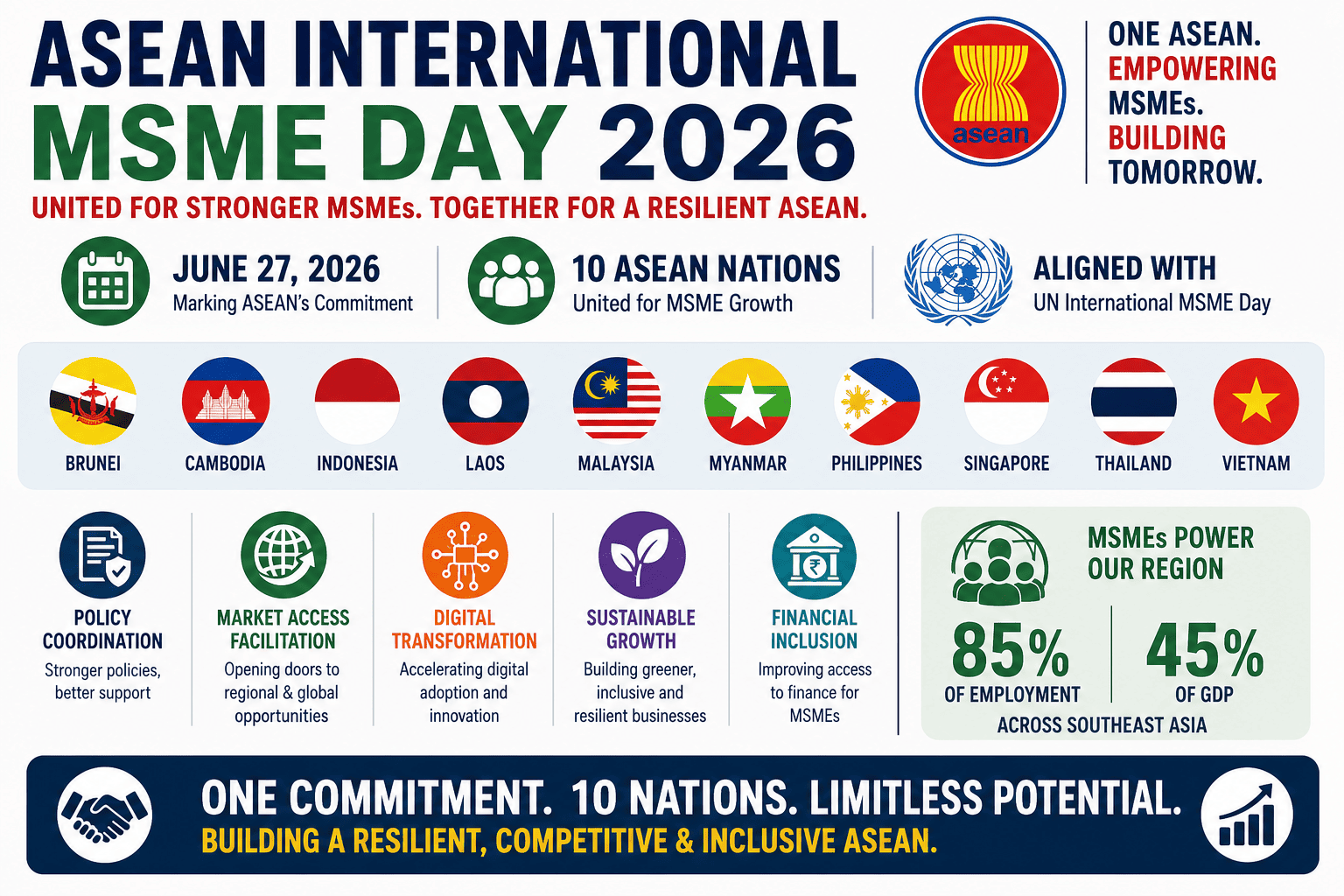
ASEAN International MSME Day 2026 represents a strategic alliance and regional commitment by all 10 ASEAN member nations, Brunei, Cambodia, Indonesia, Laos, Malaysia, Myanmar, Philippines, Singapore, Thailand, and Vietnam, to strengthen MSME resilience and competitiveness across Southeast Asia. Marked on June 27, 2026, this initiative aligns with the United Nations International MSME Day and represents a unified ASEAN approach to supporting small and medium enterprises through policy coordination, market access facilitation, digital transformation acceleration, sustainable growth initiatives, and financial inclusion programmes. MSMEs account for 85% of employment and 45% of GDP across the region, making this regional commitment a critical pillar of ASEAN’s post-pandemic recovery and long-term economic integration.
📅 June 27, 2026⏱ 15 min read✍️ GTsetu Editorial Team📰 News + Analysis
Deal Type
Strategic Alliance
Regional commitment by all 10 ASEAN nations, unified MSME support framework
ASEAN MSMEs
85% / 45%
85% of employment, 45% of GDP, MSMEs are the backbone of ASEAN economies
Member Nations
10
All ASEAN nations, Brunei, Cambodia, Indonesia, Laos, Malaysia, Myanmar, Philippines, Singapore, Thailand, Vietnam
Key Priorities
5 Pillars
Digital transformation, sustainable growth, market access, green MSMEs, financial inclusion
Section 1, The News
1
The Full Story: ASEAN International MSME Day 2026
🌏
Strategic Alliance, June 27, 2026
ASEAN International MSME Day 2026: All 10 Member Nations Sign Strategic Alliance to Strengthen MSME Resilience and Competitiveness
On June 27, 2026, all 10 ASEAN member nations, Brunei, Cambodia, Indonesia, Laos, Malaysia, Myanmar, Philippines, Singapore, Thailand, and Vietnam, marked International MSME Day with a strategic alliance and regional commitment to strengthen MSME resilience and competitiveness across Southeast Asia.
This unified regional initiative aligns with the United Nations International MSME Day and represents a coordinated ASEAN approach to supporting small and medium enterprises through five key priority pillars: digital transformation, sustainable growth, market access facilitation, green MSME development, and financial inclusion. The strategic alliance establishes a framework for policy coordination, knowledge sharing, and joint programmes across the region.
MSMEs account for 85% of employment and 45% of GDP across ASEAN, making this regional commitment a critical pillar of the region’s post-pandemic recovery and long-term economic integration agenda. The strategic alliance builds on existing ASEAN frameworks including the ASEAN Economic Community (AEC) Blueprint 2025 and the ASEAN Strategic Action Plan for SME Development.
10
ASEAN member nations, unified regional commitment
85%
Regional workforce employed by MSMEs, the backbone of ASEAN economies
45%
Regional GDP contributed by MSMEs, economic significance is enormous
5
Priority pillars: digital, sustainability, market access, green MSMEs, financial inclusion
“This strategic alliance is a testament to ASEAN’s collective commitment to building resilient and competitive MSMEs. By working together across all 10 member nations, we create a powerful ecosystem where small businesses can thrive, innovate, and drive sustainable growth for the entire region.”
— ASEAN Secretariat Official
“MSMEs are the lifeblood of our economies. This regional commitment sends a clear signal: ASEAN is serious about supporting our small businesses through digital transformation, sustainable practices, and expanded market access. The future of our region depends on it.”
— SME Development Representative, ASEAN Member Nation
💡 GTsetu Perspective
ASEAN’s strategic alliance for MSME resilience is a powerful reminder: regional coordination creates opportunities that individual nations cannot achieve alone. For businesses, this means new markets, shared resources, and coordinated support frameworks across 10 countries. If ASEAN is building a unified MSME ecosystem, what regional alliance could unlock your business growth? GTsetu helps you find verified partners across ASEAN and 100+ countries to seize these opportunities.
Section 2, Scale
2
The Scale, 10 Nations, 85% Employment, 45% GDP
The ASEAN International MSME Day 2026 strategic alliance is designed for regional impact. The commitment leverages ASEAN’s collective economic weight to create opportunities that individual nations cannot achieve alone.
📊 Regional Impact, ASEAN MSMEs by the Numbers
10
ASEAN member nations united in this strategic alliance
85%
Employment, MSMEs are the primary source of jobs across Southeast Asia
45%
GDP, economic contribution of MSMEs to the regional economy
The ASEAN strategic alliance recognises that MSME challenges, access to markets, digital adoption, sustainable practices, financial inclusion, are common across borders. A coordinated regional approach creates efficiency, avoids duplication, and builds a unified support ecosystem that individual nations cannot build alone. This model, regional coordination through strategic alliance, is the blueprint for MSME development in integrated economic communities.
Section 3, The Anatomy
3
What Each ASEAN Nation Brings to the Alliance
The ASEAN International MSME Day 2026 strategic alliance succeeds because each member nation contributes unique strengths while benefiting from the collective. This complementarity principle is the foundation of any strategic alliance worth entering.
🎯 Target: MSME resilience and competitiveness across Southeast Asia
🏢 5 priority pillars for MSME development
📈 85% employment, 45% GDP covered
Alliance Dimension
What ASEAN Secretariat Provides
What Member Nations Provide
Why This Balance Works
Policy Framework
Regional policy coordination and strategic direction
National policy adaptation and implementation
Regional framework + national execution = unified impact
Market Access
ASEAN-wide market integration frameworks
National trade facilitation and support
ASEAN opens doors; nations make them accessible
Digital Transformation
Regional digital economy guidelines
National digital adoption programmes
Consistent standards across ASEAN nations
Sustainability
ASEAN sustainable development framework
National green MSME initiatives
Shared sustainability goals across the region
Financial Inclusion
Regional financial integration frameworks
National SME finance programmes
ASEAN enables; nations deliver
Risk
Regional policy and coordination risk
National implementation risk
Both sides have skin in the game, different but real stakes
Section 4, The Context
4
The ASEAN Context, Economic Integration and MSMEs
Understanding the ASEAN International MSME Day 2026 strategic alliance requires understanding ASEAN’s economic integration journey, a movement that has transformed Southeast Asia since 1967. This alliance is the latest evolution of a proven regional cooperation model.
🌏 ASEAN Economic Integration, The Path to 2026
1967
ASEAN Founded
Association of Southeast Asian Nations established by Indonesia, Malaysia, Philippines, Singapore, and Thailand. Foundation of regional cooperation laid.
2015
ASEAN Economic Community (AEC) Established
AEC Blueprint 2015 launched, creating a single market and production base. MSMEs identified as key priority for regional economic integration.
2020-2025
AEC Blueprint 2025 & MSME Strategic Action Plan
ASEAN Strategic Action Plan for SME Development (2021-2025) adopted. Focus on digitalisation, sustainability, and post-pandemic recovery. MSMEs central to economic resilience.
Jun 2026
ASEAN International MSME Day 2026, Strategic Alliance
All 10 ASEAN nations sign strategic alliance for MSME resilience and competitiveness. Unified commitment to digital transformation, sustainable growth, market access, green MSMEs, and financial inclusion. Builds on 60 years of regional cooperation.
🔑 Key Lesson: Build on Regional Frameworks
ASEAN has spent decades building regional cooperation infrastructure. The International MSME Day 2026 strategic alliance leverages this existing framework rather than starting from zero. This is a critical lesson for any regional or cross-border initiative: don’t build what you can align with. The ASEAN model of regional coordination with national implementation is proven and replicable. If you’re a business looking to enter ASEAN markets, understanding this framework is essential. GTsetu helps you find verified partners across all 10 ASEAN nations, aligned with this regional economic integration agenda.
Section 5, Why This Works
5
Why This Strategic Alliance Model Works for Regional MSME Development
🎯 The Core Logic
The ASEAN International MSME Day 2026 strategic alliance succeeds because it is built on three interlocking strategic advantages: decades of proven regional cooperation infrastructure (ASEAN since 1967), unified policy commitment across all 10 nations, and diverse but complementary MSME ecosystems across Southeast Asia. Neither individual nations nor the ASEAN Secretariat could achieve the same impact alone, nations need regional coordination to avoid duplication and create scale, while the Secretariat needs national implementation to turn frameworks into impact.
Why Regional Strategic Alliances Are Accelerating
60 yrs
ASEAN’s proven regional cooperation infrastructure, built and trusted since 1967
10
Nations, unified commitment creating scale that individual nations cannot achieve
5
Priority pillars, digital, sustainability, market access, green MSMEs, financial inclusion
Diverse
MSME ecosystems, from Singapore’s tech SMEs to Indonesia’s manufacturing MSMEs
85%
Employment, MSMEs are the backbone of ASEAN economies, making resilience critical
45%
GDP, economic contribution making MSMEs a regional priority for development
Section 6, MSME Opportunity
6
The ASEAN MSME Opportunity, Why Regional Alliances Are Critical in 2026
🏢 ASEAN MSME Development 2026
Why Every Business, Policy Maker, and Investor Should Pay Attention to ASEAN’s MSME Agenda
MSMEs account for 85% of employment and 45% of GDP across ASEAN, making them the foundation of Southeast Asian economies. Yet MSMEs face common challenges: limited market access, slow digital adoption, sustainability pressures, and financial exclusion. The strategic alliance creates a coordinated response that individual nations cannot build alone. For businesses, this means new opportunities for cross-border partnerships, market entry, and supply chain integration.
85%
Employment, MSMEs are the primary source of jobs across Southeast Asia
45%
GDP, MSMEs are the economic engine of the ASEAN region
10
Nations, unified strategic alliance across all ASEAN member states
5
Priority pillars, a comprehensive framework for MSME development
$3T
ASEAN economy, MSMEs drive growth in the world’s 5th largest economy
2026
Year of the strategic alliance, a pivotal moment for ASEAN MSME development
🌐 GTsetu for ASEAN Business Partnerships
GTsetu’s verified partner network includes businesses across all 10 ASEAN nations, Brunei, Cambodia, Indonesia, Laos, Malaysia, Myanmar, Philippines, Singapore, Thailand, and Vietnam. Every company on GTsetu is verified on 6 government-sourced points: Name, Address, Registration Number, Company Status, Company Type, and Date of Certificate of Incorporation. Additional capabilities like industry specialisation, certifications, and trade references are self-reported. If you’re looking to expand into ASEAN markets, find supply chain partners, or build cross-border collaborations, GTsetu is where your partner search begins with verified profiles across the region. Find ASEAN business partners →
Section 7, Types of Alliance
7
4 Types of Strategic Alliance, Which Fits Your Situation?
The ASEAN International MSME Day 2026 commitment represents a regional strategic alliance. But the right structure depends entirely on what you need, what you can commit, and how deeply you want to integrate. Here are four primary models for strategic alliances.
01
Regional Policy Alliance
Formal commitment between multiple nations or regions to align policies, share frameworks, and coordinate initiatives. No new entity, just shared commitment. The ASEAN International MSME Day 2026 model. Fastest to execute in government contexts, ideal when policy alignment is the primary objective.
🤝 ASEAN MSME Alliance
02
Joint Programme Alliance
Multiple parties commit resources to a shared programme or initiative. Shared funding, shared governance, shared impact measurement. Deeper integration than policy alliance. Common in regional development projects where execution is as important as commitment.
📋 Shared programme model
03
Market Access Alliance
Alliance focused specifically on facilitating cross-border market access. Includes mutual recognition agreements, trade facilitation, and investment promotion. Often the bridge between policy alliance and joint programme, practical commercial focus.
🌍 Cross-border market focus
04
Capacity Building Alliance
Alliance focused on building shared capabilities, training, technical assistance, technology transfer. Often the most practical form of regional cooperation. Enables smaller nations to benefit from larger neighbours’ expertise without requiring deep integration.
📚 Capability building focus
📊 Strategic Alliance Model Comparison, Regional Cooperation
Model
Resource Commitment
Policy Alignment
Implementation Depth
Speed to Execute
Reversibility
Policy Alliance
Low (coordination)
✓ High
~ National adoption
Fast (6-12 months)
Moderate
Joint Programme
Moderate, shared funding
✓ High
✓ Strong
Moderate (12-18 months)
Moderate
Market Access
Low-Medium
~ Moderate
✓ Strong (commercial)
Fast (6-12 months)
Moderate
Capacity Building
Low-Medium
~ Moderate
~ Programme-dependent
Moderate (12-18 months)
High
Section 8, How to Align
8
How to Align: A 5-Step Playbook for Regional Strategic Alliances
The ASEAN International MSME Day 2026 strategic alliance did not happen by accident. It followed a deliberate progression, from shared recognition of common challenges to unified commitment, that every regional cooperation initiative can adapt. Here is the distilled playbook.
1
Identify Common Challenges That No Single Party Can Solve Alone
ASEAN nations recognised that MSME challenges, limited market access, slow digital adoption, sustainability pressures, financial exclusion, are common across borders and require coordinated response. No single nation can build an ASEAN-wide MSME ecosystem alone. Define your common challenges with that precision. If the problem is shared, the solution must be collaborative.
2
Build on Existing Regional Frameworks and Trust
ASEAN had 60 years of regional cooperation infrastructure before the MSME Day 2026 alliance. They didn’t build from zero, they built on the ASEAN Economic Community, the Strategic Action Plan for SME Development, and the ASEAN Secretariat’s coordination capacity. For any regional alliance, start with what exists. Don’t build new governance structures when existing ones can be adapted.
3
Secure Formal Commitment from All Parties
The ASEAN strategic alliance is a formal commitment by all 10 member nations. This is not a memorandum of understanding, it’s a binding regional commitment with clear priorities and accountability. For any alliance, ensure formal documentation, clear scope, and explicit commitment from all parties. Ambiguity kills alliances.
4
Define Clear Priorities with Measurable Outcomes
The ASEAN alliance has five clear priority pillars: digital transformation, sustainable growth, market access, green MSMEs, and financial inclusion. Each pillar has associated programmes and metrics. Define your priorities with that same clarity. Vague alliances produce vague outcomes.
5
Establish Monitoring, Review, and Adaptation Mechanisms
ASEAN’s strategic alliance includes regular review mechanisms at the ASEAN Secretariat and national levels. Alliances must be living frameworks, not static documents. Build in regular review, progress reporting, and adaptation mechanisms. The best alliance is one that evolves as conditions change.
Section 9, Dos and Don’ts
9
Dos and Don’ts of Regional Strategic Alliances
✅ Do These
✅ Build on existing regional cooperation frameworks, ASEAN leveraged 60 years of infrastructure
✅ Secure formal commitment from all parties, not just a memorandum of understanding
✅ Define clear priorities with measurable outcomes, ASEAN has 5 pillars with metrics
✅ Identify common challenges that no single party can solve alone, shared problems require shared solutions
✅ Establish regular review and adaptation mechanisms, alliances must evolve
✅ Build in national-level implementation with regional coordination, the ASEAN model
✅ Share best practices and lessons learned across the alliance
✅ Ensure transparency in governance and reporting
✅ Start with pilot programmes before full-scale commitment
✅ Document the alliance formally, scope, priorities, metrics, and review mechanisms
❌ Avoid These
❌ Start from zero when existing regional frameworks can be leveraged
❌ Proceed without formal commitment from all parties, informal alliances fail
❌ Define vague priorities without measurable outcomes, “supporting MSMEs” is not a strategy
❌ Ignore differences in member capacity and maturity, one size does not fit all
❌ Create alliance structures that duplicate existing regional bodies
❌ Neglect national-level implementation planning, regional frameworks without national execution fail
❌ Wait for perfect alignment before starting, progress over perfection
❌ Let one nation dominate the agenda, all parties must have voice
❌ Underestimate the coordination cost of multi-party alliances
❌ Forget to build in exit provisions and adaptation mechanisms
Section 10, Misconceptions
10
Common Misconceptions About Regional Strategic Alliances
❌ Myth
“A strategic alliance is just a fancy name for a memorandum of understanding, it has no real teeth.”
✅ Reality
The ASEAN International MSME Day 2026 alliance is a formal regional commitment with clear priorities, governance structures, and accountability mechanisms. It is not a memorandum of understanding, it is a binding agreement with regular review and reporting. The distinction is critical: an MOU is a statement of intent; a strategic alliance is a commitment to action.
❌ Myth
“Alliance priorities should be broad to accommodate all parties, specificity limits participation.”
✅ Reality
The ASEAN alliance has five clearly defined priority pillars with specific programmes and metrics. Broad, vague alliances produce no tangible outcomes. Specificity creates accountability. The most effective alliances are those where every party knows exactly what they’re committing to and what success looks like.
❌ Myth
“If we have a strong alliance framework, national-level implementation will naturally follow.”
✅ Reality
The ASEAN model explicitly recognises that regional framework requires national implementation. The alliance succeeds because it combines regional coordination with national execution. Without both, the alliance is empty. Any strategic alliance must plan for and resource national-level implementation from the start.
❌ Myth
“Alliances should be permanent, changing priorities signals instability.”
✅ Reality
ASEAN’s strategic alliance includes regular review and adaptation mechanisms. The best alliances are living frameworks that evolve with changing circumstances. Rigid, permanent alliances become irrelevant. Build in flexibility and regular review, the ability to adapt is a strength, not a weakness.
❌ Myth
“Smaller nations get less value from regional alliances, their needs are different.”
✅ Reality
ASEAN’s alliance includes all 10 nations, from Singapore to Myanmar, Brunei to Indonesia. The model recognises that smaller nations benefit from regional scale and access while contributing their unique strengths. In effective alliances, value is not zero-sum. All parties gain from coordination, shared resources, and collective market access that individual nations cannot achieve alone.
Section 11, GTsetu
11
How GTsetu Helps You Find the Right Regional Business Partners Across ASEAN
ASEAN has the regional strategic alliance for MSME resilience. Most businesses are not ASEAN member nations, but they need access to the ASEAN market, supply chains, and partnerships that the alliance enables. GTsetu is the verified B2B discovery platform that connects businesses across all 10 ASEAN nations and 100+ countries, enabling cross-border collaboration at scale, before you reveal a single confidential detail.
🌐 Platform Spotlight, GTsetu
Find Verified Business Partners Across All 10 ASEAN Nations and 100+ Countries, Anonymously, Securely, With Zero Broker Fees
Every company on GTsetu is verified using government tie-ups on 6 key points: Name, Address, Registration Number, Company Status, Company Type, and Date of Certificate of Incorporation. This is the foundation of trust. Additional information such as industry specialisation, certifications, and trade references is self-reported by companies. You evaluate who is real before you engage. You share nothing sensitive until an NDA is countersigned. And you pay no broker commission on any collaboration formed, the deal is entirely between you and your partner.
✅
6-Point Government-Sourced VerificationName, Address, Registration Number, Company Status, Company Type, Date of Incorporation confirmed using government tie-ups.
🕵️
Anonymous DiscoveryEvaluate verified partner profiles without revealing your identity until mutual interest is confirmed.
📄
Built-In NDA WorkflowShare business plans or product specifications only after NDA is executed, full audit trail, no external legal required.
🚫
Zero CommissionNo broker fees, your cross-border partnership is entirely between you and your partner.
🌏
100+ CountriesAll 10 ASEAN nations plus Japan, India, Korea, Australia, Europe, Americas, verified partners everywhere.
🔐
Encrypted CollaborationShare market intelligence, supply chain data, and partnership documents securely between verified partners.
What ASEAN Nations Did, What GTsetu Enables For Your Business
What ASEAN Nations Did
What GTsetu Enables for Your Business
Why This Matters
Built a regional alliance across 10 nations for MSME resilience
✓ Browse verified company profiles across all ASEAN nations with government-sourced verification
You evaluate partners’ verified legal identity across the region, not marketing claims
Identified 5 priority pillars for coordinated action
✓ Filter by self-reported industry specialisation, certifications, and trade capabilities
Find partners with the specific capabilities your ASEAN market entry requires
Leveraged regional coordination for greater impact
✓ Cross-border discovery across 100+ countries with built-in NDA protection
Your confidential business information is protected when exploring ASEAN markets
Built on existing ASEAN frameworks and trust
✓ Verified profiles from trusted government-sourced data, not self-registration
GTsetu is the only platform with government tie-ups for company verification in ASEAN and beyond
Alliance is direct between governments, no intermediaries
✓ Zero commission on any partnership, all terms are direct between you and your partner
No broker splits your margin or misaligns your commercial terms in ASEAN partnerships
FAQ
?
Frequently Asked Questions
Q
What is ASEAN International MSME Day 2026?
ASEAN International MSME Day 2026 is a strategic alliance and regional commitment by all 10 ASEAN member nations, Brunei, Cambodia, Indonesia, Laos, Malaysia, Myanmar, Philippines, Singapore, Thailand, and Vietnam, to strengthen MSME resilience and competitiveness across Southeast Asia. Marked on June 27, 2026, this initiative aligns with the United Nations International MSME Day and represents a unified ASEAN approach to supporting small and medium enterprises through policy coordination, digital transformation, sustainable growth, market access, green MSMEs, and financial inclusion.
Q
Why is the strategic alliance model growing in ASEAN?
The strategic alliance model is growing in ASEAN because it provides regional coordination without requiring deep integration. Nations can align policies, share best practices, and coordinate programmes while maintaining national autonomy. The ASEAN model, regional framework plus national implementation, has proven effective for 60 years. Strategic alliances allow ASEAN to achieve scale and coordination that individual nations cannot achieve alone, especially for complex challenges like MSME resilience.
Q
What is the difference between a strategic alliance and a trade agreement?
A strategic alliance is a broad cooperation framework covering policy alignment, programme coordination, and capacity building across multiple areas. It does not necessarily create new legal rights or obligations. A trade agreement is a legally binding treaty that creates specific rights and obligations regarding tariffs, market access, and dispute resolution. The ASEAN MSME Day 2026 alliance is a strategic alliance, it coordinates policy and programmes without creating new trade rules. Many strategic alliances evolve into or complement trade agreements over time.
Q
How can my business benefit from ASEAN’s MSME resilience agenda?
Businesses can benefit in multiple ways: (1) Market access, ASEAN’s coordinated efforts make cross-border trade easier for MSMEs. (2) Digital transformation, national programmes and regional coordination accelerate digital adoption. (3) Supply chain integration, ASEAN’s economic integration creates opportunities for cross-border supply chains. (4) Financial inclusion, regional financial integration programmes improve access to capital. (5) Partnership opportunities, GTsetu helps you find verified business partners across all 10 ASEAN nations to seize these opportunities.
Q
What are the 5 priority pillars of the ASEAN MSME Day 2026 alliance?
The five priority pillars are: (1) Digital Transformation, accelerating MSME digital adoption across the region. (2) Sustainable Growth, promoting environmentally sustainable MSME practices. (3) Market Access, facilitating cross-border trade and market entry for MSMEs. (4) Green MSMEs, supporting sustainable and climate-resilient MSMEs. (5) Financial Inclusion, improving access to finance for MSMEs across ASEAN. Each pillar has specific programmes, targets, and monitoring mechanisms.
Q
Does GTsetu charge commission on cross-border partnerships formed through the platform?
No. GTsetu charges zero commission on any partnership, whether supply chain collaboration, joint venture, distribution agreement, or cross-border business partnership, formed through the platform. The commercial terms of your agreement are entirely between you and your partner. This is a foundational design principle: broker intermediation in cross-border partnerships typically costs 5-15% of deal value and creates incentive misalignment. GTsetu removes the broker entirely. Learn more about GTsetu →
Ready to Find Your ASEAN Business Partners? Start on GTsetu.
500+ verified businesses across all 10 ASEAN nations and 100+ countries. Zero broker fees. Anonymous discovery. Built-in NDA workflows. Your next cross-border partnership starts with a verified profile, not a trade fair handshake. Align with ASEAN’s MSME resilience agenda and find partners you can trust.
Business Development Expert | International Trade & Strategic Partnerships
Daniel Carter is a Business Development Expert at GTsetu, specializing in global trade, international business expansion, and strategic partnership development. With extensive experience working across multiple industries and markets, Daniel helps organizations identify growth opportunities, build commercial relationships, and expand their international footprint.
His expertise includes cross-border collaborations, market entry strategies, supply chain partnerships, manufacturing ecosystems, and business matchmaking. Through his work at GTsetu, Daniel supports companies seeking to establish meaningful connections with partners, distributors, investors, and industry stakeholders across global markets.
Daniel is committed to helping businesses unlock new opportunities through collaboration-driven growth and practical international trade strategies.