ASEAN DTI Global Market Initiative 2026: What MSMEs Must Learn About Regional Integration
🔴 BREAKINGASEAN DTI Global Market Initiative 2026: Strategic Alliance launched for MSME market integration across Philippines, Indonesia, Malaysia, Thailand◆Target: 50,000+ MSMEs integrated into regional trade corridors by 2028◆Focus sectors: Agriculture, F&B, Handicrafts, Digital Services, high-growth MSME export categories◆Find verified trade partners on GTsetu, 100+ countries, zero commission◆🔴 BREAKINGASEAN DTI Global Market Initiative 2026: Strategic Alliance launched for MSME market integration across Philippines, Indonesia, Malaysia, Thailand◆Target: 50,000+ MSMEs integrated into regional trade corridors by 2028◆Focus sectors: Agriculture, F&B, Handicrafts, Digital Services, high-growth MSME export categories◆Find verified trade partners on GTsetu, 100+ countries, zero commission◆
Home › Blog › ASEAN DTI Global Market Initiative 2026
ASEAN DTI Global Market Initiative 2026: How a Strategic Alliance Is Integrating MSMEs Across Maritime ASEAN
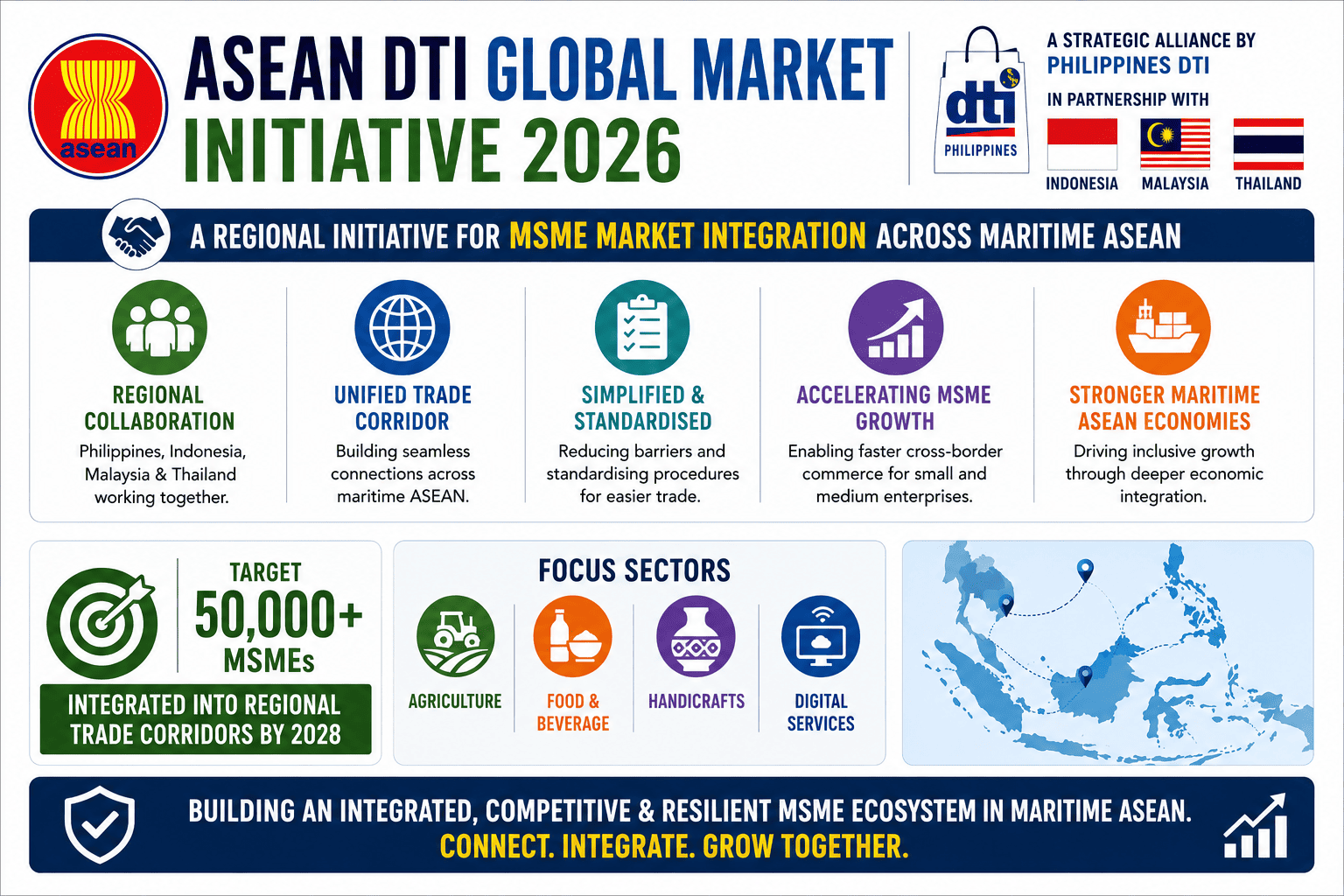
The ASEAN DTI Global Market Initiative 2026 is a strategic alliance launched by the Philippines Department of Trade and Industry (DTI) in partnership with Indonesia, Malaysia, and Thailand. This regional program targets MSME market integration across maritime ASEAN, creating a unified trade corridor that reduces barriers, standardises procedures, and accelerates cross-border commerce for 50,000+ MSMEs by 2028.
🎯 Direct Answer
The ASEAN DTI Global Market Initiative 2026 is a strategic alliance launched by the Philippines Department of Trade and Industry (DTI) in partnership with Indonesia, Malaysia, and Thailand. This regional program focuses on MSME market integration across maritime ASEAN, creating a unified trade corridor that reduces barriers, standardises procedures, and accelerates cross-border commerce for small and medium enterprises. The initiative targets 50,000+ MSMEs integrated into regional trade corridors by 2028, with focus sectors including agriculture, food and beverage, handicrafts, and digital services. The program builds on existing ASEAN Economic Community (AEC) frameworks and responds to the growing demand for simplified cross-border trade procedures as maritime ASEAN economies continue to integrate.
📅 May 6, 2026⏱ 15 min read✍️ GTsetu Editorial Team📰 News + Analysis
Deal Type
Strategic Alliance
Regional Program for MSME market integration
Target
50,000+ MSMEs
MSMEs integrated into regional trade corridors by 2028
Focus Sectors
Agriculture + F&B + Handicrafts
High-growth MSME export categories with regional demand
Market Impact
$10B+
Estimated annual trade value accessible through integrated corridors
Section 1, The News
1
The Full Story: ASEAN DTI Global Market Initiative 2026
🌏
Initiative Launched, May 6, 2026
Philippines DTI Leads Strategic Alliance for MSME Market Integration Across Maritime ASEAN
On May 6, 2026, the Philippines Department of Trade and Industry (DTI), the government body responsible for trade and industry development, announced the ASEAN DTI Global Market Initiative 2026, a strategic alliance with Indonesia, Malaysia, and Thailand. This regional program focuses on MSME market integration across maritime ASEAN, creating a unified trade corridor that reduces barriers, standardises procedures, and accelerates cross-border commerce.
The initiative targets 50,000+ MSMEs integrated into regional trade corridors by 2028, with focus sectors including agriculture, food and beverage, handicrafts, and digital services, areas where ASEAN MSMEs have competitive advantages and where regional demand is growing.
This strategic alliance builds on the existing ASEAN Economic Community (AEC) frameworks and responds to a structural shift: maritime ASEAN economies are increasingly integrated, and MSMEs need structured support to access regional markets. The DTI-led initiative creates the institutional bridge that reduces trade barriers and accelerates cross-border commerce for MSMEs.
DTI
Philippines Department of Trade and Industry, lead agency for trade integration
50,000+
MSMEs targeted for regional market integration by 2028
4 Countries
Philippines, Indonesia, Malaysia, Thailand, maritime ASEAN alliance
Agriculture + F&B
Primary focus sectors with high MSME export potential
“The ASEAN DTI Global Market Initiative 2026 is a strategic enabler for MSMEs to access regional markets. We are building a structured pathway that reduces trade barriers and accelerates cross-border commerce for 50,000+ MSMEs.”
— DTI Official, May 6, 2026
“Maritime ASEAN is the world’s most dynamic trade region. This strategic alliance ensures that MSMEs, not just large corporations, benefit from regional integration.”
— ASEAN Trade Representative
💡 GTsetu Perspective
The ASEAN DTI Global Market Initiative 2026 represents a strategic approach to MSME market integration, moving from fragmented national efforts to a coordinated regional program. For MSMEs considering cross-border trade, the lesson is clear: market integration risk is reduced by strategic alliances that provide standardised procedures, digital platforms, and institutional support. If DTI can build this bridge for 50,000+ MSMEs, what verified trade partner could accelerate your ASEAN market integration? GTsetu helps you find that partner.
Section 2, Target
2
Target: 50,000+ MSMEs Integrated by 2028
The ASEAN DTI Global Market Initiative has a clear quantitative target: 50,000+ MSMEs successfully integrated into regional trade corridors by 2028. This is not a symbolic number, it represents a deliberate strategy to build a critical mass of MSMEs participating in cross-border trade across maritime ASEAN.
🎯 MSME Integration Target, Maritime ASEAN
2024
Baseline
~5,000 MSMEs Pre-Initiative
2026
15,000+
15,000 MSMEs ● Live
2027
30,000+
30,000 MSMEs In Progress
2028
50,000+
50,000+ MSMEs Target
⚙️ Why Structured Market Integration Works
The ASEAN DTI Global Market Initiative targets 50,000+ MSMEs because market integration is a volume game, not every MSME will succeed, but with structured support, the success rate improves dramatically. The initiative provides standardised procedures, digital platforms, and institutional support, the three biggest barriers for MSMEs entering regional markets. By solving these systematically, DTI increases the probability of success for each MSME, making the 50,000+ target achievable.
Section 3, The Anatomy
3
What Each Partner Brings to the Table
The ASEAN DTI Global Market Initiative works because each partner contributes complementary assets. This complementarity principle is the foundation of any successful regional trade alliance.
🚀 Focus: Agriculture, F&B, Handicrafts, Digital Services
🌏 Maritime ASEAN trade corridors
Collaboration Dimension
What DTI Provides
What ASEAN Partners Provide
Why This Balance Works
MSME Pipeline
50,000+ MSMEs prepared for integration
National MSME ecosystems and market access
DTI leads; partners provide national reach
Trade Procedures
Standardised framework and digital platforms
National customs and regulatory alignment
Reduces the single biggest barrier for MSMEs: procedure complexity
Market Access
Philippine trade network and export promotion
Direct market access in Indonesia, Malaysia, Thailand
Creates a unified trade corridor
Digital Infrastructure
Regional digital trade platform
National digital infrastructure integration
Enables seamless cross-border transactions
Risk
Policy risk, reputational risk
Market execution risk
Shared risk, all partners have skin in the game
Value Creation
Philippine MSME export growth
Regional supply chain integration
Creates cross-border MSME trade ecosystem
Section 4, The Relationship
4
A Layered Partnership: Government + Regional Integration
The ASEAN DTI Global Market Initiative is not a one-off program, it builds on years of ASEAN economic integration and responds to a structural shift in regional trade patterns. This is the right way to build market integration: layer government leadership with regional partner collaboration.
🤝 ASEAN MSME Integration, Relationship History
2015
ASEAN Economic Community (AEC) Established
ASEAN Economic Community established, creating a single market and production base. Sets the foundation for regional trade integration and MSME participation in cross-border commerce.
2020–2023
MSME Digital Transformation Initiatives
ASEAN member states launch digital transformation programs for MSMEs, recognising the need for digital platforms to support cross-border trade. Philippines DTI leads pilot programs in digital trade facilitation.
2024–2025
Maritime ASEAN Trade Integration Accelerates
Maritime ASEAN economies, Philippines, Indonesia, Malaysia, Thailand, experience increased trade integration. MSMEs identify regulatory complexity and procedure variation as the biggest barriers to cross-border trade. Demand grows for unified framework.
May 2026
ASEAN DTI Global Market Initiative 2026 Launched
Philippines DTI leads strategic alliance with Indonesia, Malaysia, and Thailand. Initiative launched: 50,000+ MSMEs targeted for regional market integration by 2028. Focus sectors: Agriculture, F&B, Handicrafts, Digital Services. Comprehensive support includes standardised procedures, digital platforms, and institutional alignment.
🔑 Key Lesson: Government Leadership + Regional Partner Collaboration
The ASEAN DTI Global Market Initiative works because it layers government leadership with regional partner collaboration. DTI provides the unified framework, digital platforms, and standardised procedures. ASEAN partners provide national market access and MSME ecosystems. Neither could achieve the 50,000+ MSME target alone. The fastest path to regional market integration is often a structured alliance that combines government leadership with regional partner collaboration. GTsetu’s platform helps you identify which verified trade partners and regional integrators can accelerate your ASEAN market expansion.
Section 5, Why This Works
5
Why This Collaboration Model Works for MSMEs
🎯 The Core Logic
The ASEAN DTI Global Market Initiative succeeds because it addresses the three biggest barriers to MSME cross-border trade: procedure complexity (MSMEs face varying customs, documentation, and regulatory requirements across countries), market access (MSMEs lack relationships with regional buyers and distributors), and digital infrastructure (MSMEs lack integrated platforms for cross-border transactions). By providing standardised procedures, digital platforms, and institutional support, the initiative reduces market integration risk from high to manageable. The initiative creates a pipeline effect, each successful MSME integration builds reference cases and network effects, making subsequent integrations easier.
Why ASEAN MSME Market Integration Is Accelerating
$10B+
Estimated annual trade value accessible through integrated maritime ASEAN corridors
50,000+
Target MSMEs integrated, creating critical mass for regional trade ecosystem
Agriculture + F&B
Focus sectors with highest MSME export potential and regional demand
Digital
Digital trade platforms, ASEAN e-commerce market projected to grow 30% annually
AEC
ASEAN Economic Community framework, provides policy foundation for integration
Handicrafts
Cultural and creative industries, high-growth MSME export category with regional demand
🌐 GTsetu for MSME Trade Integration
GTsetu’s verified partner network includes trade facilitators, regional integrators, MSME export advisors, and cross-border commerce partners across ASEAN and 100+ countries. Every company on GTsetu is verified on 6 government-sourced points: Name, Address, Registration Number, Company Status, Company Type, and Date of Certificate of Incorporation. Additional capabilities like trade facilitation expertise and regional networks are self-reported. If you’re an MSME looking to access ASEAN regional markets, or a trade facilitator seeking verified MSME partners, GTsetu is where your partner search begins with verified profiles, not cold calls. Find trade partners →
Section 6, ASEAN Opportunity
6
ASEAN Maritime Trade Opportunity, Why Now Is the Time for MSME Market Integration
🌏 ASEAN Maritime Trade 2026
Why Every MSME Should Be Considering ASEAN Regional Market Integration
ASEAN maritime trade has transformed. The ASEAN Economic Community (AEC) is creating a single market and production base, and MSMEs are increasingly recognised as the engine of regional trade growth. The ASEAN DTI Global Market Initiative creates the structured bridge that reduces integration barriers for 50,000+ MSMEs. Focus sectors, Agriculture, F&B, Handicrafts, Digital Services, align with ASEAN’s highest MSME export potential.
650M+
ASEAN population, one of the world’s largest consumer markets
$10B+
Annual MSME trade value accessible through integrated regional corridors
50,000+
Target MSMEs integrated, creating critical mass for regional trade ecosystem
Agriculture
Largest MSME export sector, ASEAN agricultural trade growing 8% annually
Digital
ASEAN e-commerce market, projected to reach $200B by 2028, 30% CAGR
Handicrafts
Cultural and creative industries, growing export demand across maritime ASEAN
🌐 GTsetu for MSME Trade Integration
GTsetu’s verified partner network includes trade facilitators, regional integrators, MSME export advisors, and cross-border commerce partners across ASEAN and 100+ countries. Every company on GTsetu is verified on 6 government-sourced points: Name, Address, Registration Number, Company Status, Company Type, and Date of Certificate of Incorporation. Additional capabilities like trade facilitation expertise and regional networks are self-reported. If you’re an MSME looking to access ASEAN regional markets, or a trade facilitator seeking verified MSME partners, GTsetu is where your partner search begins with verified profiles, not cold calls. Find trade partners →
Section 7, Types of Collaboration
7
4 Types of Regional Trade Collaboration, Which Fits Your Situation?
The ASEAN DTI Global Market Initiative uses a Strategic Alliance model, government-led regional collaboration. But MSMEs and trade facilitators have multiple options for regional market integration. The right structure depends on your resources, timeline, and integration ambition.
01
Strategic Alliance (Regional Program)
A formal collaboration between multiple governments or trade bodies aimed at achieving a shared regional objective. The ASEAN DTI Global Market Initiative model. Provides standardised procedures, digital platforms, and institutional support. Best for large-scale MSME market integration.
🌏 DTI × ASEAN Partners
02
Trade Facilitation Partnership
A partnership focused on simplifying cross-border trade procedures, customs harmonisation, and documentation standardisation. Often involves digital platforms and mutual recognition of standards. Best for MSMEs needing procedural support.
📋 Simplified trade procedures
03
Digital Trade Platform
A digital platform that connects MSMEs across borders, providing e-commerce capabilities, payment integration, and logistics support. Often the entry point for MSMEs beginning regional trade. Lower commitment, faster to deploy.
💻 Digital-first integration
04
MSME Export Consortium
A group of MSMEs from multiple countries forming a collective export entity. Shared logistics, shared marketing, shared compliance. Best for smaller MSMEs that cannot independently enter regional markets.
🤝 Collective market access
📊 Regional Trade Collaboration Comparison, MSMEs
Model
Capital Required
Market Access
Procedure Support
Speed to Execute
Scalability
Strategic Alliance
Low (government-funded)
✓ High
✓ Full
Medium (6–12 months)
✓ Very High
Trade Facilitation
Low (service fees)
~ Moderate
✓ High
Fast (2–4 months)
Moderate
Digital Platform
Minimal
~ Limited
~ Limited
Fastest (1–3 months)
High
Export Consortium
Low (shared costs)
~ Moderate
~ Limited
Medium (4–8 months)
Moderate
Section 8, How to Integrate
8
How to Integrate: A 5-Step Playbook for MSMEs and Trade Facilitators
The ASEAN DTI Global Market Initiative provides a structured pathway for MSME market integration. For any MSME or trade facilitator considering regional trade, here is the distilled playbook.
1
Define Your Regional Market Integration Objective with Precision
The ASEAN DTI Global Market Initiative targets 50,000+ MSMEs, but each MSME has a specific objective: export market access, supply chain integration, or digital trade participation. Define your specific integration objective: What regional markets do you want to access? What is your trade volume target? What is your timeline? Vague objectives produce failed market integration.
2
Find Verified Trade Partners, Not Just Any Contact
The crucial word is “verified.” DTI uses government-vetted partners. For MSMEs and trade facilitators without government backing, GTsetu provides verified profiles of trade facilitators, regional integrators, and cross-border commerce partners across ASEAN. GTsetu verifies companies using government tie-ups on 6 key points: Name, Address, Registration Number, Company Status, Company Type, and Date of Certificate of Incorporation. Additional information like trade facilitation expertise and regional networks is self-reported and should be validated independently.
3
Protect Your IP Before Any Sensitive Disclosure
Before sharing your trade data, customer lists, or pricing models with any trade partner, execute a mutual NDA. GTsetu’s built-in NDA workflow handles this automatically: mutual NDA executed and countersigned before any sensitive information is shared, with a full digital audit trail.
4
Choose the Right Integration Structure for Your Objective
DTI chose a Strategic Alliance, government-led regional collaboration. A trade facilitation partnership is right when you need procedural support. A digital platform is right when you want to test demand before committing. Match the structure to the objective, not to what’s easiest to negotiate.
5
Formalise and Scale in Stages, Pilot Before Full Commitment
The ASEAN DTI Global Market Initiative targets 50,000+ MSMEs, but each MSME integrates in stages: pilot trade, export validation, then full market integration. Never commit full integration resources before validating demand with a pilot trade. Structure every collaboration milestone formally in writing: scope of support, fee structure, market access terms, and renewal conditions.
Section 9, Dos and Don’ts
9
Dos and Don’ts of Regional Trade Integration
✅ Do These
✅ Partner with verified trade facilitators who have regional market access
✅ Use government-backed initiatives like the ASEAN DTI Global Market Initiative when available
✅ Protect your trade data with NDA before sharing sensitive business information
✅ Start with a pilot trade before committing to full market integration
✅ Target sectors with highest regional demand: Agriculture, F&B, Handicrafts, Digital Services
✅ Build relationships with regional buyers before full-scale trade integration
✅ Use verified platforms like GTsetu rather than cold outreach for partner discovery
✅ Document the collaboration formally, service agreement, fee structure, and deliverables
✅ Leverage regional programs for market integration, they reduce risk and cost
✅ Build a pipeline, not every MSME will succeed, but structured support improves success rates
❌ Avoid These
❌ Attempt regional trade without understanding customs and regulatory requirements
❌ Assume your product-market fit in one ASEAN country translates directly to another
❌ Share sensitive trade data before NDA is countersigned
❌ Commit to full-scale market integration before validating demand with a pilot
❌ Partner with a trade facilitator who has no proven regional network
❌ Underestimate the importance of cultural and business practice differences in ASEAN
❌ Build a full integration structure when a pilot would achieve the same objective
❌ Ignore regional programs, they provide support and credibility that private partners cannot
❌ Enter regional trade without a clear market access strategy
❌ Assume one-size-fits-all, each MSME needs a tailored integration approach
Section 10, Misconceptions
10
Common Misconceptions About ASEAN Trade Integration
❌ Myth
“ASEAN trade integration is only for large corporations, MSMEs can’t participate.”
✅ Reality
The ASEAN DTI Global Market Initiative targets 50,000+ MSMEs specifically. MSMEs are the focus, not an afterthought. The initiative provides standardised procedures, digital platforms, and institutional support that reduce barriers specifically for MSMEs. The challenge is not market openness, but structured access, which the initiative provides.
❌ Myth
“A strategic alliance is less valuable than bilateral trade agreements.”
✅ Reality
The ASEAN DTI Global Market Initiative uses a strategic alliance model, not bilateral trade agreements. Strategic alliances provide regional standardisation, shared digital platforms, and institutional alignment that bilateral agreements cannot. For MSMEs, the regional alliance model is more accessible and practical than complex trade agreements.
❌ Myth
“If we have a great product, regional buyers will find us.”
✅ Reality
Regional buyers rarely discover MSMEs through passive channels. Structured market integration support, like the ASEAN DTI Global Market Initiative provides, is essential for market access. The key is not just having a great product, but having a partner who can provide the standardised procedures and market connections.
❌ Myth
“Government-led initiatives are too slow and bureaucratic, better to go private.”
✅ Reality
Government-led initiatives like the ASEAN DTI Global Market Initiative provide credibility, standardisation, and institutional support that private partners cannot replicate. The speed is often faster than building market integration capability from scratch. The initiative targets 50,000+ MSMEs by 2028, that’s a structured pathway, not a bureaucratic delay.
❌ Myth
“Regional trade integration requires a physical presence in each market.”
✅ Reality
The ASEAN DTI Global Market Initiative provides digital platforms and standardised procedures that enable virtual market integration. Many MSMEs begin regional trade through digital channels and partner relationships first, then establish physical presence once revenue is confirmed. Physical presence is a milestone, not a prerequisite.
Section 11, GTsetu
11
How GTsetu Helps You Find Trade Partners
The ASEAN DTI Global Market Initiative provides government-backed market integration support. For MSMEs and trade facilitators without government backing, finding the right verified trade partner is the critical first step. GTsetu is the verified B2B discovery platform that enables this evaluation at scale, across 100+ countries, before you reveal a single confidential detail.
🌐 Platform Spotlight, GTsetu
Find Verified Trade Facilitators, Regional Integrators, and MSME Export Partners Across 100+ Countries, Anonymously, Securely, With Zero Broker Fees
Every company on GTsetu is verified using government tie-ups on 6 key points: Name, Address, Registration Number, Company Status, Company Type, and Date of Certificate of Incorporation. This is the foundation of trust. Additional information such as trade facilitation expertise, regional networks, and customer references is self-reported by companies. You evaluate who is real before you engage. You share nothing sensitive until an NDA is countersigned. And you pay no broker commission on any collaboration formed, the deal is entirely between you and your partner.
✅
6-Point Government-Sourced VerificationName, Address, Registration Number, Company Status, Company Type, Date of Incorporation confirmed using government tie-ups.
🕵️
Anonymous DiscoveryEvaluate verified partner profiles without revealing your identity until mutual interest is confirmed.
📄
Built-In NDA WorkflowShare trade data and business plans only after NDA is executed, full audit trail.
🚫
Zero CommissionNo broker fees, your trade integration agreement is entirely between you and your partner.
Sourced and prepared 50,000+ MSMEs for regional market integration
✓ Browse verified trade facilitator and regional integrator profiles with government-sourced verification
You evaluate the partner’s verified legal identity and credibility, not marketing claims
Partnered with verified ASEAN trade facilitators with regional market access
✓ Filter by self-reported trade facilitation expertise, regional networks, and market access capabilities
Find partners with the specific regional integration expertise your MSME needs
Structured strategic alliance with clear scope of support and digital platforms
✓ Built-in NDA and document workflow protects your business plan from the first conversation
Your trade data and business plans are protected at every stage
Targeted sectors with highest MSME export potential: Agriculture, F&B, Handicrafts, Digital
✓ Partner profiles show sector expertise and regional market specialisation
Identify partners with the specific sector expertise your MSME needs
Zero intermediary in the DTI initiative, direct government-to-government collaboration
✓ Zero commission on any partnership, all terms are direct between the two parties
No broker fees or commission, your market integration budget goes directly to the support you need
FAQ
?
Frequently Asked Questions
Q
What exactly is the ASEAN DTI Global Market Initiative 2026?
The ASEAN DTI Global Market Initiative 2026 is a strategic alliance launched by the Philippines Department of Trade and Industry (DTI) in partnership with Indonesia, Malaysia, and Thailand. The initiative focuses on MSME market integration across maritime ASEAN, creating a unified trade corridor that reduces barriers, standardises procedures, and accelerates cross-border commerce. The initiative targets 50,000+ MSMEs integrated into regional trade corridors by 2028 with focus sectors including agriculture, food and beverage, handicrafts, and digital services.
Q
Why is ASEAN maritime trade attractive for MSMEs?
ASEAN maritime trade offers one of the world’s largest consumer markets (650M+ population), growing middle-class demand, and increasing regional integration through the ASEAN Economic Community. The ASEAN DTI Global Market Initiative creates the structured bridge that reduces integration barriers for MSMEs. Focus sectors, Agriculture, F&B, Handicrafts, Digital Services, align with ASEAN’s highest MSME export potential. The total addressable market for MSME trade across ASEAN is estimated at over $10 billion annually.
Q
What is the difference between a Strategic Alliance and a Trade Facilitation Partnership?
A Strategic Alliance is a formal collaboration between multiple governments or trade bodies aimed at achieving a shared regional objective. It provides standardised procedures, digital platforms, and institutional support. The ASEAN DTI Global Market Initiative is a Strategic Alliance. A Trade Facilitation Partnership is a more focused collaboration focused on simplifying cross-border trade procedures, customs harmonisation, and documentation standardisation. Use a Strategic Alliance when you need comprehensive regional integration. Use a Trade Facilitation Partnership when you need procedural support specifically.
Q
How can I find a trade partner for ASEAN market integration without government backing?
The systematic approach involves four steps: (1) Define your integration objective precisely, what specific market access, trade facilitation, or digital platform support do you need? (2) Search verified platforms, GTsetu lists verified trade facilitators, regional integrators, and MSME export partners across ASEAN and 100+ countries. GTsetu verifies companies using government tie-ups on 6 points. (3) Evaluate anonymously first, review verified profiles and self-reported capability data before revealing your identity or trade data. (4) Execute NDA before any sensitive disclosure, GTsetu’s built-in NDA workflow handles this automatically. A structured, verified search on GTsetu is more reliable than cold outreach or trade fair introductions.
Q
What are the biggest barriers for MSMEs in regional trade integration?
The three biggest barriers are: (1) Procedure complexity, MSMEs face varying customs, documentation, and regulatory requirements across countries. (2) Market access, MSMEs lack relationships with regional buyers and distributors. (3) Digital infrastructure, MSMEs lack integrated platforms for cross-border transactions. The ASEAN DTI Global Market Initiative addresses all three barriers through standardised procedures, digital platforms, and institutional support. For MSMEs without government backing, finding a verified trade facilitator who provides this support is essential.
Q
Does GTsetu charge commission on trade partnerships formed through the platform?
No. GTsetu charges zero commission on any collaboration, whether a strategic alliance, trade facilitation partnership, digital platform integration, or MSME export consortium, formed through the platform. The commercial terms of your trade integration agreement are entirely between you and your partner. This is a foundational design principle: broker intermediation typically costs 5–15% of deal value and creates incentive misalignment. GTsetu removes the broker entirely. Learn more about GTsetu →
Ready to Integrate into ASEAN Regional Markets? Start on GTsetu.
500+ verified trade facilitators, regional integrators, MSME export partners, and cross-border commerce specialists across ASEAN and 100+ countries. Zero broker fees. Anonymous discovery. Built-in NDA workflows. Your ASEAN market integration starts with a verified partner, not a cold call.
Business Development Expert | Global Markets & Trade Intelligence
Lucas Bennett is a Business Development Expert at GTsetu with a focus on international trade, market intelligence, and cross-border business development. He works closely with organizations looking to expand into new markets, develop strategic alliances, and strengthen their position within global business ecosystems.
Lucas brings expertise in market research, international partnership development, trade opportunities, and business growth strategies. At GTsetu, he contributes insights on emerging market trends, global collaboration opportunities, and industry developments that help businesses make informed expansion decisions.
Passionate about connecting organizations across geographies, Lucas helps companies navigate international markets and build partnerships that drive sustainable growth and long-term success.