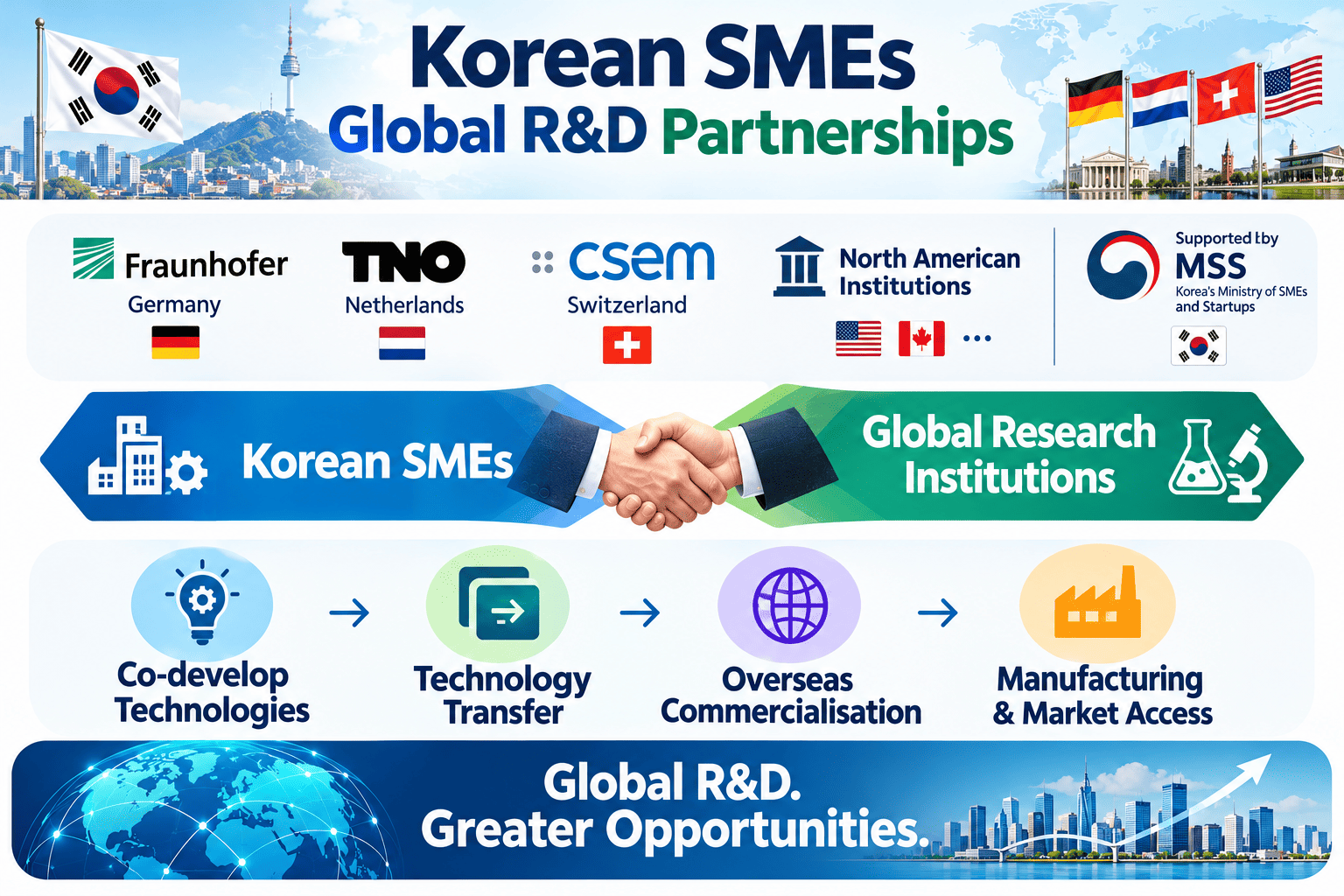
Korean SMEs are joining global R&D partnerships with leading international research institutions, including Fraunhofer (Germany), TNO (Netherlands), CSEM (Switzerland), and North American institutions. The programme, supported by Korea’s Ministry of SMEs and Startups (MSS), enables Korean SMEs to co-develop technologies with major research partners and receive structured support for technology transfer and overseas commercialisation.
Korean SMEs are joining global R&D partnerships with Fraunhofer (Germany), TNO (Netherlands), CSEM (Switzerland), and North American institutions under a programme supported by Korea’s Ministry of SMEs and Startups (MSS), announced March 24, 2026. The programme allows Korean SMEs to co-develop technologies with major international research institutions and receive support for technology transfer and overseas commercialisation. The partnerships pair Korean SMEs, who bring applied product development and manufacturing capability in electronics and technology, with research institutions, who bring fundamental research capability, laboratory infrastructure, and technology transfer expertise. The model gives Korean SMEs access to world-class R&D capability without building it in-house, while giving research institutions a route to commercialise their technology through Korean manufacturing and market access.
“Korean SMEs do not need to build world-class research capability in-house to access it. Through global R&D partnerships, they can co-develop technology with institutions like Fraunhofer, TNO, and CSEM, then commercialise the results through their own manufacturing and market access. This is how SME innovation scales in 2026.”— Ministry of SMEs and Startups (MSS), Republic of Korea
“Research institutions like Fraunhofer, TNO, and CSEM have always needed industrial partners to translate laboratory results into products. Korean SMEs, with their manufacturing depth and speed to market, are exceptionally strong commercialisation partners, provided the IP framework and technology transfer terms are structured correctly from the start.”— GTsetu Innovation & R&D Partnerships Team
The Korean SME global R&D programme is a template for how SME technology development is actually happening in 2026: partnership-led, IP-aware, and commercialisation-focused rather than capital-intensive and vertically integrated. Korean SMEs that establish co-development relationships with Fraunhofer, TNO, CSEM, and North American institutions in 2026 will hold technology positions that competitors entering later will find difficult to replicate. GTsetu is where verified R&D partner discovery happens systematically, connecting SMEs with research institutions, technology integrators, and co-development partners across East Asia, Europe, North America, and 100+ countries. See our guide to cross-border business partnerships for the strategic context.
Like every successful R&D collaboration, the Korean SME global R&D partnerships work because each party contributes what the other cannot efficiently replicate. This complementarity principle is the foundation of any co-development partnership worth building. For the full evaluation framework, see our guide to partnership evaluation criteria.
| Collaboration Dimension | What the Korean SME Provides | What the Research Institution Provides | Why This Balance Works |
|---|---|---|---|
| Technology Development | Applied product development, engineering, and manufacturing scale-up | Frontier research, laboratory infrastructure, scientific expertise | Research meets commercialisation, creating a complete innovation pipeline |
| IP & Technology Transfer | Industrial application of IP, product integration, manufacturing know-how | Patent portfolios, technology transfer offices, licensing frameworks | IP moves from laboratory to product with clear ownership and licensing terms |
| Market Access | Korean and Asian market access, manufacturing supply chain, OEM relationships | European and North American research networks, industry consortia | Both parties unlock new geographies for co-developed technology |
| Funding | MSS programme support, internal R&D budget, commercialisation investment | Research grants, institutional funding, laboratory resources | Public programme support reduces R&D cost and risk for both parties |
| Knowledge | Manufacturing expertise, quality systems, market intelligence | Scientific publications, research methodology, technology roadmaps | Knowledge-sharing accelerates co-development and de-risks commercialisation |
The Korean SME global R&D programme succeeds because it is built on three interlocking strategic advantages: an industrial partner with applied development and manufacturing capability (the Korean SME), a research partner with frontier research capability and laboratory infrastructure (Fraunhofer, TNO, CSEM, North American institutions), and public programme support that reduces the cost and risk of international co-development. Neither party could have achieved the same result through any other mechanism, the SME cannot independently build world-class research capability, and the research institution cannot replicate the SME’s manufacturing scale and market access.
Korea’s electronics and technology sector is one of the world’s most advanced, but frontier research capability is globally distributed, Fraunhofer and TNO in Europe, CSEM in Switzerland, and leading institutions in the United States and Canada. The MSS-supported global R&D programme creates a structured route for Korean SMEs to access that capability, co-develop technology, and commercialise it overseas. For the research groundwork behind this type of partnership, see global market research for manufacturers.
GTsetu’s verified partner network includes research institutions, technology integrators, R&D service providers, and co-development partners across South Korea, Germany, the Netherlands, Switzerland, the United States, Canada, and 100+ other countries. Every company on GTsetu is verified on 6 government-sourced points: Name, Address, Registration Number, Company Status, Company Type, and Date of Certificate of Incorporation. Additional capabilities like research expertise, technology transfer experience, and co-development track record are self-reported. If you’re a Korean SME seeking international R&D partners, or a research institution looking to commercialise technology with industrial partners, GTsetu is where your partner search begins with verified profiles, not cold calls. See cross-border business partnerships and partnership evaluation criteria for the strategic context. Find R&D partners →
The Korean SME global R&D programme used an R&D and co-development partnership model. But R&D collaborations come in many forms. The right structure depends on what you need, what you can invest, and how deeply you want to integrate. For the commercial framework, see cross-border business partnerships.
Joint development of new technology, products, or processes with a research institution, sharing research effort, IP rights, and commercial outcomes. The Korean SME global R&D model. Best where you need frontier research capability you cannot build in-house. See cross-border manufacturing partnerships.
🔬 Korean SME global R&DLicense technology from a research institution or another company under a formal technology transfer agreement. Revenue to the licensor through royalties; faster than co-development but less control over the technology roadmap. Requires careful IP and field-of-use structuring. See warranty clause.
📄 Technology transferShared ownership or formal consortium with research and industry partners for a defined technology programme. Best for large, multi-party research programmes where no single partner has all the capability required. Requires careful governance, IP, and exit structuring. See partnership evaluation criteria.
🤝 Research consortiumCommission a research institution to perform specific research, testing, or certification work on a fee-for-service basis. Lowest commitment, fastest to set up, no shared IP. Often the first step before deeper co-development. Best for validation and compliance work. See manufacturing certifications.
📊 Contract research, step 1The Korean SME global R&D programme did not happen by accident. It followed a deliberate progression from identifying the right research capability to structuring IP to commercialising the results. Here is the distilled playbook.
Korean SMEs on the programme knew exactly what they needed: a research partner with frontier capability in a specific technology area (electronics, materials, microtechnology) and a route to technology transfer and overseas commercialisation. They didn’t need to build a research laboratory, they needed access to one. Define your gap that precisely. Vague needs produce vague partner searches and failed collaborations. Start with global market research for manufacturers to identify where your technology roadmap and research capability intersect.
The crucial word is “verified.” Fraunhofer, TNO, and CSEM are not random research organisations, they are established institutions with proven industry collaboration and technology transfer track records. For businesses that don’t have an existing research network, GTsetu provides verified profiles of research institutions, technology integrators, and R&D service providers across South Korea, Europe, North America, and 100+ countries. GTsetu verifies companies using government tie-ups on 6 key points: Name, Address, Registration Number, Company Status, Company Type, and Date of Certificate of Incorporation. Additional information like research expertise and co-development track record is self-reported and should be validated through commercial due diligence.
In R&D co-development partnerships, your technology roadmap, invention disclosures, and commercial strategy are valuable IP. Before sharing anything sensitive, execute a mutual NDA. This is non-negotiable regardless of how well you think you know the research institution. GTsetu’s built-in NDA workflow handles this automatically: mutual NDA executed and countersigned before any sensitive information is shared, with a full digital audit trail. For the IP framework, see asset purchase agreement and warranty clause for the commercial terms.
The Korean SME global R&D programme chose an R&D and co-development partnership model with technology transfer support. This is right when you need frontier research capability and shared IP. A technology licensing arrangement is right when you need faster access to existing technology. A research consortium is right for large, multi-party programmes. Contract research is right for specific testing or validation work. Match the structure to the objective, not to what’s easiest to negotiate. For certification groundwork, see manufacturing certifications for international trade.
The Korean SME global R&D programme structured IP and technology transfer terms first, and the overseas commercialisation followed, in that order. The co-development agreement unlocks the partnership opportunity; the technology transfer and commercialisation capitalise on it. Never commit to full-scale R&D investment before you have the IP framework and technology transfer terms in place. Structure every collaboration milestone formally in writing: research scope, IP ownership, licensing terms, commercialisation rights, and performance metrics. For risk allocation, see risk allocation in cross-border deals and material breach.
Korean SMEs on the global R&D programme had the advantage of an MSS-supported initiative with curated research institution matchmaking. Most SMEs and technology providers are not that fortunate, and even when a research connection exists, identifying whether it can be extended into a commercial co-development partnership requires systematic evaluation. GTsetu is the verified B2B partner discovery platform that enables this evaluation at scale, across 100+ countries, before you reveal a single confidential detail. For the consulting dimension, see international business development consulting.
| What the Programme Did | What GTsetu Enables for You | Why This Matters |
|---|---|---|
| Connected Korean SMEs with Fraunhofer, TNO, CSEM and North American institutions | ✓ Browse verified research institutions and R&D partners with government-sourced verification before engaging | You evaluate the partner’s verified legal identity and research credentials, not marketing claims |
| Chose partners with complementary capabilities, applied development met frontier research | ✓ Filter by self-reported research expertise, technology transfer experience, and co-development track record (validate independently) | Find potential partners with the specific research capability your technology roadmap requires |
| Secured IP and technology transfer terms before research began | ✓ Built-in NDA and document workflow protects your technology roadmap and invention disclosures from the first conversation | Your research data, IP disclosures, and commercial strategy are protected at every stage |
| Targeted partners whose capabilities were complementary (research vs. commercialisation) | ✓ Self-reported partner profiles show research expertise, technology transfer experience, and co-development focus | Identify potential complementarity, the gap between your applied capability and the partner’s research capability |
| Zero intermediary in the R&D partnership, direct MSS-supported co-development | ✓ Zero commission on any partnership, all terms are direct between the two parties | No broker splits your partnership value or misaligns your research and commercialisation objectives |
500+ verified research institutions, technology integrators, and R&D partners across South Korea, Europe, North America, and 100+ countries. Zero broker fees. Anonymous discovery. Built-in NDA workflows. Your next R&D partnership starts with a verified profile, not a cold introduction.
Find Verified Partners Free → Browse the Network
Business Development Expert | Global Trade & Cross-Border Partnerships
Lui Wang is a Business Development Expert at GTsetu, specializing in international trade, cross-border partnerships, and market expansion strategies. With extensive experience working across diverse business ecosystems, Lui helps companies identify growth opportunities, establish strategic collaborations, and navigate the complexities of global commerce.
His expertise spans manufacturing, supply chain partnerships, technology collaborations, market entry strategies, and international business development. Through GTsetu, Lui works closely with businesses, trade organizations, and industry stakeholders to facilitate meaningful connections that drive sustainable growth across regions and sectors.
Lui is particularly passionate about helping organizations build long-term international partnerships, unlock new markets, and strengthen their global competitiveness in an increasingly interconnected economy.