Germany–UK Business Forum Deepens SME Opportunities in Critical Materials and Supply Chains – GTsetu
🔴 BREAKINGGermany-UK Business Forum: Joint Statement on Critical Raw Materials Signed in Berlin◆HyProMag Pforzheim Plant Opens as Practical Demonstration of Supply Chain Diversification◆Find Verified Critical Materials & Supply Chain Partners on GTsetu — 100+ Countries, Zero Commission◆🔴 BREAKINGGermany-UK Business Forum: Joint Statement on Critical Raw Materials Signed in Berlin◆HyProMag Pforzheim Plant Opens as Practical Demonstration of Supply Chain Diversification◆Find Verified Critical Materials & Supply Chain Partners on GTsetu — 100+ Countries, Zero Commission◆
Home › Blog › Germany-UK Business Forum Critical Materials
Germany–UK Business Forum Deepens SME Opportunities in Critical Materials and Supply Chains
Germany and the UK signed a joint statement on critical raw materials cooperation at the Germany-UK Business Forum in Berlin on 27 April 2026. The agreement opens new opportunities for SMEs in resilient supply chains, recycling, and industrial partnerships, building on the Kensington Treaty framework.
🎯 Direct Answer
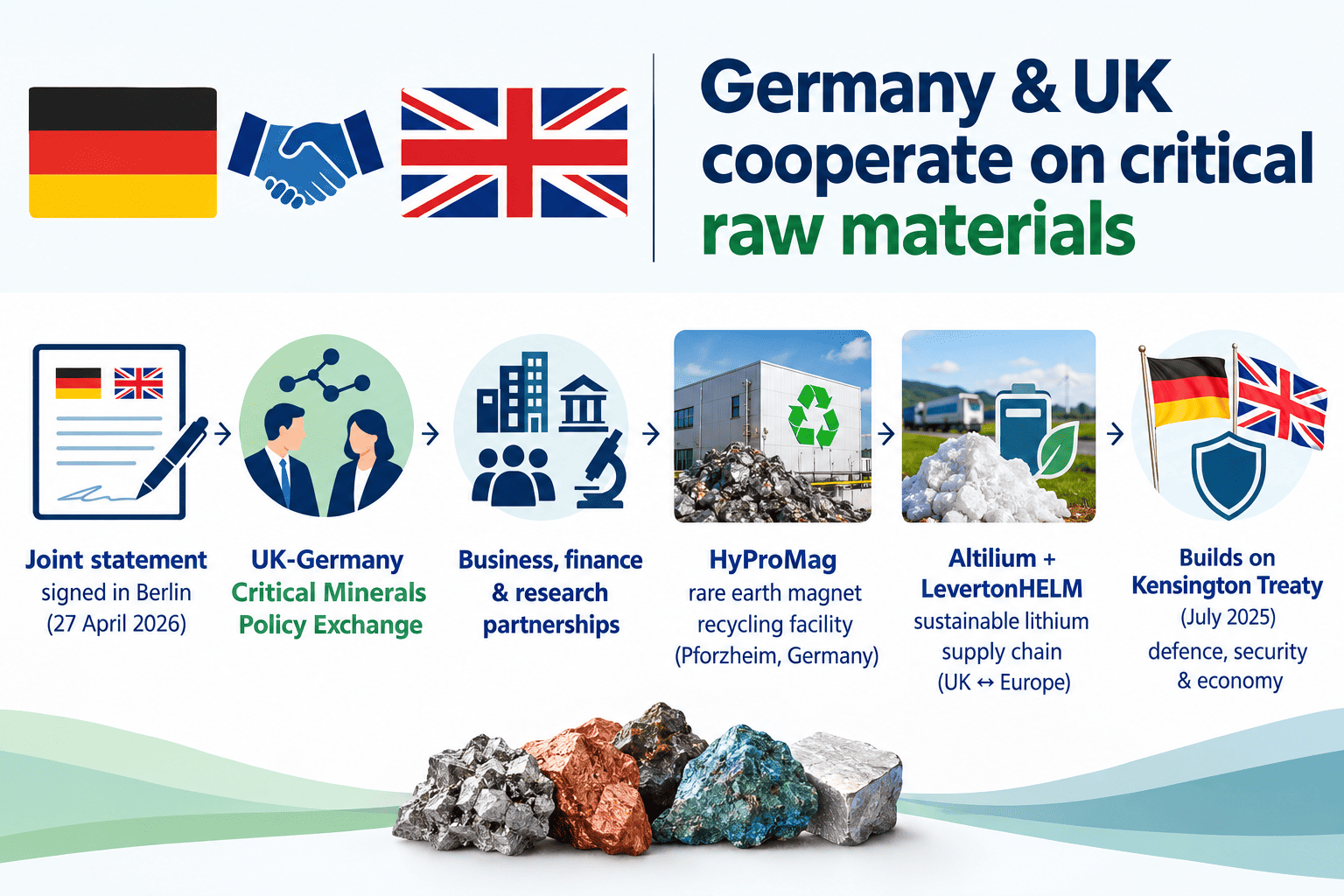
Germany and the UK signed a joint statement on cooperation on critical raw materials at the Germany-UK Business Forum in Berlin on 27 April 2026 [citation:2]. The agreement, signed by UK Secretary of State for Business and Trade Peter Kyle and German Federal Minister for Economic Affairs and Energy Katherina Reiche, establishes the UK-Germany Critical Minerals Policy Exchange to deepen collaboration across the critical raw materials landscape [citation:2]. The joint statement specifically encourages commercial partnerships and research collaborations between British and German companies, financial institutions and research organisations [citation:2]. Practical demonstrations of this commitment include HyProMag’s rare earth magnet recycling facility in Pforzheim, Germany — the first of its kind in the EU — and Altilium’s joint venture with LevertonHELM for a sustainable lithium supply chain between the UK and Europe [citation:2][citation:6]. This builds on the Kensington Treaty signed in July 2025, which established the framework for post-Brexit bilateral cooperation across defence, security, and the economy [citation:5].
📅 April 27, 2026⏱ 16 min read✍️ GTsetu Editorial Team📰 News + Analysis
Agreement Type
Joint Statement
UK-Germany Critical Minerals Policy Exchange established
SME Focus
Commercial Partnerships
Encouraging partnerships between British and German companies
Key Project
HyProMag Pforzheim
First rare earth magnet recycling plant in the EU
Trade Volume
€118.4B
Germany-UK bilateral trade in 2025, UK back in top 10
Section 1 — The News
1
The Full Story: Germany-UK Critical Materials Cooperation
⛏️
Agreement Signed — April 27, 2026
Germany and UK Sign Joint Statement on Critical Raw Materials Cooperation at Berlin Business Forum
At the Germany-UK Business-Government Forum held at the Haus der Deutschen Wirtschaft in Berlin on 27 April 2026, UK Secretary of State for Business and Trade Peter Kyle and German Federal Minister for Economic Affairs and Energy Katherina Reiche signed a joint statement on cooperation on critical raw materials [citation:2][citation:14]. The agreement establishes the UK-Germany Critical Minerals Policy Exchange — a platform for increased collaboration across the entirety of the critical raw materials landscape [citation:2].
The joint statement specifically commits both countries to encourage commercial partnerships and research collaborations between British and German companies, financial institutions and research organisations [citation:2]. The agreement also covers exchange of information and best practices on market developments, regulatory frameworks and investment approaches, and exploring ways to pool demand for critical minerals and build more integrated supply chains with third parties [citation:2].
As practical demonstrations of this commitment, the joint statement highlighted HyProMag’s expansion of rare earth magnet recycling facilities to Germany — its Pforzheim plant is the first of its kind in the EU — and Altilium’s joint venture with LevertonHELM, progressing to its next phase in developing a sustainable lithium supply chain between the UK and Europe [citation:2][citation:6]. Both projects mark major steps in de-risking mutual supply chains and supporting the resilience of key industries such as automotive [citation:2].
Policy Exchange
UK-Germany Critical Minerals Policy Exchange established
HyProMag
First EU rare earth magnet recycling plant opens in Pforzheim
Altilium
UK-Europe lithium supply chain JV with LevertonHELM
SMEs
Commercial partnerships and research collaborations encouraged
“We recognise the strategic importance of secure, sustainable and diverse access to critical minerals and critical raw materials for the advancement of clean and sustainable energy technologies, digital transformation, and economic resilience in both our countries and the wider European continent.”
— UK-Germany Joint Statement on Critical Raw Materials [citation:2]
“By working together we can be compatible, and we can be strategic, and we can lay the foundations for long-term resilience.”
— Peter Kyle, UK Secretary of State for Business and Trade [citation:5]
📌 Related Content — Critical Materials & Supply Chain
The Germany-UK critical materials agreement represents a structural shift in how European nations approach supply chain resilience. For SMEs, the explicit encouragement of commercial partnerships and research collaborations is a direct invitation to participate in critical materials supply chains. The practical examples — HyProMag’s recycling facility and Altilium’s lithium JV — demonstrate that smaller, specialized companies are not just beneficiaries but drivers of this cooperation. GTsetu connects manufacturers and service providers across the UK, Germany, and 100+ countries, enabling the verified partner discovery that these cross-border collaborations require. Find verified supply chain partners →
Section 2 — The Anatomy
2
What Each Partner Brings to the Table
Like every successful strategic alliance, the Germany-UK critical materials partnership works because each party contributes assets that the other cannot efficiently replicate. This complementarity principle is the foundation of any cross-border cooperation worth entering.
Collaboration Anatomy — Strategic Alliance for Critical Materials
The Germany-UK critical materials partnership succeeds because it addresses three systemic barriers to supply chain resilience: (1) Fragmented demand — individual countries cannot achieve the scale needed to justify investment in critical materials infrastructure; pooling demand through the Policy Exchange creates the scale necessary for viable projects [citation:2]; (2) Technology and market gaps — Germany has industrial scale but needs innovation; the UK has research excellence but needs market access. The partnership connects both; and (3) SME participation barriers — smaller companies often lack the networks and visibility to participate in cross-border supply chains. The explicit encouragement of commercial partnerships and research collaborations directly addresses this gap [citation:2]. By combining policy coordination with practical project support, the partnership creates a framework where SMEs can participate in and benefit from critical materials supply chain development.
Why Critical Materials Supply Chain Cooperation Is Accelerating
Policy Exchange
UK-Germany Critical Minerals Policy Exchange established
HyProMag
First EU rare earth magnet recycling plant opens in Pforzheim
SMEs
Commercial partnerships and research collaborations encouraged
Altilium
UK-Europe lithium supply chain JV with LevertonHELM
€118.4B
Germany-UK bilateral trade in 2025, UK back in top 10
Kensington Treaty
July 2025 framework for post-Brexit cooperation
Section 4 — EU CRM Act
4
EU Critical Raw Materials Act & Supply Chain Resilience
🇪🇺 EU Critical Raw Materials Act 2026
Why the Germany-UK Partnership Aligns with EU Critical Materials Objectives
The Germany-UK critical materials agreement directly supports the objectives of the EU Critical Raw Materials Act (CRMA), which sets ambitious targets for domestic extraction, processing, and recycling of critical raw materials. The CRMA aims to ensure that by 2030, at least 10% of the EU’s annual consumption of critical raw materials comes from domestic extraction, at least 40% is processed within the EU, and at least 25% comes from recycling [citation:28]. The HyProMag Pforzheim plant — the first rare earth magnet recycling facility in the EU — is a direct contribution to these recycling targets [citation:6]. The Germany-UK partnership also supports the CRMA’s goal of diversifying supply sources, with the agreement explicitly exploring ways to pool demand and work with third parties to build more integrated critical minerals supply chains [citation:2]. For SMEs in both countries, this alignment with EU policy creates a favourable environment for critical materials investments and partnerships.
10%
EU target for domestic extraction of CRMs by 2030
40%
EU target for domestic processing of CRMs by 2030
25%
EU target for CRM consumption from recycling by 2030
65%
Maximum share of annual consumption from any single non-EU supplier
HyProMag
First EU rare earth magnet recycling plant, supports 25% recycling target
Policy Exchange
UK-Germany platform for supply chain coordination and diversification
⛏️ GTsetu for Critical Materials & Supply Chain Collaboration
GTsetu’s verified partner network includes manufacturers, recycling technology providers, research organisations, and supply chain partners across the UK, Germany, and 100+ countries. Every company on GTsetu is verified on 6 government-sourced points: Name, Address, Registration Number, Company Status, Company Type, and Date of Certificate of Incorporation. If you’re an SME seeking critical materials supply chain partners, a research organisation seeking commercialisation partners, or a manufacturer seeking resilient supply sources, GTsetu is where your partner search begins with verified profiles, not cold calls. Find critical materials partners →
Section 5 — Types of Collaboration
5
4 Types of Strategic Alliances for Critical Materials — Which Fits Your Situation?
The Germany-UK critical materials agreement is a Strategic Alliance model. But strategic partnerships for critical materials and supply chain resilience come in many forms. The right structure depends on what you need, what you can invest, and what market you’re targeting.
01
Strategic Alliance (Bilateral)
Two governments or large institutions partner to coordinate supply chain policy, pool demand, and support commercial partnerships. The Germany-UK model. Best when bilateral coordination creates scale that individual markets cannot achieve.
🤝 Germany-UK Policy Exchange
02
Commercial Partnership
Companies from both countries partner for supply chain integration, technology commercialisation, or market access. Explicitly encouraged by the Germany-UK agreement. Best when SMEs need cross-border partners to scale.
🏭 HyProMag Pforzheim
03
Research Collaboration
Research organisations and companies collaborate on critical materials technology development. Explicitly supported in the joint statement. Best when innovation is needed to solve supply chain challenges.
🔬 University of Birmingham
04
Joint Venture
Companies form a jointly-owned entity for critical materials production, recycling, or supply chain operations. The Altilium-LevertonHELM model. Best when long-term supply chain integration is required.
⚖️ Altilium + LevertonHELM
📊 Collaboration Model Comparison — Critical Materials & Supply Chain
Model
Capital Required
Supply Chain Access
Technology Access
Speed to Execute
Reversibility
Strategic Alliance
Low (policy coordination)
✓ High
~ Moderate
Fast (3–6 months)
Moderate
Commercial Partnership
Moderate (investment)
✓ High
✓ High
Moderate (6–12 months)
Moderate
Research Collaboration
Moderate (R&D funding)
~ Moderate
✓ Maximum
Slow (12–24 months)
Low
Joint Venture
High (equity investment)
✓ Maximum
✓ High
Slow (12–18 months)
Low
Section 6 — How to Build
6
How to Build a Cross-Border Partnership: A 5-Step Playbook
The Germany-UK critical materials agreement demonstrates how governments and companies can collaborate on supply chain resilience. Here is the distilled playbook for building your own cross-border partnership.
1
Define Your Supply Chain Gap and Target Materials
Before you can engage with potential partners, you need to identify exactly how your supply chain gap aligns with the partnership’s focus areas. Are you seeking rare earth magnets, lithium, or other critical materials? Do you need recycling technology, processing capacity, or supply chain coordination? Map your capability to the partnership’s focus areas and identify which partner needs your specific expertise. GTsetu’s partner discovery process starts with this capability mapping.
2
Find Verified Cross-Border Partners
The Germany-UK agreement explicitly encourages commercial partnerships and research collaborations between British and German companies, financial institutions, and research organisations [citation:2]. The crucial word is “verified.” GTsetu provides verified company profiles of manufacturers, recycling technology providers, and research organisations across the UK, Germany, and 100+ countries. Every company is verified on 6 government-sourced points: Name, Address, Registration Number, Company Status, Company Type, and Date of Certificate of Incorporation.
3
Protect Your IP Before Sharing Technical Information
Critical materials partnerships involve sensitive IP, proprietary recycling technologies, and confidential supply chain data. Before sharing anything sensitive — even a capability requirements document — execute a mutual NDA. GTsetu’s built-in NDA workflow handles this automatically: mutual NDA executed and countersigned before any sensitive information is shared, with a full digital audit trail.
4
Structure the Partnership for the Policy Framework
Every commercial partnership, research collaboration, or joint venture associated with the Germany-UK critical materials framework needs to explicitly address the agreement’s objectives: supply chain resilience, diversification, and economic security. If you sign a JV agreement for recycling, the technology transfer and supply chain integration terms need to reflect the partnership’s strategic objectives. GTsetu’s collaboration workspace supports structured, documented commercial negotiation and agreement management.
5
Move Now — Partnership Positions Are Being Established
The Germany-UK critical materials partnership is being operationalised now. The UK-Germany Critical Minerals Policy Exchange will meet annually at working level [citation:2]. Commercial partnerships and research collaborations are being established in 2026. For SMEs, the 2026 window is when supply chain positions are being allocated. The companies that wait for the partnership to reach full operational capability before acting will find that the early movers have already established the relationships that generate the compound advantage. GTsetu’s verified partner network enables rapid identification and engagement with the right critical materials counterparty without the 12-18 months of conference circuit and government introduction that characterises traditional international business networking.
Section 7 — Dos and Don’ts
7
Dos and Don’ts of Cross-Border Partnerships
✅ Do These
✅ Partner with verified companies that can demonstrate their supply chain credentials
✅ Align your partnership with the Germany-UK agreement’s objectives: resilience, diversification, security
✅ Execute NDA before sharing recycling technology or supply chain data
✅ Consider research collaborations with universities and research organisations
✅ Leverage the UK-Germany Critical Minerals Policy Exchange as a framework
✅ Document all commercial agreements with clear IP ownership provisions
✅ Use verified platforms like GTsetu to find cross-border partners
✅ Monitor policy developments as the Policy Exchange operationalises
❌ Avoid These
❌ Enter a partnership without verifying the partner’s credentials and track record
❌ Share recycling technology or process data before NDA is executed
❌ Underestimate the compliance and regulatory requirements of cross-border partnerships
❌ Assume that policy agreements automatically translate into commercial opportunities
❌ Neglect the differences in product standards and certifications between the UK and EU
❌ Rely on unverified intermediaries who cannot demonstrate their supply chain connections
❌ Ignore the post-Brexit regulatory differences that affect cross-border operations
❌ Overlook the importance of aligning with EU Critical Raw Materials Act objectives
Section 8 — Misconceptions
8
Common Misconceptions That Kill Supply Chain Deals
❌ Myth
“Government agreements are just political statements — they don’t create real business opportunities.”
✅ Reality
The Germany-UK joint statement explicitly encourages commercial partnerships and research collaborations between British and German companies, financial institutions and research organisations [citation:2]. The practical examples — HyProMag’s Pforzheim plant and Altilium’s lithium JV — demonstrate that the agreement translates into concrete business activity. The Policy Exchange provides a structured framework for business collaboration.
❌ Myth
“Critical materials supply chains are only for large corporations — SMEs can’t participate.”
✅ Reality
The Germany-UK agreement specifically targets SMEs through its encouragement of commercial partnerships and research collaborations. HyProMag, Altilium, and DEScycle are all examples of smaller, specialised companies leading critical materials innovation [citation:2][citation:16]. The joint statement’s focus on interlinkages and business collaborations creates pathways for SMEs to participate in supply chain development.
❌ Myth
“Post-Brexit, UK-German business collaboration is too difficult to pursue.”
✅ Reality
The Kensington Treaty (July 2025) and the Germany-UK Business Forum are actively addressing post-Brexit barriers [citation:5][citation:14]. Trade volume reached €118.4 billion in 2025, with the UK back in Germany’s top 10 trading partners [citation:26]. While challenges remain — customs procedures, product standards, labour mobility — the institutional framework for cooperation is stronger than at any point since Brexit. The joint statement explicitly acknowledges these challenges and commits to addressing them through the Policy Exchange.
❌ Myth
“Critical materials recycling is a niche sector with limited commercial opportunity.”
✅ Reality
Recycling is a central pillar of Europe’s critical materials strategy. The EU Critical Raw Materials Act sets a target of 25% of annual consumption from recycling by 2030 [citation:28]. HyProMag’s Pforzheim plant, with a permitted capacity of up to 750 tonnes of NdFeB magnets per year, is the first of its kind in the EU [citation:6]. The HPMS technology can save up to 90% of CO2 emissions compared to primary production [citation:12]. This is a high-growth sector with significant commercial opportunity.
❌ Myth
“I can find the right cross-border partner through cold outreach or trade fairs.”
✅ Reality
Cross-border partnerships require verified credentials and trusted introductions. Cold outreach carries identity and credential risks. GTsetu provides a verified platform where every company is checked on 6 government-sourced points before engagement. The Germany-UK agreement’s encouragement of commercial partnerships works best when companies can find and verify each other efficiently — that is exactly what GTsetu enables.
Section 9 — GTsetu
9
How GTsetu Helps You Find Critical Materials & Supply Chain Partners
The Germany-UK critical materials agreement creates the framework for cooperation. Most SMEs are not that fortunate — and even when opportunities exist, identifying the right cross-border partner requires systematic evaluation. GTsetu is the verified B2B partner discovery platform that enables this evaluation at scale, across 100+ countries, before you share a single confidential detail.
🌐 Platform Spotlight — GTsetu
Find Verified Manufacturers, Recycling Technology Providers, and Research Partners Across 100+ Countries — Anonymously, Securely, With Zero Broker Fees
Every company on GTsetu is verified using government tie-ups on 6 key points: Name, Address, Registration Number, Company Status, Company Type, and Date of Certificate of Incorporation. This is the foundation of trust. Additional information such as manufacturing capabilities, recycling technologies, research expertise, and supply chain credentials is self-reported by companies. You evaluate who is real before you engage. You share nothing sensitive until an NDA is countersigned. And you pay no broker commission on any collaboration formed — the deal is entirely between you and your partner.
✅
6-Point Government-Sourced VerificationName, Address, Registration Number, Company Status, Company Type, Date of Incorporation confirmed using government tie-ups.
🕵️
Anonymous DiscoveryEvaluate verified partner profiles without revealing your identity until mutual interest is confirmed.
📄
Built-In NDA WorkflowShare technology specs and supply chain data only after NDA is executed — full audit trail, no external legal required.
🚫
Zero CommissionNo broker fees — your commercial partnership, research collaboration, or supply chain agreement is entirely between you and your partner.
🌍
100+ CountriesUK, Germany, Europe, and beyond — find critical materials partners and supply chain connections in every ecosystem.
🔐
Encrypted CollaborationShare technical specifications, recycling process data, and contract terms securely between verified partners.
Q
What exactly did Germany and the UK agree on critical materials?
Germany and the UK signed a joint statement on cooperation on critical raw materials at the Germany-UK Business Forum in Berlin on 27 April 2026 [citation:2]. The agreement establishes the UK-Germany Critical Minerals Policy Exchange to deepen collaboration across the critical raw materials landscape [citation:2]. The joint statement covers: exchange of information and best practices related to market developments; regulatory frameworks and investment approaches; encouragement of commercial partnerships and research collaborations between British and German companies, financial institutions and research organisations; and exploring ways to pool demand for critical minerals and build more integrated supply chains with third parties [citation:2].
Q
How does this agreement benefit SMEs?
The joint statement explicitly commits both countries to encourage commercial partnerships and research collaborations between British and German companies, financial institutions and research organisations [citation:2]. This creates direct opportunities for SMEs to participate in critical materials supply chains. Practical examples include HyProMag’s rare earth magnet recycling facility in Pforzheim and Altilium’s lithium supply chain joint venture with LevertonHELM — both demonstrating how smaller, specialised companies can lead in critical materials innovation [citation:2][citation:6]. The Policy Exchange will meet annually at working level, providing a structured framework for ongoing business collaboration.
Q
What is the HyProMag Pforzheim plant?
HyProMag’s Pforzheim plant is the first rare earth magnet recycling and manufacturing facility in the EU [citation:6]. It uses patented Hydrogen Processing of Magnet Scrap (HPMS) technology, developed at the University of Birmingham, to recycle NdFeB magnets. The plant is permitted for up to 750 tonnes per annum of NdFeB magnets and alloys, with an initial capacity of approximately 100 tonnes per annum, scaling to 350 tonnes within three years [citation:6]. The plant was explicitly highlighted in the Germany-UK joint statement as a practical demonstration of both nations’ commitment to diversifying supply chains [citation:2]. The HPMS technology can save up to 90% of CO2 emissions compared to primary production [citation:12].
Q
What is the EU Critical Raw Materials Act and how does it relate to this agreement?
The EU Critical Raw Materials Act (CRMA) sets ambitious targets for domestic extraction, processing, and recycling of critical raw materials. By 2030, at least 10% of the EU’s annual consumption should come from domestic extraction, 40% from domestic processing, and 25% from recycling, with no more than 65% from any single non-EU supplier [citation:28]. The Germany-UK agreement directly supports these objectives by encouraging supply chain diversification and recycling cooperation. HyProMag’s Pforzheim plant is a direct contribution to the recycling target [citation:6]. The partnership also supports the CRMA’s goal of diversifying supply sources through pooling demand and working with third parties [citation:2].
Q
How can my company find cross-border partners in critical materials?
The systematic approach involves four steps: (1) Define your supply chain gap and target materials — what critical materials or technologies do you need? (2) Search verified platforms — GTsetu lists verified manufacturers, recycling technology providers, and research organisations across the UK, Germany, and 100+ countries. Every company is verified on 6 government-sourced points; (3) Evaluate anonymously first — review verified profiles and self-reported capabilities before revealing your identity; (4) Execute NDA before any sensitive disclosure — GTsetu’s built-in NDA workflow protects your IP and supply chain data.
Q
Does GTsetu charge commission on partnerships formed through the platform?
No. GTsetu charges zero commission on any collaboration — whether a commercial partnership, research collaboration, joint venture, or supply chain agreement — formed through the platform. The commercial terms of your agreement are entirely between you and your partner. Learn more about GTsetu →
Ready to Find Your Critical Materials Partner? Start on GTsetu.
500+ verified manufacturers, recycling technology providers, and research organisations across the UK, Germany, and 100+ countries. Zero broker fees. Anonymous discovery. Built-in NDA workflows. Your next cross-border partnership starts with a verified profile — not a cold call.
Business Development Expert | Global Trade & Cross-Border Partnerships
Lui Wang is a Business Development Expert at GTsetu, specializing in international trade, cross-border partnerships, and market expansion strategies. With extensive experience working across diverse business ecosystems, Lui helps companies identify growth opportunities, establish strategic collaborations, and navigate the complexities of global commerce.
His expertise spans manufacturing, supply chain partnerships, technology collaborations, market entry strategies, and international business development. Through GTsetu, Lui works closely with businesses, trade organizations, and industry stakeholders to facilitate meaningful connections that drive sustainable growth across regions and sectors.
Lui is particularly passionate about helping organizations build long-term international partnerships, unlock new markets, and strengthen their global competitiveness in an increasingly interconnected economy.