GTsetu

Mexico–Canada Trade Mission 2026: 10+ Commercial Agreements Signed Across Agrifood, Life Sciences & More
🔴 BREAKING Mexico–Canada Trade Mission 2026: 10+ commercial agreements signed across life sciences, agrifood, education & creative industries ◆ Governments explicitly highlight SME participation and cross-border expansion as key mission outcomes ◆ Agrifood and life sciences lead the deal count — but education and creative industries also deliver agreements ◆ Find verified cross-border trade and manufacturing partners on GTsetu — 100+ countries, zero commission ◆ 🔴 BREAKING Mexico–Canada Trade Mission 2026: 10+ commercial agreements signed across life sciences, agrifood, education & creative industries ◆ Governments explicitly highlight SME participation and cross-border expansion as key mission outcomes ◆ Agrifood and life sciences lead the deal count — but education and creative industries also deliver agreements ◆ Find verified cross-border trade and manufacturing partners on GTsetu — 100+ countries, zero commission ◆
Home  ›  Blog  ›  Mexico–Canada Trade Mission Collaboration
🔴 Breaking News 🌾 Agriculture & Food 🌎 North America 🤝 Trade Deals

Mexico–Canada Trade Mission: How 10+ Commercial Agreements Are Reshaping Cross-Border SME Collaboration

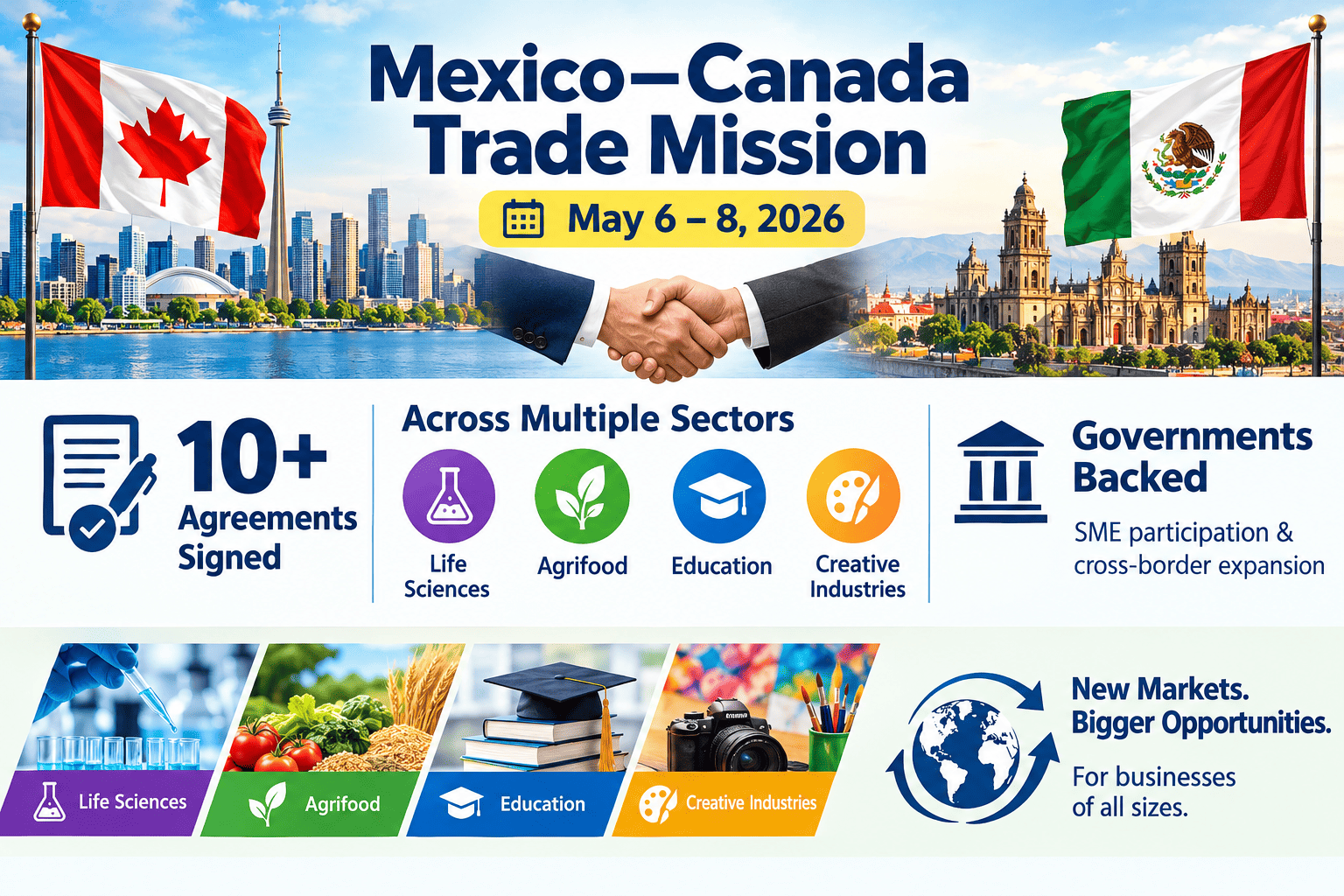
Mexico and Canada concluded a three-day trade mission in May 2026 with more than 10 commercial agreements signed across life sciences, agrifood, education and creative industries. Both governments explicitly highlighted SME participation and cross-border expansion — a signal that the bilateral commercial relationship is broadening beyond large corporations to include smaller manufacturers and exporters.

🎯 Direct Answer

The Mexico–Canada Trade Mission, held May 6–8, 2026, concluded with more than 10 commercial agreements signed across multiple sectors, including life sciences, agrifood, education, and creative industries. The governments of both countries explicitly highlighted SME participation and cross-border expansion as key outcomes of the mission. For manufacturers, exporters, and service providers in North America, the mission demonstrates the value of structured, government-backed trade delegations for opening doors to new markets. The diversity of sectors involved — from agrifood to life sciences to creative industries — reflects the broadening scope of the bilateral commercial relationship, creating opportunities for businesses of all sizes to engage in cross-border collaboration.

📅 May 8, 2026 ⏱ 16 min read ✍️ GTsetu Editorial Team 📰 News + Analysis
Agreements Signed
10+
Commercial agreements across multiple sectors signed during the May 2026 mission
Sectors Covered
4+
Life sciences, agrifood, education, creative industries — diversified deal flow
Focus
SMEs
Governments explicitly highlighted SME participation and cross-border expansion
Duration
3 Days
May 6–8, 2026 — intensive B2B matchmaking and government-led negotiations
Section 1 — The News

1 The Full Story: Mexico–Canada Trade Mission 2026

🌎
Trade Mission — May 6–8, 2026

Mexico–Canada Trade Mission Signs 10+ Commercial Agreements Across Life Sciences, Agrifood, Education & Creative Industries

From May 6 to 8, 2026, a Mexico–Canada trade mission brought together businesses and government representatives from both countries for three days of B2B matchmaking, sector roundtables, and commercial negotiations. The mission concluded with more than 10 commercial agreements signed across multiple sectors.

The agreements spanned life sciences, agrifood, education, and creative industries, reflecting the breadth of the bilateral commercial relationship. Crucially, both governments explicitly highlighted SME participation and cross-border expansion as key outcomes of the mission — a signal that trade delegations are no longer the preserve of large corporations.

For manufacturers, exporters, and service providers across North America, the mission demonstrates the value of structured, government-backed trade delegations for opening doors to new markets. The diversity of sectors involved — from agrifood to life sciences to creative industries — reflects the broadening scope of the Mexico–Canada commercial relationship, creating opportunities for businesses of all sizes to engage in cross-border collaboration.

May 2026
Trade mission held May 6–8, 2026, across Mexico and Canada
10+
Commercial agreements signed across life sciences, agrifood, education & creative
SMEs
Governments explicitly highlighted SME participation as a key mission outcome
4+
Sectors covered — life sciences, agrifood, education, creative industries
“The breadth of agreements signed during this mission — from agrifood to life sciences to creative industries — demonstrates the depth and diversity of the Mexico–Canada commercial relationship. We are particularly pleased to see SMEs playing a central role.”
— Government of Canada Trade Mission Statement
“Cross-border expansion is no longer limited to large corporations. Through structured trade missions like this, Mexican SMEs can access Canadian markets, and Canadian SMEs can access Mexican markets, with government support reducing the barriers to entry.”
— Mexican Trade Delegation Representative
💡 GTsetu Perspective

What makes this trade mission significant is not just the number of agreements — it is the explicit focus on SMEs. Government-backed trade missions have traditionally been the domain of large corporations with dedicated international business development teams. By highlighting SME participation, Mexico and Canada are signalling that the infrastructure of cross-border trade is becoming more accessible. For SMEs that cannot access these programs, verified partner discovery platforms like GTsetu provide an alternative pathway to the same outcomes: finding, evaluating, and engaging with potential cross-border partners systematically, before revealing confidential details.

🔗

Related reading: Cross-Border Business Partnerships — a comprehensive guide to structuring and managing international partnerships.

Section 2 — Sectors Covered

2 Sectors Covered by the Agreements

The Mexico–Canada trade mission produced agreements across four broad sectors, each with distinct implications for SMEs and cross-border collaboration.

🌾

Agrifood

Agrifood was a central pillar of the mission, with agreements covering food processing, agricultural technology, and cross-border supply chains. Both countries have complementary agricultural strengths — Canada in grains, pulses, and processed foods; Mexico in fresh produce, specialty foods, and agri-tech. For SMEs in food manufacturing and agri-processing, this opens pathways to new markets and supply chain partnerships.

🌾 Complementary agri strengths
🔬

Life Sciences

Life sciences agreements covered medical devices, pharmaceuticals, and health technology. Canada has a strong life sciences research and development ecosystem; Mexico has a growing medical device manufacturing sector. Agreements in this space create opportunities for technology transfer, joint ventures, and supply chain integration between SMEs in both countries.

🔬 Tech transfer + manufacturing
🎓

Education

Education agreements focused on student exchange, joint research programs, and institutional partnerships. These create long-term bridges between the two countries — training the next generation of professionals who will work across both markets, and building research collaborations that can evolve into commercial partnerships over time.

🎓 Long-term capacity building
🎨

Creative Industries

Creative industries agreements covered film, television, digital media, and design. These agreements facilitate co-production, content distribution, and talent exchange between the two countries. For creative SMEs — production houses, design studios, digital agencies — this opens access to new markets and collaborative opportunities.

🎨 Co-production + distribution
⚙️ Why Sector Diversity Matters

The fact that agreements spanned agrifood, life sciences, education, and creative industries is itself significant. It means the Mexico–Canada commercial relationship is not dependent on any single sector — and it creates opportunities for SMEs in a wide range of industries. A food processor in Mexico can find a Canadian distribution partner. A medical device manufacturer in Canada can find a Mexican contract manufacturing partner. A design studio in either country can find co-production opportunities. The breadth of the mission reflects a deliberate strategy to diversify cross-border engagement beyond traditional trade categories.

🔗

Related reading: How to Get NSF Sanitation Certification — essential for food equipment manufacturers entering the North American market.

Section 3 — The Anatomy

3 What Each Partner Brings to the Table

Like every successful bilateral trade initiative, the Mexico–Canada mission works because each country contributes complementary strengths. This complementarity principle is the foundation of any collaboration worth entering.

Collaboration Anatomy — Mexico–Canada Trade Mission
Mexico
🇲🇽 North America
What they bring
Manufacturing scale + Agri produce
Sector strengths
Agrifood, medical devices, auto
SME focus
Growing SME export sector
What they lack
Access to Canadian market
Mission role
Partner + Market Seeker
+
Trade
Canada
🇨🇦 North America
What they bring
R&D + Life sciences + Agri tech
Sector strengths
Life sciences, agri-food, creative
SME focus
Strong SME support ecosystem
What they lack
Access to Mexican market
Mission role
Partner + Market Seeker
🎯 Target: 10+ commercial agreements across 4+ sectors
🤝 Explicit SME participation + cross-border expansion focus
🌎 Bilateral government-backed trade mission model
Collaboration Dimension Mexico Provides Canada Provides SME Opportunity
AgrifoodFresh produce, specialty foods, agri-techGrains, pulses, processed foods, agri-techSupply chain partnerships, distribution agreements, co-manufacturing
Life SciencesMedical device manufacturing, clinical researchR&D, pharmaceuticals, health technologyTechnology transfer, joint ventures, contract manufacturing
EducationStudent exchange, Spanish language trainingJoint research, English language trainingInstitutional partnerships, training programs, research collaborations
Creative IndustriesFilm production, design talent, digital mediaCo-production, distribution, technologyCo-production agreements, distribution partnerships, talent exchange
Cross-SectorManufacturing capacity, competitive costsMarket access, technology, capitalComprehensive cross-border partnership opportunities
🔗

Related reading: Partnership Evaluation Criteria — a framework for assessing potential cross-border partners before you commit.

Section 4 — Why This Works

4 Why This Collaboration Model Works for Cross-Border Trade

🎯 The Core Logic

The Mexico–Canada trade mission succeeds because it is built on three interlocking strategic advantages: complementary economic strengths across multiple sectors, government-backed structure that reduces risk and provides legitimacy for SMEs, and a deliberate focus on cross-border expansion that aligns commercial and policy objectives. Neither country could have achieved the same result through unilateral action — Mexico cannot independently create demand for its agrifood and manufacturing exports in Canada, and Canada cannot independently access Mexico’s growing life sciences and manufacturing base. The mission creates a structured, time-bound platform where these complementarities can be identified, negotiated, and formalized.

Why North America Cross-Border Collaboration Is Accelerating

USMCA
The US-Mexico-Canada Agreement provides the foundational framework for trilateral trade
Nearshoring
Global supply chain diversification is driving increased North American manufacturing integration
SMEs
Governments are explicitly targeting SMEs for cross-border trade support and programs
4+
Sectors in one mission — the breadth reflects a diversified commercial strategy
10+
Agreements in a 3-day mission — demonstrating the efficiency of structured trade delegations
3 Days
Intensive B2B matchmaking and negotiations — compressed timeline for faster results
🔗

Related reading: What Are Incoterms 2020? — the essential framework for defining responsibilities in cross-border trade contracts.

Section 5 — North America Opportunity

5 North America Trade Opportunity — Why Now Is the Time to Collaborate

🌎 North America Trade 2026

Why Every Manufacturer and Exporter Should Be Building Cross-Border Capabilities Now

The Mexico–Canada trade mission is part of a broader acceleration in North American cross-border collaboration, driven by nearshoring trends, USMCA implementation, and government programs explicitly targeting SME participation. For manufacturers and exporters, the window to establish cross-border partnerships is now — before competitors lock in distribution channels, supply chain relationships, and market presence. The diversity of sectors covered in this mission — agrifood, life sciences, education, creative industries — means opportunities exist across a wide range of industries, not just traditional manufacturing.

USMCA
Trilateral trade agreement providing the framework for North American commerce
Nearshoring
Global supply chain shifts driving North American manufacturing integration
SME Focus
Government programs explicitly targeting SME cross-border expansion
Diversity
Opportunities across agrifood, life sciences, education, and creative industries
10+ Deals
Demonstrating the efficiency of structured, government-backed trade missions
3 Days
Compressed timeline for B2B matchmaking and commercial negotiations
🌐 GTsetu for Cross-Border Trade Collaboration

GTsetu’s verified partner network includes manufacturers, exporters, distributors, and service providers across Mexico, Canada, the United States, and 100+ other countries. Every company on GTsetu is verified using government tie-ups on 6 key points: Name, Address, Registration Number, Company Status, Company Type, and Date of Certificate of Incorporation. If you’re a manufacturer or exporter looking to access North American markets, or a Canadian or Mexican company seeking supply chain partners, GTsetu is where your partner search begins with verified profiles, not cold calls. Find cross-border trade partners →

🔗

Related reading: Global Market Research for Manufacturers — how to assess new markets before committing resources.

Section 6 — Types of Collaboration

6 4 Types of Cross-Border Collaboration — Which Fits Your Situation?

The Mexico–Canada trade mission produced commercial agreements, but the right collaboration structure depends on your objectives, resources, and risk tolerance. Here are the four primary models for cross-border engagement.

01

Distribution Partnership

You manufacture; a local distributor sells and services in their market. Lightest form of cross-border collaboration. Often the first step before a deeper manufacturing agreement in a new geography. Tests demand before capital is committed.

🌍 Market entry, step 1
02

Supply Agreement

A direct supplier relationship where one party provides goods or services to the other on agreed terms. Deeper than distribution, requires the supplier to meet quality, volume, and compliance standards. Often the outcome of a successful market entry.

📦 Commercial supply relationship
03

Joint Venture

A new shared legal entity co-owned by both parties. Deepest integration, full profit and risk sharing. Used for strategic manufacturing or technology partnerships where both parties have large complementary assets and long-term commitment.

⚖️ Deep integration
04

Mentorship & Knowledge Partnership

A structured program for training, certification, and knowledge transfer without immediate commercial commitment. Builds long-term capability and ecosystem sustainability. Often complements other collaboration types and serves as a precursor to supply agreements.

📚 Capability building
📊 Collaboration Model Comparison — Cross-Border Trade
Model Capital Required Market Access Speed to Execute Reversibility
Distribution Minimal ✓ Local market access Fastest (1–3 months) High
Supply Agreement Moderate ✓ Commercial relationship Moderate (6–12 months) Moderate
Joint Venture High — shared capex ✓ Deep integration Slow (12–24 months) Low
Mentorship Low ~ Indirect Fastest (1–3 months) High
🔗

Related reading: International Wholesale Distributors — how to find and evaluate distribution partners in new markets.

Section 7 — How to Collaborate

7 How to Collaborate: A 5-Step Playbook for Cross-Border Trade

The Mexico–Canada trade mission followed a deliberate progression — from government-led scoping to B2B matchmaking to commercial agreement. Here is the distilled playbook for manufacturers and exporters seeking cross-border collaboration.

1

Define Your Cross-Border Objective with Precision

The Mexico–Canada mission succeeded because each participant had a clear objective: market access, supply chain partnership, technology transfer, or distribution. Define your objective that precisely. Are you seeking a distributor, a manufacturing partner, a technology provider, or a joint venture partner? Vague objectives produce vague partner searches and failed negotiations.

2

Find Verified Cross-Border Partners — Not Just Any Partner

The crucial word is “verified.” The Mexico–Canada mission was structured by governments — participants were vetted and matched. For businesses that cannot access a government trade mission, GTsetu provides verified profiles of manufacturers, distributors, and service providers across North America and 100+ countries. GTsetu verifies companies using government tie-ups on 6 key points: Name, Address, Registration Number, Company Status, Company Type, and Date of Certificate of Incorporation. Additional information like certifications and export experience is self-reported and should be validated independently.

3

Protect Your IP and Data Before Any Technical Disclosure

In cross-border trade, your product specifications, customer data, and proprietary processes are valuable IP. Before sharing anything sensitive — even a capability requirements document — execute a mutual NDA. GTsetu’s built-in NDA workflow handles this automatically: mutual NDA executed and countersigned before any sensitive information is shared, with a full digital audit trail.

4

Choose the Right Collaboration Structure for Your Objective

The Mexico–Canada mission produced commercial agreements, but the right structure depends on your objective. A distribution agreement is right when you need market access without capital commitment. A supply agreement is right when you need a reliable source or customer. A JV is right when you want permanent shared ownership. A mentorship program is right when you need capability building. Match the structure to the objective.

5

Formalise and Scale in Stages — Agreement First, Volume Second

The Mexico–Canada mission signed agreements before expecting massive trade volumes. The agreement enables the trade; the trade justifies the investment. Never commit to scale before you have the commercial agreement in place. Structure every collaboration milestone formally in writing: scope, pricing, delivery terms, quality standards, exclusivity, and termination conditions.

🔗

Related reading: Risk Allocation in Cross-Border Deals — how to structure contracts that protect both parties.

Section 8 — Dos and Don’ts

8 Dos and Don’ts of Cross-Border Trade Collaboration

✅ Do These
  • ✅ Build on structured trade programs — government missions and industry delegations provide legitimacy and access
  • ✅ Verify your partner’s track record — the right partner opens doors, not just provides contracts
  • ✅ Build capability before expecting contracts — market access requires quality, compliance, and readiness
  • ✅ Sign NDA before sharing customer data, product specs, or proprietary processes
  • ✅ Choose a partner whose market reach is complementary to yours — the gap is where value is created
  • ✅ Define the collaboration scope clearly — what products, what volumes, what timelines, what pricing
  • ✅ Start with a small order or pilot program before committing to capacity expansion
  • ✅ Build in quality audit rights — partners must be able to verify compliance
  • ✅ Use verified platforms like GTsetu rather than trade fair introductions for strategic partners
  • ✅ Document the collaboration formally — distribution agreement, supply contract, or JV agreement before trade begins
❌ Avoid These
  • ❌ Invest in capacity expansion before securing a commercial agreement
  • ❌ Share customer data or product specifications before NDA is countersigned
  • ❌ Accept self-reported partner capability claims without reference verification
  • ❌ Assume that a trade mission guarantees a contract — participation is necessary but not sufficient
  • ❌ Partner with a company whose existing suppliers are your direct competitors — conflict of interest risk
  • ❌ Neglect exclusivity terms — know whether your partner can source from or sell to your competitors
  • ❌ Choose a partner whose needs duplicate your capabilities — the gap is where value is created
  • ❌ Start trade on informal terms — pricing, delivery, quality standards, and payment terms must be documented
  • ❌ Underestimate compliance requirements — cross-border trade has strict customs, labeling, and certification standards
  • ❌ Build a JV when a distribution or supply agreement would achieve the same objective at lower commitment and risk
🔗

Related reading: Commercial Due Diligence — how to verify a partner’s financial and operational capacity before committing.

Section 9 — Misconceptions

9 Common Misconceptions That Kill Cross-Border Trade Collaborations

❌ Myth

“A trade mission agreement is just a photo opportunity — it won’t lead to real commercial activity.”

✅ Reality

Trade mission agreements are commercial contracts, not photo opportunities. The 10+ agreements signed in the Mexico–Canada mission represent binding commitments between companies — distribution agreements, supply contracts, joint venture frameworks. The mission provides the structured environment and government legitimacy that accelerates deal-making, but the agreements themselves are commercial documents with real obligations. SMEs that participate in these missions and sign agreements are entering into enforceable commercial relationships.

❌ Myth

“We can figure out the commercial terms after the agreement — the relationship will guide us.”

✅ Reality

Commercial disputes are the most common reason cross-border collaborations fail. Once trade has started on undefined terms, both parties’ leverage is gone. Pricing, delivery schedules, quality standards, payment terms, and dispute resolution mechanisms must be defined before the first shipment. The trade mission agreement provides the framework; the contract provides the operational detail. Define both upfront.

❌ Myth

“The partner’s market access automatically becomes our market access.”

✅ Reality

A partnership gives you access to a market through a partner, not automatic sales. Your partner still needs to market your products, meet local regulatory requirements, and manage customer relationships. Partnership is a door-opener, not a guarantee. Plan the commercial development separately from the partnership agreement. Use the partnership to establish presence, then build the market systematically.

❌ Myth

“We should build our export capacity first to show partners we’re serious.”

✅ Reality

The Mexico–Canada mission did the opposite — companies signed agreements first, then scaled capacity to fulfil them. Building export capacity without knowing whether a partner will buy from you is capital destruction. The correct sequence is always: agreement first → pilot order → capacity investment. Never invest in scale before you have the commercial pipeline to justify it.

❌ Myth

“A collaboration with a partner in another country requires physical presence there to manage effectively.”

✅ Reality

The Mexico–Canada trade mission participants manage their partnerships from their home offices with structured communication protocols, scheduled review sessions, and clear contractual frameworks — not permanent presence. What matters is clear protocols for quality documentation, scheduled audits, and commercial reviews, not physical proximity. GTsetu’s encrypted collaboration workspace supports exactly this structured cross-border working relationship.

🔗

Related reading: Breach of Contract — what happens when a cross-border agreement is not honoured, and how to protect yourself.

Section 10 — GTsetu

10 How GTsetu Helps You Find the Right Cross-Border Trade Partner

The Mexico–Canada trade mission gave participating companies a structured pathway to cross-border partnerships. Most businesses do not have access to government trade missions — and even when they do, identifying which partners are the right fit requires systematic evaluation. GTsetu is the verified B2B manufacturing discovery platform that enables this evaluation at scale, across 100+ countries, before you reveal a single confidential detail.

🌐 Platform Spotlight — GTsetu

Find Verified Cross-Border Trade Partners, Manufacturers, Distributors, and Service Providers Across 100+ Countries — Anonymously, Securely, With Zero Broker Fees

Every company on GTsetu is verified using government tie-ups on 6 key points: Name, Address, Registration Number, Company Status, Company Type, and Date of Certificate of Incorporation. This is the foundation of trust. Additional information such as certifications, export experience, and manufacturing capabilities is self-reported by companies. You evaluate who is real before you engage. You share nothing sensitive until an NDA is countersigned. And you pay no broker commission on any collaboration formed — the deal is entirely between you and your partner.

✅
6-Point Government-Sourced VerificationName, Address, Registration Number, Company Status, Company Type, Date of Incorporation confirmed using government tie-ups.
🕵️
Anonymous DiscoveryEvaluate verified partner profiles without revealing your identity until mutual interest is confirmed.
📄
Built-In NDA WorkflowShare design specs only after NDA is executed — full audit trail, no external legal required.
🚫
Zero CommissionNo broker fees — your distribution agreement, supply contract, or JV is entirely between you and your partner.
🌍
100+ CountriesMexico, Canada, United States, India, China, Germany — find trade partners in every major market.
🔐
Encrypted CollaborationShare product specs, pricing, and contract terms securely between verified partners.
Find Verified Partners → Browse the Network

What the Mexico–Canada Mission Did — What GTsetu Enables For You

What the Mission Did What GTsetu Enables for You Why This Matters
Brought together government and business for structured B2B matchmaking✓ Browse verified company profiles with government-sourced verification before engagingYou find the partner before your competitors do, first-mover advantage
Facilitated 10+ commercial agreements across 4+ sectors✓ Filter by self-reported capabilities, certifications, and export experience (validate independently)Find potential partners with the specific capabilities your market entry requires
Explicitly highlighted SME participation and cross-border expansion✓ Built-in NDA and document workflow protects your product data and customer information from the first conversationYour product specifications, pricing, and customer data are protected at every stage
Created structured, time-bound platform for commercial negotiations✓ Self-reported partner profiles show market reach, manufacturing capabilities, and export marketsIdentify partners positioned to serve your target market — and beyond
Government-backed legitimacy for participating companies✓ Zero commission on any partnership — all commercial terms are direct between the two partiesNo broker splits your margin or misaligns your commercial terms
FAQ

? Frequently Asked Questions

Q What is the Mexico–Canada Trade Mission 2026?
The Mexico–Canada Trade Mission took place from May 6–8, 2026, bringing together businesses and government representatives from both countries. More than 10 commercial agreements were signed across life sciences, agrifood, education, and creative industries. The governments explicitly highlighted SME participation and cross-border expansion as key outcomes. The mission included B2B matchmaking sessions, sector roundtables, and commercial negotiations, structured to facilitate deal-making between companies from both countries.
Q Why is this trade mission significant for SMEs?
The Mexico–Canada trade mission is significant for SMEs because both governments explicitly highlighted SME participation and cross-border expansion as key outcomes. Government-backed trade missions have traditionally been the domain of large corporations with dedicated international business development teams. By focusing on SMEs, Mexico and Canada are signalling that the infrastructure of cross-border trade is becoming more accessible. For SMEs that cannot access these programs, GTsetu provides an alternative pathway to the same outcomes: finding, evaluating, and engaging with potential cross-border partners systematically.
Q What sectors were covered by the agreements?
The agreements spanned four broad sectors: agrifood (food processing, agricultural technology, supply chains), life sciences (medical devices, pharmaceuticals, health technology), education (student exchange, joint research, institutional partnerships), and creative industries (film, television, digital media, design). The diversity of sectors reflects the breadth of the Mexico–Canada commercial relationship and the opportunities for SMEs across different industries. This diversification is deliberate — it reduces dependence on any single sector and creates opportunities for businesses of all types.
Q How can I find a cross-border trade partner for my business?
The systematic approach involves four steps: (1) Define your cross-border objective precisely — are you seeking a distributor, a manufacturing partner, a technology provider, or a joint venture partner? (2) Search verified platforms — GTsetu lists verified manufacturers, distributors, and service providers across Mexico, Canada, the United States, and 100+ countries. GTsetu verifies companies using government tie-ups on 6 points: Name, Address, Registration Number, Company Status, Company Type, and Date of Certificate of Incorporation. Additional information like certifications and export experience is self-reported and should be validated independently. (3) Evaluate anonymously first — review verified profiles and self-reported capability data before revealing your identity or product requirements. (4) Execute NDA before any technical disclosure — GTsetu’s built-in NDA workflow handles this automatically before any sensitive document exchange. Cold approaches through trade fairs rarely surface the right partner; a structured, verified search on GTsetu does.
Q What happens if my cross-border partner also works with my competitors?
This is one of the most important and most frequently overlooked questions in cross-border trade. If your distribution partner also sells competing products from your direct competitors, your collaboration advantage evaporates. Before signing any distribution or supply agreement, explicitly negotiate: (1) Exclusivity scope — is the agreement exclusive to you in your product category or geographic region? (2) Volume commitments — what minimum volumes is the partner committing to? (3) Competitive supply terms — can the partner source from or sell to your competitors during the agreement period? These terms must be in the agreement before signing.
Q Does GTsetu charge commission on partnerships formed through the platform?
No. GTsetu charges zero commission on any collaboration — whether a distribution agreement, supply contract, Joint Venture, licensing deal, or mentorship program — formed through the platform. The commercial terms of your agreement are entirely between you and your partner. This is a foundational design principle: broker intermediation in cross-border trade partnerships typically costs 5–15% of deal value and creates incentive misalignment between the broker and both parties. GTsetu removes the broker entirely. Learn more about GTsetu →

Ready to Find Your Cross-Border Trade Partner? Start on GTsetu.

500+ verified manufacturers, distributors, exporters, and service providers across Mexico, Canada, the United States, and 100+ countries. Zero broker fees. Anonymous discovery. Built-in NDA workflows. Your next cross-border partnership starts with a verified profile — not a trade fair handshake.

Find Verified Partners Free → Browse the Network