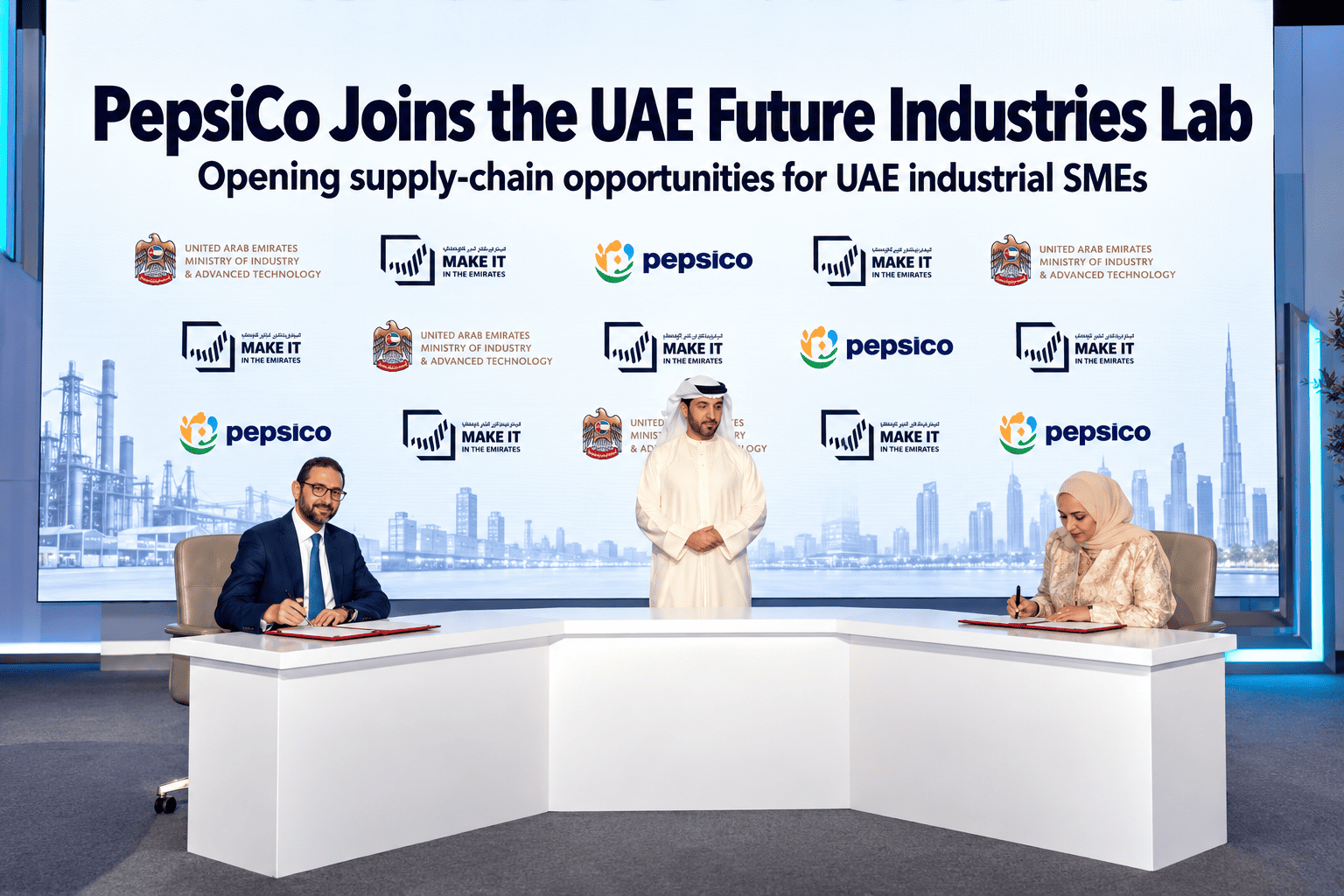
PepsiCo has joined the UAE’s Future Industries Lab, a Ministry of Industry and Advanced Technology initiative, to give industrial SMEs exposure to its supply chains, manufacturing expertise, sustainability practices, and finance pathways. This is a blueprint for how large corporates can open their ecosystems to smaller manufacturers, and for how SMEs can access the kind of corporate partnership that accelerates growth.
PepsiCo has joined the UAE’s Future Industries Lab, an initiative of the Ministry of Industry and Advanced Technology (MoIAT), in a collaboration designed to support industrial SMEs. Under the initiative, PepsiCo provides SMEs with exposure to its supply chains, manufacturing expertise, sustainability practices, and finance pathways, creating potential routes for smaller manufacturers into a large corporate ecosystem. The Future Industries Lab brings together government entities, large corporations, and SMEs to accelerate industrial development, technology adoption, and sustainable manufacturing in the UAE, aligning with national programs like Operation 300bn and Make it in the Emirates. For SMEs in food, agriculture, packaging, and adjacent sectors, this is a structured pathway to corporate partnership that was previously accessible only through lengthy, informal relationship-building.
“The Future Industries Lab reflects our commitment to building a diversified, sustainable industrial base in the UAE. By bringing together government, large corporates, and SMEs, we are creating an ecosystem where smaller manufacturers can access the expertise, supply chains, and finance they need to scale.”— Ministry of Industry and Advanced Technology, UAE
“PepsiCo is committed to supporting the communities where we operate. Joining the Future Industries Lab allows us to share our supply chain expertise, sustainability practices, and manufacturing knowledge with local SMEs, helping them grow while strengthening the resilience of our own supply base.”— PepsiCo Representative, UAE
This collaboration is a template for how large corporates can genuinely support SME ecosystems, not through charity or CSR, but through structured commercial access. PepsiCo gains a more resilient, local supply base. SMEs gain supply chain exposure, manufacturing knowhow, sustainability best practices, and finance pathways. The UAE government gains progress toward its industrial diversification goals. The key insight for SMEs: structured corporate partnership programs like the Future Industries Lab are the fastest route into a large corporate ecosystem, faster than cold outreach, faster than trade fairs, and often faster than waiting for a tender. GTsetu helps you find the right corporate partner when no such structured program exists.
Related reading: BRICS SME Working Group & PartNIR: How 3 Joint Working Group Meetings Are Shaping the New Industrial Revolution for Global Manufacturers, how government-backed frameworks are connecting SMEs to global industrial cooperation.
The Future Industries Lab is not a single event or a one-time program, it is a structured, ongoing collaboration platform run by the UAE Ministry of Industry and Advanced Technology (MoIAT). It brings together three stakeholder groups that rarely interact systematically: government entities, large corporations, and SMEs. The Lab’s purpose is to accelerate industrial development, technology adoption, and sustainable manufacturing practices across the UAE.
Most SMEs struggle to access large corporate supply chains for a simple reason: large corporates do not have a structured way to discover, evaluate, and onboard smaller suppliers. Procurement teams are optimized for large, established vendors. The Future Industries Lab solves this by creating a curated, government-backed channel through which corporates like PepsiCo can engage SMEs systematically. For SMEs, this means the barrier to corporate partnership is no longer “who you know”, it is “can you demonstrate capability in a structured program.”
PepsiCo’s collaboration with the Future Industries Lab focuses on four distinct areas of SME support. Together, they form a comprehensive framework for helping smaller manufacturers integrate into larger corporate ecosystems.
SMEs gain exposure to PepsiCo’s supply chains, understanding how a global food and beverage giant sources, evaluates, and manages suppliers. This includes visibility into procurement standards, quality requirements, and vendor onboarding processes.
🔗 Vendor ecosystem entryAccess to PepsiCo’s manufacturing knowledge, process optimization, quality systems, production efficiency, and operational best practices. SMEs learn how global standards are applied in practice, not just in theory.
⚙️ Operational capability upliftExposure to PepsiCo’s sustainability frameworks, responsible sourcing, water stewardship, carbon reduction, and packaging innovation. These practices are increasingly required for participation in global supply chains.
🌱 ESG capability buildingExposure to finance pathways, how large corporates structure supplier financing, payment terms, and investment in their supply chains. This helps SMEs understand the financial requirements and opportunities of corporate partnership.
💰 Financial readinessWhat makes this collaboration distinctive is that it addresses four dimensions of SME readiness simultaneously. Supply chain access alone is not enough if an SME cannot meet quality standards. Manufacturing expertise alone is not enough if an SME cannot access finance. Sustainability practices alone are not enough if an SME cannot navigate procurement. By combining all four, PepsiCo and MoIAT are building genuinely partnership-ready SMEs, not just providing exposure. This is the model for any corporate-SME collaboration: address the complete readiness stack, not just one piece.
Related reading: GAMSNE Meghalaya Rural Bank MoU Transforms Agricultural Finance in Northeast India, how financial institutions are building structured pathways for agricultural and rural SMEs.
Like every successful multi-party collaboration, the PepsiCo × Future Industries Lab initiative works because each stakeholder contributes what the others cannot efficiently replicate. This complementarity principle is the foundation of any collaboration worth entering.
| Collaboration Dimension | MoIAT Provides | PepsiCo Provides | SME Gains |
|---|---|---|---|
| Supply Chain | National industrial policy context | Vendor ecosystem access, procurement standards | Visibility into how corporates source and evaluate suppliers |
| Manufacturing | Industrial standards alignment | Process optimization, quality systems, operational best practices | Operational capability uplift to corporate standards |
| Sustainability | National ESG and sustainability goals | Responsible sourcing, water stewardship, carbon reduction frameworks | ESG capability building required for global supply chains |
| Finance | SME finance policy support | Supplier financing models, payment terms, investment practices | Understanding of financial requirements and opportunities in corporate partnership |
| Credibility | Government endorsement and platform legitimacy | Corporate validation of SME capabilities | Third-party validation that opens doors with other corporates |
The PepsiCo × Future Industries Lab collaboration succeeds because it is built on three interlocking strategic advantages: government-backed structure that gives SMEs legitimacy and access, a corporate anchor partner with real supply chain needs and expertise, and a national industrial strategy that aligns all stakeholders toward the same outcome. Neither PepsiCo nor the SMEs could have achieved the same result through any other mechanism, PepsiCo cannot efficiently discover and evaluate hundreds of small suppliers, and SMEs cannot independently break into a global corporate’s vendor ecosystem.
The UAE has made industrial diversification a national priority. Operation 300bn and Make it in the Emirates have created a policy environment where corporate-SME collaboration is encouraged, supported, and increasingly expected. For SMEs in food processing, agriculture, packaging, logistics, and adjacent sectors, the Future Industries Lab represents a structured pathway into corporate supply chains that was previously unavailable. The window to engage is now, as corporate partners like PepsiCo are actively seeking local suppliers through government-backed programs.
GTsetu’s verified partner network includes food manufacturers, agricultural processors, packaging companies, logistics providers, and corporate supply chain partners across the UAE, GCC, and 100+ other countries. Every company on GTsetu is verified using government tie-ups on 6 key points: Name, Address, Registration Number, Company Status, Company Type, and Date of Certificate of Incorporation. If you’re an SME looking to access corporate supply chains, or a corporate looking to discover qualified local suppliers, GTsetu is where your partner search begins with verified profiles, not cold calls. Find supply chain partners →
Related reading: Lifestyle International Flipkart Private Labels, how large retail ecosystems are building private label supply chains with manufacturer partners.
PepsiCo and MoIAT used a structured Lab program, but the right collaboration structure depends on your objectives, resources, and risk tolerance. Here are the four primary models for corporate-SME engagement.
A structured program where a corporate provides training, mentorship, and capability building to SMEs, with the goal of integrating them into the supply chain. The PepsiCo × Future Industries Lab model. Fast to deploy, low capital for SMEs, high value if commercial contracts follow.
🏭 PepsiCo × UAE Future Industries LabA direct supplier relationship where the SME provides goods or services to the corporate on agreed terms. Deeper than a development program, requires the SME to meet quality, volume, and compliance standards. Often the outcome of a successful supplier development program.
📦 Commercial partnershipA new shared legal entity co-owned by the corporate and the SME. Deepest integration, full profit and risk sharing. Less common in corporate-SME contexts but used for strategic manufacturing or technology partnerships. Best when both parties have large complementary assets and long-term commitment.
⚖️ Deep integrationA structured program for training, certification, and knowledge transfer without immediate commercial commitment. Builds long-term capability and ecosystem sustainability. Often complements other collaboration types and serves as a precursor to supply agreements.
📚 Capability buildingRelated reading: Union Bank of India C2treds, how supply chain finance platforms are enabling SME participation in corporate ecosystems.
The PepsiCo × Future Industries Lab collaboration did not happen by accident. It followed a deliberate progression, from government initiative to corporate participation to SME engagement. Here is the distilled playbook for SMEs and manufacturers seeking corporate partnerships.
PepsiCo’s collaboration focuses on supply chain, manufacturing, sustainability, and finance. Which of these areas aligns with your capabilities and growth objectives? If you’re a food processor, supply chain access is your pathway. If you’re a packaging manufacturer, sustainability practices may be your entry point. If you’re a logistics provider, finance pathways could be your differentiator. Define where your capabilities meet the corporate’s needs before you engage.
The crucial word is “verified.” PepsiCo was not a random contact, MoIAT approached the company with a proven track record in supply chain development, sustainability, and SME engagement. For SMEs who don’t have a government program to leverage, GTsetu provides verified profiles of corporates, suppliers, and manufacturing partners across the UAE, GCC, and 100+ countries. GTsetu verifies companies using government tie-ups on 6 key points: Name, Address, Registration Number, Company Status, Company Type, and Date of Certificate of Incorporation. Additional information like certifications and supply chain capabilities is self-reported and should be validated independently.
In food and manufacturing, your recipes, process technology, and customer data are valuable IP. Before sharing anything sensitive, even a capability requirements document, execute a mutual NDA. GTsetu’s built-in NDA workflow handles this automatically: mutual NDA executed and countersigned before any sensitive information is shared, with a full digital audit trail.
PepsiCo and MoIAT used a supplier development program model. A supply agreement is right when you’re ready for commercial commitment. A JV is right when you want permanent shared ownership. A mentorship program is right when you need capability building. Match the structure to your objective, not to what’s easiest to negotiate. The Future Industries Lab provides a pathway to each type.
The Future Industries Lab is the direct access point for PepsiCo resources. It includes partnership matching, capability building, and commercial exploration. Identify whether your local SME association is connected to the Lab, and use GTsetu to find verified partners who are already engaged with corporate supply chain programs. Once you’ve proven capability through a structured program, scale into commercial agreements.
PepsiCo had MoIAT through a government initiative. Most SMEs are not that fortunate, and even when a structured program exists, identifying which corporate partners are actively seeking suppliers requires systematic evaluation. GTsetu is the verified B2B manufacturing discovery platform that enables this evaluation at scale, across 100+ countries, before you reveal a single confidential detail.
| What PepsiCo & MoIAT Are Doing | What GTsetu Enables for You | Why This Matters |
|---|---|---|
| Created the Future Industries Lab to give SMEs structured access to corporate ecosystems | ✓ Browse verified company profiles with government-sourced verification before engaging | You find the partner before your competitors do, first-mover advantage |
| Brought PepsiCo into the Lab to provide supply chain, manufacturing, sustainability, and finance exposure | ✓ Filter by self-reported capabilities, certifications, and supply chain expertise (validate independently) | Find potential corporate partners with the specific supply chain needs your capabilities match |
| Provides SME pathways for supply chain access and capability building | ✓ Built-in NDA and document workflow protects your recipes, process data, and customer information from the first conversation | Your food technology, process specifications, and supply chain data are protected at every stage |
| Builds cross-border supply chain collaboration across the UAE and GCC | ✓ Self-reported partner profiles show geographic reach, manufacturing capabilities, and export markets | Identify partners positioned to serve the full GCC and global supply chain ecosystem |
| Creates government-backed partnership mechanisms under Operation 300bn | ✓ Zero commission on any partnership, all commercial terms are direct between the two parties | No broker splits your margin or misaligns your commercial terms |
500+ verified manufacturers, corporate partners, food processors, packaging companies, and supply chain enablers across the UAE, GCC, India, China, and 100+ countries. Zero broker fees. Anonymous discovery. Built-in NDA workflows. Your next corporate partnership starts with a verified profile, not a cold email.
Find Verified Partners Free → Browse the Network
Business Development Expert | Global Markets & Trade Intelligence
Lucas Bennett is a Business Development Expert at GTsetu with a focus on international trade, market intelligence, and cross-border business development. He works closely with organizations looking to expand into new markets, develop strategic alliances, and strengthen their position within global business ecosystems.
Lucas brings expertise in market research, international partnership development, trade opportunities, and business growth strategies. At GTsetu, he contributes insights on emerging market trends, global collaboration opportunities, and industry developments that help businesses make informed expansion decisions.
Passionate about connecting organizations across geographies, Lucas helps companies navigate international markets and build partnerships that drive sustainable growth and long-term success.