ASEAN Economic Community Plan 2026-2030: What MSMEs Must Learn About Southeast Asia’s Digital & Sustainability Transformation
🔴 BREAKINGASEAN Economic Community Plan 2026-2030 unveiled: MSME sustainability and digitalization at the core of Southeast Asia’s economic future◆All 10 ASEAN nations commit to unified economic roadmap targeting sustainability, digital transformation, and MSME empowerment◆Digital economy targets, green MSME initiatives, and cross-border e-commerce frameworks to be implemented across Southeast Asia◆Find verified MSME partners on GTsetu, 100+ countries, zero commission◆🔴 BREAKINGASEAN Economic Community Plan 2026-2030 unveiled: MSME sustainability and digitalization at the core of Southeast Asia’s economic future◆All 10 ASEAN nations commit to unified economic roadmap targeting sustainability, digital transformation, and MSME empowerment◆Digital economy targets, green MSME initiatives, and cross-border e-commerce frameworks to be implemented across Southeast Asia◆Find verified MSME partners on GTsetu, 100+ countries, zero commission◆
Home › Blog › ASEAN Economic Community Plan 2026-2030
ASEAN Economic Community Plan 2026-2030: How Southeast Asia’s Digital & Sustainability Roadmap Is Transforming MSMEs Across 10 Nations
The Association of Southeast Asian Nations (ASEAN) has unveiled its Economic Community Strategic Plan 2026-2030, a comprehensive roadmap adopted by all 10 member nations. The plan places MSME sustainability and digitalization at the core of Southeast Asia’s economic integration agenda, targeting a unified, competitive, and inclusive regional economy.
🎯 Direct Answer
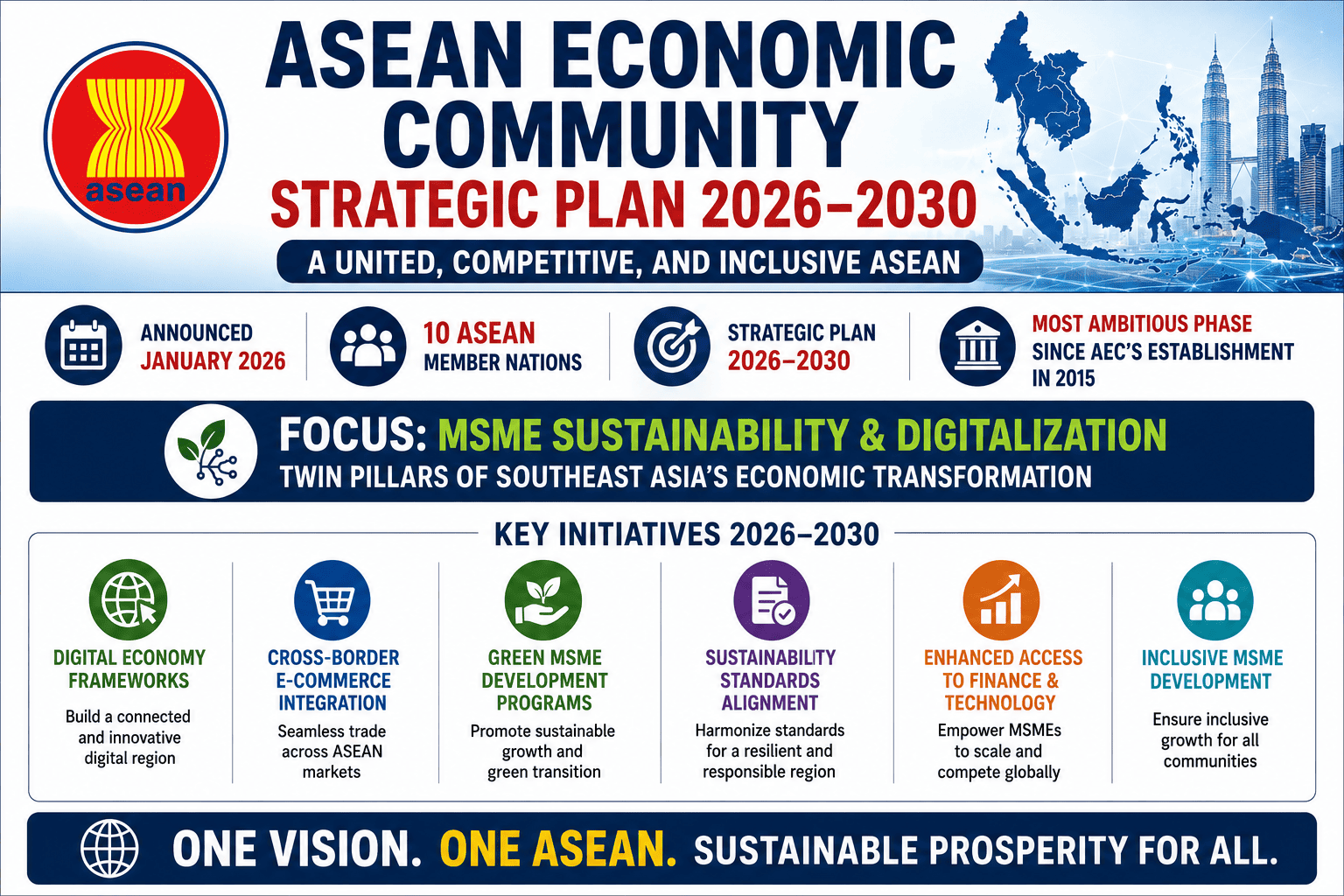
The ASEAN Economic Community (AEC) Strategic Plan 2026-2030 is a comprehensive economic integration roadmap adopted by all 10 ASEAN member nations (Brunei, Cambodia, Indonesia, Laos, Malaysia, Myanmar, Philippines, Singapore, Thailand, Vietnam). Announced in January 2026, the plan focuses on MSME sustainability and digitalization as the twin pillars of Southeast Asia’s economic transformation. The strategic plan targets the creation of a unified, competitive, and inclusive regional economy through initiatives including digital economy frameworks, green MSME development programs, cross-border e-commerce integration, sustainability standards alignment, and enhanced MSME access to finance and technology. This represents the most ambitious phase of ASEAN economic integration since the AEC’s establishment in 2015.
📅 January 2026⏱ 16 min read✍️ GTsetu Editorial Team📰 News + Analysis
Plan Type
Strategic Plan
ASEAN Economic Community roadmap 2026-2030
Nations
All 10 ASEAN
Brunei, Cambodia, Indonesia, Laos, Malaysia, Myanmar, Philippines, Singapore, Thailand, Vietnam
Core Focus
MSME + Digital
MSME sustainability and digitalization at the core
Timeframe
2026-2030
Five-year strategic implementation roadmap
Section 1, The News
1
The Full Story: ASEAN Economic Community Plan 2026-2030
🌏
Plan Unveiled, January 2026
ASEAN Launches Economic Community Strategic Plan 2026-2030: MSME Sustainability and Digitalization at the Core
In January 2026, the Association of Southeast Asian Nations (ASEAN) unveiled its Economic Community Strategic Plan 2026-2030, a comprehensive roadmap adopted by all 10 member nations. The plan represents the most ambitious phase of ASEAN economic integration since the AEC’s establishment in 2015.
The strategic plan places MSME sustainability and digitalization at the core of Southeast Asia’s economic transformation agenda. Key initiatives include digital economy frameworks, green MSME development programs, cross-border e-commerce integration, sustainability standards alignment, and enhanced MSME access to finance and technology.
The plan targets the creation of a unified, competitive, and inclusive regional economy that leverages digital transformation for MSME growth while building sustainability resilience across all 10 ASEAN nations.
10 Nations
All ASEAN member states united under the strategic plan
MSME
Sector focus, sustainability and digitalization for small businesses
2026-2030
Five-year implementation timeframe
Digital
Core pillar, digital economy transformation across Southeast Asia
“The AEC Strategic Plan 2026-2030 represents our collective commitment to building a sustainable and digitally empowered ASEAN. Our MSMEs are the engine of our economies, and this plan ensures they have the tools, technology, and market access to thrive.”
— ASEAN Secretary-General
“Digitalization and sustainability are not separate agendas, they are the twin pillars of ASEAN’s future economic competitiveness. This plan integrates them at every level, from MSME access to finance to cross-border e-commerce standards.”
— ASEAN Economic Community Deputy Secretary-General
💡 GTsetu Perspective
The ASEAN Economic Community Plan 2026-2030 is a government-level recognition of what GTsetu enables at the business level: verified cross-border connections between MSMEs across Southeast Asia. While ASEAN sets the strategic framework, digital economy standards, sustainability benchmarks, and cross-border e-commerce protocols, GTsetu provides the platform where MSMEs from all 10 ASEAN nations and 100+ other countries can find verified partners, protect their interests with NDAs, and collaborate without broker commissions. The strategic plan opens the door, GTsetu helps MSMEs walk through it.
Section 2, The Twin Pillars
2
Digitalization & Sustainability: The Twin Pillars of ASEAN’s Economic Future
The AEC Strategic Plan 2026-2030 is built on two interconnected pillars that together define the future of Southeast Asian MSMEs: digitalization and sustainability. Each pillar is supported by specific initiatives and implementation targets.
💻
Digitalization
Accelerating digital transformation across ASEAN MSMEs through technology access, digital literacy, and cross-border e-commerce infrastructure.
●Digital economy framework harmonization
●Cross-border e-commerce standards
●MSME digital literacy programs
●Digital payment integration
●Technology access for underserved MSMEs
♻️
Sustainability
Building sustainable and resilient MSMEs through green practices, circular economy principles, and sustainability standards alignment across ASEAN.
●Green MSME development programs
●Sustainability standards alignment
●Circular economy initiatives
●Green financing access
●Climate-resilient business practices
⚙️ Why Digitalization and Sustainability Must Be Integrated
The ASEAN Economic Community Plan recognizes that digitalization and sustainability are not separate agendas, they reinforce each other. Digital technologies enable sustainability tracking, supply chain transparency, and green reporting. Sustainable practices create market differentiation and resilience that digital platforms can amplify. For MSMEs across ASEAN, the integrated approach means that a single strategic investment, such as adopting digital supply chain management, can simultaneously advance both pillars. This is the future of Southeast Asian competitiveness.
Section 3, The Anatomy
3
What Each ASEAN Nation Brings to the Table
Like every successful regional integration effort, the AEC Strategic Plan works because each ASEAN nation contributes unique strengths that collectively create a more competitive economic bloc. This diversity is the foundation of ASEAN’s economic power.
🇧🇳
Brunei
Energy, finance, digital infrastructure
🇰🇭
Cambodia
Garments, agriculture, tourism, SMEs
🇮🇩
Indonesia
Market size, manufacturing, digital economy
🇱🇦
Laos
Hydropower, agriculture, mining, connectivity
🇲🇾
Malaysia
Manufacturing, tech, palm oil, finance
🇲🇲
Myanmar
Natural resources, agriculture, garments
🇵🇭
Philippines
BPO, agriculture, remittances, SMEs
🇸🇬
Singapore
Finance, logistics, tech, digital infrastructure
🇹🇭
Thailand
Manufacturing, agriculture, tourism, auto
🇻🇳
Vietnam
Manufacturing, agriculture, tech, SMEs
ASEAN Nation
Key Economic Strength
MSME Focus Area
Contribution to AEC Plan
Brunei
Energy, finance, digital infrastructure
Digital adoption, sustainable energy
Digital infrastructure leadership
Cambodia
Garments, agriculture, tourism
Sustainable agriculture, digital trade
MSME export development
Indonesia
Market size, manufacturing, digital
Digital economy, green manufacturing
Largest market integration
Laos
Hydropower, agriculture, connectivity
Sustainable energy, rural digitization
Green energy connection
Malaysia
Manufacturing, tech, finance
Digitalization, sustainable manufacturing
Technology and finance hub
Myanmar
Natural resources, agriculture, garments
Green agriculture, digital access
Emerging market integration
Philippines
BPO, agriculture, remittances
Digital services, sustainable agri
Digital services leadership
Singapore
Finance, logistics, tech, digital
Fintech, sustainable finance
Regional headquarters and finance
Thailand
Manufacturing, agriculture, tourism
Green manufacturing, digital tourism
Manufacturing and logistics hub
Vietnam
Manufacturing, agriculture, tech
Digitalization, sustainable agriculture
Manufacturing and export growth
Section 4, The Evolution
4
Evolution of ASEAN Economic Integration, From 2015 to 2030
The AEC Strategic Plan 2026-2030 represents the next phase in ASEAN’s economic integration journey. Understanding this evolution helps MSMEs anticipate the future direction of regional policies and align their business strategies accordingly.
🌏 ASEAN Economic Integration, Timeline
2015
ASEAN Economic Community Established
The AEC was formally established, transforming ASEAN into a single market and production base. The focus was on trade liberalization, tariff reduction, and creating a foundation for regional economic integration.
2016-2020
Implementation Phase I, Trade Liberalization
ASEAN member states implemented tariff reduction schedules, harmonized customs procedures, and established mutual recognition arrangements for key sectors. Focus remained primarily on goods trade and manufacturing integration.
2021-2025
Implementation Phase II, Services & Investment
Regional integration expanded to services, investment, and professional mobility. COVID-19 accelerated digital adoption, leading to early digital economy frameworks. MSMEs became a recognized priority.
The current phase places MSME sustainability and digitalization at the core of ASEAN economic integration. Digital economy frameworks, green MSME programs, cross-border e-commerce standards, and sustainability alignment across 10 nations define this transformative era.
🔑 Key Lesson: Strategic Plans Provide Visibility for MSME Investment
The ASEAN Economic Community Plan 2026-2030 provides five-year visibility into the region’s economic priorities. This is critical for MSMEs: when you know that ASEAN will invest in digital infrastructure, sustainability standards, and MSME access to technology, you can align your business investments, digital adoption, sustainability certification, cross-border marketing, with the plan’s timeline. The strategic plan reduces policy uncertainty and enables MSMEs to invest with confidence. GTsetu complements this by handling the partner discovery and verification layer within this established regional framework.
Section 5, Why This Works
5
Why This Strategic Plan Works for ASEAN MSMEs
🎯 The Core Logic
The AEC Strategic Plan 2026-2030 succeeds because it is built on three strategic advantages: a unified regional commitment across 10 diverse nations, a focus on the two most transformative economic forces (digitalization and sustainability), and a five-year implementation timeframe that gives MSMEs planning visibility. The plan recognizes that MSMEs are the engines of ASEAN economies and that their digital transformation and sustainability journey are inseparable from regional competitiveness. Neither individual nations nor private sector initiatives alone could achieve the same scale of transformation, ASEAN’s collective action is what makes this plan work.
Why ASEAN MSME Collaboration Is Accelerating in 2026
600M+
ASEAN population, a vast and growing market for MSMEs across the region
$3.6T
ASEAN combined GDP, the fifth-largest economy in the world
Digital
ASEAN digital economy projected to reach $1T by 2030, MSMEs are the primary beneficiaries
MSME
MSMEs represent 97% of all enterprises in ASEAN and 85% of employment
Green
Sustainability standards alignment creates new market opportunities for certified MSMEs
10
Unified commitment across all 10 nations, a rare and powerful regional consensus
Section 6, ASEAN Opportunity
6
Southeast Asia’s MSME Opportunity, Why 2026-2030 Is the Time to Collaborate
🌏 ASEAN MSME Ecosystem 2026-2030
Why Every MSME Should Be Looking at Cross-Border Collaboration Across ASEAN
ASEAN is home to 600+ million people, a combined GDP of $3.6 trillion, and a rapidly growing middle class. MSMEs are the backbone of the region’s economy, accounting for 97% of all enterprises and 85% of employment. The AEC Strategic Plan 2026-2030 creates unprecedented opportunities for MSMEs to leverage digitalization and sustainability as competitive advantages across Southeast Asia’s integrated market.
600M+
ASEAN population, the third-largest market globally
97%
MSMEs represent 97% of all enterprises across ASEAN economies
$1T
ASEAN digital economy projected value by 2030, MSMEs are key drivers
Green
Sustainability standards create new export and partnership opportunities for MSMEs
Digital
ASEAN digital economy framework harmonization enables cross-border e-commerce
10
All ASEAN nations unified under a single strategic economic roadmap
🌐 GTsetu for ASEAN MSME Collaboration
GTsetu’s verified partner network includes MSMEs, traders, and small businesses across all 10 ASEAN nations and 100+ other countries. Every company on GTsetu is verified on 6 government-sourced points: Name, Address, Registration Number, Company Status, Company Type, and Date of Certificate of Incorporation. Additional capabilities like product certifications, sustainability credentials, and digital capabilities are self-reported. If you’re an ASEAN MSME looking for cross-border partners, whether in Singapore, Vietnam, Indonesia, or Thailand, GTsetu is where your partner search begins with verified profiles, not cold calls. Find ASEAN MSME partners →
Section 7, Types of Collaboration
7
4 Types of ASEAN MSME Collaboration, Which Fits Your Situation?
The ASEAN Economic Community Plan creates the strategic framework, but MSMEs can collaborate through multiple models. The right structure depends entirely on what you need, what you can invest, and how deeply you want to integrate across Southeast Asia.
01
Cross-Border E-Commerce Partnership
MSMEs list products on cross-border digital platforms that handle discovery, order management, and payment settlement across ASEAN. Leverages the AEC’s digital economy frameworks. Fastest, lowest-risk entry into ASEAN markets.
💻 ASEAN digital market entry
02
Sustainability Partnership
MSMEs collaborate on green products, sustainable supply chains, or circular economy initiatives. Aligns with AEC sustainability targets. Creates differentiation and meets emerging regulatory standards across ASEAN.
♻️ Green ASEAN collaboration
03
Technology & Digital Partnership
MSMEs collaborate on technology adoption, digital tools, or platform integration. Leverages the AEC’s digitalization pillar. Ideal for MSMEs lacking digital infrastructure or expertise in specific ASEAN markets.
⚙️ Digital transformation ASEAN
04
Supply Chain Integration
MSMEs become suppliers to each other across ASEAN borders. Leverages the single market concept. Ideal for manufacturers needing raw materials, components, or finished products from trusted ASEAN partners.
🏭 ASEAN supply chain
📊 ASEAN MSME Collaboration Model Comparison
Model
Capital Required
Market Access
Risk Level
Speed to Execute
Reversibility
E-Commerce
Minimal
~ Moderate
Low
Fastest (1-4 weeks)
High
Sustainability
Low-Moderate
✓ Differentiated
Low-Moderate
Moderate (2-4 months)
Moderate
Technology
Moderate
✓ High
Moderate
Moderate (2-3 months)
Moderate
Supply Chain
Moderate-High
✓ Direct
Moderate
Slow (3-6 months)
Low-Moderate
Section 8, How to Collaborate
8
How to Collaborate: A 5-Step Playbook for ASEAN MSMEs
The ASEAN Economic Community Plan provides the strategic framework, but MSMEs still need to find the right business partner, establish trust, and execute profitably across borders. Here is the distilled playbook for ASEAN cross-border collaboration.
1
Define Your ASEAN Market Gap with Precision
Do you need market access in Singapore, manufacturing capacity in Vietnam, digital technology from Malaysia, or sustainability certification support from Thailand? Define your gap precisely. Vague needs produce vague partner searches and failed negotiations across ASEAN’s diverse markets.
2
Find Verified ASEAN MSME Partners, Not Just Any Partner
The crucial word is “verified.” With thousands of MSMEs across 10 ASEAN nations, you need a systematic way to identify reliable partners. GTsetu provides verified profiles of MSMEs, traders, and small businesses across all ASEAN countries and 100+ countries globally. GTsetu verifies companies using government tie-ups on 6 key points: Name, Address, Registration Number, Company Status, Company Type, and Date of Certificate of Incorporation. Additional information like product certifications, sustainability credentials, and digital capabilities is self-reported by companies and should be validated independently.
3
Protect Your Business Before Any Engagement
In cross-border ASEAN trade, product specifications, pricing, and supplier relationships are valuable business information. Before sharing sensitive details, execute a mutual NDA. This is non-negotiable regardless of how well you think you know the prospective partner. GTsetu’s built-in NDA workflow handles this automatically with a full digital audit trail.
4
Choose the Right Collaboration Structure for Your ASEAN Objective
Cross-border e-commerce is right when you need market access with minimal commitment. Sustainability partnerships are right when you need green credentials and differentiation. Technology partnerships are right when you need digital infrastructure. Supply chain integration is right when you need reliable components. Match the structure to the objective.
The AEC Strategic Plan provides the enabling framework, MSMEs should start with a small trial to test partner reliability, product quality, and logistics across borders. Scale only after the trial is successful. Document all terms: pricing, delivery schedules, quality standards, payment terms, and dispute resolution. Leverage ASEAN’s digital economy frameworks and sustainability standards as competitive advantages.
Section 9, Dos and Don’ts
9
Dos and Don’ts of ASEAN MSME Cross-Border Collaboration
✅ Do These
✅ Leverage the AEC Strategic Plan, align your business strategy with ASEAN’s digitalization and sustainability priorities
✅ Start with a small trial order to test partner reliability, product quality, and logistics across ASEAN borders
✅ Verify your partner’s business registration and trade references through platforms like GTsetu
✅ Invest in digital tools that align with ASEAN’s digital economy frameworks
✅ Pursue sustainability certification that aligns with ASEAN’s green MSME targets
✅ Sign NDA before sharing pricing, supplier relationships, or product specifications
✅ Document all terms, pricing, delivery, quality, payment, in writing before production
✅ Use verified platforms like GTsetu for partner discovery, not trade fairs or cold calls
✅ Stay updated on ASEAN digital economy and sustainability standards implementation
❌ Avoid These
❌ Commit to large orders before verifying partner reliability across ASEAN borders
❌ Share pricing, supplier relationships, or business plans before NDA is countersigned
❌ Accept self-reported trade volume claims without independent verification
❌ Assume that the ASEAN framework eliminates the need for your own due diligence
❌ Partner with a business whose product portfolio directly competes with yours
❌ Ignore ASEAN’s diverse cultural and business practices, research each market’s norms
❌ Neglect sustainability standards, they are becoming mandatory for ASEAN market access
❌ Underestimate currency fluctuation risks in cross-border ASEAN transactions
❌ Ignore logistics and customs differences across ASEAN nations
❌ Start trading on informal terms, all agreements must be documented
Section 10, Misconceptions
10
Common Misconceptions That Kill ASEAN MSME Collaborations
❌ Myth
“The ASEAN Economic Community means all trade barriers are removed, we can just start exporting anywhere.”
✅ Reality
The AEC creates the enabling framework, it does not automate trade. MSMEs still need to find verified partners, negotiate commercial terms, meet product standards, handle customs clearance, and manage logistics. The plan removes policy barriers; business execution still requires effort.
❌ Myth
“Digitalization and sustainability are separate priorities, we should choose one.”
✅ Reality
The AEC Plan integrates both because they reinforce each other. Digital tools enable sustainability tracking and reporting; sustainability creates market differentiation that digital platforms amplify. MSMEs that treat them as integrated priorities will have the strongest competitive advantage in ASEAN markets.
❌ Myth
“We should focus on one ASEAN market at a time, regional integration is too complex.”
✅ Reality
The AEC framework simplifies regional engagement through harmonized standards, digital platforms, and common frameworks. MSMEs can leverage ASEAN’s single market concept to access multiple markets through a single partnership. Digital platforms like GTsetu make cross-border partner discovery across all 10 nations systematic and efficient.
❌ Myth
“Sustainability certification is expensive and not yet required in ASEAN markets.”
✅ Reality
Sustainability standards are rapidly becoming mandatory for ASEAN market access, particularly for exports to Singapore, Malaysia, and Thailand. The AEC Plan includes sustainability alignment as a core pillar. Early adoption of green practices creates a competitive advantage and positions MSMEs for regional market access, while late adopters risk being locked out.
❌ Myth
“Digital platforms cannot replace personal relationships in ASEAN business culture.”
✅ Reality
Digital platforms like GTsetu enable relationships to start efficiently. You find verified potential partners, establish trust through verified profiles, execute NDAs, and only then move to personal engagement. The platform handles the discovery and verification layer; the relationship building still happens at the personal level. This is the best of both worlds in ASEAN’s diverse business culture.
Section 11, GTsetu
11
How GTsetu Helps MSMEs Find the Right ASEAN Cross-Border Partner
The ASEAN Economic Community Plan provides the strategic framework, but MSMEs still need to discover, verify, and engage with specific business partners across 10 diverse nations. GTsetu is the verified B2B discovery platform that enables this at scale, across all ASEAN countries and 100+ countries worldwide, before you reveal a single confidential detail.
🌐 Platform Spotlight, GTsetu
Find Verified MSME Partners, Traders, and Suppliers Across All 10 ASEAN Nations, Anonymously, Securely, With Zero Broker Fees
Every company on GTsetu is verified using government tie-ups on 6 key points: Name, Address, Registration Number, Company Status, Company Type, and Date of Certificate of Incorporation. This is the foundation of trust. Additional information such as product certifications, sustainability credentials, digital capabilities, and trade references is self-reported by companies. You evaluate who is real before you engage. You share nothing sensitive until an NDA is countersigned. And you pay no broker commission on any collaboration formed, the deal is entirely between you and your partner.
✅
6-Point Government-Sourced VerificationName, Address, Registration Number, Company Status, Company Type, Date of Incorporation confirmed using government tie-ups.
🕵️
Anonymous DiscoveryEvaluate verified partner profiles without revealing your identity until mutual interest is confirmed.
📄
Built-In NDA WorkflowShare product specs, pricing, or supplier details only after NDA is executed, full audit trail, no external legal required.
🚫
Zero CommissionNo broker fees, your trade agreement, supply contract, or collaboration is entirely between you and your partner.
🌏
All 10 ASEAN NationsBrunei, Cambodia, Indonesia, Laos, Malaysia, Myanmar, Philippines, Singapore, Thailand, Vietnam, plus 100+ global countries.
🔐
Encrypted CollaborationShare product specifications, pricing, and trade documentation securely between verified partners.
What the AEC Strategic Plan Enables, What GTsetu Provides For You
What the AEC Plan Provides
What GTsetu Provides for You
Why This Combination Matters
Digital economy frameworks, cross-border e-commerce standards, digital payment integration
✓ Verified MSME profiles with digital capability indicators and technology readiness
ASEAN builds digital infrastructure; GTsetu connects digital-ready MSMEs
Sustainability standards alignment, green MSME programs, circular economy initiatives
✓ Self-reported sustainability credentials and green certification indicators
ASEAN sets sustainability targets; GTsetu helps MSMEs find green partners
MSME access to finance, green financing, digital lending, regional funding mechanisms
✓ Verified partner profiles with trade references and business credibility indicators
ASEAN enables funding; GTsetu enables partner discovery that justifies investment
Cross-border MSME matchmaking, ASEAN digital platforms for business connectivity
✓ Anonymous discovery, zero-commission matching across all 10 ASEAN nations
ASEAN creates the ecosystem; GTsetu executes the matchmaking without broker fees
Technology transfer, digital literacy programs, technology access for underserved MSMEs
✓ Built-in NDA and secure document sharing for technology collaboration
ASEAN enables tech access; GTsetu protects IP during tech collaboration
FAQ
?
Frequently Asked Questions
Q
What exactly is the ASEAN Economic Community Plan 2026-2030?
The ASEAN Economic Community (AEC) Strategic Plan 2026-2030 is a comprehensive economic integration roadmap adopted by all 10 ASEAN member nations. Announced in January 2026, the plan focuses on MSME sustainability and digitalization as the twin pillars of Southeast Asia’s economic transformation. Key initiatives include digital economy frameworks, green MSME development programs, cross-border e-commerce integration, sustainability standards alignment, and enhanced MSME access to finance and technology. The plan targets the creation of a unified, competitive, and inclusive regional economy over the five-year implementation period.
Q
Why is the AEC Plan specifically focused on digitalization and sustainability?
Digitalization and sustainability are the two most transformative forces shaping global economic competitiveness. For ASEAN, digitalization enables MSMEs to access regional markets, reduce transaction costs, and compete globally. Sustainability addresses climate resilience, regulatory alignment, and consumer demand for green products. The AEC Plan recognizes that these two priorities are interconnected, digital tools enable sustainability tracking, and sustainable practices create market differentiation that digital platforms amplify. Together, they define the competitive future of ASEAN MSMEs.
Q
How can ASEAN MSMEs benefit from the AEC Strategic Plan?
ASEAN MSMEs can benefit through (1) Digital economy access, cross-border e-commerce standards and digital payment integration enable regional market entry. (2) Sustainability differentiation, green MSME programs and sustainability alignment create competitive advantages. (3) Technology access, digital literacy programs and technology partnerships reduce adoption costs. (4) Market visibility, ASEAN’s digital matchmaking platforms and regional networks increase MSME exposure across 600+ million consumers. (5) Financing access, green financing and regional funding mechanisms become available to certified MSMEs.
Q
How can I find a reliable MSME partner in ASEAN countries?
The systematic approach involves four steps: (1) Define your trade requirement precisely, what products, quantities, and standards do you need? (2) Search verified platforms, GTsetu lists verified MSMEs, traders, and suppliers across all 10 ASEAN nations and 100+ countries. GTsetu verifies companies using government tie-ups on 6 points: Name, Address, Registration Number, Company Status, Company Type, and Date of Certificate of Incorporation. Additional information like product certifications, sustainability credentials, and digital capabilities is self-reported and should be validated independently. (3) Evaluate anonymously first, review verified profiles and self-reported capability data before revealing your identity. (4) Execute NDA before any sensitive information exchange, GTsetu’s built-in NDA workflow handles this automatically.
Q
What are the key risks in ASEAN cross-border MSME collaboration?
Key risks include (1) Partner reliability, product quality and delivery can vary without proper verification; start with a trial order. (2) Regulatory differences, while ASEAN harmonizes standards, implementation timelines vary by nation. (3) Currency fluctuation, factor this into pricing across multiple ASEAN currencies. (4) Cultural and language differences, ASEAN has diverse business practices; establish clear communication protocols. (5) Digital readiness gaps, not all MSMEs have equal digital capabilities; verify technology readiness. GTsetu’s verified profiles and NDA workflows address the first and documentation risks; the AEC framework addresses regulatory and standards risks.
Q
Does GTsetu charge commission on ASEAN trade partnerships formed through the platform?
No. GTsetu charges zero commission on any collaboration, whether cross-border e-commerce, sustainability partnership, technology collaboration, or supply chain integration, formed through the platform. The commercial terms of your agreement are entirely between you and your partner. This is a foundational design principle: broker intermediation in MSME trade typically costs 5–15% of deal value and creates incentive misalignment. GTsetu removes the broker entirely. Learn more about GTsetu →
Ready to Find Your ASEAN Cross-Border MSME Partner? Start on GTsetu.
500+ verified MSMEs, traders, and suppliers across all 10 ASEAN nations and 100+ countries. Zero broker fees. Anonymous discovery. Built-in NDA workflows. Your next cross-border partnership starts with a verified profile, not a cold email.
Business Development Expert | Global Trade & International Market Development
Sarah Ann Mitchell is a Business Development Expert at GTsetu with a strong focus on global trade, international market development, and strategic business partnerships. She works with companies seeking to expand internationally by identifying collaboration opportunities, connecting with key stakeholders, and developing market access strategies.
Sarah brings expertise in cross-border business development, international trade ecosystems, partnership building, and global market intelligence. Her work at GTsetu involves supporting businesses, manufacturers, startups, and industry leaders in building relationships that accelerate growth and create long-term commercial value.
Passionate about fostering international collaboration, Sarah helps organizations navigate evolving global markets and discover new opportunities through strategic partnerships, trade networks, and ecosystem-driven growth initiatives.