SkillsFuture × Queen Bees: What SMEs Must Learn About Singapore’s AI Skills Revolution
🔴 BREAKINGSkillsFuture Singapore × Queen Bees: Commercial partnership signed to accelerate AI skills training for SMEs, targeting 10,000+ workers by 2027◆Queen Bees to deliver customised AI upskilling programmes under SkillsFuture framework, 15+ industry verticals covered◆New training pathways: Generative AI, AI for Business Operations, AI-Driven Customer Experience, and AI-Assisted Decision Making◆Find verified training and services partners on GTsetu, 100+ countries, zero commission◆🔴 BREAKINGSkillsFuture Singapore × Queen Bees: Commercial partnership signed to accelerate AI skills training for SMEs, targeting 10,000+ workers by 2027◆Queen Bees to deliver customised AI upskilling programmes under SkillsFuture framework, 15+ industry verticals covered◆New training pathways: Generative AI, AI for Business Operations, AI-Driven Customer Experience, and AI-Assisted Decision Making◆Find verified training and services partners on GTsetu, 100+ countries, zero commission◆
Home › Blog › SkillsFuture × Queen Bees Partnership
🔴 Breaking News📚 Workforce Training🇸🇬 Singapore🤖 AI Skills
SkillsFuture × Queen Bees: How a Strategic Commercial Partnership Is Supercharging Singapore’s SME AI Skills Revolution
Singapore’s national skills movement just signed a commercial partnership with Queen Bees, a leading AI workforce development specialist, to deliver AI upskilling programmes to SMEs across 15+ industry verticals. Target: 10,000+ workers trained in Generative AI, AI for Business Operations, and AI-Driven Customer Experience by 2027.
🎯 Direct Answer
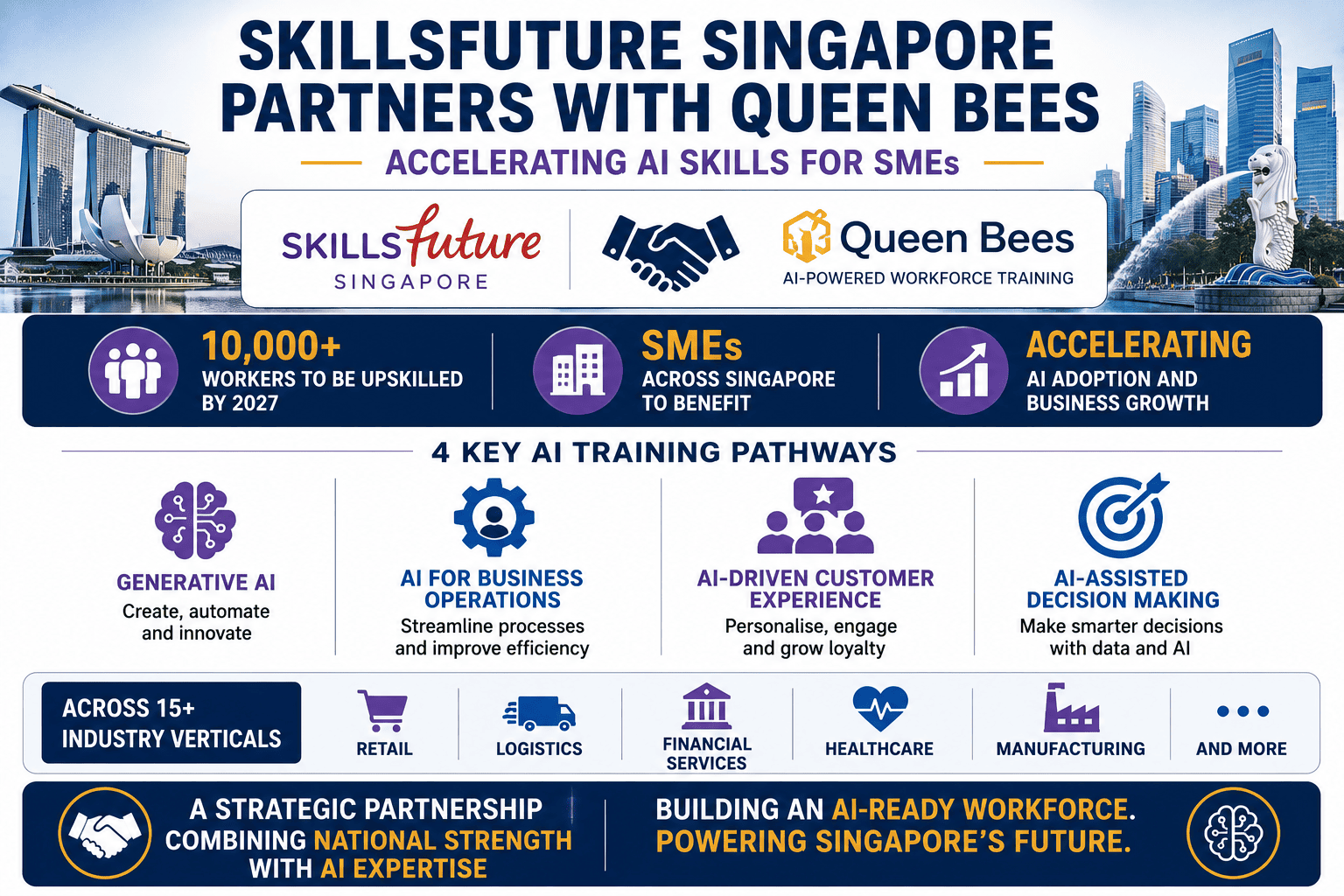
SkillsFuture Singapore has signed a commercial partnership with Queen Bees, a specialist AI workforce training provider, to accelerate AI skills development for small and medium enterprises (SMEs) across the island. Under the agreement, Queen Bees will deliver customised AI upskilling programmes under the SkillsFuture framework, targeting 10,000+ workers by 2027. The partnership covers four key training pathways, Generative AI, AI for Business Operations, AI-Driven Customer Experience, and AI-Assisted Decision Making, across 15+ industry verticals including retail, logistics, financial services, healthcare, and manufacturing. This commercial services partnership combines SkillsFuture’s national training infrastructure and subsidy framework with Queen Bees’ specialised AI curriculum and delivery expertise.
📅 March 14, 2026⏱ 14 min read✍️ GTsetu Editorial Team📰 News + Analysis
Deal Type
Commercial
Services partnership, Queen Bees delivers AI training under SkillsFuture framework
Training Target
10,000+
Workers trained in AI skills across 15+ industry verticals by 2027
Queen Bees
AI Specialist
Leading AI workforce training provider with proven SME programme delivery
Sector Coverage
15+
Industry verticals including retail, logistics, finance, healthcare, manufacturing
Section 1, The News
1
The Full Story: SkillsFuture Singapore × Queen Bees
🤖
Partnership Announced, March 2026
SkillsFuture Singapore Signs Commercial Partnership with Queen Bees to Deliver AI Skills Training to SMEs Across 15+ Industries
In March 2026, SkillsFuture Singapore, the national movement to promote lifelong learning and skills development, announced a commercial partnership with Queen Bees, a specialist AI workforce training provider, to accelerate AI skills adoption among small and medium enterprises (SMEs) across the island.
Under the agreement, Queen Bees will deliver customised AI upskilling programmes under the SkillsFuture framework, targeting 10,000+ workers by 2027. The partnership covers four key training pathways, Generative AI, AI for Business Operations, AI-Driven Customer Experience, and AI-Assisted Decision Making, across 15+ industry verticals including retail, logistics, financial services, healthcare, and manufacturing.
This commercial services partnership combines SkillsFuture’s national training infrastructure and subsidy framework with Queen Bees’ specialised AI curriculum and delivery expertise, a model that other national skills bodies and workforce development agencies can replicate to accelerate AI adoption in their SME sectors.
10,000+
Workers targeted for AI skills training by 2027
15+
Industry verticals covered, retail, logistics, finance, healthcare, manufacturing
4
Training pathways: GenAI, Business Ops, Customer Experience, Decision Making
SME
Primary target segment, small and medium enterprises across Singapore
“This partnership will accelerate AI skills adoption among Singapore’s SMEs, enabling them to harness the power of artificial intelligence to drive productivity and competitiveness. Queen Bees’ specialised expertise in AI workforce training complements SkillsFuture’s national infrastructure perfectly.”
— SkillsFuture Singapore Spokesperson
“Our AI training programmes are designed specifically for SME needs, practical, hands-on, and immediately applicable. Partnering with SkillsFuture allows us to reach thousands of workers who might otherwise be left behind in the AI revolution.”
— Queen Bees Leadership
💡 GTsetu Perspective
This partnership exemplifies a growing trend: national skills bodies partnering with specialist providers to deliver AI training at scale. The commercial model, combining public infrastructure with private sector expertise, is proving more agile and impactful than purely government-delivered programmes. If SkillsFuture found their Queen Bees for AI skills, what specialist partner could accelerate your workforce development initiative? That’s the question GTsetu helps organisations answer across 100+ countries.
Section 2, Scale and Reach
2
Scale and Reach, 10,000+ Workers, 15+ Industries
The SkillsFuture × Queen Bees partnership is designed for scale. The commercial services agreement leverages SkillsFuture’s national reach and Queen Bees’ specialist delivery capability to achieve impact that neither could deliver alone.
📊 Training Scale, SkillsFuture × Queen Bees Partnership
Launch
Pilot
Mar 2026 Programme Launch
Year 1
2,500 workers
Target ● In Progress
Year 2
6,000+ workers
Scale Phase Projected
2027
10,000+ workers
Target Full Scale
⚙️ Why Scale and Specialisation Must Work Together
SkillsFuture brings the national infrastructure, reach, subsidy framework, and credibility. Queen Bees brings the specialist AI curriculum and delivery expertise. Neither could achieve this scale alone. SkillsFuture couldn’t build bespoke AI curricula across 15+ industries quickly enough. Queen Bees couldn’t reach 10,000+ workers without SkillsFuture’s national network. This model, public infrastructure + private specialist delivery, is the blueprint for AI upskilling at national scale.
Section 3, The Anatomy
3
What Each Partner Brings to the Table
Like every successful services collaboration, the SkillsFuture × Queen Bees partnership works because each party contributes what the other cannot efficiently replicate. This complementarity principle is the foundation of any services partnership worth entering.
National training network, subsidy framework, quality assurance
AI curriculum, trainers, programme delivery systems
Queen Bees’ expertise runs on SkillsFuture’s national reach, no new infrastructure required
Market Access
Access to Singapore’s SME ecosystem
Specialist AI training credibility
SkillsFuture opens doors; Queen Bees delivers the value
Curriculum IP
Quality framework and certification standards
Proven AI training programmes for SME needs
SkillsFuture validates quality; Queen Bees provides the content
Credibility
National brand trust
AI specialist reputation
Combined credibility drives SME participation
Resource Commitment
Subsidy funding and programme administration
Training delivery resources and curriculum development
Shared resource model maximises impact
Risk
Policy and reputation risk
Delivery and quality risk
Both sides have skin in the game, different but real stakes
Section 4, The Context
4
The SkillsFuture Context, Singapore’s National Skills Movement
Understanding the SkillsFuture × Queen Bees partnership requires understanding SkillsFuture itself, a national movement that has transformed workforce development in Singapore since its launch in 2015. This partnership is the latest evolution of a proven model.
🇸🇬 SkillsFuture Singapore, Evolution of a National Movement
2015
SkillsFuture Movement Launched
Singapore launches national movement to promote lifelong learning and skills mastery. Foundation established: SkillsFuture Credit, SkillsFuture Series, and SkillsFuture Advice.
2017–2023
Scaling and Sectoral Focus
SkillsFuture expands into sector-specific programmes: SkillsFuture for Digital Economy, SkillsFuture for Manufacturing, SkillsFuture for Financial Services. Over 500,000 Singaporeans enrolled in subsidised training programmes.
2024–2025
AI and Digital Upskilling Focus
SkillsFuture prioritises AI and digital skills to support Singapore’s Smart Nation initiative. Launch of SkillsFuture for AI and Digital Transformation programmes. Partnerships with tech providers accelerate.
Mar 2026
SkillsFuture × Queen Bees Commercial Partnership
SkillsFuture signs commercial partnership with Queen Bees to deliver specialised AI skills training to SMEs across 15+ industries. Target: 10,000+ workers by 2027. This model of public-private commercial partnership sets a new benchmark for national skills bodies globally.
🔑 Key Lesson: Build on National Infrastructure
SkillsFuture has built 10 years of national infrastructure, credibility, and subsidy frameworks. Queen Bees brings specialist AI curriculum and delivery expertise. The commercial partnership model leverages existing public infrastructure rather than building new. This is a critical lesson for workforce development bodies globally: don’t build what you can partner for. If you’re a national skills body, AI training provider, or corporate learning function, GTsetu helps you identify verified partners who complement your capabilities, not duplicate them.
Section 5, Why This Works
5
Why This Commercial Partnership Model Works for Workforce Development
🎯 The Core Logic
The SkillsFuture × Queen Bees partnership succeeds because it is built on three interlocking strategic advantages: proven national infrastructure (SkillsFuture’s 10-year foundation), specialist AI curriculum expertise (Queen Bees’ proprietary programmes), and scale execution capacity (15+ industry verticals, 10,000+ workers). Neither party could achieve the same result independently, SkillsFuture cannot build specialist AI curricula across 15+ industries quickly enough, and Queen Bees cannot reach 10,000+ workers without SkillsFuture’s national network.
Why Public-Private Commercial Partnerships Are Accelerating
10 yrs
SkillsFuture’s national infrastructure, proven, trusted, and ready to scale
15+
Industry verticals, Queen Bees AI curriculum tailored to each sector’s needs
4x
Training pathways, Generative AI, Business Ops, Customer Experience, Decision Making
SME
Primary target, AI skills for small and medium enterprises, the backbone of Singapore’s economy
Commercial
Partnership model, public infrastructure + private specialist delivery, agile and scalable
2027
Target completion, 10,000+ workers trained in AI skills by 2027, transforming Singapore’s SME workforce
Section 6, SME Opportunity
6
Singapore’s SME AI Training Opportunity, Why Now Is the Time to Partner
🇸🇬 Singapore SME Workforce Development 2026
Why Every Workforce Development Organisation Should Be Partnering with National Skills Bodies on AI Training
SMEs account for 99% of all enterprises and 65% of Singapore’s workforce. AI adoption in SMEs is currently at 23%, but 72% of SME leaders say AI skills are critical for their future competitiveness. The gap between demand and supply is enormous. National skills bodies are the most efficient channel to reach SMEs at scale. Specialist AI training providers like Queen Bees are the most efficient source of quality curriculum. The partnership model bridges the gap.
99%
SMEs as percentage of all enterprises in Singapore
65%
Workforce employed by SMEs, the target for AI upskilling
23%
Current AI adoption rate among SMEs, significant growth opportunity
72%
SME leaders who say AI skills are critical for future competitiveness
10,000+
Workers targeted for AI skills training through this partnership alone
$500M+
SkillsFuture investment in workforce development, the infrastructure exists
🌐 GTsetu for Services Partnerships
GTsetu’s verified partner network includes workforce development specialists, training providers, AI curriculum developers, and corporate learning functions across Singapore, Australia, India, the UK, and 100+ other countries. Every company on GTsetu is verified on 6 government-sourced points: Name, Address, Registration Number, Company Status, Company Type, and Date of Certificate of Incorporation. Additional capabilities like programme offerings, client references, and industry specialisation are self-reported. If you’re a national skills body looking to find specialist training partners, or a training provider seeking to partner with government agencies, GTsetu is where your partner search begins with verified profiles, not cold calls. Find services and training partners →
Section 7, Types of Partnership
7
4 Types of Services Partnership, Which Fits Your Situation?
SkillsFuture and Queen Bees used a commercial services partnership. But the right structure depends entirely on what you need, what you can commit, and how deeply you want to integrate. Here are four primary models for services collaboration.
01
Commercial Services Partnership
One party provides services (training, consulting, delivery) to a partner’s clients or ecosystem, typically with revenue sharing or fee-for-service. No new entity, no equity exchange. The SkillsFuture × Queen Bees model. Fast to execute, ideal when specialist expertise needs to reach a broader audience.
🤝 SkillsFuture × Queen Bees
02
Joint Venture (JV)
A new shared legal entity co-owned by both parties. Deepest integration, full profit and risk sharing. Best for long-term market anchor when both parties have large complementary assets and long-term commitment. More common in manufacturing than services but applies to large-scale training infrastructure.
⚖️ Shared ownership model
03
Licensing Agreement
One party licenses its intellectual property (curriculum, methodology, software) to another for a fee or royalty. No equity sharing. Ideal when the core value is IP and the partner handles delivery. Common in e-learning and certification programmes.
📄 IP licensing model
04
Referral Partnership
Lightest form of collaboration, one partner refers clients to another in exchange for commission or reciprocal referrals. No operational integration. Often the first step before a deeper partnership in a new market. Tests demand and client fit before committing resources.
🌐 Market entry, step 1
📊 Services Partnership Model Comparison, Workforce Development
Model
Resource Commitment
IP Access
Reach/Scale Uplift
Speed to Execute
Reversibility
Commercial
Moderate (delivery capacity)
✓ Shared use
✓ High
Fast (2–4 months)
Moderate
Joint Venture
High, shared capex
✓ Co-developed IP
✓ Maximum
Slow (12–24 months)
Low
Licensing
Minimal
Partial (licensed IP only)
~ Depends on licensee’s reach
Fast (2–3 months)
High
Referral
Minimal
✗ None
✗ Low
Fastest (1–2 months)
High
Section 8, How to Partner
8
How to Partner: A 5-Step Playbook for Services and Training Organisations
The SkillsFuture × Queen Bees partnership did not happen by accident. It followed a deliberate progression, from identifying the capability gap to structuring a commercial relationship, that every services organisation can adapt. Here is the distilled playbook.
1
Define the Capability Gap with Precision
SkillsFuture knew exactly what they needed: specialist AI curriculum and delivery expertise across 15+ industries. They didn’t need to build new infrastructure, they needed specific programme content and trainers to complement their national reach. Define your gap that precisely, e.g., “We need a partner who can deliver Generative AI training to retail SMEs within 3 months.” Vague needs produce vague partner searches.
2
Find Verified Services Partners, Not Just Any Provider
The crucial word is “verified.” Queen Bees had a proven track record of AI training delivery. For organisations who don’t have an existing relationship, GTsetu provides verified profiles of services providers, training specialists, curriculum developers, and workforce development organisations across 100+ countries. GTsetu verifies companies using government tie-ups on 6 key points. Additional information like programme offerings, client references, and industry specialisation is self-reported and should be validated independently through your own due diligence.
3
Protect Your IP and Client Data Before Any Disclosure
In services partnerships, your curriculum content, client lists, pricing models, and training methodologies are valuable IP. Before sharing anything sensitive, including programme specifications or client references, execute a mutual NDA. GTsetu’s built-in NDA workflow handles this automatically: mutual NDA executed and countersigned before any sensitive information is shared, with a full digital audit trail.
4
Choose the Right Partnership Structure for Your Objective
SkillsFuture chose a commercial partnership for AI training, combining public infrastructure with private specialist delivery. A commercial model is right when you need specialist expertise and reach without equity commitment or operational integration. A JV is right when you want a permanent shared entity. A licensing model is right when IP transfer is the core value. Match the structure to the objective, not to what’s easiest to negotiate.
5
Formalise and Scale in Stages, Pilot First, Then Expand
SkillsFuture likely began with pilot programmes in one or two verticals before committing to 15+ industries. Never commit to full-scale rollout before validating programme quality, trainer capability, and SME engagement. Structure every partnership milestone formally in writing: scope of services, delivery schedule, quality metrics, payment terms, and renewal conditions.
Section 9, Dos and Don’ts
9
Dos and Don’ts of Services and Training Partnerships
✅ Do These
✅ Build on existing infrastructure before building new, SkillsFuture leveraged national reach
✅ Verify partner’s client references and programme delivery track record
✅ Sequence pilot programmes before full-scale rollout, test in one vertical first
✅ Sign NDA before sharing curriculum, client data, or pricing models
✅ Choose a partner whose strengths are complementary, public infrastructure + private specialist delivery
✅ Define quality metrics and delivery KPIs clearly before programme launch
✅ Run a small-scale pilot before committing to large-scale programme delivery
✅ Build in programme quality audit rights and client feedback mechanisms
✅ Use verified platforms like GTsetu rather than cold outreach for strategic partnerships
✅ Document the partnership formally, commercial agreement, IP terms, and quality standards
❌ Avoid These
❌ Build new infrastructure when existing national infrastructure can be leveraged
❌ Share curriculum content or client lists before NDA is countersigned
❌ Accept self-reported programme success claims without reference verification
❌ Assume that a partner’s IP is transferable without active knowledge-transfer, require trainer exchange and documentation
❌ Partner with a provider who is also your competitor’s preferred training partner, exclusivity matters
❌ Neglect exclusivity terms, know whether your partner can deliver the same programme to your competitors
❌ Choose a partner whose strengths duplicate yours, the gap is where value is created
❌ Start delivery on informal terms, scope, pricing, and quality standards must be documented
❌ Underestimate the cultural alignment required, public-private partnerships require explicit communication protocols
❌ Build a JV when a commercial partnership would achieve the same objective at lower risk
Section 10, Misconceptions
10
Common Misconceptions About Services and Training Partnerships
❌ Myth
“A commercial partnership is less committed than a JV, we should always aim for equity.”
✅ Reality
SkillsFuture and Queen Bees chose a commercial partnership because it was the right structure for their objective, combining public infrastructure with private specialist delivery. Equity is not inherently more valuable than access to specialist capabilities and reach. The right structure depends on your objective, not on perceived commitment levels.
❌ Myth
“We can figure out the IP ownership terms after delivery starts, the relationship will guide us.”
✅ Reality
IP ownership disputes are the most common reason services partnerships collapse, and they are almost always caused by vague or absent upfront agreements. Once delivery has started on undefined IP terms, both parties’ leverage is gone. In services partnerships, curriculum IP, methodology, and client data accumulate rapidly. Define ownership of jointly-developed materials before the first training session.
❌ Myth
“The partner’s client relationships automatically become our client relationships.”
✅ Reality
A commercial partnership with SkillsFuture gives Queen Bees access to SME audiences, not automatic participation. The client engagement requires proactive marketing, programme quality, and trust-building. SkillsFuture’s endorsement is a door-opener, not a guarantee. Plan the client acquisition strategy separately from the partnership agreement.
❌ Myth
“We should build programme delivery capacity first to show clients we’re serious, then find the training partner.”
✅ Reality
SkillsFuture did the opposite, secured the Queen Bees partnership, validated programme quality, then announced scale targets. Building delivery capacity before validating programme quality and client demand is resource destruction. The correct sequence is: partner → pilot → quality validation → scale. Never invest in scale before you have proven delivery capability.
❌ Myth
“A partnership with a national skills body requires physical presence in-country to manage effectively.”
✅ Reality
The SkillsFuture × Queen Bees partnership is managed with structured programme review meetings, quality audits, and joint marketing, not permanent presence. What matters is clear protocols for programme delivery, quality monitoring, and client feedback mechanisms, not permanent proximity. GTsetu’s encrypted collaboration workspace supports exactly this structured cross-border working relationship.
Section 11, GTsetu
11
How GTsetu Helps You Find the Right Services and Training Partner
SkillsFuture had Queen Bees through an established network. Most organisations are not that fortunate, and even when a known provider exists, identifying whether they can deliver at the required scale and quality requires systematic evaluation. GTsetu is the verified B2B services discovery platform that enables this evaluation at scale, across 100+ countries, before you reveal a single confidential detail.
🌐 Platform Spotlight, GTsetu
Find Verified Services Partners, Training Providers, and Workforce Development Organisations Across 100+ Countries, Anonymously, Securely, With Zero Broker Fees
Every company on GTsetu is verified using government tie-ups on 6 key points: Name, Address, Registration Number, Company Status, Company Type, and Date of Certificate of Incorporation. This is the foundation of trust. Additional information such as programme offerings, client references, industry specialisation, and quality certifications is self-reported by companies. You evaluate who is real before you engage. You share nothing sensitive until an NDA is countersigned. And you pay no broker commission on any partnership formed, the deal is entirely between you and your partner.
✅
6-Point Government-Sourced VerificationName, Address, Registration Number, Company Status, Company Type, Date of Incorporation confirmed using government tie-ups.
🕵️
Anonymous DiscoveryEvaluate verified partner profiles without revealing your identity until mutual interest is confirmed.
📄
Built-In NDA WorkflowShare programme specifications or client data only after NDA is executed, full audit trail, no external legal required.
🚫
Zero CommissionNo broker fees, your commercial partnership is entirely between you and your partner.
🌍
100+ CountriesSingapore, Australia, India, UK, Japan, find services and training partners in every region.
🔐
Encrypted CollaborationShare programme materials, trainer profiles, and client feedback securely between verified partners.
What SkillsFuture Did, What GTsetu Enables For You
What SkillsFuture Did
What GTsetu Enables for You
Why This Matters
Leveraged 10 years of national infrastructure to scale AI training
✓ Browse verified services provider profiles with government-sourced verification before engaging
You evaluate the partner’s verified legal identity, not marketing claims
Chose Queen Bees for their AI curriculum expertise and delivery track record
✓ Filter by self-reported capabilities, programme offerings, and client references (validate independently)
Find potential partners with the specific expertise your workforce development initiative requires
Secured formal commercial agreement before programme delivery began
✓ Built-in NDA and document workflow protects IP from the first conversation
Your curriculum IP, client data, and methodology are protected at every stage
Targeted a partner whose capabilities were complementary (AI expertise vs national reach)
✓ Self-reported partner profiles show programme offerings, industry specialisation, and geographic coverage
Identify potential complementarity, the gap between your capabilities and theirs
Zero intermediary in the partnership, direct commercial terms
✓ Zero commission on any partnership, all terms are direct between the two parties
No broker splits your margin or misaligns your commercial terms
FAQ
?
Frequently Asked Questions
Q
What exactly did SkillsFuture Singapore and Queen Bees agree to?
SkillsFuture Singapore signed a commercial partnership with Queen Bees in March 2026 to deliver AI skills training to SMEs across Singapore. Under the agreement, Queen Bees provides specialist AI curriculum and programme delivery expertise under the SkillsFuture framework. The partnership covers four training pathways, Generative AI, AI for Business Operations, AI-Driven Customer Experience, and AI-Assisted Decision Making, across 15+ industry verticals. Target: 10,000+ workers by 2027.
Q
Why is the commercial partnership model growing in workforce development?
The commercial partnership model, combining public infrastructure with private specialist delivery, is growing because it is more agile, scalable, and cost-effective than building all capabilities in-house. National skills bodies have the reach, subsidy frameworks, and credibility. Specialist providers have the curriculum, trainer networks, and delivery expertise. The commercial partnership model allows each to do what they do best, reaching workers faster and with higher quality than either could deliver alone.
Q
What is the difference between a commercial partnership and a joint venture?
A commercial partnership is a service arrangement, no new entity, no equity exchange. One party provides services to the other’s audience, typically with revenue sharing or fee-for-service. It executes faster (2–4 months), requires less capital, and is easier to exit. A Joint Venture (JV) creates a new co-owned legal entity with shared equity, governance, and profits. Use a commercial partnership when you need specialist expertise and reach without equity commitment. Use a JV when you want permanent shared ownership and full operational integration.
Q
How can I find a workforce development or training partner for my organisation?
The systematic approach involves four steps: (1) Define your programme gap precisely, what specific training expertise, client reach, or delivery capability do you need? (2) Search verified platforms, GTsetu lists verified services providers, training specialists, and workforce development organisations across 100+ countries. GTsetu verifies companies using government tie-ups on 6 key points. (3) Evaluate anonymously first, review verified profiles and self-reported capability data before revealing your identity or programme requirements. (4) Execute NDA before any sensitive disclosure, GTsetu’s built-in NDA workflow handles this automatically. Cold outreach rarely surfaces the right partner; a structured, verified search on GTsetu does.
Q
What happens if my training partner also provides programmes to my competitors?
This is one of the most important and most frequently overlooked questions in services partnerships. If your partner provides the same programmes to your competitors, your differentiation evaporates. Before signing any commercial agreement, explicitly negotiate: (1) Exclusivity scope, is the programme exclusive to your organisation in your target geography? (2) Competitive delivery terms, can the partner deliver to competitors during the agreement period? (3) Improvement ownership, who owns jointly-developed programme enhancements? These terms must be in the agreement before signing.
Q
Does GTsetu charge commission on services partnerships or commercial agreements formed through the platform?
No. GTsetu charges zero commission on any partnership, whether commercial services agreement, licensing deal, referral partnership, or joint venture, formed through the platform. The commercial terms of your agreement are entirely between you and your partner. This is a foundational design principle: broker intermediation in services partnerships typically costs 5–15% of deal value and creates incentive misalignment. GTsetu removes the broker entirely. Learn more about GTsetu →
Ready to Find Your Queen Bees? Start on GTsetu.
500+ verified services providers, training specialists, workforce development organisations, and commercial partners across Singapore, Australia, India, the UK, and 100+ countries. Zero broker fees. Anonymous discovery. Built-in NDA workflows. Your next services partnership starts with a verified profile, not a cold call.
Business Development Expert | Global Markets & Trade Intelligence
Lucas Bennett is a Business Development Expert at GTsetu with a focus on international trade, market intelligence, and cross-border business development. He works closely with organizations looking to expand into new markets, develop strategic alliances, and strengthen their position within global business ecosystems.
Lucas brings expertise in market research, international partnership development, trade opportunities, and business growth strategies. At GTsetu, he contributes insights on emerging market trends, global collaboration opportunities, and industry developments that help businesses make informed expansion decisions.
Passionate about connecting organizations across geographies, Lucas helps companies navigate international markets and build partnerships that drive sustainable growth and long-term success.