Dabur Rural Distribution Expansion, Commercial Partnership & Channel Strategy 2026
🔴 BREAKINGDabur India expands rural distribution network, reaching 100,000+ villages through commercial partnerships and channel partnerships◆Over 8.5 million retail outlets · 133,000+ villages · Rural demand outperforms urban for 8 consecutive quarters◆Agriculture · Food · Ayurveda · Last-mile delivery · Self-help groups · Local distributor partnerships◆Find your distribution technology and channel partnership partner on GTsetu, verified on 6 key data points, zero broker fees, 100+ countries◆🔴 BREAKINGDabur India expands rural distribution network, reaching 100,000+ villages through commercial partnerships and channel partnerships◆Over 8.5 million retail outlets · 133,000+ villages · Rural demand outperforms urban for 8 consecutive quarters◆Agriculture · Food · Ayurveda · Last-mile delivery · Self-help groups · Local distributor partnerships◆Find your distribution technology and channel partnership partner on GTsetu, verified on 6 key data points, zero broker fees, 100+ countries◆
Home › Blog › FMCG & Distribution › Rural Expansion 2026
Dabur Rural Distribution Expansion, Commercial Partnership & Channel Strategy 2026
Dabur India is executing an aggressive rural distribution expansion strategy, aiming to reach 100,000+ villages directly through commercial partnerships and channel partnerships. The initiative combines investments in last-mile delivery infrastructure, partnerships with rural self-help groups and local distributors, and smaller SKU (sachet) strategies to deepen penetration in India’s hinterlands. Here is your complete industry analysis and action guide for distribution and channel partners.
📋 Direct Answer
Dabur India is expanding its rural distribution network through commercial partnerships and channel partnerships, aiming to reach 100,000+ villages directly across India. The company currently reaches over 8.5 million retail outlets, making it the second most distributed FMCG company in India, with a rural footprint spanning more than 133,000 villages [citation:6]. The expansion combines last-mile delivery infrastructure investments, partnerships with rural self-help groups and local distributors, and smaller SKU (sachet) strategies to reduce dependence on traditional wholesale channels [citation:1]. Rural India accounts for nearly 45% of Dabur’s domestic revenues, and rural demand has outperformed urban markets for eight consecutive quarters [citation:1][citation:6]. Government initiatives like the ‘Mahatma Gandhi Gram Swaraj Initiative’ and ‘She Marts’ for rural women-led enterprises are providing additional tailwinds for Dabur’s rural deepening strategy [citation:2]. The expansion creates significant opportunities for distribution technology partners, last-mile logistics providers, rural retail networks, and channel partners across India’s agricultural, food, and Ayurveda sectors.
📅 2026⏱ 15 min read✍️ GTsetu Editorial Team📰 FMCG + Distribution + Rural India Analysis
Partnership Type
Commercial Partnership
Distribution & Channel Partnership, Dabur India
Geographic Focus
Indian Subcontinent
100,000+ villages · 133,000+ villages reached · Rural India
Sector
Agriculture · Food · Ayurveda
FMCG · Natural healthcare · Rural consumer goods
Reach
8.5M Outlets
Second most distributed FMCG company in India
Section 1, The Expansion
1
The Rural Expansion: Dabur’s Channel Partnership Strategy
🏘️ Rural Distribution Expansion
+
🤝 Commercial Partnerships
+
🛒 Channel Partnerships
=
🌾 100,000+ Villages Reached
🏘️
Expansion, 2026, India
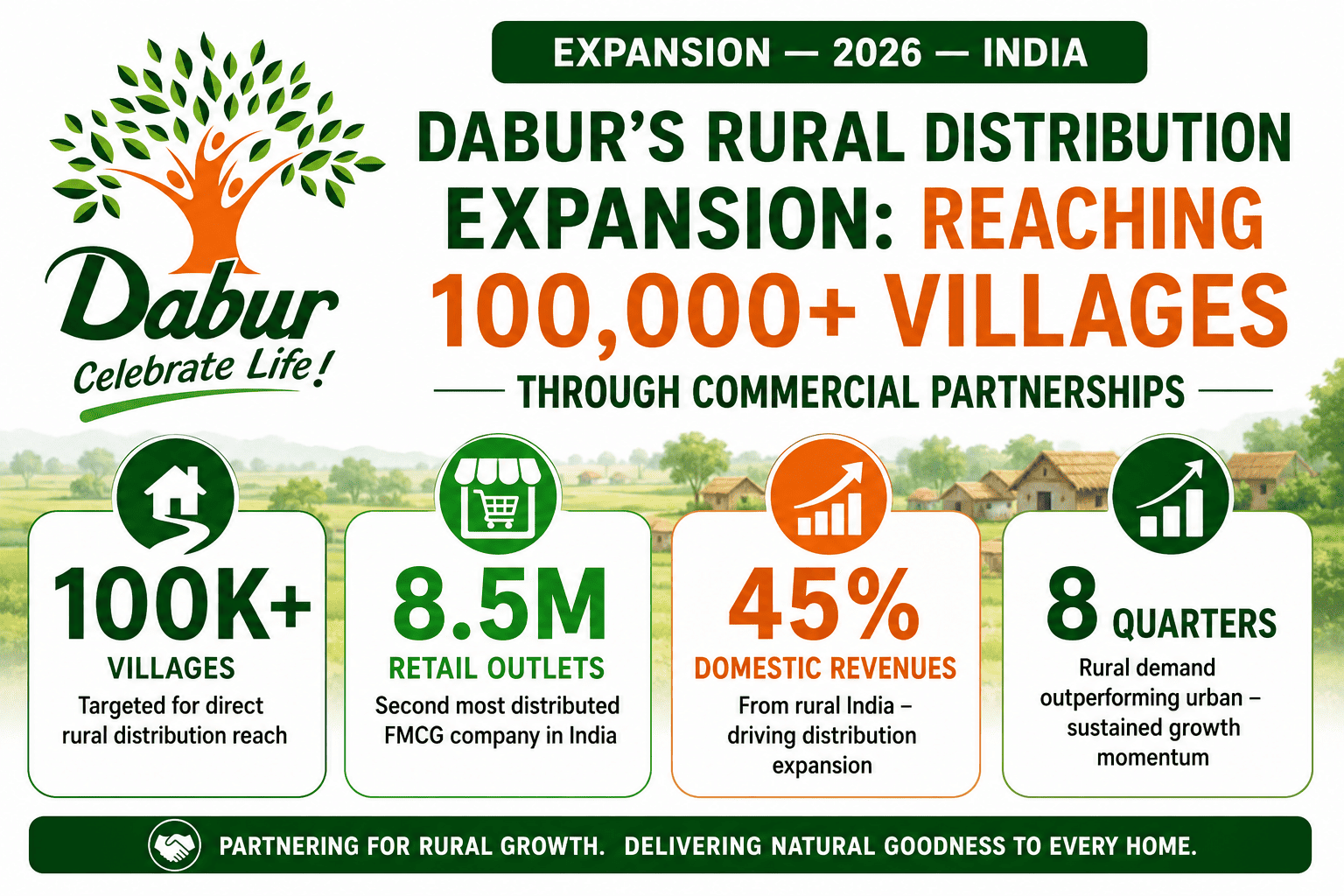
Dabur’s Rural Distribution Expansion: Reaching 100,000+ Villages Through Commercial Partnerships
Dabur India is executing an aggressive rural distribution expansion strategy, aiming to reach 100,000+ villages directly across India through commercial partnerships and channel partnerships [citation:1]. The company currently reaches over 8.5 million retail outlets across India, making it the second most distributed FMCG company in the country, with a rural footprint spanning more than 133,000 villages [citation:6].
The expansion combines last-mile delivery infrastructure investments, partnerships with rural self-help groups and local distributors, and smaller SKU (sachet) strategies to reduce dependence on traditional wholesale channels [citation:1]. Rural India accounts for nearly 45% of Dabur’s domestic revenues, and rural demand has outperformed urban markets for eight consecutive quarters [citation:6].
Government initiatives like the ‘Mahatma Gandhi Gram Swaraj Initiative’ to support village industries and the establishment of ‘She Marts’ for rural women-led enterprises are providing additional tailwinds for Dabur’s rural deepening strategy [citation:2]. The expansion creates significant opportunities for distribution technology partners, last-mile logistics providers, rural retail networks, and channel partners across India’s agricultural, food, and Ayurveda sectors.
100K+
Villages targeted for direct rural distribution reach
8.5M
Retail outlets, second most distributed FMCG company in India [citation:6]
45%
Domestic revenues from rural India, driving distribution expansion [citation:1]
“We have sharpened our competitive edge through stronger innovation and focused brand building, leading to healthy market share gains. Our rural expansion through commercial partnerships and channel partnerships is key to driving growth in India’s hinterlands.”
— Dabur India Management, Q3 FY26 Earnings [citation:6]
💡 GTsetu Perspective
Dabur’s rural distribution expansion represents a structural shift in FMCG distribution across India’s hinterlands. The companies that establish distribution technology partnerships, last-mile logistics relationships, and channel partnership agreements will hold preferred partner positions in this expanding rural ecosystem. GTsetu is where verified distribution and channel partners connect across India’s agricultural, food, and Ayurveda sectors.
Section 2, The Evolution
2
The Road to Expansion: How Dabur Built Rural Distribution Scale
📅 Pre-2024, Foundation
Dabur Establishes Rural Distribution Network
Dabur builds extensive rural distribution network across India, reaching millions of retail outlets and establishing itself as one of the most distributed FMCG companies in the country.
📅 2024, Strategic Focus
Rural Deepening Becomes Core Strategy
Dabur identifies rural deepening as a core growth pillar. Investments in last-mile delivery infrastructure and partnerships with rural self-help groups and local distributors begin to accelerate.
📅 2025, Expansion Acceleration
Rural Distribution Network Expands Rapidly
Dabur expands total reach by 50,000 outlets, taking distribution to over 8.5 million outlets. Rural footprint spans more than 133,000 villages. Rural demand outperforms urban for multiple consecutive quarters [citation:6].
📅 2026, ACCELERATING ✓
Dabur Rural Distribution Expansion, Target: 100,000+ Villages
Dabur accelerates rural distribution expansion through commercial partnerships and channel partnerships, aiming to reach 100,000+ villages directly. Government initiatives like ‘She Marts’ provide additional tailwinds [citation:1][citation:2].
Section 3, Distribution Structure
3
Distribution Structure: Channels, Partnerships, and Last-Mile Delivery
Dabur’s rural distribution expansion is built on a multi-channel distribution structure combining traditional wholesale, direct rural distribution, and innovative channel partnerships. Here is the complete breakdown of the distribution structure and partner contributions.
📊 Distribution Structure, Rural FMCG Ecosystem
🏘️ Direct Rural Distribution
100,000+ Villages Target
Direct rural distribution network · Last-mile delivery infrastructure · Smaller SKU (sachet) strategy · Reduced dependence on wholesale channels [citation:1]
🤝 Commercial Partnerships
Local Distributors & SHGs
Partnerships with rural self-help groups · Local distributor networks · Community-owned retail channels · Reduced wholesale dependency [citation:1][citation:2]
🛒 Channel Partnerships
She Marts & Rural Retail
‘She Marts’ for rural women-led enterprises · Community retail channels · Deeper hinterland penetration · Core consumer engagement [citation:2]
Distribution Channels and Reach Metrics
Distribution Channel
Reach
Key Partners
Growth Driver
Direct Rural
133,000+ villages [citation:6]
Local distributors, sub-stockists
Last-mile infrastructure
Retail Outlets
8.5 million+ [citation:6]
General trade, retail partners
Second most distributed FMCG company
Commercial Partnerships
100,000+ villages target [citation:1]
Self-help groups, local distributors
Reduced wholesale dependency
Channel Partnerships
She Marts + Community Retail [citation:2]
Rural women-led enterprises
Deeper hinterland penetration
Section 4, Industry Impact
4
Industry Impact: Reshaping Rural FMCG Distribution
🏘️ Rural FMCG Distribution, The Expansion Effect
🏘️
Reach
100,000+ Villages Target
Direct rural distribution expansion creates unprecedented reach into India’s hinterlands, serving 45% of Dabur’s domestic revenues [citation:1].
🤝
Partnerships
Commercial Partnership Growth
Partnerships with self-help groups, local distributors, and community retail channels create sustainable rural distribution networks [citation:1][citation:2].
📈
Demand
Rural Outperformance
Rural demand outperforms urban markets for eight consecutive quarters, driving FMCG growth across India [citation:6].
🛒
Retail
8.5M+ Outlets
Second most distributed FMCG company in India with 8.5 million+ retail outlets [citation:6].
👩🌾
Community
She Marts & SHGs
Government initiatives like ‘She Marts’ enable community-owned retail channels for deeper penetration [citation:2].
📦
Logistics
Last-Mile Delivery
Investment in last-mile delivery infrastructure creates opportunities for distribution technology and logistics partners [citation:1].
Section 5, Technology Focus
5
Technology Focus: Last-Mile Delivery & Distribution Technology
📦 Core Technology Pillars, Rural Distribution
Dabur’s rural distribution expansion is built on five core technology and operational pillars that collectively enable efficient rural reach. Last-Mile Delivery Infrastructure: Investment in distribution networks, transportation, and logistics to reach remote villages efficiently [citation:1]. Smaller SKU (Sachet) Strategy: Affordable packaging formats that make products accessible to rural consumers with lower disposable income [citation:1]. Digital Distribution Management: Technology platforms for order management, inventory tracking, and distributor coordination across rural networks. Channel Partner Integration: Systems for onboarding, managing, and supporting self-help groups and local distributor partners. Rural Consumer Engagement: Understanding rural consumption patterns, preferences, and purchase behaviour to optimise product mix and distribution.
Last-Mile
Investment in distribution networks, transportation, and logistics for efficient rural reach [citation:1]
SKU
Smaller SKU (sachet) strategy for affordable products accessible to rural consumers [citation:1]
Digital
Digital platforms for order management, inventory tracking, and distributor coordination
Channel
Systems for onboarding and managing self-help groups and local distributor partners
Consumer
Understanding rural consumption patterns and preferences to optimise product mix
Scale
Building distribution scale across 8.5M+ outlets and 133,000+ villages [citation:6]
Section 6, Opportunity
6
The Distribution Opportunity: Who Benefits Most from Dabur’s Rural Expansion?
🌾 Distribution & Channel Opportunity, Rural Expansion 2026
The Structural Distribution Shifts Dabur’s Rural Expansion Will Drive Across India’s Hinterlands
Dabur’s rural distribution expansion is not just a company initiative, it is a catalyst for transforming FMCG distribution across India’s rural markets. For distribution technology companies, logistics partners, and channel partners on all sides, this creates specific, time-sensitive opportunities.
Last-Mile Logistics
Dabur’s investment in last-mile delivery infrastructure creates opportunities for logistics partners serving rural India [citation:1]
Channel Partners
Self-help groups, local distributors, and community retail channels are essential for rural distribution expansion [citation:1][citation:2]
Distribution Technology
Digital platforms for order management, inventory tracking, and distributor coordination are increasingly important
Rural Retail Networks
She Marts and community-owned retail channels create new distribution pathways [citation:2]
Supply Chain Partners
Raw material suppliers, packaging partners, and supply chain providers benefit from rural expansion
Consumer Insight
Understanding rural consumption patterns and preferences is essential for optimising product mix
Section 7, How to Capitalise
7
How to Capitalise: The 6-Step Action Playbook for Distribution Partners
1
Map Your Distribution Capability to Dabur’s Rural Requirements
Before you can engage with Dabur’s rural distribution network, you need to identify exactly how your logistics, channel, or technology capability aligns with the expansion requirements. Are you a last-mile logistics provider, local distributor, channel partner, or distribution technology specialist? Map your capability to the rural expansion’s needs. GTsetu’s partner discovery process starts with this capability mapping.
2
Identify Your Partner Gap in the Rural Ecosystem
Dabur’s rural distribution expansion creates new opportunities across the ecosystem. Do you need a rural distribution partner for your products? A logistics provider for last-mile delivery? A channel partner for deeper penetration? Define your partner gap precisely. GTsetu’s verified network provides documented partner profiles for every one of these needs.
3
Verify Partners Before Sharing Commercial Terms
Distribution partnerships involve commercial terms, market intelligence, and sometimes proprietary information. Not all prospective partners will be legitimate or reliable. Verify your partner’s business registration (6 points via government sources: Name, Address, Registration Number, Company Status, Company Type, Date of Certificate of Incorporation) before any substantive conversation. GTsetu’s verification process documents these credentials before you invest a single hour.
4
Audit Your Regulatory and Compliance Requirements
Rural distribution in India involves complex regulatory requirements. Understand the local retail regulations, food safety requirements, and distributor registration requirements that apply to your partnership. For FMCG distribution, understand the specific compliance frameworks for rural markets. Your compliance audit is non-negotiable before you can form a channel partnership.
5
Structure Your Distribution or Channel Agreement
Every distribution agreement, channel partnership, and logistics contract needs to explicitly address the rural distribution ecosystem’s unique characteristics. Territory definitions, delivery schedules, pricing terms, and marketing support need to be clearly defined. Agreements need to reflect the realities of rural distribution. GTsetu’s collaboration workspace supports structured, documented commercial negotiation and agreement management.
6
Move Now, Rural Distribution Positions Are Being Established
The rural distribution opportunity is largest for the companies that establish logistics partnerships, channel relationships, and distribution agreements early, before preferred partner positions are locked in and territory coverage is allocated. For last-mile logistics providers, partnerships formed early will have preferred carrier status as volumes scale. For channel partners, early collaboration establishes the coverage relationships. GTsetu’s verified partner network enables rapid identification and engagement with the right distribution counterparty.
Section 8, Dos and Don’ts
8
Dos and Don’ts for Distribution Channel Partners Under Rural Expansion
✅ Do These
✅ Map your distribution capability to Dabur’s rural expansion requirements immediately
✅ Identify your partner gap, logistics, channel, or technology
✅ Verify all prospective partners on 6 key data points before sharing any commercial information
✅ Execute NDAs before discussing proprietary distribution strategies or commercial terms
✅ Audit your regulatory and compliance requirements, local retail, food safety, and distributor registration
✅ Establish distribution or channel partnerships early before preferred positions are locked in
✅ Structure agreements to account for rural distribution’s unique characteristics
✅ Consider the entire rural ecosystem, self-help groups, local distributors, and community retail
✅ Build relationships across the distribution value chain, logistics through to retail
✅ Leverage GTsetu to find verified distribution and channel partners across India
❌ Avoid These
❌ Wait until the expansion reaches scale to identify partners, preferred positions will be taken
❌ Assume all prospective distribution partners are legitimate without verification
❌ Share proprietary distribution strategies or commercial terms without an NDA in place
❌ Ignore regulatory and compliance requirements, distribution partnerships have legal implications
❌ Limit partner search to a single region, rural India requires diverse distribution coverage
❌ Assume only the large distributors matter, self-help groups and small partners are essential
❌ Structure agreements without accounting for rural distribution’s unique challenges
❌ Focus only on urban distribution models, rural requires different approaches
❌ Attempt to serve rural markets without local partnerships, local knowledge is essential
❌ Miss the early partner identification window, the distribution ecosystem is being built now
Section 9, Misconceptions
9
Common Misconceptions About Rural Distribution Expansion
❌ Myth
“Rural markets are too fragmented and expensive to serve profitably.”
✅ Reality
Rural India accounts for nearly 45% of Dabur’s domestic revenues, and rural demand has outperformed urban markets for eight consecutive quarters [citation:1][citation:6]. The scale of opportunity in rural markets is substantial, with 100,000+ villages targeted for direct distribution [citation:1]. Commercial partnerships and channel partnerships enable cost-effective distribution through self-help groups and local distributors [citation:1][citation:2].
❌ Myth
“Only large distributors can serve rural markets effectively.”
✅ Reality
Dabur’s rural expansion relies on multiple distribution channels including self-help groups, local distributors, and community-owned retail [citation:1][citation:2]. ‘She Marts’ for rural women-led enterprises are creating new community-owned retail channels [citation:2]. This creates opportunities for partners of all sizes who understand local markets and have community relationships.
❌ Myth
“Rural consumers have the same preferences as urban consumers.”
✅ Reality
Rural consumers have different consumption patterns, preferences, and purchasing behaviour. Dabur’s smaller SKU (sachet) strategy is designed specifically for rural affordability [citation:1]. Understanding rural consumer behaviour is essential for product mix optimisation and distribution strategy. Partners who understand rural preferences have a significant competitive advantage.
❌ Myth
“Technology has no role in rural distribution.”
✅ Reality
Technology is increasingly important in rural distribution, digital platforms for order management, inventory tracking, and distributor coordination enable efficient operations at scale. Dabur’s expansion to 8.5 million+ outlets and 133,000+ villages requires technology-enabled distribution management [citation:6]. Distribution technology partners play a critical role in enabling rural distribution scale.
Section 10, GTsetu
10
How GTsetu Connects Distribution Partners Across the Rural Ecosystem
Dabur’s rural distribution expansion creates the opportunity, an integrated distribution ecosystem spanning India’s hinterlands. It does not find you the verified last-mile logistics partner with rural coverage. It does not connect you with the channel partner who has community relationships. It does not verify the distributor’s market reach. Finding the right distribution partner, verified, compliant, and strategically aligned, is the step that turns the rural expansion opportunity into actual supply relationships and channel agreements. That is exactly what GTsetu enables, systematically.
🌐 Platform Spotlight, GTsetu
Find Verified Distribution and Channel Partners Across India’s Rural Ecosystem, Before Partner Positions Are Locked
GTsetu is the verified B2B distribution and channel partner discovery platform connecting logistics providers, distributors, channel partners, and 100+ countries, zero broker fees on any partnership formed. Dabur’s rural expansion creates the distribution opportunity. GTsetu puts the right distribution partner in front of you before your competitors get there first. Every company on GTsetu is verified on 6 key data points via government sources: Name, Address, Registration Number, Company Status, Company Type, and Date of Certificate of Incorporation.
✅
6-Point Govt. VerificationEvery company verified on Name, Address, Registration Number, Company Status, Company Type, and Date of Certificate of Incorporation via official government registries.
🕵️
Anonymous DiscoveryEvaluate verified distribution and channel partners across India and beyond without revealing your company identity or commercial terms until mutual interest is confirmed.
📄
Built-In NDA WorkflowProtect your proprietary distribution strategies and commercial terms, NDA countersigned with full audit trail before any disclosure.
🚫
Zero CommissionNo broker fees. Your distribution agreement, channel partnership, or logistics contract stays entirely between you and your partner.
🌍
India + 100+ CountriesFind distribution and channel partners across India and 100+ countries globally.
⚡
Move NowEarly partner positions are most valuable, before preferred distribution slots are filled and territory coverage is allocated.
Q
What is Dabur’s rural distribution expansion initiative?
Dabur India is executing an aggressive rural distribution expansion strategy, aiming to reach 100,000+ villages directly through commercial partnerships and channel partnerships [citation:1]. The initiative combines investments in last-mile delivery infrastructure, partnerships with rural self-help groups and local distributors, and smaller SKU (sachet) strategies to reduce dependence on traditional wholesale channels. Dabur currently reaches over 8.5 million retail outlets across India, making it the second most distributed FMCG company in the country [citation:6].
Q
How is Dabur expanding its rural distribution network?
Dabur is expanding its rural distribution network through multiple channels: direct rural distribution reaching 100,000+ villages [citation:1], collaboration with rural self-help groups, partnerships with local distributors, and investment in last-mile delivery infrastructure. The company has expanded its total reach by 50,000 outlets in recent quarters, taking distribution to over 8.5 million outlets, with rural footprint now spanning more than 133,000 villages [citation:6].
Q
What is driving Dabur’s rural expansion strategy?
Rural India accounts for nearly 45% of Dabur’s domestic revenues, and rural demand has outperformed urban markets for eight consecutive quarters [citation:1][citation:6]. The company’s rural expansion is driven by improving rural consumption trends, government initiatives like the ‘Mahatma Gandhi Gram Swaraj Initiative’ and ‘She Marts’ for rural women-led enterprises [citation:2], and a strategic focus on deepening penetration in hinterlands through smaller SKUs and local partnerships.
Q
What role do commercial partnerships play in Dabur’s rural distribution?
Commercial partnerships are central to Dabur’s rural distribution strategy [citation:1]. The company partners with rural self-help groups, local distributors, and community-owned retail channels to enable deeper penetration into villages. These channel partnerships reduce dependence on traditional wholesale channels and create sustainable distribution networks in hard-to-reach rural markets. Government initiatives like ‘She Marts’ for rural women-led enterprises are providing additional channel partnership opportunities [citation:2].
Q
How can GTsetu help me find distribution partners for rural expansion?
GTsetu is the verified partner discovery platform that connects logistics providers, distributors, channel partners, and 100+ countries, without broker fees. Every company on GTsetu is verified on 6 key data points (Name, Address, Registration Number, Company Status, Company Type, Date of Certificate of Incorporation) using government sources. For last-mile logistics: find verified partners with rural coverage. For channel partners: connect with self-help groups and local distributors. The process: (1) browse verified profiles anonymously, (2) execute an NDA before any commercial disclosure, (3) establish partnership with documented agreement. Zero commission on any deal. Start your rural distribution partner search on GTsetu →
The Rural Distribution Window Is Open. Find Your Distribution Partner on GTsetu.
Dabur’s rural distribution expansion is accelerating now. Distribution partnerships, channel relationships, and logistics agreements are being formed. 500+ verified distribution and channel partners across India and 100+ countries. Zero broker fees. Anonymous discovery. Built-in NDA workflows. Move now, before the best partner positions are locked in.
Business Development Expert | Global Markets & Trade Intelligence
Lucas Bennett is a Business Development Expert at GTsetu with a focus on international trade, market intelligence, and cross-border business development. He works closely with organizations looking to expand into new markets, develop strategic alliances, and strengthen their position within global business ecosystems.
Lucas brings expertise in market research, international partnership development, trade opportunities, and business growth strategies. At GTsetu, he contributes insights on emerging market trends, global collaboration opportunities, and industry developments that help businesses make informed expansion decisions.
Passionate about connecting organizations across geographies, Lucas helps companies navigate international markets and build partnerships that drive sustainable growth and long-term success.