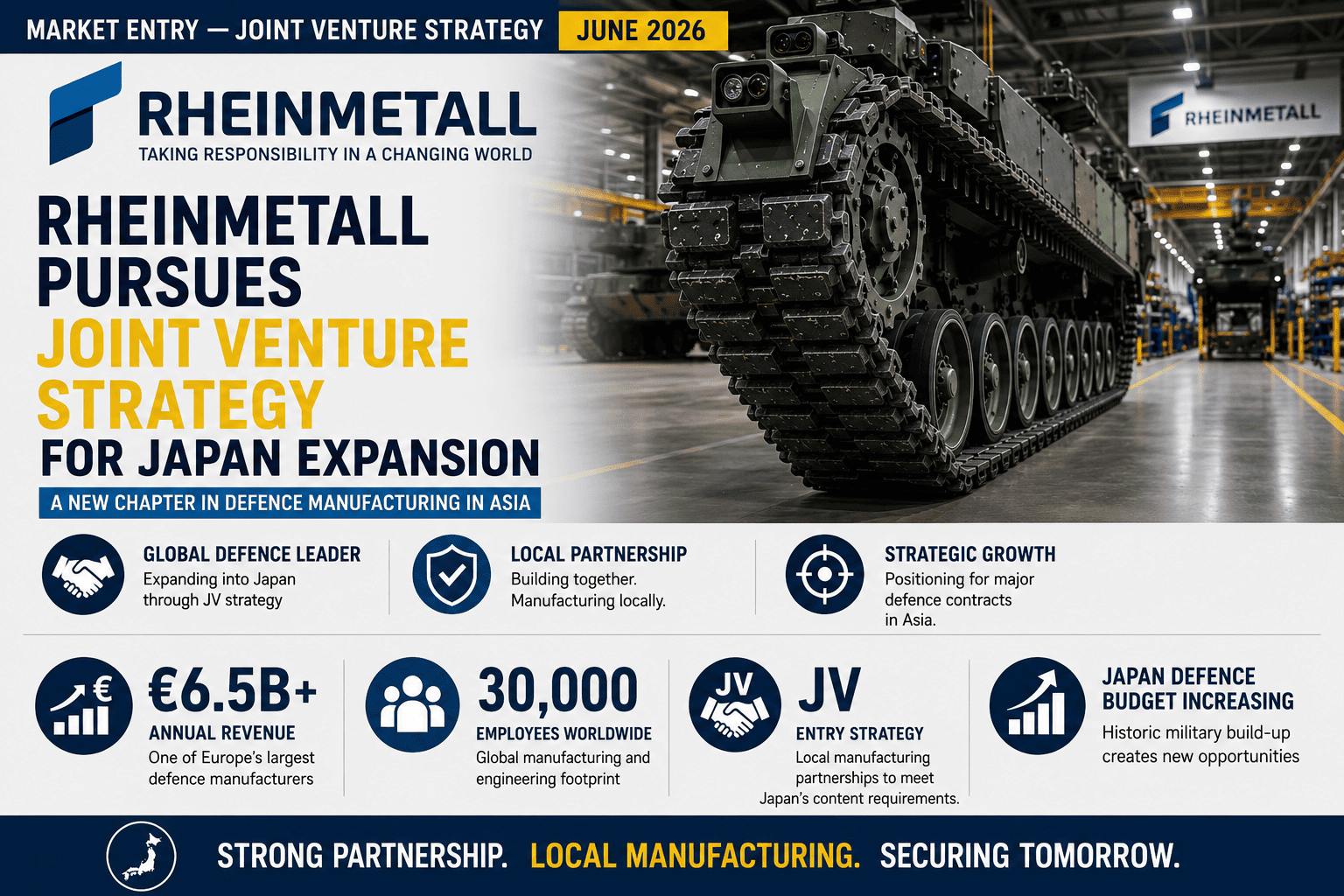
Rheinmetall Expands into Japan Through Joint Venture Strategy, Defence Manufacturing Market Entry
🔴 BREAKINGRheinmetall expands into Japan through joint venture strategy, global defence firms increasingly entering Asian markets via local manufacturing partnerships◆Japanese defence market set for major growth, government increasing military spending and seeking local production partners◆Find your defence & aerospace manufacturing partner on GTsetu, verified on 6 key data points, zero broker fees, 100+ countries◆🔴 BREAKINGRheinmetall expands into Japan through joint venture strategy, global defence firms increasingly entering Asian markets via local manufacturing partnerships◆Japanese defence market set for major growth, government increasing military spending and seeking local production partners◆Find your defence & aerospace manufacturing partner on GTsetu, verified on 6 key data points, zero broker fees, 100+ countries◆
Home › Blog › Defence Manufacturing › Market Entry
Rheinmetall Expands into Japan Through Joint Venture Strategy, A New Era for Defence Manufacturing in Asia
German defence giant Rheinmetall is expanding into Japan through a joint venture strategy, as global defence firms increasingly enter Asian markets through local manufacturing partnerships. Japan’s defence budget is on the rise, and the government is actively seeking to diversify its supply chain and enhance local production capabilities. Here is everything you need to know about the expansion, the JV strategy, and how to find your defence and aerospace manufacturing partner on GTsetu.
📋 Direct Answer
Rheinmetall, the German defence and automotive giant, is pursuing a joint venture strategy to expand into Japan, part of a broader trend of global defence firms entering Asian markets through local manufacturing partnerships. Japan’s defence budget has been increasing, with the government actively seeking to diversify its supply chain and enhance local production capabilities. The joint venture approach allows Rheinmetall to meet Japan’s local content requirements, build long-term relationships with Japanese defence procurement agencies, and position itself for major defence contracts in the region. This move reflects the growing strategic importance of the Asia-Pacific region for European defence manufacturers, as geopolitical tensions rise and Japan undertakes its most significant military build-up since World War II. For manufacturers and suppliers in the defence and aerospace sector, Rheinmetall’s expansion signals new partnership opportunities in Japan’s defence industrial base. GTsetu connects verified defence and aerospace manufacturers with market entry partners across Japan, Europe, and 100+ countries.
📅 June 2026⏱ 14 min read✍️ GTsetu Editorial Team📰 Defence Industry + Market Entry Strategy
Company
Rheinmetall
German defence giant, €6.5B+ annual revenue, expanding into Japan through JV strategy
Market
Japan
Asia’s fastest-growing defence market, government increasing military spending and seeking local production partners
Strategy
Joint Venture
Local manufacturing partnerships, meeting Japan’s local content and procurement requirements
GTsetu
Partner Network
Find verified defence & aerospace partners across Japan, Europe, and 100+ countries, zero broker fees
Section 1, The Move
1
The Full Story: Rheinmetall’s Japan Expansion, A Strategic Move into Asia’s Defence Market
🇩🇪 Rheinmetall, €6.5B+ defence and automotive giant
+
🇯🇵 Japanese Partners, Local JV collaboration
=
🏗️ Joint Venture, Local manufacturing and market access
🏗️
Market Entry, Joint Venture Strategy, June 2026
Rheinmetall Pursues Joint Venture Strategy for Japan Expansion, A New Chapter in Defence Manufacturing in Asia
Rheinmetall AG, one of Europe’s largest defence and automotive manufacturers, is expanding into Japan through a joint venture strategy, according to industry sources. The move is part of a broader trend of global defence firms entering Asian markets through local manufacturing partnerships, as geopolitical tensions rise and Japan undertakes its most significant military build-up since World War II.
The German defence giant, which reported over €6.5 billion in revenue in 2025 and employs approximately 30,000 people worldwide, is known for its military vehicle systems, weapons and ammunition, and defence electronics. By establishing a joint venture with a Japanese partner, Rheinmetall aims to meet Japan’s local content requirements, build long-term relationships with the Japanese Ministry of Defence, and position itself for major defence contracts in the region.
This strategic move reflects the growing importance of the Asia-Pacific region for European defence manufacturers. With Japan increasing its defence budget and actively seeking to diversify its supply chain, the joint venture approach allows Rheinmetall to access one of the world’s most significant defence markets while complying with local regulations and building manufacturing capabilities within the country.
€6.5B+
Rheinmetall’s annual revenue, one of Europe’s largest defence manufacturers
30,000
Employees worldwide, Rheinmetall’s global manufacturing and engineering footprint
JV
Entry strategy, local manufacturing partnerships to meet Japan’s content requirements
⬆️
Japan defence budget increasing, historic military build-up creates new opportunities
“This joint venture strategy is a textbook example of how global defence firms are entering Asian markets, not through exports alone, but through local manufacturing partnerships.”
— Industry Source
💡 GTsetu Perspective
Rheinmetall’s Japan expansion through a joint venture is a clear signal that defence manufacturers must think beyond export-only strategies. Accessing Japan’s defence market now requires local manufacturing capabilities and partnerships. The companies that identify their Japan JV partners in 2026, as Rheinmetall’s strategy unfolds, will be positioned to participate in Japan’s procurement supply chains before the market matures. GTsetu is where verified defence and aerospace partner discovery happens systematically, not through trade missions or broker introductions.
Section 2, Why Japan
2
Why Japan? The Defence Market Opportunity
Japan represents one of the most significant defence market opportunities in Asia, driven by a historic shift in national security policy, increasing military spending, and a government commitment to diversifying its defence supply chain. Here is why Rheinmetall and other global defence firms are targeting Japan.
🇯🇵 Japan Defence Market, Key Drivers
📊 Budget
Record High
Japan’s defence budget has reached record levels, with the government committed to significant increases as part of its national security strategy.
🏗️ Local Production
Priority
The Japanese government actively seeks local manufacturing partners to enhance supply chain resilience and reduce dependency on foreign suppliers.
🛡️ Geopolitics
Rising Tensions
Geopolitical tensions in the Asia-Pacific region have accelerated Japan’s military build-up and demand for advanced defence capabilities.
🔗 Supply Chain
Diversification
Japan’s defence procurement strategy emphasises supply chain diversification and establishing manufacturing capabilities with allied nations.
Section 3, JV Strategy
3
Rheinmetall’s Joint Venture Strategy, Why Local Partnerships Matter
Rheinmetall’s joint venture approach to Japan market entry reflects the evolution of how global defence firms access Asian markets. Here is what the JV strategy looks like and why it matters.
🏗️ Rheinmetall Japan JV, Strategy Breakdown
Step 1
Identify Local Partner
Rheinmetall identifies a Japanese defence or industrial company with established relationships with the Ministry of Defence and local supply chain capabilities.
Step 2
Establish JV Structure
The joint venture is structured to meet Japan’s local content requirements while leveraging Rheinmetall’s technology and manufacturing expertise.
Step 3
Local Manufacturing
Manufacturing capabilities are established within Japan, allowing Rheinmetall to participate in defence procurement and supply chain opportunities.
Step 4
Long-Term Position
The JV positions Rheinmetall for major defence contracts in Japan and the wider Asia-Pacific region, building on long-term relationships.
Section 4, Global Trend
4
The Global Trend, Defence Firms Entering Asian Markets Through Local Manufacturing Partnerships
Rheinmetall’s Japan expansion is not an isolated move, it is part of a broader global trend of defence manufacturers entering Asian markets through local manufacturing partnerships. Here is what is driving this shift.
🌏 The Three Forces Driving Defence Firms into Asia
Three converging factors are driving global defence firms to establish local manufacturing partnerships in Asia. First, geopolitical tensions, rising security concerns in the Asia-Pacific region have led to increased defence spending and a demand for advanced capabilities. Second, local content requirements, countries like Japan are imposing local production requirements on defence procurement, making JVs essential for market access. Third, supply chain resilience, governments are seeking to diversify their defence supply chains and reduce dependency on foreign suppliers, creating opportunities for companies with local manufacturing capabilities.
⬆️
Rising geopolitical tensions driving Asia-Pacific defence spending and capability requirements
Local Content
Japan and other Asian nations imposing local production requirements for defence contracts
Supply Chain
Governments seeking to diversify defence supply chains and reduce foreign dependency
Joint Ventures
JV strategy becoming the preferred entry model for defence firms entering Asian markets
€B
Billions in new defence procurement budgets across Asia as governments modernise military capabilities
Technology Transfer
Partnerships enabling technology transfer and local skill development in defence manufacturing
Section 5, Defence Budget
5
Japan’s Defence Budget, A Historic Build-Up
Japan is undertaking its most significant military build-up since World War II, creating unprecedented opportunities for defence manufacturers and suppliers.
Indicator
Current Status
What This Means
Defence Budget
Record high, significant year-on-year increases
Major procurement opportunities across all defence sectors
Modernisation
Significant investment in advanced capabilities
Demand for advanced defence technologies and systems
Local Production
Government actively encouraging domestic manufacturing
JV opportunities for foreign defence firms with local partners
Supply Chain Diversification
Reducing dependency on foreign suppliers
Increased demand for local manufacturing and supply chain capabilities
Strategic Importance
Asia-Pacific region increasingly critical for global defence
Long-term growth opportunity for defence manufacturers
Japan’s defence procurement strategy is undergoing significant change, with a focus on supply chain diversification and building manufacturing capabilities with allied nations. Here is what manufacturers need to know.
🔗 Japan’s Defence Procurement, Key Trends
Diversification
Reducing dependency on any single foreign supplier through multi-sourcing and local production
Local Content
New procurement requirements mandating local manufacturing and value addition
JV Partnerships
Foreign defence firms encouraged to form JVs with Japanese partners for major contracts
Technology Transfer
Technology transfer and skill development increasingly part of JV agreements
Resilience
Supply chain resilience now a strategic priority for Japan’s defence establishment
Long-Term
Decade-long procurement cycles requiring sustained local manufacturing partnerships
Section 7, Partnership Opportunity
7
Partnership Opportunities for Manufacturers, What Rheinmetall’s Expansion Signals
Rheinmetall’s Japan expansion creates ripple effects across the defence manufacturing ecosystem, opening new partnership opportunities for companies at every level of the supply chain.
Defence firms seeking Japanese JV partners for local manufacturing and market access
Supply Chain
Components and sub-systems suppliers needed for Rheinmetall’s Japan manufacturing operations
Technology
Technology transfer and licensing opportunities for Japanese manufacturers
Distribution
Distribution and logistics partners for defence equipment in the Japanese market
After-Market
Maintenance, repair, and overhaul (MRO) services for defence equipment in Japan
Consulting
Market entry, regulatory, and compliance consulting for defence firms entering Japan
Section 8, How to Capitalise
8
How to Capitalise: The 5-Step Japan Defence Market Entry Action Playbook
1
Map Your Japan Market Position
Before you can act on the Japan defence market opportunity, you need to know your competitive position. Identify your product categories, assess Japan’s local content requirements, and determine whether your company is best suited for a JV, supply chain partnership, or technology licensing approach. For defence manufacturers with advanced capabilities, the JV route may offer the most access. For component suppliers, direct supply chain relationships may be the faster path. GTsetu’s partner discovery process starts with this market position assessment, you need to know your entry strategy before you can brief a partner on what you need them to do.
2
Identify Your Japan Partner Gap
The defence market opportunity requires local partnerships. An European defence manufacturer with advanced technology needs a Japanese JV partner with government relationships, manufacturing facilities, and local supply chain expertise. A component supplier needs a Japanese distribution partner or prime contractor relationship. Define your Japan partner gap precisely: do you need a JV partner, a supply chain partner, a technology licensee, or a distribution partner? GTsetu’s verified network provides documented partner profiles for every one of these needs across Japan, Europe, and 100+ countries.
3
Verify Partners Before Disclosing Commercial Information
The defence market opportunity will generate significant partnership interest, not all of it will be credible. In the defence sector, where sensitive technology and pricing information is involved, the risk of disclosing proprietary information to unverified counterparties is acute. Verify your partner’s business registration (6 points via government sources: Name, Address, Registration Number, Company Status, Company Type, Date of Certificate of Incorporation) before any substantive commercial conversation. GTsetu’s verification process documents these credentials before you invest a single hour, and the built-in NDA workflow ensures your commercial terms are protected before any disclosure.
4
Structure Your JV Agreement Before the Market Moves
Every defence JV, supply chain agreement, and technology licensing deal associated with Japan market entry needs to explicitly address the local content requirements, technology transfer provisions, and procurement timelines. If you sign a JV agreement today, the manufacturing capacity, local content milestones, and technology transfer schedule need to be structured to meet Japan’s defence procurement requirements. Contracts written without local content consideration need to be reviewed and amended. GTsetu’s collaboration workspace supports structured, documented commercial negotiation and agreement management, protecting both parties as defence contracts are awarded.
5
Move in 2026, The Defence Market First-Mover Advantage Is Real
The Japan defence market opportunity is largest for the companies that establish JV relationships, supply chain positions, and local manufacturing capabilities in 2026, before the market matures and major defence contracts are awarded. For defence manufacturers, JV partnerships formed in 2026 position you for procurement cycles that may run through 2030 and beyond. For component suppliers, supply chain relationships established now will have two or three years of integration before competitors who wait enter. The companies that wait will find that the early movers have already established the relationships that generate the compound advantage. GTsetu’s verified partner network enables rapid identification and engagement with the right counterparty without the 12–18 months of trade missions and diplomatic introductions that characterise traditional defence market entry.
Section 9, Dos and Don’ts
9
Dos and Don’ts for Defence Manufacturing Market Entry in Japan
✅ Do These
✅ Map Japan’s local content requirements for your specific product category immediately
✅ Identify verified Japanese partners with established Ministry of Defence relationships
✅ Understand Japan’s defence procurement cycles, they are long, plan accordingly
✅ Structure JV agreements with clear technology transfer and local content milestones
✅ Execute NDAs before sharing sensitive defence technology or pricing information
✅ Build relationships with Japanese defence procurement agencies and industry associations
✅ Consider long-term positioning, defence contracts often span a decade or more
✅ Leverage GTsetu’s verified network to find Japan defence and aerospace partners
❌ Avoid These
❌ Assume you can enter Japan through exports alone, local manufacturing is now required
❌ Attempt to bypass Japanese partners, government relationships are essential
❌ Wait for Rheinmetall’s JV to be fully operational before identifying your own partnership opportunities
❌ Share defence technology or pricing with unverified Japanese partners without formal NDAs
❌ Underestimate the time required for Japan defence market entry, it takes years, not months
❌ Assume technology transfer will be straightforward, export controls and security clearances apply
❌ Miss the GTsetu network for verified defence and aerospace partner discovery
Section 10, GTsetu
10
How GTsetu Helps You Find Defence & Aerospace Partners for Japan Market Entry
Rheinmetall’s Japan expansion signals the opportunity. GTsetu connects you with the right defence and aerospace partners to make your Japan market entry successful. Finding the right partner, verified, capable, and strategically aligned, is the step that turns the Japan defence opportunity into actual contracts.
🌐 Platform Spotlight, GTsetu
Find Verified Defence & Aerospace Partners, Before the Japan Market Window Closes
GTsetu is the verified B2B manufacturing and trading partner discovery platform connecting defence and aerospace manufacturers with documented capability profiles, zero broker fees on any partnership formed. Rheinmetall’s Japan expansion creates the opportunity. GTsetu puts the right partner in front of you before your competitors get there first. Every company on GTsetu is verified on 6 key data points via government sources: Name, Address, Registration Number, Company Status, Company Type, and Date of Certificate of Incorporation.
✅
6-Point Govt. VerificationEvery company verified on Name, Address, Registration Number, Company Status, Company Type, and Date of Certificate of Incorporation via official government registries.
🕵️
Anonymous DiscoveryEvaluate verified Japanese, European, and global defence partners without revealing your company identity until mutual interest is confirmed.
📄
Built-In NDA WorkflowProtect your defence technology, pricing, and supply chain designs, NDA countersigned with full audit trail before any commercial disclosure.
🚫
Zero CommissionNo broker fees. Your JV, supply chain, or licensing agreement stays entirely between you and your partner.
🌍
Japan + 100+ CountriesFind defence and aerospace partners across Japan, Europe, and 100+ countries globally.
⚡
Move in 2026Defence market partnership positions are most valuable right now, before major contracts are awarded and preferred supplier slots are filled.
Q
Why is Rheinmetall expanding into Japan through a joint venture?
Rheinmetall is expanding into Japan through a joint venture as part of a broader trend of global defence firms entering Asian markets through local manufacturing partnerships. Japan’s defence budget has been increasing, and the government is actively seeking to diversify its defence supply chain and enhance local production capabilities. The joint venture approach allows Rheinmetall to meet Japan’s local content requirements, build long-term relationships with Japanese defence procurement agencies, and position itself for major defence contracts in the region. This strategy reflects the growing strategic importance of the Asia-Pacific region for European defence manufacturers.
Q
What is driving global defence firms to enter Asian markets?
Three key factors are driving global defence firms to enter Asian markets: geopolitical tensions in the Asia-Pacific region that have increased defence spending and demand for advanced capabilities; local content requirements imposed by countries like Japan that make JVs essential for market access; and supply chain resilience as governments seek to diversify their defence supply chains and reduce dependency on foreign suppliers. Rheinmetall’s Japan expansion is a prime example of this trend, with the JV strategy enabling local manufacturing and long-term market positioning.
Q
How can manufacturers find defence and aerospace partners for Japan market entry?
Manufacturers can use GTsetu, the verified B2B manufacturing and trading partner discovery platform, to find defence and aerospace partners across Japan, Europe, and 100+ countries. Every company on GTsetu is verified on 6 key data points via government sources: Name, Address, Registration Number, Company Status, Company Type, and Date of Certificate of Incorporation. The platform offers anonymous discovery, built-in NDA workflows, zero broker fees, and documented partner profiles. Start your Japan defence partner search on GTsetu →
Q
What partnership opportunities does Rheinmetall’s Japan expansion create?
Rheinmetall’s Japan expansion creates partnership opportunities at multiple levels of the defence manufacturing ecosystem. These include JV partnerships with Japanese companies for local manufacturing and market access; supply chain partnerships for components and sub-systems; technology transfer and licensing opportunities for Japanese manufacturers; distribution and logistics partnerships for defence equipment; MRO and after-market services for defence equipment; and consulting and regulatory compliance services for defence firms entering Japan. GTsetu’s verified network connects companies with partners across all these categories.
Rheinmetall’s Japan Expansion Creates Opportunity. Find Your Partner on GTsetu.
The Japan defence market is opening. JV relationships, supply chain positions, and local manufacturing capabilities are being established right now. 500+ verified manufacturers, distributors, and industrial partners across Japan, Europe, and 100+ countries. Zero broker fees. Anonymous discovery. Built-in NDA workflows. Move in 2026, before major defence contracts are awarded and preferred supplier slots are filled.
Business Development Expert | Global Trade & International Market Development
Sarah Ann Mitchell is a Business Development Expert at GTsetu with a strong focus on global trade, international market development, and strategic business partnerships. She works with companies seeking to expand internationally by identifying collaboration opportunities, connecting with key stakeholders, and developing market access strategies.
Sarah brings expertise in cross-border business development, international trade ecosystems, partnership building, and global market intelligence. Her work at GTsetu involves supporting businesses, manufacturers, startups, and industry leaders in building relationships that accelerate growth and create long-term commercial value.
Passionate about fostering international collaboration, Sarah helps organizations navigate evolving global markets and discover new opportunities through strategic partnerships, trade networks, and ecosystem-driven growth initiatives.