Saudi Aramco & BYD: Why Energy-Mobility Alliances Are the New Strategic Playbook
🔴 THOUGHT LEADERSHIPSaudi Aramco & BYD deepen energy-mobility alliance, oil giant and world’s largest EV maker bet on shared ground◆Vision 2030 targets 30% EV adoption in Saudi Arabia, up from roughly 1%, Aramco-BYD R&D ties accelerate the shift◆BYD already retailing in Riyadh; SATC joint development agreement targets powertrains, batteries, low-carbon fuels◆Find your GCC or China energy & mobility partner on GTsetu, verified on 6 key data points, zero broker fees, 100+ countries◆🔴 THOUGHT LEADERSHIPSaudi Aramco & BYD deepen energy-mobility alliance, oil giant and world’s largest EV maker bet on shared ground◆Vision 2030 targets 30% EV adoption in Saudi Arabia, up from roughly 1%, Aramco-BYD R&D ties accelerate the shift◆BYD already retailing in Riyadh; SATC joint development agreement targets powertrains, batteries, low-carbon fuels◆Find your GCC or China energy & mobility partner on GTsetu, verified on 6 key data points, zero broker fees, 100+ countries◆
Home › Blog › Aramco–BYD Alliance 2026
💡 Thought Leadership⚡ Strategic Alliance🇸🇦 GCC Energy🇨🇳 China Mobility
Saudi Aramco & BYD: Why Energy and Mobility Are Finding Common Ground
A state oil major and the world’s largest electric vehicle manufacturer are deepening a research and commercial alliance that would have seemed contradictory a decade ago. Saudi Aramco and BYD are betting that energy transition is not a binary choice between fuels and electrons, and their partnership is becoming a template for how traditional energy companies and EV leaders across the GCC and China can find shared opportunity instead of competing futures.
📋 Direct Answer
Saudi Aramco and BYD are exploring deeper cooperation across new energy vehicle (NEV) technologies, building on a Joint Development Agreement signed between Saudi Aramco Technologies Company (SATC), Aramco’s wholly-owned technology subsidiary, and BYD, the Chinese company that overtook Tesla as the world’s largest electric vehicle maker. The collaboration combines Aramco’s research strength in low-carbon fuels, advanced powertrains, and combustion efficiency with BYD’s leadership in EVs and battery technology. The strategic logic: Saudi Arabia’s Vision 2030 targets raising EV adoption from roughly 1% to 30% of the national vehicle fleet, and Aramco, rather than treating electrification as a threat to its core business, is positioning itself as an enabler of multiple parallel pathways to cleaner mobility. For BYD, the tie-up deepens its foothold in a market it entered through retail showrooms in Riyadh and gives it a regionally embedded partner with deep engineering and government relationships. For GCC-China industrial cooperation more broadly, the alliance is a signal of how traditional energy companies and EV leaders are increasingly choosing shared opportunity over zero-sum competition.
📅 June 20, 2026⏱ 16 min read✍️ GTsetu Editorial Team📰 Energy Media + Strategic Alliance Analysis
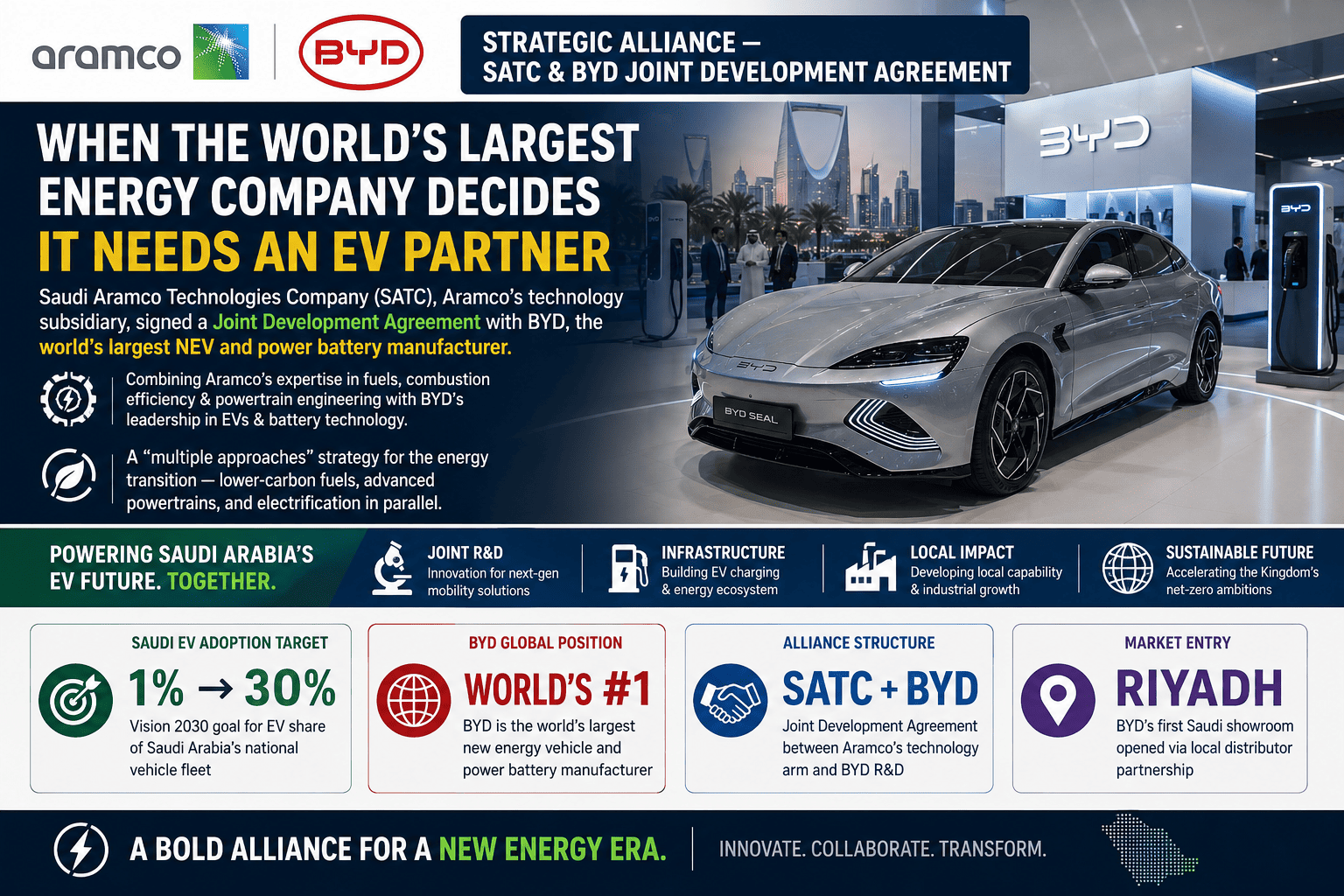
Saudi EV Adoption Target
1% → 30%
Vision 2030 goal for EV share of Saudi Arabia’s national vehicle fleet
BYD Global Position
World’s #1
BYD is the world’s largest new energy vehicle and power battery manufacturer
Alliance Structure
SATC + BYD
Joint Development Agreement between Aramco’s technology arm and BYD R&D
Market Entry
Riyadh
BYD’s first Saudi showroom opened via local distributor partnership
Section 1, The Alliance
1
The Alliance: An Oil Giant and an EV Leader at the Same Table
🇸🇦 Saudi Aramco, world’s leading integrated energy & chemicals company
+
🇨🇳 BYD, world’s largest new energy vehicle & power battery manufacturer
=
⚡ A Working Model for Energy–Mobility Convergence
🔋
Strategic Alliance, SATC & BYD Joint Development Agreement
When the World’s Largest Energy Company Decides It Needs an EV Partner
Saudi Aramco Technologies Company (SATC), Aramco’s wholly-owned technology subsidiary, signed a Joint Development Agreement with BYD, the Chinese company that overtook Tesla to become the world’s largest manufacturer of new energy vehicles and power batteries. The agreement is built to combine the research and development capabilities of both organisations, Aramco’s decades of work on combustion efficiency, fuels chemistry, and powertrain engineering, paired with BYD’s leadership in electric vehicle and battery technology.
On the surface, the pairing looks unlikely: one company’s core business is extracting and refining hydrocarbons, the other’s is replacing the internal combustion engine altogether. But Aramco has been explicit that it does not see this as a contradiction. Ali A. Al-Meshari, Aramco’s Senior Vice President of Technology Oversight & Coordination, has framed the company’s approach as pursuing “multiple approaches” and “parallel technological pathways” to the energy transition, lower-carbon fuels, advanced powertrains, and electrification all developing simultaneously rather than one displacing the others on a fixed timeline.
The timing is not incidental. Saudi Arabia’s Vision 2030 program has set a target of raising electric vehicle adoption from roughly 1% to 30% of the Kingdom’s vehicle fleet, a transformation that requires not just vehicles on the road but charging infrastructure, climate-adapted battery technology, and local industrial capability. BYD had already entered the Saudi market through a retail showroom in Riyadh’s Al Ghadir district, opened with local distributor Al-Futtaim Electric Mobility Solutions. The Aramco tie-up deepens that footprint considerably, giving BYD an R&D and infrastructure partner with unmatched reach inside the Kingdom’s energy and industrial establishment.
30%
Target EV share of Saudi Arabia’s vehicle fleet under Vision 2030
#1
BYD’s global rank by NEV sales volume, ahead of Tesla
Riyadh
Site of BYD’s first Saudi retail showroom, opened with a local distributor
SATC
Aramco’s technology subsidiary leading the joint R&D effort with BYD
“From innovative lower-carbon fuels to advanced powertrain concepts, we believe multiple approaches are necessary to support a practical energy transition.”
— Ali A. Al-Meshari, Senior Vice President, Technology Oversight & Coordination, Aramco
“At the crossroads of technological innovation and environmental protection, BYD always believes that true breakthroughs come from openness and collaboration.”
— Luo Hongbin, Senior Vice President, BYD
💡 GTsetu Perspective
The Aramco-BYD alliance is not a one-off curiosity, it is an early, high-visibility example of a pattern that will define the next decade of energy and mobility industry structure: traditional energy companies and EV technology leaders choosing collaboration over displacement. Companies further down the supply chain, component makers, fuels specialists, battery materials suppliers, charging infrastructure firms, that identify their own GCC or China partner in 2026, while this convergence is still forming, will be positioned ahead of competitors who wait for the model to fully mature. GTsetu is where verified GCC and China partner discovery happens systematically, not through industry conferences or one-off introductions.
Section 2, How It Took Shape
2
How the Partnership Took Shape
📅 2024, BYD Enters the Saudi Market
First BYD Showroom Opens in Riyadh
BYD opens its first store in Riyadh’s Al Ghadir district through local distributor Al-Futtaim Electric Mobility Solutions, featuring a showroom, discovery center, and service center. The move establishes BYD’s retail presence in the Kingdom just as Vision 2030’s electrification targets begin shaping consumer demand.
📅 April 2025, Tesla Enters, Aramco Responds
Tesla Launches Saudi Sales, Days Later, Aramco and BYD Sign
Following Tesla’s own market entry event in Riyadh on April 10, Saudi Aramco Technologies Company and BYD sign a Joint Development Agreement on new energy vehicle technologies on April 21, 2025. The agreement formalises R&D cooperation between Aramco’s fuels and powertrain engineers and BYD’s EV and battery specialists.
📅 Mid-2025, Aramco Frames the Strategic Logic
“Parallel Pathways” Framing Emerges in Public Statements
Aramco executives, including Ali A. Al-Meshari, repeatedly emphasise that the company is not abandoning traditional energy but pursuing multiple parallel technological pathways, lower-carbon fuels, advanced powertrains, and electrification, simultaneously. This framing positions the BYD alliance as one strand of a broader diversification strategy that also includes Aramco’s separate move into the lithium business.
📅 Late 2025, BYD’s Global Momentum Builds Leverage
BYD’s Record International Sales Strengthen Its Negotiating Position
BYD posts record international NEV sales growth through 2025, reinforcing its position as the partner of scale for any energy major seeking EV and battery expertise. Its rapid global expansion, especially across the Middle East, gives the Aramco tie-up added strategic weight on both sides.
📅 2026, Cooperation Widens
Aramco and BYD Explore Broader Energy-Mobility Cooperation
Through 2026, the two companies continue exploring an expanded scope of cooperation, from climate-adapted battery and vehicle design suited to Saudi Arabia’s high-heat environment, to charging infrastructure and lower-carbon fuel pathways. The alliance increasingly reads less like a single R&D deal and more like a long-horizon bet that energy majors and EV leaders need each other’s capabilities to navigate the transition profitably.
Section 3, Why It Makes Sense
3
Why an Oil Major Needs an EV Partner, and Vice Versa
It is easy to read the Aramco-BYD alliance as a defensive move by an oil company hedging against its own obsolescence. The more accurate reading is that both sides have genuine capability gaps that the other fills, and that gap-filling logic is what makes the alliance durable rather than performative.
📊 What Each Side Brings, and What Each Side Needs
🇸🇦 Aramco Brings
Fuels & Powertrain Engineering
Decades of combustion chemistry, materials science, and powertrain R&D that EV-only companies typically lack in-house.
🇨🇳 BYD Brings
EV & Battery Leadership at Scale
The world’s largest NEV and power battery manufacturer, with manufacturing scale and battery chemistry expertise few rivals can match.
🇸🇦 Aramco Brings
Regional Market Access & Capital
Deep ties to Saudi government, Vision 2030 policy alignment, and financial resources to scale infrastructure quickly.
🇨🇳 BYD Brings
Retail & Brand Momentum
An established Riyadh retail footprint and record international sales growth that signal consumer-facing credibility.
🇸🇦 Aramco Needs
A Credible Stake in Electrification
Without an EV-side capability, Aramco’s “parallel pathways” strategy would be incomplete, and vulnerable to being read as denial rather than diversification.
🇨🇳 BYD Needs
Climate-Adapted Engineering for the Gulf
Batteries and vehicles built for temperate markets need adaptation for Gulf heat extremes, exactly the kind of materials and engineering problem Aramco’s R&D teams are built to solve.
The Strategic Calculation, In Numbers
Factor
Aramco’s Position
BYD’s Position
What This Means
Core competitive risk
Long-term decline in combustion-fuel demand as EV adoption rises
Intensifying global competition from Tesla and other EV makers entering new markets
Both companies face pressure to diversify their addressable market
Policy tailwind
Vision 2030 diversification mandate from the Saudi state
Chinese industrial policy support for global EV and battery export champions
Both companies are partially executing national industrial strategy through this alliance
Technical gap being filled
Limited in-house EV and battery platform expertise
Limited fuels chemistry and Gulf-climate materials engineering depth
A genuine technical complementarity, not just a branding exercise
Infrastructure constraint
Saudi Arabia’s charging network remains limited relative to the 2030 EV target
Needs reliable local infrastructure to sustain EV sales growth in the Gulf
Infrastructure build-out is a likely next phase of cooperation beyond R&D
Broader diversification context
Aramco separately expanding into lithium and other EV-adjacent raw materials
BYD expanding aggressively across Middle East, Latin America, and Europe
Both companies treat this alliance as one piece of a much larger diversification strategy, not a standalone bet
Section 4, On the Table
4
What’s Actually on the Table: The Areas of Cooperation
🔋
Core Focus
NEV R&D Breakthroughs
Joint research targeting efficiency and environmental performance gains in new energy vehicles, combining both companies’ R&D teams.
Continued investment in lower-carbon fuel chemistry for vehicles that remain combustion-based during the transition period.
🌡️
Emerging Focus
Climate-Adapted Batteries
Battery and vehicle design suited to Saudi Arabia’s high-heat environment, a materials science problem central to Gulf EV adoption.
🔌
Emerging Focus
Charging Infrastructure
Addressing Saudi Arabia’s limited EV charging footprint, a precondition for the Vision 2030 adoption target to be realistic.
⛏️
Adjacent Strategy
Battery Raw Materials
Aramco’s separate expansion into the lithium business runs in parallel, potentially feeding into future battery-supply cooperation.
Section 5, The Bigger Pattern
5
The Bigger Pattern: GCC-China Energy and Mobility Convergence
🎯 Why This Alliance Is a Signal, Not an Outlier
The Aramco-BYD alliance sits inside a broader convergence between Gulf state-owned energy and industrial champions and Chinese technology and manufacturing leaders. Three forces are driving this pattern. First, Gulf economic diversification mandates, Vision 2030 and equivalent national strategies across the GCC require state energy companies to build credible positions in adjacent industries, including EVs, batteries, and clean technology, rather than relying solely on hydrocarbon revenue. Second, China’s global EV manufacturing scale, Chinese companies like BYD have achieved cost and technology leadership in EVs and batteries that few non-Chinese manufacturers can match, making them natural technology partners for any region pursuing rapid electrification. Third, shared appetite for alternatives to Western-centric supply chains, both Gulf states and China have strategic reasons to deepen bilateral industrial ties that reduce dependence on a single set of trading partners or technology standards.
Vision 2030
Saudi Arabia’s diversification blueprint creates direct demand for EV, battery, and clean-mobility partnerships
#1
China’s position as the world’s largest EV and battery manufacturing base, making Chinese partners the default choice for scale
Energy Majors Diversify
State oil companies across the Gulf increasingly building EV-adjacent capabilities rather than treating electrification as a pure threat
Supply Chain Diversification
Both GCC states and China have strategic reasons to deepen bilateral ties that reduce reliance on any single trading bloc
Climate Engineering Gap
Gulf heat extremes create a genuine technical niche that rewards local R&D partnerships rather than off-the-shelf EV imports
Early-Mover Template
Aramco-BYD offers other GCC energy companies and Chinese mobility firms a working reference model for structuring similar alliances
Section 6, Opportunity Map
6
The Opportunity Map for Suppliers and Partners
🏭 Where the Supply Chain Opens Up Around This Alliance
The Aramco-BYD Alliance Creates Openings Well Beyond the Two Named Companies
A strategic alliance between an energy major and an EV leader is never a closed system. It pulls in component suppliers, materials specialists, infrastructure builders, and distribution partners on both sides. For companies in the GCC and China watching this alliance unfold, the opportunity is not to compete with Aramco or BYD, it is to plug into the ecosystem the alliance is building.
Battery Materials
Lithium, cathode, and thermal-management material suppliers gain relevance as Gulf battery R&D scales up
Charging Infrastructure
Hardware and grid-integration firms have a clear opening as Saudi Arabia builds out charging capacity to support the 30% target
Thermal Engineering
Specialists in heat-resistant battery casings and cooling systems address a problem central to Gulf EV viability
EV Distribution
Dealership, financing, and after-sales partners are needed across the GCC as Chinese EV brands scale beyond Riyadh
Low-Carbon Fuels
Specialty fuel chemistry firms have an opening as Aramco continues to invest in combustion-side decarbonisation alongside EVs
Manufacturing JVs
Component and assembly partners stand to benefit if Gulf-based EV manufacturing capacity follows the R&D cooperation
Section 7, The Playbook
7
A 5-Step Playbook for Joining the Energy-Mobility Convergence
1
Identify Where Your Capability Fits the Gap
The Aramco-BYD alliance works because each side fills a genuine gap in the other’s capability stack. Before approaching any potential partner in this space, map precisely where your company’s expertise, whether in battery materials, thermal engineering, charging hardware, or fuels chemistry, addresses a real gap that a GCC energy company or a Chinese mobility firm cannot easily fill internally. Vague positioning as a “clean energy partner” will not get traction; specific, demonstrable capability will.
2
Target the Right Tier of Partner
Few companies will partner directly with Aramco or BYD at the scale of a Joint Development Agreement. The realistic opportunity for most suppliers and mid-sized manufacturers is one or two tiers down, the distributors, component makers, and infrastructure builders that supply or service the broader alliance ecosystem. Identify the specific layer of the supply chain where your offering is most relevant, and target partners at that tier rather than aiming straight at the headline names.
3
Verify Before You Disclose
High-profile alliances generate a wave of inbound and outbound partnership interest, and not every counterparty claiming proximity to the Aramco-BYD ecosystem is credible. Verify a prospective partner’s business registration and standing before any substantive technical or commercial conversation, and use a formal NDA before sharing proprietary materials data, fuel formulations, or component designs.
4
Build for Gulf Operating Conditions From Day One
A recurring theme in the Aramco-BYD cooperation is climate adaptation, batteries and vehicles engineered for temperate markets often underperform in Gulf heat extremes. Any supplier or technology partner entering this ecosystem should treat thermal performance, dust resistance, and high-ambient-temperature reliability as core design requirements, not afterthoughts, since this is precisely the kind of localisation gap the alliance is trying to close.
5
Move While the Ecosystem Is Still Forming
The supplier and distribution relationships around the Aramco-BYD alliance, and the broader GCC-China energy-mobility convergence it represents, are still being established. Companies that identify their position and build relevant partnerships in 2026 will be better placed than those that wait until the ecosystem matures and the obvious supplier slots are filled. Early engagement with verified counterparties compounds into preferred-partner status as the alliance scales.
Section 8, Dos and Don’ts
8
Dos and Don’ts for Energy and Mobility Partners Watching This Space
✅ Do These
✅ Treat energy-mobility convergence as a genuine technical complementarity, not a marketing narrative
✅ Map precisely where your capability addresses a real gap in an energy major’s or EV maker’s stack
✅ Engineer for Gulf-specific operating conditions, heat, dust, and grid limitations, from the outset
✅ Target the realistic tier of the supply chain, components, infrastructure, distribution, rather than only headline names
✅ Verify any partner’s business registration and standing before substantive technical disclosure
✅ Execute formal NDAs before sharing materials data, fuel formulations, or component designs
✅ Track Vision 2030 and equivalent GCC national strategies for policy-aligned opportunity windows
✅ Engage early, while supplier and distribution relationships in the ecosystem are still forming
✅ Watch for adjacent moves, like Aramco’s lithium push, that signal where future cooperation may expand
❌ Avoid These
❌ Assume this is purely a defensive PR move by Aramco rather than a real capability-driven alliance
❌ Pitch generic “sustainability” capability without a specific, demonstrable technical fit
❌ Assume off-the-shelf EV or battery products designed for temperate markets will work unmodified in the Gulf
❌ Approach Aramco or BYD directly without first identifying the realistic tier of engagement for your company’s size
❌ Disclose proprietary technical or commercial information to unverified counterparties claiming alliance proximity
❌ Ignore Saudi Arabia’s current charging infrastructure constraints when sizing near-term EV-related opportunity
❌ Treat the alliance as a single isolated deal rather than part of a broader GCC-China industrial pattern
❌ Wait for the ecosystem to fully mature before identifying and engaging credible partners
Section 9, Misconceptions
9
Common Misconceptions About the Aramco-BYD Alliance
❌ Myth
“Aramco partnering with BYD means Aramco is exiting the oil business.”
✅ Reality
Aramco has been explicit that it is not abandoning traditional energy. The company continues to invest heavily in lower-carbon fuels, advanced powertrain technology for combustion engines, and oil and chemicals as its core business. The BYD alliance is one strand of a “parallel pathways” strategy, not a pivot away from hydrocarbons, Aramco is hedging across multiple transition scenarios rather than betting the company on electrification alone.
❌ Myth
“This is just a marketing partnership with no real technical substance.”
✅ Reality
The cooperation is structured as a formal Joint Development Agreement between Saudi Aramco Technologies Company and BYD, explicitly designed to combine R&D teams on efficiency and environmental performance breakthroughs. Both companies have research infrastructure and engineering talent dedicated to this kind of technical collaboration, it is structured as genuine joint development work, not a sponsorship or branding arrangement.
❌ Myth
“Saudi Arabia is already at scale on EV adoption, the market opportunity is mostly captured.”
✅ Reality
Saudi EV adoption started from a very low base, roughly 1% of the vehicle fleet, with a 2030 target of 30%. The country also faces real infrastructure constraints, including a still-limited public charging network. This means the bulk of the market-building work, including charging infrastructure, dealership networks, and consumer financing, is still ahead rather than behind, the opportunity window remains wide open.
❌ Myth
“This is an exclusive alliance, no other GCC energy companies or Chinese EV makers can replicate it.”
✅ Reality
The Aramco-BYD structure, a state energy major’s technology arm signing a joint development agreement with a leading Chinese EV manufacturer, is a replicable template, not a one-off arrangement. Other GCC national energy companies and other Chinese EV and battery manufacturers have similar strategic incentives to pursue comparable alliances, and the broader pattern of GCC-China industrial cooperation suggests more such deals are likely.
❌ Myth
“BYD doesn’t need a local partner, it can simply export finished vehicles into the Gulf.”
✅ Reality
BYD’s own market entry strategy, opening a retail showroom with a local distributor before deepening into R&D cooperation with Aramco, shows that even the world’s largest EV maker recognises the value of local engineering, distribution, and infrastructure partners for sustained success in the Gulf. Climate adaptation, after-sales service, and charging access all require local capability that pure vehicle exports cannot provide.
Section 10, GTsetu
10
How GTsetu Helps You Find the Right Energy or Mobility Partner
The Aramco-BYD alliance proves the model: energy companies and mobility leaders that find the right complementary partner can move faster than either could alone. But not every company has Aramco’s scale to negotiate a joint development agreement directly with a global EV champion. Finding a verified, capable, and strategically aligned counterparty, at whatever tier of the supply chain you operate, is the step that turns the energy-mobility convergence into an opportunity you can actually act on. That is exactly what GTsetu enables, systematically.
🌐 Platform Spotlight, GTsetu
Find Verified GCC and China Energy & Mobility Partners, Before the Ecosystem Fills In
GTsetu is the verified B2B manufacturing and trading partner discovery platform connecting GCC energy companies, Chinese mobility and battery firms, component suppliers, and infrastructure builders with documented capability profiles, zero broker fees on any partnership formed. The Aramco-BYD alliance creates the opening. GTsetu puts the right partner in front of you before your competitors get there first. Every company on GTsetu is verified on 6 key data points via government sources: Name, Address, Registration Number, Company Status, Company Type, and Date of Certificate of Incorporation.
✅
6-Point Govt. VerificationEvery company verified on Name, Address, Registration Number, Company Status, Company Type, and Date of Certificate of Incorporation via official government registries.
🕵️
Anonymous DiscoveryEvaluate verified GCC and China partner profiles without revealing your company identity or pricing until mutual interest is confirmed.
📄
Built-In NDA WorkflowProtect your materials data, fuel formulations, and component designs, NDA countersigned with full audit trail before any commercial disclosure.
🚫
Zero CommissionNo broker fees. Your joint development, supply, or distribution agreement stays entirely between you and your partner.
🌍
GCC + China + 100+ CountriesFind energy and mobility partners, manufacturers, and JV candidates across the Gulf, China, and 100+ countries globally.
⚡
Move in 2026First-mover partnership positions are most valuable right now, before preferred supplier slots and distribution territories are claimed.
Saudi Aramco Technologies Company (SATC), a wholly-owned subsidiary of Aramco, signed a Joint Development Agreement with BYD to collaborate on new energy vehicle (NEV) technologies. The partnership combines Aramco’s research in low-carbon fuels and advanced powertrains with BYD’s leadership in electric vehicles and battery technology, aiming to improve vehicle efficiency and environmental performance. Both companies have framed it as combining their respective R&D teams to pursue breakthroughs that neither could achieve as quickly alone.
Q
Why is an oil company partnering with an EV maker?
Aramco is diversifying into low-carbon energy and mobility technology to remain competitive through the energy transition, while supporting Saudi Arabia’s Vision 2030 target of raising EV adoption from roughly 1% to 30% of the vehicle fleet by 2030. Rather than treating electrification as a threat, Aramco is positioning itself as an enabler of multiple parallel pathways to cleaner mobility, including hybrid systems, lower-carbon fuels, and EV-specific R&D. The company has stated publicly that this is part of a deliberate “parallel pathways” strategy rather than an abandonment of its core energy business.
Q
What does BYD gain from the Aramco alliance?
BYD gains a deep-pocketed, regionally embedded partner with engineering expertise in fuels, materials, and powertrains, plus a foothold in a market central to Saudi Arabia’s economic diversification. BYD already entered the Saudi market through retail showrooms in Riyadh opened with local distributor Al-Futtaim Electric Mobility Solutions, and the Aramco tie-up strengthens its position as the country pursues large-scale EV adoption. It also gives BYD access to climate-engineering expertise relevant to adapting its vehicles and batteries for Gulf operating conditions.
Q
What does this signal for GCC-China industrial cooperation?
The Aramco-BYD alliance reflects a broader pattern of Gulf state-owned energy and industrial champions partnering with Chinese technology and manufacturing leaders across EVs, batteries, and clean energy. It signals growing GCC-China industrial integration as both regions pursue economic diversification and supply chain alternatives. Other Gulf energy majors and other Chinese EV and battery manufacturers face similar strategic incentives, suggesting this alliance is a template likely to be replicated rather than a one-off arrangement.
Q
How can GTsetu help me capitalise on the energy-mobility convergence?
GTsetu is the verified partner discovery platform that connects GCC energy companies, Chinese mobility and battery firms, component suppliers, and infrastructure builders with documented company profiles, without broker fees. Every company on GTsetu is verified on 6 key data points (Name, Address, Registration Number, Company Status, Company Type, Date of Certificate of Incorporation) using government sources. For suppliers and manufacturers targeting this ecosystem: find verified GCC distributors, Chinese component partners, and JV candidates across the Gulf and China. The process: (1) browse verified profiles anonymously, (2) execute an NDA before any commercial disclosure, (3) run a pilot or trial collaboration to validate capabilities, (4) formalise the partnership with a documented agreement. Zero commission on any deal. Start your GCC-China partner search on GTsetu →
The Energy-Mobility Convergence Is Open. Find Your Partner on GTsetu.
Traditional energy companies and EV leaders are finding shared opportunity instead of competing futures. The supplier, distribution, and joint-development partner positions are being established right now. 500+ verified manufacturers, distributors, and industrial partners across the GCC, China, and 100+ countries. Zero broker fees. Anonymous discovery. Built-in NDA workflows. Move in 2026, before the best positions are taken.
Business Development Expert | Global Trade & International Market Development
Sarah Ann Mitchell is a Business Development Expert at GTsetu with a strong focus on global trade, international market development, and strategic business partnerships. She works with companies seeking to expand internationally by identifying collaboration opportunities, connecting with key stakeholders, and developing market access strategies.
Sarah brings expertise in cross-border business development, international trade ecosystems, partnership building, and global market intelligence. Her work at GTsetu involves supporting businesses, manufacturers, startups, and industry leaders in building relationships that accelerate growth and create long-term commercial value.
Passionate about fostering international collaboration, Sarah helps organizations navigate evolving global markets and discover new opportunities through strategic partnerships, trade networks, and ecosystem-driven growth initiatives.