Foxconn India Supplier Network: What Electronics Manufacturers Must Learn About Supplier Ecosystem Development
🔴 BREAKINGFoxconn India Supplier Ecosystem: Taiwan giant actively developing local Indian component suppliers to localise its electronics supply chain◆Foxconn India investment commitment crosses $1.5B, supplier ecosystem is the next frontier◆iPhone assembly localisation target: 25% of global iPhone production in India by 2025, supplier ecosystem is the bottleneck◆Find verified electronics manufacturing partners on GTsetu, 100+ countries, zero commission◆🔴 BREAKINGFoxconn India Supplier Ecosystem: Taiwan giant actively developing local Indian component suppliers to localise its electronics supply chain◆Foxconn India investment commitment crosses $1.5B, supplier ecosystem is the next frontier◆iPhone assembly localisation target: 25% of global iPhone production in India by 2025, supplier ecosystem is the bottleneck◆Find verified electronics manufacturing partners on GTsetu, 100+ countries, zero commission◆
Home › Blog › Foxconn India Supplier Ecosystem
🔴 Market Insight📱 Electronics Mfg🇮🇳 India Manufacturing🇹🇼 Taiwan Supply Chain
Foxconn × India Suppliers: Why Factory Announcements Are Only Half the Story of India’s Electronics Ambition
Foxconn’s India expansion is not just about factories, it is about building the supplier ecosystem that makes those factories viable at scale. The world’s largest contract electronics manufacturer is actively qualifying and developing Indian component suppliers, signalling a structural upgrade in India’s position in global electronics value chains.
🎯 Direct Answer
Foxconn is strengthening its India electronics manufacturing presence through active supplier ecosystem development, moving beyond headline factory investments to build the localised component supply chain that makes large-scale Indian electronics production economically viable. The company is identifying, qualifying, and supporting Indian suppliers in precision components, sub-assemblies, packaging, and tooling, providing technical standards, quality frameworks, and supply commitments in exchange for localised sourcing. This Supply Chain Alliance model mirrors how Foxconn built its China and Vietnam supplier networks and is the decisive factor determining whether India becomes a genuine electronics manufacturing hub or simply an assembly destination. The supplier ecosystem matters more than the factory announcement, it is what separates sustainable scale from headline optics.
📅 January 2026⏱ 15 min read✍️ GTsetu Editorial Team📰 Market Insight + Analysis
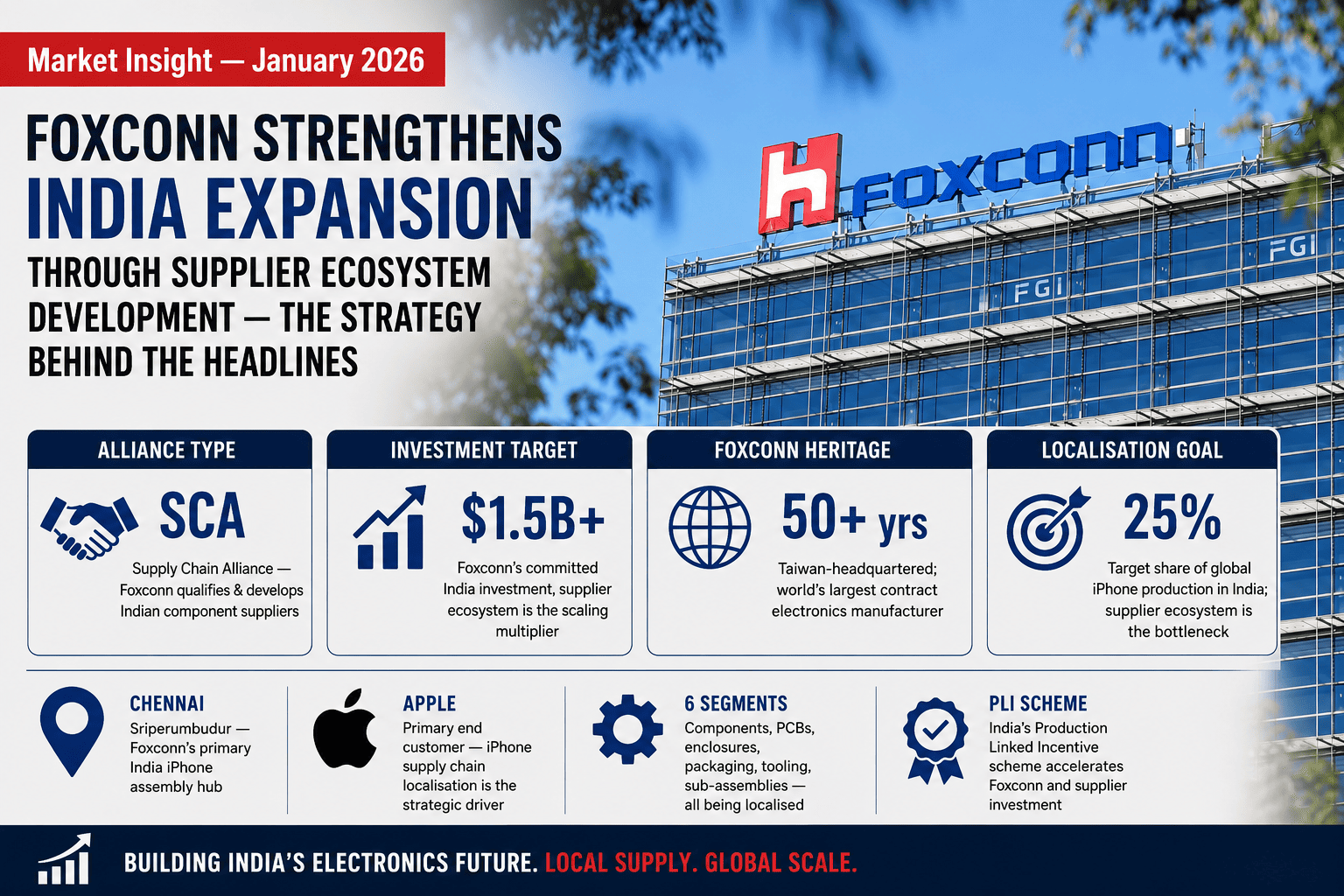
Alliance Type
SCA
Supply Chain Alliance, Foxconn qualifies & develops Indian component suppliers
Investment Target
$1.5B+
Foxconn’s committed India investment, supplier ecosystem is the scaling multiplier
Foxconn Heritage
50+ yrs
Taiwan-headquartered; world’s largest contract electronics manufacturer
Localisation Goal
25%
Target share of global iPhone production in India; supplier ecosystem is the bottleneck
Section 1, The News
1
The Full Story: Foxconn’s Supplier Ecosystem Play in India
📱
Market Insight, January 2026
Foxconn Strengthens India Expansion Through Supplier Ecosystem Development, The Strategy Behind the Headlines
In early 2026, industry reports confirmed what supply chain analysts had been tracking for months: Foxconn, the world’s largest contract electronics manufacturer, headquartered in New Taipei City, Taiwan, is deepening its India commitment not through additional factory announcements, but through the less glamorous and more strategically critical work of building a localised Indian supplier ecosystem.
Foxconn’s India operations, centred on iPhone assembly at its Sriperumbudur facility near Chennai, have demonstrated that the assembly factory is not the binding constraint. The binding constraint is components. Currently, a significant share of components used in India-assembled iPhones are imported from China and Taiwan, limiting the value-add retained in India and making production economics sensitive to logistics cost and geopolitical risk.
Foxconn’s supplier ecosystem development initiative addresses this directly: identifying, qualifying, and actively supporting Indian manufacturers in precision components, PCB sub-assemblies, mechanical enclosures, packaging, and tooling to meet the exacting standards of Apple’s supply chain. This is the same strategy Foxconn deployed to build the Chinese and Vietnamese supplier ecosystems, and it is what will determine whether India’s electronics manufacturing story is structural or merely cyclical.
Chennai
Sriperumbudur, Foxconn’s primary India iPhone assembly hub
Apple
Primary end customer, iPhone supply chain localisation is the strategic driver
6 segments
Components, PCBs, enclosures, packaging, tooling, sub-assemblies, all being localised
PLI scheme
India’s Production Linked Incentive scheme accelerates Foxconn and supplier investment
“The supplier ecosystem matters more than the factory. You can build a factory in six months. Building a supplier ecosystem that can manufacture to Apple’s quality standards takes years, and that’s precisely what makes it a durable competitive advantage.”
— Electronics Manufacturing Industry Analysis, January 2026
“India’s electronics ambition will be defined not by how many Foxconn factories are built, but by how many Indian companies enter Foxconn’s supply chain and meet global standards.”
— Supply Chain Analyst, India Electronics Council Report
💡 GTsetu Perspective
Foxconn’s India factory is the headline. The supplier ecosystem is the headline that matters. Every percentage point of localisation, every Indian supplier that achieves Foxconn’s quality standards, represents revenue captured in India rather than imported from China. If you are an Indian precision manufacturer, a PCB producer, a tooling company, or a packaging specialist, the Foxconn supplier ecosystem is the most consequential opportunity in India’s manufacturing landscape right now. The question GTsetu helps you answer is: what does a verified Foxconn-standard supplier profile look like, and how do you get qualified?
Section 2, Localisation Ladder
2
Localisation Ladder, From Assembly to Full Component Ecosystem
Foxconn’s India supplier ecosystem strategy is not a single event, it is a staged localisation progression that mirrors exactly how the company built its manufacturing dominance in China and Vietnam. The logic is tight: each rung of localisation reduces import dependence, improves margins, and deepens India’s position in the global electronics value chain.
📱 India Electronics Localisation, Foxconn’s Progression
Phase 1
Entry
Assembly Only 100% Import
Phase 2
Packaging & Tooling
Local suppliers ● Active
Phase 3
PCBs & Enclosures
In qualification In Progress
Phase 4
Full Ecosystem Localisation
Target state Target
📱 Why Ecosystem and Assembly Must Scale Together
Foxconn’s localisation strategy illustrates a critical principle: assembly capacity and supplier ecosystem must be sequenced correctly. A Foxconn factory without a local supplier base is a sophisticated import processing operation, high cost, low resilience, limited India value-add. Only when Indian suppliers can meet Apple’s exacting tolerances and quality standards does the full economic logic of India manufacturing unlock. The sequence, ecosystem development first, volume scale second, is the correct order for sustainable electronics manufacturing in any new geography.
Section 3, The Anatomy
3
What Each Party Brings to the Supply Chain Alliance
Like every successful supply chain alliance, the Foxconn × Indian Suppliers model works because each party contributes what the other cannot efficiently replicate. This complementarity, global standards meet local manufacturing, is the economic engine of supplier ecosystem development everywhere Foxconn has operated.
Alliance Anatomy, Supply Chain Alliance Structure
Foxconn
🇹🇼 New Taipei, Taiwan, Est. 1974
What they bring
Global Standards + Offtake
India facility
Sriperumbudur, Chennai
End customer
Apple, Sony, Dell, HP
Specialty
Global supply chain orchestration
What they lack
Local component supply at cost
Alliance role
Anchor Customer + Standard Setter
+
SCA
Indian Suppliers
🇮🇳 Tamil Nadu, Karnataka, Maharashtra
What they bring
Local Cost Base + Agility
Expertise
Precision mfg, PCBs, tooling
Scale potential
Rapid capacity ramp with PLI support
Specialty
Cost-competitive local manufacturing
What they lack
Apple-tier quality standards & volumes
Alliance role
Component & Sub-Assembly Provider
🎯 Target: Full electronics supply chain localisation in India
📱 End goal: 25% of global iPhone production made in India
📈 $1.5B+ committed investment
Alliance Dimension
What Foxconn Provides
What Indian Suppliers Provide
Why This Balance Works
Quality Standards
Apple-tier specifications, process audits, quality frameworks
Manufacturing capacity, workforce, local infrastructure
Foxconn’s standards run on Indian suppliers’ factories, no new capability build required from scratch
Volume Offtake
Guaranteed volume commitments that justify capex investment
Flexible capacity, cost-competitive pricing vs imports
Indian suppliers invest in equipment knowing Foxconn’s offtake de-risks payback
Technical Transfer
50+ years of electronics manufacturing process IP
Adaptation to Indian cost structures and material availability
Indian suppliers produce to Foxconn’s spec, elevating quality to Apple’s tier
Certification Support
Supplier audit and qualification frameworks, compliance guidance
Existing ISO/quality systems; Indian regulatory knowledge
Foxconn’s endorsement de-risks Indian suppliers for global electronics procurement
Capital Commitment
$1.5B+ factory investment; no equity in supplier entities
Supplier capex backed by PLI incentives and Foxconn volume
Asset-light for Foxconn on the supplier side; high-value for suppliers, asymmetric but balanced
Risk
Reputational risk, Apple’s supply chain quality is non-negotiable
Production risk, capex risk, qualification risk
Both sides have skin in the game, quality failure hurts both parties
Section 4, The Strategy
4
A Layered Strategy, Assembly First, Ecosystem Second
One of the most important strategic lessons from Foxconn’s India expansion is that it is not a single move, it is a deliberate sequenced strategy. This is the right way to build manufacturing ecosystems in new geographies: establish the assembly anchor, prove the market, then systematically develop the supplier base that makes the anchor economically self-sustaining.
📱 Foxconn × India, Strategic Progression
Phase 1
Assembly Operations Launch, Sriperumbudur, Tamil Nadu
Foxconn establishes its India iPhone assembly operations, initially relying heavily on imported components from Taiwan and China. This proves the India market proposition, workforce capability, infrastructure, regulatory environment, before committing to supplier ecosystem investment.
Phase 2
PLI Integration and India-Produced Volume Growth
India’s Production Linked Incentive scheme for electronics attracts Foxconn into committing larger volume targets. iPhone models are added to the India production roster. The economic case for localising components strengthens as assembly volume grows and import costs compound.
2023–25
Supplier Qualification Programme Expands
Foxconn begins actively qualifying Indian suppliers in packaging, mechanical components, and tooling. Initial successes demonstrate that Indian manufacturers can meet global electronics standards with the right technical support and quality frameworks.
Jan 2026
Supplier Ecosystem Development Identified as Strategic Priority
Industry reports confirm that Foxconn has elevated supplier ecosystem development to a core strategic priority in its India expansion, moving beyond factory investment into active component localisation. PCBs, enclosures, and precision components are the next qualification targets. The strategy mirrors China, where Foxconn’s factory success was built on a supplier ecosystem that took 15 years to mature.
🔑 Key Lesson: Ecosystem Before Scale
Foxconn did not invest in India’s supplier ecosystem first and then build a factory. It built the factory, proved the market, and is now systematically developing the supplier base that makes the factory’s economics self-sustaining. This sequence is critical. Assembly without suppliers is expensive. Assembly with a local supplier ecosystem is a structural competitive advantage. The fastest path to sustainable electronics manufacturing at scale is always through a proven anchor customer relationship that de-risks supplier capex investment. GTsetu helps Indian suppliers identify which anchor customers, Foxconn and beyond, have verified procurement needs that match their manufacturing capabilities.
Section 5, Why This Works
5
Why the Supplier Ecosystem Model Works for Electronics Manufacturing
🎯 The Core Logic
Foxconn’s India supplier ecosystem strategy succeeds because it is built on three interlocking structural advantages: a proven anchor customer relationship (Apple) that creates guaranteed demand, a government incentive framework (PLI) that de-risks supplier capex, and a market-timing alignment with global electronics supply chain diversification driven by geopolitical risk and the China+1 imperative. No individual Indian supplier could access Apple-tier volumes alone, and Foxconn cannot achieve India cost competitiveness without local components. The ecosystem model resolves both constraints simultaneously.
Why India-Taiwan Electronics Collaboration Is Accelerating
China+1
Global electronics OEMs diversifying production away from China, India is the primary beneficiary
PLI
India’s Production Linked Incentive scheme provides up to 6% cash incentive on incremental production
$300B
India’s electronics production target by 2026, supplier ecosystem is the critical bottleneck
CECA
India-Taiwan trade framework facilitating technology and capital flows for electronics manufacturing
50 yrs
Foxconn’s electronics manufacturing IP, the most valuable technology transfer in global electronics
4 hubs
Foxconn India presence, Tamil Nadu, Karnataka, Telangana, Maharashtra, national supplier reach
Section 6, India Electronics Opportunity
6
India’s Electronics Manufacturing Opportunity, Why Now Is the Time to Enter the Ecosystem
🇮🇳 India Electronics Manufacturing 2025–26
Why Every Component Manufacturer and Precision Specialist Should Be Entering Foxconn’s Supplier Ecosystem
India’s electronics output has doubled since 2014, and the trajectory is accelerating. With Foxconn, Tata Electronics, and Dixon Technologies all expanding assembly capacity, the upstream component opportunity is enormous. The current import dependency in India-assembled electronics is not a ceiling, it is the gap that Indian suppliers are being invited to fill, with Foxconn actively lowering the entry barrier through qualification support and guaranteed offtake.
$101B
India electronics production in FY23, growing at 17%+ annually
25%
Target share of global iPhone production in India, supplier ecosystem is the bottleneck
60%+
Current import content in India-assembled smartphones, the supplier opportunity
6%
PLI cash incentive rate on incremental electronics production, de-risks supplier capex
Apple
End customer, the most demanding quality standard in consumer electronics; the most valuable qualification
15 yrs
Time it took Foxconn to build China’s supplier ecosystem, India has the advantage of a proven blueprint
🌐 GTsetu for Electronics Supply Chain Alliances
GTsetu’s verified partner network includes electronics manufacturers, precision component suppliers, PCB producers, tooling specialists, packaging companies, and sub-assembly providers across India, Taiwan, South Korea, Japan, and 100+ other countries. Every company on GTsetu is verified on 6 government-sourced points: Name, Address, Registration Number, Company Status, Company Type, and Date of Certificate of Incorporation. Additional capabilities like certifications and OEM approvals are self-reported. If you’re an Indian manufacturer looking to enter Foxconn’s or any other anchor customer’s supplier ecosystem, or a global electronics company seeking to identify qualified Indian component suppliers, GTsetu is where your supplier search begins with verified profiles, not trade fair cold calls. Find supplier ecosystem partners →
Section 7, Types of Collaboration
7
4 Types of Electronics Supply Chain Collaboration, Which Fits Your Situation?
Foxconn and Indian suppliers are using a Supply Chain Alliance model, but this is just one of four primary collaboration structures available to electronics manufacturers. The right structure depends on the depth of integration required, the risk profile, and the strategic objective.
01
Supply Chain Alliance (SCA)
An anchor manufacturer actively develops and qualifies local suppliers, providing technical standards, quality frameworks, and offtake commitments. No equity exchange. The Foxconn × India suppliers model. Fastest to scale, lowest risk for anchor, highest capability development for suppliers.
📱 Foxconn × Indian Suppliers
02
Technical Assistance Agreement (TAA)
A technology holder transfers manufacturing knowhow and process IP to a partner for a fee or royalty. No new entity, no equity. Best when specific technology IP is the gap, not just standards alignment. Faster to execute than a JV, higher knowledge transfer than an SCA.
⚙️ IP transfer + standards
03
Joint Venture (JV)
A new co-owned legal entity with shared equity, governance, and P&L. Deepest integration, maximum mutual commitment. Best for large-scale, long-term market anchors where both parties have large complementary assets and want permanent shared ownership.
⚖️ Full shared ownership
04
Contract Manufacturing
You own the design and brand; a contract manufacturer produces to specification for a per-unit fee. No equity sharing, no ecosystem development. Ideal when capacity access in a new geography is the need, and the manufacturer already meets the required standards independently.
🏭 Capacity without commitment
📊 Collaboration Model Comparison, Electronics Manufacturing
Model
Capital Required
Standards Transfer
OEM Credibility Uplift
Speed to Execute
Reversibility
Supply Chain Alliance
Low (supplier capex backed by offtake)
✓ Full standards access
✓ High
Fast (6–12 months to qualify)
Moderate
TAA
Low (fees/royalties)
✓ Full IP + process
✓ High
Fast (3–6 months)
Moderate
Joint Venture
High, shared capex
✓ Co-developed IP
✓ Maximum
Slow (12–24 months)
Low
Contract Mfg
Minimal
~ Process only
~ Depends on CM’s certs
Fastest (1–4 months)
High
Section 8, How to Join
8
How to Join a Supplier Ecosystem: A 5-Step Playbook for Electronics Manufacturers
Entering Foxconn’s supplier ecosystem, or any anchor customer’s supply chain, requires a deliberate qualification process. Here is the distilled playbook, drawn from how successful Indian suppliers have navigated global electronics supply chain entry.
1
Define Your Component or Sub-Assembly Capability with Precision
Foxconn does not need generalists, it needs companies that can reliably produce specific components to specific tolerances at volume. Define your manufacturing capability with exactly the same precision you would use to write a product specification. What do you make? To what tolerance? At what volume? With what certifications? Vague supplier profiles are invisible in structured supply chain qualification processes.
2
Get Verified, Not Just Listed
The crucial distinction in entering any major supply chain is verification over self-promotion. Foxconn’s procurement team does not accept self-reported profiles. GTsetu provides verified company profiles on 6 government-sourced points, Name, Address, Registration Number, Company Status, Company Type, Date of Incorporation, before any procurement engagement. For electronics manufacturers, self-reported certifications (ISO 9001, IATF, specific OEM approvals) should be independently validated. Build a profile that can withstand due diligence, because with Foxconn, it will be subjected to exactly that.
3
Protect Your Process IP Before Any Technical Disclosure
In electronics manufacturing, your production process, equipment configurations, and yield data are valuable IP. Before sharing anything sensitive, even a manufacturing capability statement with tolerances, execute a mutual NDA. This protects your process knowledge from being used to qualify a competitor. GTsetu’s built-in NDA workflow handles this automatically before any sensitive document exchange, with a full digital audit trail.
4
Invest in Qualification Before Volume Commitment
Foxconn’s supplier qualification process is rigorous, sample production, process audits, quality system review, PPAP-equivalent documentation. Budget for a 6–18 month qualification runway before you receive purchase orders. This is not a weakness of the process, it is what makes the Foxconn supplier credential so valuable. Every manufacturer that has survived Foxconn’s qualification has a credential that opens doors across the entire Apple supply chain globally.
5
Formalise and Scale, Volume First, Diversification Second
Once qualified, focus entirely on delivering volume and quality consistency to the anchor customer. Your Foxconn qualification is not a credential to diversify immediately, it is a mandate to build the manufacturing system that can reliably deliver at scale. Diversification to other customers comes after you have proven your quality system is stable at volume. Document every stage of your production process formally: this documentation becomes your most valuable asset when engaging the next anchor customer.
Section 9, Dos and Don’ts
9
Dos and Don’ts of Electronics Supplier Alliance Partnerships
✅ Do These
✅ Define your manufacturing capability at component level, Foxconn qualifies components, not companies in general
✅ Invest in ISO 9001 and relevant electronics certifications before approaching anchor customers
✅ Budget 6–18 months for qualification, the process is rigorous and the credential is worth the wait
✅ Sign NDA before sharing tolerance specifications, process parameters, or yield data
✅ Apply for PLI incentives, the production incentives de-risk your capex investment significantly
✅ Document your production process formally, PPAP-equivalent documentation is expected by Foxconn
✅ Run qualification sample batches before committing to capacity expansion capex
✅ Use verified platforms like GTsetu rather than trade fair introductions for strategic supplier discovery
✅ Build quality systems that can sustain Apple-tier consistency, not just pass an initial audit
✅ Formalise all supply agreements in writing before production begins, scope, pricing, quality standards, audit rights
❌ Avoid These
❌ Invest in capacity expansion before receiving qualified supplier status from the anchor customer
❌ Share process data or equipment specifications before NDA is countersigned
❌ Assume qualification in one product category transfers to another, each component is qualified separately
❌ Prioritise price competition over quality consistency, Apple-tier supply chains delists on quality failure, not price
❌ Neglect exclusivity considerations, know whether you can supply Foxconn’s competitors simultaneously
❌ Diversify to other anchor customers before your quality system is stable at volume with the first
❌ Underestimate India-Taiwan cultural communication protocols, explicit written communication is essential
❌ Start supplying on informal terms, pricing, quality standards, and audit rights must be documented before production
❌ Approach Foxconn as a general manufacturer, identify the specific component category where you have genuine capability advantage
Section 10, Misconceptions
10
Common Misconceptions That Kill Electronics Supplier Partnerships
❌ Myth
“Getting into Foxconn’s supplier ecosystem requires connections or broker relationships.”
✅ Reality
Foxconn’s supplier qualification is driven by capability, quality systems, and verified company credentials, not broker relationships. The qualification process is systematic and evidence-based. A verified company profile on GTsetu, combined with legitimate certifications and a documented capability statement, is far more effective than any intermediary.
❌ Myth
“The factory announcement is the important thing, supplier ecosystem will develop naturally.”
✅ Reality
Supplier ecosystems do not develop naturally, they require active investment, qualification frameworks, and technical support from the anchor manufacturer. Foxconn’s China ecosystem took 15 years of deliberate cultivation. In India, Foxconn is investing the same deliberate effort. The factory without the ecosystem is an expensive import processing operation.
❌ Myth
“Being a Foxconn supplier means being dependent on one customer, too risky.”
✅ Reality
A Foxconn supplier qualification is the most transferable credential in electronics manufacturing. Companies qualified by Foxconn to Apple standards can supply Tata Electronics, Dixon, and dozens of global electronics companies with minimal re-qualification. The initial concentration risk is real and should be managed, but the qualification credential itself is diversification capital for every engagement that follows.
❌ Myth
“We should build capacity first to demonstrate commitment to Foxconn, then seek qualification.”
✅ Reality
Foxconn’s supplier qualification assesses process capability and quality systems, not factory size. Building capacity before qualification is capital at risk. The correct sequence is: quality system → qualification samples → Foxconn approval → purchase orders → capacity investment. Never commit capex without approved supplier status and a volume commitment from the anchor customer.
❌ Myth
“Indian manufacturers cannot meet Apple-tier quality standards, this ecosystem opportunity is for others.”
✅ Reality
Indian manufacturers are already in Foxconn’s India supplier ecosystem, in packaging, tooling, and specific mechanical components. The qualification bar is high but achievable. What Foxconn’s ecosystem development initiative specifically provides is the technical support and standards framework to help more Indian manufacturers cross that bar. The barrier is process discipline, not Indian industrial capability.
Section 11, GTsetu
11
How GTsetu Helps You Find Supplier Ecosystem Partners
Foxconn’s Indian suppliers found their way into the ecosystem through a combination of industrial connections, government schemes, and persistent qualification attempts. Most electronics manufacturers, whether anchor customers building a supplier base or component suppliers seeking to enter one, do not have a systematic, verified discovery mechanism. GTsetu is the verified B2B manufacturing discovery platform that provides this mechanism at scale, across 100+ countries, before you reveal a single confidential detail.
🌐 Platform Spotlight, GTsetu
Find Verified Electronics Suppliers, Anchor Customers, Contract Manufacturers, and Supply Chain Partners Across 100+ Countries, Anonymously, Securely, With Zero Broker Fees
Every company on GTsetu is verified using government tie-ups on 6 key points: Name, Address, Registration Number, Company Status, Company Type, and Date of Certificate of Incorporation. This is the foundation of trust. Additional information such as quality certifications (ISO 9001, IATF 16949, IPC standards), OEM approval lists, manufacturing capabilities, and component specialisations is self-reported by companies. You evaluate who is real before you engage. You share nothing sensitive until an NDA is countersigned. And you pay no broker commission on any supply chain alliance formed, the deal is entirely between you and your partner.
✅
6-Point Government-Sourced VerificationName, Address, Registration Number, Company Status, Company Type, Date of Incorporation confirmed using government tie-ups.
🕵️
Anonymous DiscoveryEvaluate verified supplier or anchor customer profiles without revealing your identity until mutual interest is confirmed.
📄
Built-In NDA WorkflowShare capability documents and process specs only after NDA is executed, full audit trail, no external legal required.
🚫
Zero CommissionNo broker fees, your supply chain alliance or supplier contract is entirely between you and your partner.
🌍
100+ CountriesTaiwan, Japan, South Korea, India, Vietnam, find electronics supply chain partners in every manufacturing hub.
🔐
Encrypted CollaborationShare tolerance data, production specs, and qualification documents securely between verified partners.
Identified Indian suppliers with specific component manufacturing capability
✓ Browse verified company profiles with government-sourced verification before engaging
You evaluate the supplier’s verified legal identity, not marketing claims
Chose suppliers for their specific manufacturing capability and quality system maturity
✓ Filter by self-reported capabilities, certifications, and component specialisations (validate independently)
Find potential partners with the specific component capability your supply chain requires
Protected process IP through formal supplier agreements before production began
✓ Built-in NDA and document workflow protects IP from the first conversation
Your process data and specifications are protected at every stage
Targeted Indian suppliers whose geographic presence and cost structure were complementary
✓ Self-reported partner profiles show manufacturing clusters, geographic reach, and component types
Identify complementarity, where a supplier’s geography and capability fills your supply chain gap
Zero intermediary in supplier relationships, all commercial terms direct
✓ Zero commission on any partnership, all terms are direct between the two parties
No broker splits your margin or misaligns your commercial terms
FAQ
?
Frequently Asked Questions
Q
What is Foxconn’s India supplier ecosystem development initiative?
Foxconn is actively identifying, qualifying, and supporting Indian component manufacturers to supply its India electronics assembly operations, primarily iPhone assembly at Sriperumbudur, Tamil Nadu. The initiative moves beyond Foxconn building factories to actively developing the local supplier ecosystem that makes those factories economically self-sustaining. This includes providing technical standards, quality frameworks, process audit support, and supply offtake commitments in exchange for localised component sourcing across packaging, tooling, mechanical components, PCBs, and sub-assemblies.
Q
Why does the supplier ecosystem matter more than the factory announcement?
A Foxconn factory in India that imports most of its components from Taiwan and China is a sophisticated import processing operation, it generates employment and some value-add, but most of the economic value remains offshore. The supplier ecosystem is what converts an assembly operation into a manufacturing hub. Every Indian component that replaces an import means more value retained in India, lower logistics costs, greater supply chain resilience, and a more competitive India cost structure. China’s electronics dominance was built not on factory scale but on the depth and quality of its supplier ecosystem, Foxconn knows this better than anyone.
Q
What types of Indian suppliers is Foxconn looking to qualify?
Foxconn’s India supplier qualification spans multiple component categories. The most accessible entry points for Indian manufacturers are packaging, tooling, and mechanical enclosures, where quality requirements are high but existing Indian precision manufacturing capability is well-developed. The next tier being actively qualified includes PCB sub-assemblies, cables and harnesses, and precision plastic components. Higher-complexity components such as display modules and camera systems remain dominated by Asian supply chains and require longer qualification timelines. Indian manufacturers with ISO 9001, IATF 16949, or IPC certifications and documented precision manufacturing capability have the strongest qualification prospects.
Q
How can an Indian manufacturer get into Foxconn’s supplier ecosystem?
The systematic approach involves four steps: (1) Define your component capability precisely, Foxconn qualifies specific components, not companies in general. (2) Build your quality system to global standards, ISO 9001 minimum, with component-specific certifications where applicable. (3) Get verified, GTsetu provides government-sourced verification of your company credentials as the foundation for any procurement engagement. Additional capability information like certifications and OEM approvals is self-reported and should be validated independently through your own due diligence. (4) Apply for PLI incentives, the Production Linked Incentive scheme de-risks your capex investment and signals government commitment to your anchor customer.
Q
What is the difference between a Supply Chain Alliance and a Technical Assistance Agreement?
A Supply Chain Alliance (SCA) is a structured supply relationship where an anchor manufacturer (like Foxconn) actively develops supplier capability through standards transfer, quality frameworks, and volume offtake commitments, without equity exchange. The focus is on qualifying suppliers to meet existing anchor customer standards. A Technical Assistance Agreement (TAA), as used by Wheels India and Topy Industries, involves the transfer of specific design IP and engineering knowhow from a technology holder to a recipient, typically for fees or royalties. An SCA is about standards compliance; a TAA is about IP access. Both can operate simultaneously, an Indian supplier could be in Foxconn’s SCA while also holding a TAA with a Taiwanese tooling specialist for process IP.
Q
Does GTsetu charge commission on supply chain alliances or supplier partnerships formed through the platform?
No. GTsetu charges zero commission on any collaboration, whether a Supply Chain Alliance, Technical Assistance Agreement, Joint Venture, licensing deal, or direct supply contract, formed through the platform. The commercial terms of your agreement are entirely between you and your partner. Broker intermediation in manufacturing supply chain partnerships typically costs 5–15% of deal value and creates incentive misalignment. GTsetu removes the broker entirely. Learn more about GTsetu →
Ready to Join India’s Electronics Supplier Ecosystem? Start on GTsetu.
500+ verified electronics manufacturers, component suppliers, precision specialists, and anchor customers across Taiwan, Japan, South Korea, India, and 100+ countries. Zero broker fees. Anonymous discovery. Built-in NDA workflows. Your entry into the next electronics supply chain alliance starts with a verified profile, not a trade fair handshake.
Business Development Expert | International Trade & Strategic Partnerships
Daniel Carter is a Business Development Expert at GTsetu, specializing in global trade, international business expansion, and strategic partnership development. With extensive experience working across multiple industries and markets, Daniel helps organizations identify growth opportunities, build commercial relationships, and expand their international footprint.
His expertise includes cross-border collaborations, market entry strategies, supply chain partnerships, manufacturing ecosystems, and business matchmaking. Through his work at GTsetu, Daniel supports companies seeking to establish meaningful connections with partners, distributors, investors, and industry stakeholders across global markets.
Daniel is committed to helping businesses unlock new opportunities through collaboration-driven growth and practical international trade strategies.