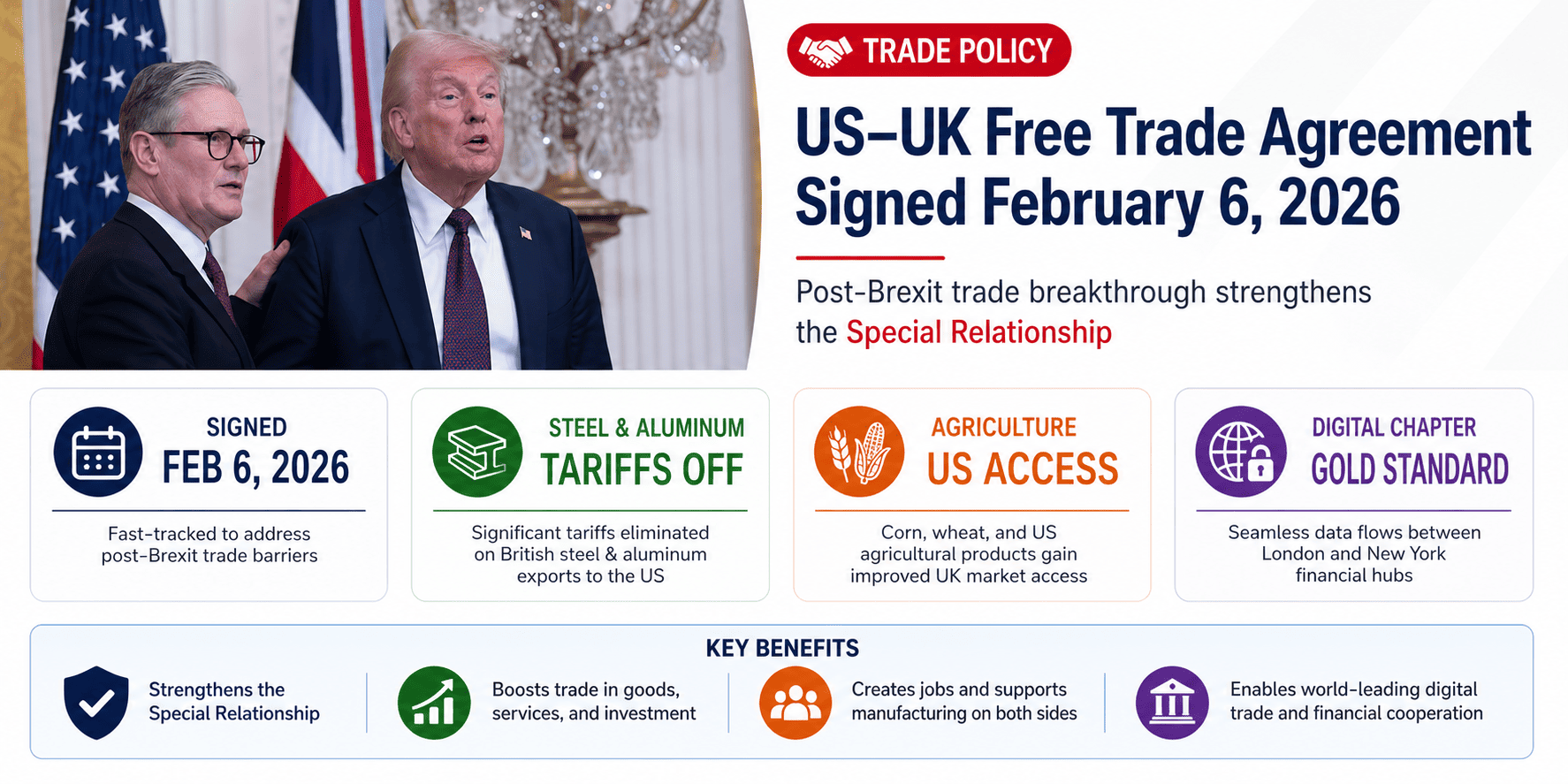
When the world’s largest economy signs a comprehensive free trade agreement with its closest strategic partner, the signal transcends tariff schedules: this is a structural rewiring of the transatlantic trade architecture, tackling post-Brexit frictions, eliminating steel and agricultural barriers, and setting a precedent for financial data sovereignty with a dedicated digital trade chapter that observers are calling the “Gold Standard” for modern FTAs.
The US–UK Free Trade Agreement was signed on February 6, 2026, fast-tracked to resolve post-Brexit trade barriers and deepen the Special Relationship. The deal delivers on three fronts: it removes significant tariffs on British steel and aluminum entering the US market; it lifts tariffs on US agricultural exports including corn and wheat heading to the UK; and it includes a landmark “Gold Standard” digital trade chapter enabling seamless cross-border data flows between the London and New York financial centres. For manufacturers, exporters, and financial services firms, the FTA opens material new pathways, and introduces a compliance and opportunity landscape that rewards those already positioned with verified transatlantic partners (GTsetu verifies company identity on 6 points using government ties: Name, Address, Registration Number, Company Status, Company Type, Date of Certificate of Incorporation).
The most immediate relief for British manufacturers arrives in the metals sector. The Section 232 tariffs, 25% on steel and 10% on aluminum, that the US imposed in 2018 and maintained through successive administrations remained a persistent drag on UK industrial exports. The FTA removes these tariffs for UK-origin product, subject to rules-of-origin and melted-and-poured criteria that prevent third-country circumvention.
The removal of steel and aluminum tariffs is not a symbolic gesture, it restores UK producers to competitive parity with Canada and Mexico under USMCA, reshaping the transatlantic metals trade map overnight.— GTsetu editorial synthesis of FTA tariff schedule analysis
| Sector | Previous Tariff Position | Post-FTA Position | Impact |
|---|---|---|---|
| British steel | 25% Section 232 tariff (US) | ✓ Eliminated | UK producers regain cost parity with USMCA partners in US market |
| British aluminum | 10% Section 232 tariff (US) | ✓ Eliminated | Aerospace-grade and packaging aluminum export economics substantially improved |
| US corn | UK MFN / WTO tariff applicable post-Brexit | ✓ Preferential rate | US agricultural exporters gain over EU corn for UK feed and processing supply chains |
| US wheat | UK MFN tariff applicable | ✓ Preferential rate | US wheat gains milling and export share in UK, volume uplift expected within 12–24 months |
| UK manufactured goods | Mixed; some MFN, some subject to quotas | ~ Phased reduction | Tariff schedules phase down over 5–10 year tracks for sensitive categories |
| Pharmaceuticals | Largely duty-free already | ✓ Maintained + regulatory harmonisation pathway | FDA–MHRA recognition framework accelerates market access timelines |
The tariff elimination on steel and aluminum applies to UK-origin product under melted-and-poured criteria. Manufacturers sourcing slab or billet from third countries for finishing in the UK should review their origin qualification before assuming preferential access. GTsetu-verified UK partners (6-point government identity verification) are well-positioned to navigate these requirements, though rules-of-origin compliance remains your responsibility to verify.
The agricultural chapter was among the most contentious in negotiations, UK consumer groups and farming unions pushed back on US hormone-treated beef and chlorinated chicken standards. The final text navigates this by granting preferential tariff access to specific US commodity crops (corn and wheat prominently cited) while retaining UK food safety standards for processed and fresh products. This represents a phased opening rather than wholesale alignment to US agricultural norms.
US corn exporters gain preferential rates into the UK, displacing some EU and Black Sea volume in UK animal feed and bioethanol processing. AHDB and USDA forecasts suggest volume uplift of 15–25% within two harvest cycles as contracts reprice to new tariff economics.
Hard red winter wheat, a US specialty, gains meaningful access for the UK milling sector. UK bakers and flour millers operating on blended grist strategies will benefit from greater competition and potentially lower input costs versus current EU and Canadian supply.
UK food safety standards on hormone treatment and chlorine washing are preserved in the FTA text. However, tariff-rate quotas for US beef are expanded, allowing more conventionally-raised US beef (which can be produced to UK-equivalent standards) into the market under managed volume limits.
The most globally significant and structurally novel element of the US–UK FTA is its digital trade chapter, described by both governments and independent trade lawyers as a “Gold Standard” framework. It goes substantially further than the digital provisions in CPTPP, USMCA, or even the UK–Singapore Digital Economy Agreement.
Unlike GDPR-era data transfer mechanisms (SCCs, adequacy decisions) which are subject to legal challenge, the digital trade chapter creates treaty-level obligations that override domestic regulatory change. For compliance teams, this means UK–US data flows are shielded from the recurring Schrems-style risk that has disrupted EU–US data infrastructure. The framework is widely viewed as a model for future digital trade agreements globally.
The US–UK FTA is a structural market-access event, not a marginal policy change. For manufacturers, the winners are those already positioned with verified US and UK supply chain partners (GTsetu verifies company identity on 6 points: Name, Address, Registration Number, Company Status, Company Type, Date of Certificate of Incorporation). Note: GTsetu does NOT verify rules-of-origin compliance, regulatory certifications, export readiness, tax compliance, import/export licences, industry certifications, or financial standing. Those remain your responsibility to verify independently as part of your FTA compliance program.
Tariff elimination is not automatic on signing, it takes effect on the entry into force date following ratification by both legislatures. Exporters should not adjust pricing or contractual commitments until formal EIF proclamation. Rules-of-origin documentation requirements apply from EIF, not from signing. Consult your customs broker and trade counsel before adjusting classification or invoicing. GTsetu verifies company identity only; rules-of-origin and regulatory compliance are your responsibility.
The deal is signed. The tariff savings are real. GTsetu helps UK and US manufacturers, exporters, and financial services firms find government-identity-verified cross-border partners (6 points: Name, Address, Registration Number, Company Status, Company Type, Incorporation Date), NDA-protected from first technical touch, so you move before competitors do. Note: Rules-of-origin compliance and regulatory certifications remain your responsibility to verify.
Find verified partners free → Browse the network
Business Development Expert | International Trade & Strategic Partnerships
Daniel Carter is a Business Development Expert at GTsetu, specializing in global trade, international business expansion, and strategic partnership development. With extensive experience working across multiple industries and markets, Daniel helps organizations identify growth opportunities, build commercial relationships, and expand their international footprint.
His expertise includes cross-border collaborations, market entry strategies, supply chain partnerships, manufacturing ecosystems, and business matchmaking. Through his work at GTsetu, Daniel supports companies seeking to establish meaningful connections with partners, distributors, investors, and industry stakeholders across global markets.
Daniel is committed to helping businesses unlock new opportunities through collaboration-driven growth and practical international trade strategies.