Leonardo’s €142B Strategic Leap: Industrial Plan 2026-2030
On March 12, 2026, Italy’s Leonardo S.p.A. unveiled its most ambitious industrial plan yet, projecting €142 billion in cumulative orders, a 9% revenue CAGR, and an entirely new multi-domain security architecture worth €21 billion. Here is the full analysis, what it means for the global supply chain, and the collaboration playbook every aerospace manufacturer needs.
⚡ Direct Answer
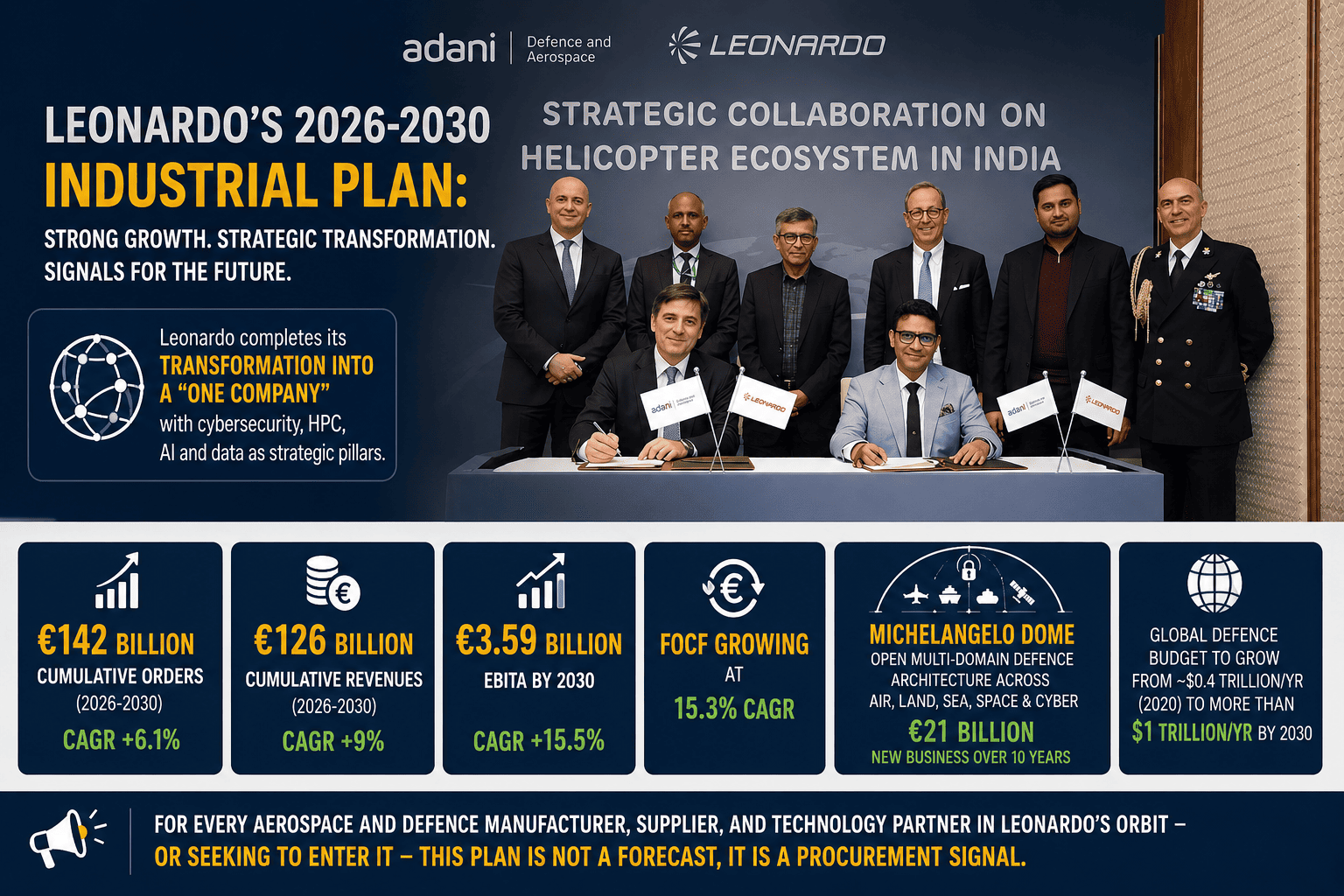
Leonardo S.p.A. has approved its 2026-2030 Industrial Plan projecting €142 billion in cumulative orders (CAGR +6.1%), €126 billion in cumulative revenues (CAGR +9%), EBITA growing at 15.5% CAGR to €3.59 billion by 2030, and FOCF growing at 15.3% CAGR. The plan completes Leonardo’s transformation into a “One Company” multinational with cybersecurity, HPC, AI and data as strategic pillars. The Michelangelo Dome, an open multi-domain defence architecture spanning air, land, sea, space and cyber, is expected to unlock €21 billion in new business over 10 years. The global defence budget is simultaneously projected to grow from ~$0.4 trillion/year (2020) to more than $1 trillion/year by 2030. For every aerospace and defence manufacturer, supplier, and technology partner in Leonardo’s orbit, or seeking to enter it, this plan is not a forecast, it is a procurement signal.
📅 March 28, 2026⏱ 18 min read✍️ GTsetu Editorial Team📰 News Analysis + Collaboration Playbook
Cumulative Orders
€142B
2026-2030 total orders; CAGR +6.1% from 2025
Revenue CAGR
+9%
€19.5B (2025) → €30B (2030), 54% revenue growth
Michelangelo Dome
€21B
Multi-domain architecture opportunity over 10 years
1
The News: Leonardo’s 2026-2030 Industrial Plan, Full Story
✈
Announced March 12, 2026, Rome, Italy
Leonardo Unveils €142B Industrial Plan, Targets Global Security Leadership with Cybersecurity, AI, HPC, and the Michelangelo Dome
On March 12, 2026, Leonardo S.p.A., Italy’s premier aerospace, defence and security group and a member of the FTSE-MIB, presented its 2026-2030 Industrial Plan update to the financial community in Rome. The Board of Directors, chaired by Stefano Pontecorvo, had unanimously approved the plan the previous day. It is the most ambitious financial and strategic roadmap in the Group’s modern history.
The plan projects €142 billion in cumulative orders over the five-year period, representing a CAGR of 6.1% from 2025’s €23.8 billion. Revenues are projected at €126 billion cumulatively, a 9% CAGR, with 2030 revenues alone reaching €30 billion, up from €19.5 billion in 2025. EBITA is targeted to grow at a 15.5% CAGR, effectively doubling profitability by 2030. Free Operating Cash Flow is projected at €8 billion cumulative over the period.
The plan formalises the completion of Leonardo’s transition to a “One Company” multinational structure, and positions the Group as what its CEO Roberto Cingolani calls “the high-tech player in global security with the most comprehensive portfolio in the sector.” The strategic pillars are unambiguous: cybersecurity, high-performance computing (HPC), artificial intelligence, and data. Leonardo simultaneously announced three completed acquisitions around the plan’s launch, GEM Elettronica, Becrypt (UK), and Iveco Group’s Defence Business, signalling that inorganic growth is immediately active, not aspirational.
€142B
Cumulative orders 2026-2030 at CAGR +6.1%
€30B
Target revenues in 2030, up 54% from €19.5B in 2025
75,500
Target employees by 2030, up from 62,700 in 2025
3 Acq.
GEM Elettronica, Becrypt UK, Iveco Defence, all March 2026
+21%
Dividend increase in 2026 with further growth committed over the Plan
“We have successfully met all the targets set out in our first Industrial Plan, exceeding all expectations. We now have platforms across every domain, and we have invested heavily in digital technologies, AI and cybersecurity.”
— Roberto Cingolani, CEO and General Manager, Leonardo S.p.A.
“Today, Leonardo presents itself to the market as a unique industrial player, reinforced by the recent launch of the Michelangelo Dome, a tangible application of the Group’s multidomain vision.”
— Roberto Cingolani, CEO and General Manager, Leonardo S.p.A.
💡 GTsetu Perspective
When one of Europe’s largest defence and aerospace groups commits to doubling its revenue, from €19.5B to €30B, in five years, it cannot do that alone. Every billion euro of additional Leonardo revenue flows through a supply chain: composites, precision machining, electronics sub-assemblies, software, cybersecurity modules, satellite systems, training services, MRO. The question is not whether Leonardo’s supply chain will expand, the plan mandates it. The question is: which verified, capable partners will be in position when the procurement cycle opens? GTsetu exists to make that answer clear.
Section 2, Financial KPIs
2
Full Financial KPI Breakdown, What the Numbers Actually Mean
The 2026-2030 plan is not aspirational forecasting, it is Inside Information disclosed under Italian market regulation. These numbers have legal standing. Here is what each metric means for the supply chain.
Cumulative Orders 2026-2030
€142B
▲ +6.1% CAGR from 2025
Orders by 2030: €32B, up from €23.8B in 2025. Backlog grows continuously.
A 9% revenue CAGR over five years means Leonardo must grow its annual revenue by approximately €2 billion per year on average. No prime contractor delivers that growth organically, it flows through a supply chain of thousands of Tier 1, 2, and 3 suppliers. Aerostructures alone targets 17.8% revenue CAGR, which effectively demands a parallel expansion in composite, machined structures, and bonded assembly suppliers. The procurement signal embedded in this plan is one of the clearest in European aerospace in the past decade.
2025 Baseline vs 2030 Target, Side-by-Side
Metric
2025 Baseline
2030 Target
Growth
CAGR
Supply Chain Signal
Orders
€23.8 billion
€32 billion
+€8.2B
+6.1%
34% more backlog to fulfil, direct supplier volume uplift
3
The Michelangelo Dome, €21 Billion Multi-Domain Opportunity
🔮
🔮 New Architecture, Announced March 12, 2026
Michelangelo Dome: Leonardo’s Open Multi-Domain Defence Architecture
The Michelangelo Dome is not a single product. It is an open, modular, scalable architecture that integrates proprietary capabilities across all five military domains through AI, HPC, cloud and data fusion, creating a dynamic “protective dome” over national critical infrastructure. The core component, MC5, is a plug-in module enabling interoperability, low-latency decision-making, and integration with third-party platforms including NATO-standard systems. It is designed to intercept, track and neutralise threats from ballistic and hypersonic missiles to large swarms of drones.
€21B
Total 10-year business opportunity across all domains
4
Division-by-Division Growth, Where the Procurement Surge Is Hottest
Not all divisions grow equally. The plan is explicit about which segments will deliver the highest growth, and consequently, where supply chain demand will be most acute. Here is where the opportunity heat map shows the brightest signals.
🔥 Hottest
🛰 Space Division
Orders CAGR
+20.7%
Revenue CAGR
+20.2%
EBITA CAGR
+26.4%
🔥 Very Hot
🔐 Cyber Division
Orders CAGR
+13.7%
Revenue CAGR
+14.5%
EBITA CAGR
+21.5%
🔥 High Growth
🏗 Aerostructures
Orders CAGR
+12.9%
Revenue CAGR
+17.8%
EBITA Target
Breakeven ’28
📈 Strong
⚡ Defence Electronics (incl. DRS, MBDA, Hensoldt)
Orders CAGR
+4.8%
Revenue CAGR
+8.5%
EBITA CAGR
+12.1%
✈ Solid
✈ Aircraft (incl. GCAP, UAV)
Orders CAGR
+2.1%
Revenue CAGR
+9%
EBITA CAGR
+7.6%
🚁 Stable
🚁 Helicopters Division
Orders CAGR
+4%
Revenue CAGR
+3.7%
EBITA CAGR
+6.4%
⚠️ The Aerostructures Breakeven Signal, Read This Carefully
Leonardo’s Aerostructures division targets EBITA breakeven by 2028 despite 17.8% revenue CAGR. This is a structural pivot: the division is scaling rapidly but not yet profitable. This means Leonardo will be actively seeking cost-efficient, high-quality Tier 2 and Tier 3 aerostructure suppliers, composites, machined frames, bonded structures, at competitive pricing, not premium pricing. Suppliers who can offer AS9100-qualified production at competitive cost with full traceability will find Aerostructures the most accessible entry point into the Leonardo supply chain in this plan period.
Section 5, Global Context
5
The Global Defence Budget Explosion, Why This Plan Is Not Just About Leonardo
🌍 Global Security Budget Context 2020-2030
The World Is Spending More on Security Than at Any Point Since WWII, And It’s Accelerating
Leonardo’s plan is not written in a vacuum. It is a response to, and a bet on, the most significant acceleration in global defence spending in modern history. The threat environment has fundamentally changed: hypersonic missiles, drone swarms, cyber-attacks, and hybrid warfare against critical infrastructure have expanded the definition of security beyond traditional perimeter defence. Nations are rebuilding defence budgets at historic speed.
~$0.4T
Global security budget per year in 2020, the pre-acceleration baseline
>$1T
Projected global security budget per year by 2030, 2.5× increase in a decade
~$1T/mo
Projected economic impact of cybercrime per month by 2030, up from $1T/year in 2020
NATO
2% GDP commitment now minimum; many members exceeding 3%, direct procurement uplift
Dual-Use
Security now covers agriculture, energy, finance, transport, markets Leonardo is explicitly targeting
GCAP
UK-Italy-Japan combat air programme, multi-billion supply chain opportunity spanning three nations
🎯 The GTsetu Perspective
A $1 trillion global security budget by 2030 does not flow through five prime contractors, it flows through thousands of verified Tier 1, 2, and 3 suppliers, technology partners, and service providers. Leonardo alone is planning to spend the equivalent of €112 billion on its own supply chain over five years (€126B revenue minus internal labour and margins). The question for every manufacturer in aerospace, electronics, cyber, space, and advanced materials is not whether the opportunity exists, it is whether they will be verified, visible, and positioned when the procurement decisions are made.
Section 6, Why Collaborate
6
Why Defence Giants Like Leonardo Collaborate, And Why You Must Too
Leonardo’s plan explicitly mentions “strategic international partnerships and joint ventures” as one of the four pillars that enabled its first Industrial Plan’s success, alongside portfolio rationalisation, M&A, and digitalisation. For suppliers and technology partners, understanding why Leonardo collaborates is the key to positioning as a partner they seek out rather than one they stumble across.
Speed
Organic technology development takes decades; partnerships compress timelines to years or months
IP
Strategic capabilities, cyber, HPC, AI, are built faster through licensed IP and proven technology partners
Geographies
US (Leonardo DRS), UK, Japan (GCAP), Saudi Arabia, local partners unlock national procurement that pure-exports cannot
Risk
JV structures share R&D risk, capital risk, and commercial risk, essential for €21B Dome-scale bets
Capability
No single company has all capabilities: MBDA for missiles, Hensoldt for sensors, each fills a gap Leonardo cannot efficiently close alone
Scale
From €19.5B to €30B requires supply chain scale that only verified, production-ready Tier 1-3 partners can deliver on schedule
Section 7, Collaboration Types
7
4 Collaboration Structures Leonardo Uses, Which One Applies to You?
Leonardo does not use a single collaboration structure. Its plan explicitly references JVs, programme cooperation, M&A, and technology transfer. For a manufacturer seeking to participate in the Leonardo ecosystem, understanding which structure fits your capability and scale is the first strategic decision.
01
Strategic Joint Ventures
Deep equity-sharing partnerships for major product lines. MBDA (missiles), Hensoldt (sensors), Leonardo-Rheinmetall Military Vehicles, LBA Systems, and the new Bromo Space JV with Airbus and Thales. Highest integration, deepest capability sharing. For Tier 1 partners with €100M+ addressable revenue.
🤝 MBDA · Hensoldt · Rheinmetall · Bromo
02
International Programme Cooperation
Government-to-government frameworks creating multi-decade supply chains: GCAP with Japan and UK for the next-generation combat air system. Partners are chosen at national and programme level, but Tier 2/3 suppliers are qualified through the Tier 1 chain. Understanding GCAP’s supply chain is where most opportunities lie.
✈ GCAP · UAV Programmes
03
Technology Licensing / Technical Assistance
IP transfer arrangements where Leonardo or its partners provide technical knowhow without full equity integration. Active in cybersecurity (Becrypt acquisition), HPC, and AI sub-systems. For technology companies with specific cyber, AI, or HPC capabilities that Leonardo needs faster than it can develop internally.
💡 Cyber · AI · HPC Transfer
04
Supplier Qualification (Tier 2/3)
The most accessible entry point for most manufacturers. Qualify as a verified, AS9100-certificated component or sub-system supplier through the LEAP programme and Leonardo’s supplier register. Demonstrated quality + cost competitiveness + ESG compliance = the three-dimensional filter. Aerostructures is the fastest-opening door.
🏭 LEAP Supplier Programme
📊 Leonardo Collaboration Structure Comparison, Which Fits You?
Structure
Revenue Scale Required
Capital Needed
Timeline to First Revenue
IP Exposure
Strategic JV
€100M+
Very High
3–5 years
Very High, shared entity
Programme Cooperation
€50M+ (Tier 1)
High
5–10 years (programme lifecycle)
High, Government security frameworks
Technology Licensing
€5M–€50M
Low–Medium
12–24 months
Medium, IP protected by NDA and licence
Tier 2/3 Supplier
€1M–€50M
Certification cost
12–36 months (qualification)
Low, component-level specs only
Section 8, How to Collaborate
8
How to Enter Leonardo’s Supply Chain: A 5-Step Playbook
The Leonardo supply chain does not welcome cold introductions, unverified claims, or incomplete quality documentation. The companies that will win business from the €142B plan are those who start the qualification process before the procurement cycle opens, not after. Here is the systematic playbook.
1
Map Your Capability Against Leonardo’s Specific Growth Divisions
Not all aerospace capability fits all Leonardo divisions. Space (+20.2% revenue CAGR) needs satellite sub-systems, precision optics, and space-qualified electronics. Cyber (+14.5%) needs cybersecurity software, secure hardware modules, and threat intelligence. Aerostructures (+17.8%) needs composite structures, CNC-machined frames, and precision fastener assemblies. Match your specific capability to the division with the highest CAGR where you can genuinely compete, that is where procurement pressure is highest and qualification queues move fastest.
2
Build a Verified Capability Profile, Not a Self-Reported Brochure
Leonardo’s supplier portal requires verifiable credentials: AS9100 certification, NADCAP approval (for special processes), financial statements, ESG compliance documentation, and trade references. The LEAP supplier development programme includes ESG requirements in all procurement tenders. This is not paperwork, it is a filter. GTsetu’s 6-point government-sourced verification process (Name, Address, Registration Number, Company Status, Company Type, Date of Incorporation) creates a baseline independently-documented profile before you approach any Tier 1 partner. Certifications (AS9100, NADCAP, ISO 9001) and production capability are self-declared and must be independently verified by you.
3
Protect Your IP Before Any Technical Disclosure
Aerospace manufacturing IP, process parameters, materials specifications, tolerance data, software source code, has dual commercial and security value. Before sharing any technical detail with any potential partner in the supply chain, execute a mutual NDA. In defence specifically, IP leakage can have consequences beyond commercial loss. GTsetu’s built-in NDA workflow is executed and countersigned before any sensitive information is shared, with a full digital audit trail, the minimum standard for any aerospace collaboration conversation.
4
Find Your Tier 1 Introduction Partner, Not the Prime Contractor Directly
Most Tier 2 and Tier 3 manufacturers reach prime contractors like Leonardo through existing Tier 1 partners, not through direct applications to the supplier register. The Tier 1 partner’s endorsement carries weight that a cold application cannot replicate. Identifying which Tier 1 companies are expanding their own supply chains in your specific capability segment, and who among them are actively seeking verified partners, is the strategic leverage point. GTsetu’s network surfaces exactly these verified Tier 1 aerospace partners across Europe, North America, and Asia.
5
Enter Through a Scoped Pilot, Not a Programme-Level Bet
Every Leonardo division talks about “operational excellence” and “confirmed efficiency plans across all divisions” in the context of the plan’s 15.5% EBITA CAGR target. This means suppliers who demonstrate excellence on a small, scoped pilot contract, on-spec, on-schedule, within cost, are positioned for programme-scale volume. The entry mechanism is always small. The qualification risk is always assessed on the first contract. Treat every initial supply contract as a demonstration, not a commercial transaction.
Section 9, Dos and Don’ts
9
Dos and Don’ts of Aerospace & Defence Collaboration
✅ Do These
✅ Obtain AS9100, NADCAP, and relevant quality certifications before initiating any Tier 1 conversation
✅ Register on Leonardo’s official supplier portal and complete the self-registration process as a baseline step
✅ Match your specific capability to the highest-CAGR division where your product fits, Space, Cyber, Aerostructures are hottest
✅ Sign a mutual NDA before sharing tolerance data, process parameters, or software specifications
✅ Build ESG compliance documentation, Leonardo’s LEAP programme includes ESG in all supplier tenders
✅ Target Tier 1 introduction partners first, not direct prime contractor applications; the Tier 1 endorsement matters
✅ Use GTsetu’s 6-point government-sourced verification (Name, Address, Registration Number, Company Status, Company Type, Date of Incorporation) to establish a credible baseline, and independently verify certifications
✅ Demonstrate excellence on a scoped pilot before expecting programme volumes
✅ Understand GCAP’s three-nation supply chain (Italy, UK, Japan), it creates qualification reciprocity across all three
✅ Treat Aerostructures’ breakeven-by-2028 target as a cost-efficiency procurement signal, competitive pricing matters here
❌ Avoid These
❌ Approach Leonardo’s supplier portal without complete certification and ESG documentation, incomplete applications are rejected
❌ Share technical specifications or process data before an NDA is countersigned, defence IP has legal and security consequences
❌ Apply for programme-level volumes without qualifying on a pilot contract first
❌ Assume your general aerospace capability maps to defence standards, MIL-SPECs, export controls, and security clearances are distinct
❌ Ignore ITAR/EAR export control requirements for any component with dual-use technology
❌ Compete on price alone in the cyber and space divisions, Leonardo’s highest-CAGR segments value verified capability over cost savings
❌ Underestimate the qualification timeline, Tier 2 supplier qualification in aerospace takes 18–36 months minimum
❌ Claim existing JV relationships as a shortcut, every Leonardo JV has independent governance with its own supply chain qualification
❌ Neglect supply chain ESG requirements, Leonardo’s plan explicitly commits to engaging suppliers in ESG training and compliance
❌ Wait for the procurement cycle to open before building your verified profile, by then, positions are already allocated
Section 10, Misconceptions
10
Common Misconceptions That Kill Aerospace & Defence Partnerships
❌ Myth
“Leonardo’s plan is about products, it doesn’t affect our supply chain business.”
✅ Reality
Every €1 of Leonardo revenue growth requires proportional supply chain spend. The plan’s €10.5B revenue increase from 2025 to 2030 does not come from Leonardo’s internal labour alone, it flows through thousands of qualified suppliers. The plan is the most explicit procurement signal a supplier can have. Aerostructures’ 17.8% revenue CAGR target requires more composite structures, machined parts, and bonded assemblies than Leonardo can currently source.
❌ Myth
“Defence procurement is only accessible to large companies, SMEs cannot enter this supply chain.”
✅ Reality
Leonardo’s Tier 3 and sub-Tier supply chain includes thousands of SMEs globally. The LEAP supplier programme is specifically designed to develop suppliers at all scales. SMEs with verified, AS9100-qualified niche capabilities in composites, precision machining, electronics sub-assemblies, or software modules are actively sought. The barrier is not size, it is documentation, certification, and verified capability. GTsetu’s verification process levels the playing field by creating credible profiles for manufacturers at every scale.
❌ Myth
“We can apply to Leonardo’s supplier portal and expect a response within weeks.”
✅ Reality
Aerospace supplier qualification is measured in months, not weeks. The standard Tier 2 qualification involves documentation review, factory audit, first article inspection, and controlled initial production. The correct approach is to begin qualification through a Tier 1 introduction partner whose endorsement pre-validates your capability, reducing the prime contractor’s qualification burden and accelerating the timeline. Direct portal applications without prior relationship are slower and statistically less successful.
❌ Myth
“The Michelangelo Dome is Leonardo’s internal technology, there’s no supplier role.”
✅ Reality
The Michelangelo Dome is explicitly described as an open, modular architecture designed for interoperability with third-party platforms. Its MC5 plug-in module integrates third-party systems across all five domains. The €21B opportunity includes sub-system suppliers across electronics, cyber, drones, HPC, AI, and space. Every company with verified capability in any of these segments has a potential Dome supply chain role.
❌ Myth
“GCAP is a UK-Italy-Japan government programme, it doesn’t create commercial supplier opportunities.”
✅ Reality
GCAP will be one of the largest defence procurement programmes in history, spanning three nations. Its supply chain, airframe structures, avionics, radar systems, propulsion sub-systems, training systems, MRO, will involve hundreds of qualified suppliers across all three countries. A verified aerospace supplier qualified in any of the three GCAP nations (Italy, UK, Japan) has a structural advantage in accessing this programme’s supply chain. GTsetu’s network spans all three geographies with verified aerospace partners.
Section 11, GTsetu
11
How GTsetu Connects You to the Global Aerospace & Defence Supply Chain
Leonardo did not build its supply chain through trade fair handshakes. It built it through systematic verification, structured partnership frameworks, and multi-decade relationship management. For the companies that will win business from the €142B plan, and the parallel expansions underway at BAE Systems, Rheinmetall, MBDA, Saab, and dozens of other prime contractors, the same systematic approach is required. GTsetu is built to deliver exactly that.
🌐 Platform Spotlight, GTsetu
Find Verified Aerospace & Defence Partners Across 100+ Countries, Before the Procurement Cycle Opens
GTsetu is the verification-first B2B manufacturing discovery platform connecting aerospace manufacturers, defence technology companies, cyber specialists, space sub-system suppliers, and Tier 1 introduction partners across 100+ countries, with 6-point government-sourced verification (Name, Address, Registration Number, Company Status, Company Type, Date of Incorporation), built-in NDA workflows, and zero broker commission on any partnership formed. In a sector where unverified capability claims can cost lives as well as contracts, verification of core business identity is not optional. It is the foundation of every conversation on GTsetu. Certifications, production capability, and ESG compliance are self-declared and must be independently verified by users.
✅
6-Point Government-Sourced VerificationGTsetu verifies Name, Address, Registration Number, Company Status, Company Type, Date of Incorporation using government tie-ups. Certifications and production capability are self-declared.
🕵️
Anonymous DiscoveryEvaluate verified aerospace partner profiles without revealing your identity until mutual interest is confirmed.
📄
Built-In NDA WorkflowMutual NDA executed and countersigned automatically before any technical specification is shared, full audit trail.
🚫
Zero CommissionNo broker fees on any partnership formed. All commercial terms are directly between the two parties.
🌍
100+ CountriesVerified aerospace partners across Italy, UK, Japan (GCAP triad), Germany, France, USA, India, and 95+ more countries.
🔐
Encrypted WorkspaceShare manufacturing process data, tolerance specifications, and engineering documentation securely with verified partners only.
What Leonardo’s Supply Chain Demands, What GTsetu Enables For Your Company
How Leonardo Qualifies Partners
What GTsetu Enables for You
Why This Matters
Multi-point capability verification before any supplier qualification begins
✓ 6-point government-sourced verification (Name, Address, Registration Number, Company Status, Company Type, Date of Incorporation) built before you approach any Tier 1 contact. Certifications self-declared.
Your first impression is documented core identity, not just a brochure claim
ESG compliance requirements embedded in all procurement tenders (LEAP programme)
✓ ESG documentation is self-declared; platform does not verify ESG status
You must prepare and present your ESG documentation independently
✓ Network of verified Tier 1 aerospace partners across GCAP nations and beyond
Your introduction comes with a verified intermediary’s credibility, not a cold portal application
IP protection via formal NDA before technical data exchange
✓ Built-in NDA workflow with audit trail before any specification is shared
Your aerospace IP is protected from the first conversation, not negotiated after the fact
Global supply chain with no concentrated exposure to any single country or customer
✓ 100+ country verified partner discovery, the same geographic diversification philosophy
You can find the right partner in the right geography for each specific programme
Direct commercial terms, no intermediary in supplier agreements
✓ Zero commission, your partnership or supply contract is directly between you and your partner
No broker splits your commercial margin or misaligns the negotiation incentives
FAQ
?
Frequently Asked Questions
Q
What is Leonardo’s 2026-2030 Industrial Plan and what are its key targets?
Leonardo’s 2026-2030 Industrial Plan, approved March 11 2026 and presented March 12 2026, projects €142 billion in cumulative orders (CAGR +6.1%), €126 billion in cumulative revenues (CAGR +9%), EBITA growing at 15.5% CAGR to €3.59 billion by 2030, and FOCF growing at 15.3% CAGR. The plan completes the transformation to a “One Company” multinational model, with cybersecurity, HPC, AI and data as strategic pillars. The Michelangelo Dome, the Group’s new open multi-domain defence architecture, is expected to unlock €21 billion in new business over 10 years. 28,000 additional hires are planned (2026-2030), with 70% STEM backgrounds and 55% under 30.
Q
What is the Michelangelo Dome and what supplier opportunities does it create?
The Michelangelo Dome is Leonardo’s open, modular, scalable multi-domain defence architecture integrating capabilities across air, land, sea, space and cyber domains using AI, HPC, cloud and data fusion. It is built around the MC5 plug-in module, enabling interoperability with third-party platforms including NATO-standard systems. The Dome is expected to unlock €21 billion in new business over 10 years, €6 billion in 2026-2030 (already in the plan) plus €15 billion in 2031-2035. Supplier opportunities span electronics, cybersecurity, drones, fixed- and rotary-wing platform integration, HPC/AI, and new space systems. Every verified Tier 2/3 supplier in these segments has a potential role.
Q
Which Leonardo division has the highest growth rate and best supplier opportunities?
The Space Division has the highest projected CAGR, orders +20.7%, revenues +20.2%, EBITA +26.4%. The Cyber Division is second: orders +13.7%, revenues +14.5%, EBITA +21.5%. Aerostructures targets 17.8% revenue CAGR with EBITA breakeven by 2028, making it both high-growth and actively cost-sensitive, which creates an accessible entry point for competitive, quality-qualified composite and machined structures suppliers. Defence Electronics (including Leonardo DRS, MBDA and Hensoldt JVs) is a solid +8.5% revenue CAGR. For most manufacturers, the highest realistic entry opportunity is Aerostructures or Defence Electronics sub-systems, with Space and Cyber as targets for technology-specialist companies.
Q
How do I become a Leonardo supplier?
Leonardo operates a formal supplier qualification process: (1) Register on the Leonardo Supplier Register via self-registration at leonardo.com/suppliers. (2) Obtain required certifications, AS9100 for quality management, NADCAP for special processes (heat treatment, composites, NDT), and relevant ESG compliance documentation. (3) Complete the LEAP supplier development programme requirements, which include ESG commitments and training. (4) For most manufacturers, the most effective path is through a verified Tier 1 introduction partner, whose endorsement pre-validates your capability and reduces Leonardo’s qualification burden. GTsetu’s verified network surfaces these Tier 1 aerospace introduction partners across Italy, UK, Japan, and other GCAP and Leonardo programme nations. GTsetu verifies companies on 6 government-sourced points (Name, Address, Registration Number, Company Status, Company Type, Date of Incorporation). Certifications and production capability must be independently verified by you. (5) Qualify through a scoped pilot contract before expecting programme-level volumes.
Q
What does Leonardo’s plan mean for aerospace manufacturers outside Europe?
Leonardo’s plan explicitly states “global presence with no concentrated exposure to any single country or customer”, and the Michelangelo Dome is designed for open international cooperation and NATO interoperability. GCAP spans Italy, UK, and Japan. Leonardo DRS is the US-based defence electronics subsidiary. The global security budget growing from $0.4T/year to $1T/year by 2030 creates demand across all geographies. For manufacturers outside Europe, the specific entry points are: (1) Japan, through GCAP’s Japan supply chain; (2) USA, through Leonardo DRS’s Tier 2/3 supplier network; (3) UK, through GCAP and the helicopter programmes (AW149 contract, £1B+ UK MoD order); (4) India, through Leonardo’s growing defence and helicopter presence. GTsetu’s verified network covers all four geographies.
Q
How can GTsetu help my aerospace or defence company find the right partners?
GTsetu’s systematic process for aerospace and defence: (1) Build your verified profile, GTsetu verifies your company on 6 government-sourced points (Name, Address, Registration Number, Company Status, Company Type, Date of Incorporation). Certifications (AS9100, ISO 9001, NADCAP) are self-declared and must be independently verified. (2) Discover anonymously, browse verified profiles of Tier 1 aerospace manufacturers, defence electronics suppliers, and cyber/space technology companies across 100+ countries without revealing your identity. (3) Protect IP with built-in NDA, mutual NDA executed automatically before any technical specification is shared. (4) Find Tier 1 introduction partners, GTsetu’s network surfaces verified Tier 1 partners in GCAP nations and Leonardo programme countries who are actively expanding supply chains. (5) Zero commission, all partnerships formed are direct between the two parties, with no broker fee. Start your aerospace partner search on GTsetu →
The €142B Leonardo Plan Is a Procurement Signal. Position Now, Not After the Cycle Opens.
500+ verified manufacturers, Tier 1 introduction partners, technology companies, and aerospace specialists across 100+ countries. Zero broker fees. Anonymous discovery. Built-in NDA workflows. GTsetu verifies companies on 6 government-sourced points (Name, Address, Registration Number, Company Status, Company Type, Date of Incorporation). Certifications and production capability must be independently verified. The companies that will win from Leonardo’s plan are already building verified profiles and Tier 1 relationships, not waiting for procurement portals to open.
Business Development Expert | Global Trade & International Market Development
Sarah Ann Mitchell is a Business Development Expert at GTsetu with a strong focus on global trade, international market development, and strategic business partnerships. She works with companies seeking to expand internationally by identifying collaboration opportunities, connecting with key stakeholders, and developing market access strategies.
Sarah brings expertise in cross-border business development, international trade ecosystems, partnership building, and global market intelligence. Her work at GTsetu involves supporting businesses, manufacturers, startups, and industry leaders in building relationships that accelerate growth and create long-term commercial value.
Passionate about fostering international collaboration, Sarah helps organizations navigate evolving global markets and discover new opportunities through strategic partnerships, trade networks, and ecosystem-driven growth initiatives.