GTsetu

Tramontina × Aequs India JV: What Manufacturers Must Learn About Global Manufacturing Collaboration
🔴 BREAKING Tramontina × Aequs: Brazil’s 113-year-old kitchenware giant opens first-ever factory outside the Americas inside India’s Hubballi Durable Goods Cluster 50:50 JV, Aequs Cookware Pvt. Ltd. (ACPL), targets India’s premium cookware market and global export from Karnataka ₹80 crore investment in 400-acre Hubballi Durable Goods Cluster, North Karnataka, Make in India’s biggest global cookware play Find verified manufacturing partners on GTsetu, 100+ countries, zero commission 🔴 BREAKING Tramontina × Aequs: Brazil’s 113-year-old kitchenware giant opens first-ever factory outside the Americas inside India’s Hubballi Durable Goods Cluster 50:50 JV, Aequs Cookware Pvt. Ltd. (ACPL), targets India’s premium cookware market and global export from Karnataka ₹80 crore investment in 400-acre Hubballi Durable Goods Cluster, North Karnataka, Make in India’s biggest global cookware play Find verified manufacturing partners on GTsetu, 100+ countries, zero commission
Home  ›  Blog  ›  Tramontina × Aequs India JV
🔴 Breaking News 🍳 Consumer Goods Mfg 🇮🇳 India Manufacturing 🇧🇷 Brazil Global Expansion

Tramontina × Aequs: How a 113-Year-Old Brazilian Giant Is Building Its Future in India

Brazil’s Tramontina, a 113-year-old kitchenware company with 22,000 products in 120 countries, just opened its first factory outside the Americas in Hubballi, India, through a 50:50 joint venture with Aequs. Investment: ₹80 crore. Entity: Aequs Cookware Pvt. Ltd. Target: India’s fast-growing premium cookware market and global export from a 400-acre industrial cluster.

🎯 Direct Answer

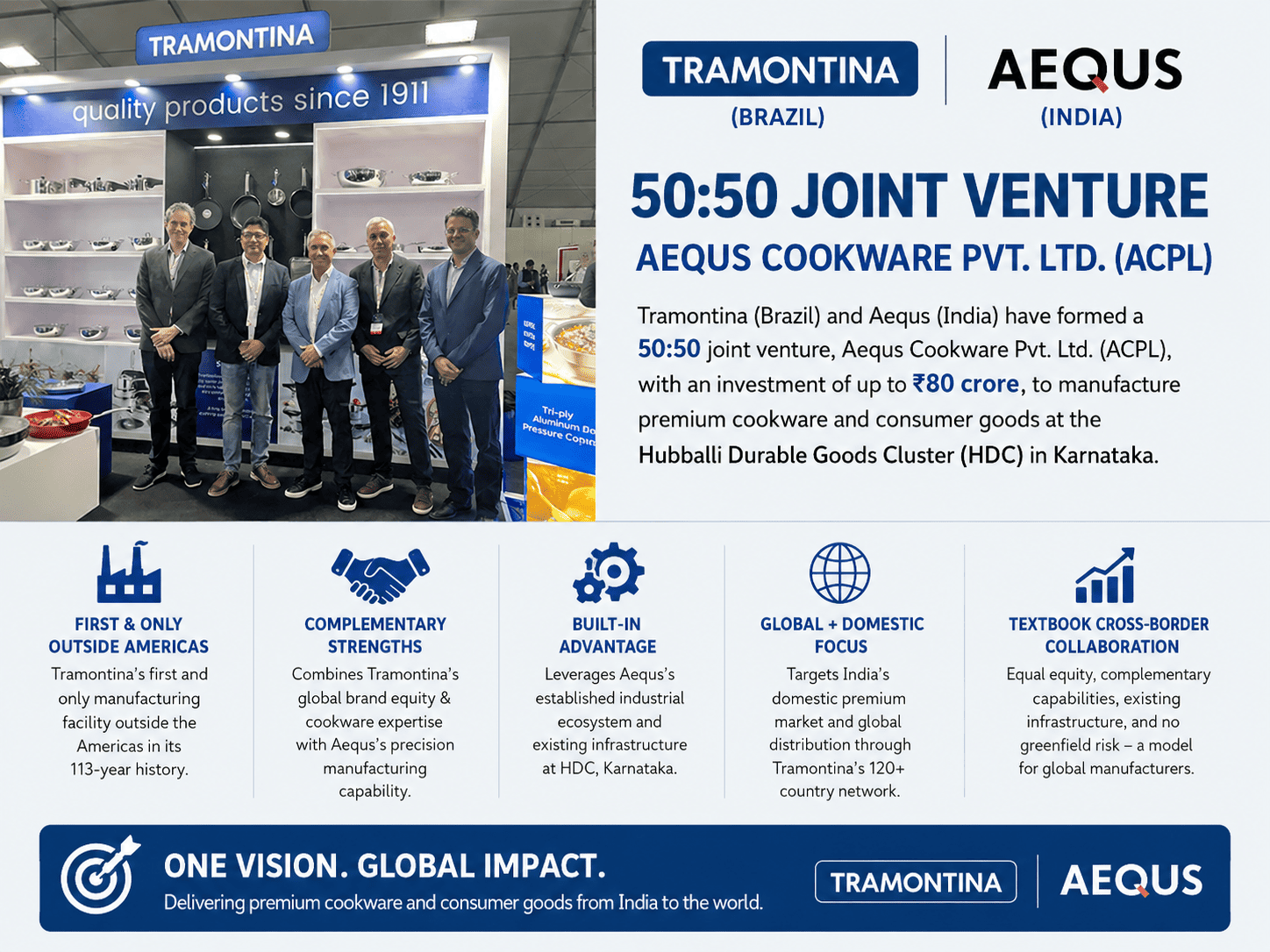
Tramontina (Brazil) and Aequs (India) have formed a 50:50 joint venture, Aequs Cookware Pvt. Ltd. (ACPL), with an investment of up to ₹80 crore, to manufacture premium cookware and consumer goods at the Hubballi Durable Goods Cluster (HDC) in Karnataka. This is Tramontina’s first and only manufacturing facility outside the Americas in its 113-year history, a decision that combines Tramontina’s global brand equity and cookware expertise with Aequs’s precision manufacturing capability and established industrial ecosystem. The JV targets both India’s domestic premium market and global distribution through Tramontina’s 120+ country network. This is a textbook example of how global manufacturers should structure cross-border collaboration: complementary strengths, equal equity, existing infrastructure, and no greenfield risk.

📅 March 13, 2026 ⏱ 16 min read ✍️ GTsetu Editorial Team 📰 News + Analysis
JV Type
50:50
Equal joint venture, Tramontina + Aequs, full shared equity and governance
Investment
₹80 Cr
Total JV investment, approximately $9.6M USD, in Hubballi facility
Tramontina Heritage
113 yrs
Founded 1911 in Brazil; 22,000 products in 120+ countries worldwide
Cluster Size
400 ac
Hubballi Durable Goods Cluster, purpose-built for consumer goods manufacturing
Section 1, The News

1 The Full Story: Tramontina × Aequs

🍳
Deal Announced, February 2025

Tramontina Opens First Factory Outside the Americas in 113 Years, Forms 50:50 JV with India’s Aequs at Hubballi Durable Goods Cluster

In February 2025, Tramontina, a Brazilian kitchenware and housewares conglomerate founded in 1911, with over 22,000 products available in 120 countries, announced a landmark 50:50 joint venture with Aequs Private Ltd., a Belagavi-based diversified precision manufacturer operating industrial clusters across three industrial zones in North Karnataka.

The new entity, Aequs Cookware Pvt. Ltd. (ACPL), will operate from the Hubballi Durable Goods Cluster (HDC) in Karnataka, a purpose-built 400-acre industrial hub designed specifically to support the consumer goods manufacturing sector. With a total investment of up to ₹80 crore (approximately $9.6 million USD), ACPL will manufacture premium cookware and consumer goods for both the Indian domestic market and for international distribution through Tramontina’s established 120+ country global network.

Most significantly: this is Tramontina’s first and only manufacturing facility outside the Americas in its 113-year history, a decision that took over a century to make, and ultimately chose India, not Southeast Asia, not Europe, not China, as the site of the company’s global expansion anchor.

1st ever
Tramontina factory outside the Americas in 113-year company history
22,000
Tramontina products across kitchenware, cutlery, and housewares categories
120+
Countries in Tramontina’s global distribution network, now sourcing from India
Karnataka
State chosen, home to 3 Aequs industrial clusters and the 400-acre HDC
“By combining Aequs’ integrated manufacturing ecosystem with Tramontina’s global strength, we will drive innovation, efficiency, and scale to deliver world-class products.”
— Aravind Melligeri, Chairman & CEO, Aequs
“The Hubballi unit will allow us to serve the global market with high-quality products under highly competitive conditions while also meeting local demand.”
— Eduardo Scomazzon, Chairman of the Board, Tramontina Brazil
💡 GTsetu Perspective

When a company that has manufactured exclusively in the Americas for 113 years decides its first overseas factory should be in India, that is not a casual decision. It is a signal. India’s combination of manufacturing cost competitiveness, engineering talent, growing domestic demand, and export positioning is now compelling enough to move century-old incumbents. Tramontina found their Aequs. The question for every global manufacturer is: what is stopping you from finding yours? GTsetu helps you find verified manufacturing partners across 100+ countries.

Section 2, Anatomy of the JV

2 Anatomy of the JV, What Each Partner Brings to the Table

The Tramontina × Aequs deal works precisely because each partner contributes what the other cannot efficiently replicate. This complementarity principle is the foundation of any collaboration worth entering. Neither company could have built this opportunity alone at anywhere near the same speed, cost, or credibility.

Collaboration Anatomy, 50:50 Joint Venture Structure (ACPL)
Tramontina
🇧🇷 Brazil, Founded 1911
What they bring
Brand + IP + Global Reach
Heritage
113 years cookware expertise
Global distribution
120+ countries, 22,000 SKUs
Specialty
Premium product design & R&D
What they lack
India presence; Asia manufacturing
JV role
Brand & Technology Provider
+
JV
Aequs
🇮🇳 Belagavi, Karnataka, India
What they bring
Factory + Cluster + Ecosystem
Cluster
400-ac HDC, Hubballi, KA
Operations
3 continents, aerospace + consumer
Specialty
Precision engineering, vertically integrated
What they lack
Global brand; cookware product IP
JV role
Manufacturing Infrastructure Provider
🎯 Entity: Aequs Cookware Pvt. Ltd. (ACPL)
🏭 Location: Hubballi Durable Goods Cluster, Karnataka
💰 Investment: Up to ₹80 crore
Collaboration Dimension What Tramontina Provides What Aequs Provides Why This Balance Works
Brand & Market Access120+ country distribution network, global brand equityLocal India market relationships and knowledgeTramontina’s brand accelerates India entry; Aequs opens domestic OEM and retail channels
Manufacturing IP113 years of product design, cookware formulations, and quality standardsPrecision engineering capabilities and process know-howTramontina knows what to make; Aequs knows how to make it in India at competitive cost
Physical InfrastructureCapital investment and quality management systems400-acre industrial cluster with machines, labor, utilities, and logisticsZero greenfield construction risk; Aequs provides a plug-and-play factory environment in a purpose-built cluster
Regulatory NavigationExport compliance, global product certifications, and international standardsIndian Make in India compliance, domestic licensing, and import duty navigationBoth partners handle their home-market regulatory complexity for the other
Capital Commitment50% equity stake, full skin in the game50% equity stake, not just a contract manufacturer, a co-ownerEqual ownership aligns incentives completely, both sides succeed or fail together
Risk ProfileBrand reputation risk; capital deployment riskOperational execution risk; capital deployment riskDifferent but real stakes on both sides, neither party is passive
⚙️ The Complementarity Principle

The anatomy of the Tramontina × Aequs JV illustrates a universal law of manufacturing collaboration: the partner who duplicates your strengths adds no value; the partner who fills your gaps multiplies them. Tramontina did not need another kitchen product designer. They needed India. Aequs did not need another precision machining operation. They needed global brand reach. The gap between these two profiles is where ₹80 crore of value creation lives. Before you search for a partner, define the gap, and then search only for partners who fill it precisely.

Section 3, Why India

3 Why India? The Manufacturing Opportunity That Moved a 113-Year-Old Company

For Tramontina, the decision to open its first non-Americas factory was not made lightly. Over a century of family ownership and deliberate manufacturing strategy preceded it. That the choice ultimately landed in India, ahead of Southeast Asia, Europe, and China, reveals exactly how compelling India’s manufacturing proposition has become in 2025.

🇮🇳 India Manufacturing Opportunity 2025–27

Why Global Manufacturers Are Choosing India as Their First Overseas Factory

India is no longer just an outsourcing destination, it is a strategic global manufacturing hub combining cost competitiveness, engineering talent, domestic consumption growth, and the Make in India government initiative. This is precisely why Tramontina’s first non-Americas factory landed in Hubballi and not in any other geography. The numbers make the case clearly.

~$250B
India’s projected consumer goods market size by 2030
300M+
India’s growing middle class, the primary premium cookware buyer segment
15–30%
Typical cost advantage vs manufacturing in developed markets like Brazil or Europe
120+
Export markets accessible from India through active FTA network
400 ac
HDC cluster size, purpose-built infrastructure; no greenfield construction required
3
Aequs industrial clusters in North Karnataka, proven manufacturing ecosystem

India’s strategic appeal for manufacturing collaboration has three dimensions that the Tramontina-Aequs deal captures perfectly. First, cost and talent, India offers engineering talent at globally competitive costs with strong technical education infrastructure and an increasingly capable precision manufacturing base. Second, domestic demand, India’s growing middle class creates immediate local market opportunity for a premium cookware brand like Tramontina, without relying entirely on export logistics. Third, global export positioning, products manufactured in India reach the Middle East, Southeast Asia, East Africa, and Europe with logistics economics that Brazilian factories operating from South America simply cannot match.

🔑 Key Lesson: Cluster Beats Greenfield Every Time

Tramontina did not buy a plot of land and build a standalone factory in India. They partnered with Aequs precisely because of the Hubballi Durable Goods Cluster, a 400-acre industrial hub with existing utilities, workforce, logistics infrastructure, and supply chain proximity. This decision eliminated 3–5 years of greenfield construction time and tens of crores in standalone infrastructure cost. Any global manufacturer evaluating India entry should ask the same question Tramontina asked: which Indian partner already has the industrial ecosystem I would otherwise need to build from scratch?

Section 4, What Is a Manufacturing Collaboration?

4 What Is a Manufacturing Collaboration, and Why Do Companies Do It?

🎯 Definition

A manufacturing collaboration is a formal arrangement between two or more companies, typically from different geographies, industries, or capability profiles, to jointly pursue a manufacturing or market objective that neither could achieve as efficiently alone. Collaborations range from lightweight (a distribution agreement) to permanent and deep (a 50:50 joint venture like Tramontina × Aequs). What makes collaboration different from simple outsourcing is the presence of mutual investment, shared risk, aligned incentives, and complementary capabilities, each party contributes something the other cannot easily replicate internally.

The Six Strategic Drivers of Manufacturing Collaboration

Market
Access local demand and distribution without building from scratch, Tramontina’s exact play in India
Cost
Leverage your partner’s infrastructure, labor, and supply chain to reduce unit costs dramatically
Speed
A partner’s existing factory and cluster beats 3–5 years of greenfield construction by every measure
Capability
Access precision engineering, certifications, or brand equity that would take decades to build in-house
Risk
Share capital exposure and operational risk, a 50:50 structure spreads the downside equally between both parties
Regulation
A local partner navigates domestic regulations, import duties, labor laws, and compliance frameworks that foreign entrants cannot easily manage alone
Section 5, Types of Collaboration

5 4 Types of Manufacturing Collaboration, Which Fits Your Situation?

Tramontina chose a 50:50 JV. But they could have licensed their brand, or contracted Aequs to manufacture for a fee, or simply sold through an Indian distributor. They chose a JV because they wanted full market ownership and deep operational control. The right structure depends entirely on what you need, how much capital you can deploy, and how deeply you want to integrate. Here are the four primary models.

01

Joint Venture (JV)

A new shared legal entity co-owned by both parties. Highest commitment, deepest integration, full profit and risk sharing. The Tramontina × Aequs model. Best when both partners have large complementary assets and a long-term market vision. Equal equity aligns incentives permanently.

⚖️ Tramontina × Aequs (ACPL)
02

Technology / IP Licensing

You license your manufacturing IP, brand, or process to a local partner who produces and sells in their market. You receive royalties without capital investment. Tramontina could have licensed their brand to an Indian manufacturer, instead they chose deeper equity participation for maximum upside.

💡 Asset-light global expansion
03

Contract Manufacturing

You own the design and brand; a partner manufactures to your specification for a per-unit fee. No equity sharing. Ideal when you need production capacity or cost reduction in a new geography without permanent commitment. Scalable and fully reversible, with the lowest capital threshold of any model.

🏭 Capacity without commitment
04

Distribution Partnership

You manufacture; a local distributor sells and services in their market. The lightest form of collaboration. Eliminates shipping lead time for end customers. Often the first step before a deeper manufacturing collaboration in a new geography, tests real demand before capital is committed.

🌍 Market entry, step 1
📊 Collaboration Model Comparison, Global Manufacturing
Model Capital Required IP Access Risk Shared? Speed to Market Reversibility
JV High, shared capex ✓ Co-developed IP ✓ Full, 50:50 Slow (12–24 months) Low
IP Licensing Low (fees/royalties) ✓ Full IP access ~ Partial Medium (6–12 months) Moderate
Contract Mfg Minimal ~ Process only ✗ Minimal Fastest (1–4 months) High
Distribution Minimal ✗ None ✗ None Fastest (1–3 months) High
Section 6, Why This JV Model Works

6 Why This JV Model Works for Global Manufacturing Expansion

🎯 The Core Logic

The Tramontina × Aequs JV succeeds because it is built on three interlocking strategic advantages: genuine complementarity between partners (neither replicates the other), existing infrastructure that eliminates greenfield risk (the 400-acre HDC cluster), and a market-timing alignment with India’s accelerating consumer premiumisation and the Make in India policy push. Neither party could have achieved the same outcome through any other mechanism, Tramontina cannot build a competitive factory in India at Aequs’s speed or cost structure, and Aequs cannot access Tramontina’s 120-country distribution network or 113 years of product IP through any shortcut.

Why India-Brazil Manufacturing Collaboration Is Accelerating

₹80 Cr
Total investment committed, a serious capital bet on India’s consumer market growth trajectory
Zero
Greenfield construction needed, HDC cluster provides ready infrastructure, saving 3–5 years of build time
50:50
Equal equity structure aligns incentives completely, both sides fully committed to ACPL’s success
Dual
Market strategy, India domestic premium consumers AND global export through Tramontina’s 120-country network
113 yrs
Tramontina product IP, impossible to replicate internally; a JV is the only efficient access route to India manufacturing
3 clusters
Aequs industrial clusters in North Karnataka, proven ecosystem with aerospace-grade engineering pedigree
🌐 GTsetu for Global Manufacturing Collaboration

GTsetu’s verified partner network includes manufacturers, contract manufacturers, distributors, and JV candidates across India, Brazil, Germany, South Korea, Japan, and 100+ other countries. Every company on GTsetu is verified on 6 government-sourced identity points: Name, Address, Registration Number, Company Status, Company Type, and Date of Certificate of Incorporation. If you’re a global manufacturer looking to enter India the way Tramontina did, through a verified local partner with an established industrial ecosystem, GTsetu is where your partner search begins with verified identity, not cold calls.

Section 7, The Playbook

7 How to Collaborate: A 5-Step Playbook for Global Manufacturers

The Tramontina × Aequs JV did not happen by accident. It followed a deliberate progression of partner evaluation, capability verification, and structured commitment. Every manufacturer seeking a global collaboration partner can adapt this playbook.

1

Define the Collaboration Objective with Precision

Before searching for a partner, answer three questions: What specific capability do I lack that a partner should provide? What do I bring that makes me an attractive collaboration partner? What does success look like in three years? Tramontina’s answers were specific, they needed India manufacturing infrastructure and local market access, and they offered 113 years of global brand equity and cookware product IP. Vague objectives produce vague partner searches and ultimately failed deals. Define the gap first, then search for the exact fit.

2

Find Verified Partners, Not Just Any Partner

The crucial word is verified. Aequs was chosen because it had demonstrated precision manufacturing at scale, operated an established industrial cluster, and had credible engineering credentials, all verifiable facts, not brochure claims. For manufacturers who don’t have an existing relationship network in a target geography, GTsetu provides verified profiles of manufacturers, contract manufacturers, and industrial partners across 100+ countries. GTsetu verifies companies using government tie-ups on 6 key identity points: Name, Address, Registration Number, Company Status, Company Type, and Date of Certificate of Incorporation. Additional information like certifications, OEM approvals, and manufacturing capabilities is self-reported and must be validated independently through your own due diligence process.

3

Protect Your IP Before Any Technical Disclosure

In manufacturing collaboration, your product designs, manufacturing processes, quality standards, and trade secrets are valuable IP. Before sharing anything sensitive, even a capability requirements document, execute a mutual NDA. This is non-negotiable regardless of how promising the initial conversation appears. GTsetu’s built-in NDA workflow handles this automatically: mutual NDA executed and countersigned before any sensitive information is shared, with a full digital audit trail. Starting production or detailed technical discussion without a signed NDA transfers all leverage to the manufacturer and creates IP theft risk that contracts cannot undo retroactively.

4

Choose the Right Collaboration Structure for Your Objective

Tramontina chose a JV for full market ownership and deep operational control. But a licensing arrangement or contract manufacturing agreement would have achieved a different set of objectives at far lower capital commitment. A JV is right when you want permanent shared ownership with full operational integration. A licensing deal is right when you want asset-light expansion through local IP commercialisation. A contract manufacturing relationship is right when you need production capacity without long-term commitment. Match the structure to the objective, not to what sounds most impressive or feels most comfortable in negotiation.

5

Formalise Everything in Writing Before Production Begins

Every collaboration needs formal documentation covering equity or revenue split, IP ownership and licensing terms, quality standards and audit rights, production volume commitments, governance and decision-making authority, and crucially, exit clauses that protect both parties if the collaboration fails. Never begin production at scale on verbal or informal terms. In cross-border collaboration, informal agreements are unenforceable by definition. Structure every collaboration milestone formally in writing: scope of the relationship, IP transfer terms, milestone conditions, quality audit rights, exclusivity clauses, and renewal and termination conditions.

Section 8, Dos and Don’ts

8 Dos and Don’ts of Global Manufacturing Collaboration

✅ Do These
  • Verify your partner’s capabilities through documented evidence, not marketing materials or trade show presentations
  • Align on quality standards in writing before production begins, verbal quality commitments are unenforceable
  • Sign NDA before sharing any product specifications, process documentation, or tolerance data
  • Run a pilot production batch before committing to full-scale investment or long-term agreements
  • Choose a partner whose capabilities are complementary to yours, the gap between your strengths is where value is created
  • Define IP ownership and licensing terms explicitly at the outset, ownership of jointly developed improvements must be agreed before creation
  • Build in exit clauses that protect both parties equitably, every JV must have a documented path for dissolution
  • Establish governance structure and communication cadence on Day 1, who decides what, how disputes are escalated
  • Leverage an existing industrial cluster (like Aequs’s HDC) rather than building greenfield, saves years and reduces risk
  • Structure equity to align incentives, equal stakes create equal commitment, as demonstrated by the 50:50 Tramontina-Aequs model
❌ Avoid These
  • Partner with an unverified company based solely on a trade fair introduction or LinkedIn recommendation
  • Share your product designs or manufacturing IP before an NDA is signed and countersigned
  • Assume cultural or operational alignment, explicitly test and document it before committing capital
  • Skip a pilot and commit to full-scale production or equity investment without operational validation
  • Negotiate on verbal or informal terms without a formal collaboration agreement before production begins
  • Partner with someone who replicates your strengths rather than filling the gap where you are weak
  • Accept self-reported capacity and certification claims without independent verification and site visits
  • Allow equity imbalances that create decision-making paralysis or one-sided resentment in governance
  • Begin a JV without agreed exit mechanisms, every partnership needs a documented path for dissolution that protects both parties
  • Underestimate the time and cost of cross-cultural communication management, India-Brazil collaboration requires explicit protocols
Section 9, Misconceptions

9 Common Misconceptions That Kill Global Manufacturing Collaborations

❌ Myth

“The cheapest local manufacturer is the best JV or contract manufacturing partner.”

✅ Reality

The best partner is the one with verified complementary capabilities. Price is one factor among many. A cheap partner who cannot hold tolerances, deliver on time, or maintain your brand’s quality standards will cost you far more in customer returns, reputational damage, and rework than a premium-priced verified partner. Tramontina chose Aequs for their precision engineering pedigree and established infrastructure, not because they were the lowest-cost option in Karnataka.

❌ Myth

“We can start producing informally and sort out the formal JV agreement once the relationship is established.”

✅ Reality

Starting production before formal agreements are in place transfers all leverage to the manufacturer. Your product is in their hands, their machines are running to your specification, and you have no documented terms. This is the single most common source of IP theft, quality disputes, and unenforceable pricing in cross-border manufacturing. Formal agreements first, production second, always. Once a factory has produced your product without clear IP ownership terms, both parties’ negotiating leverage is gone.

❌ Myth

“A JV is always superior to licensing, we should always pursue equity participation.”

✅ Reality

JVs are appropriate when both parties have large, complementary assets and a long-term shared market vision with significant capital available. Licensing works better when you want low-capital, reversible market expansion without operational responsibilities. Tramontina chose a JV because they wanted full market ownership and operational depth in India. A company with the same IP but less capital might have achieved equal strategic value through a licensing arrangement. The right structure depends on your objectives, not on a hierarchy of commitment levels.

❌ Myth

“The partner’s quoted production capacity is their real available capacity.”

✅ Reality

Self-reported capacity and real available capacity are consistently different. A factory might have large nominal capacity but if cycle time already exceeds takt time for existing customer orders, your production joins a queue. Always request current utilisation rates, lead time data from existing customers, and takt versus cycle time analysis before accepting quoted capacity figures as available capacity. GTsetu verifies identity; capacity verification remains entirely your responsibility.

❌ Myth

“A cross-continental collaboration requires permanent physical presence to manage effectively.”

✅ Reality

The Tramontina × Aequs collaboration is managed between Brazil and Karnataka without requiring permanent leadership relocation. What matters is clear protocols for document transfer, scheduled production review sessions, agreed quality audit rights, and defined escalation paths, not permanent physical proximity. The operational discipline of cross-border governance is more important than geographic presence. GTsetu’s encrypted collaboration workspace supports exactly this kind of structured cross-border operational relationship as the partnership scales.

Section 10, JV vs Licensing vs Contract Manufacturing

10 JV vs Licensing vs Contract Manufacturing, Full Comparison

Tramontina chose a JV. But the same strategic objectives could have been partially achieved through licensing or contract manufacturing at significantly lower capital risk and with faster time-to-market. Understanding the trade-offs between structures is essential before committing to any collaboration model.

Factor Joint Venture (Tramontina × Aequs) IP / Tech Licensing Contract Manufacturing Distribution Partnership
Legal structureNew co-owned entity (ACPL, 50:50)License agreement, no new entityManufacturing services agreementDistribution or reseller agreement
Capital requiredHigh, ₹80 crore in this caseLow, upfront legal + royaltiesMinimal, per-unit cost onlyMinimal, inventory terms only
Upside sharing✓ Full profit sharingRoyalty % onlyNone, you keep full marginMargin split only
Speed to productionSlowest (12–24 months setup)Medium (6–12 months)Fastest (1–4 months)Fastest (1–3 months)
Market permanence✓ Permanent entity in marketDepends on licensee performanceReversible, switch CMs anytimeReversible, change distributors
ControlShared, 50:50 = consensus requiredLow, licensee runs operationsHigh, you specify everythingModerate, you set product, they sell
Best when…Long-term vision, large opportunity, strong partner with complementary assetsAsset-light global expansion with strong IPCapacity needed fast; pilot or overflowMarket entry; demand testing; LT reduction
Section 11, GTsetu

11 How GTsetu Helps You Find the Right Global Collaboration Partner

Tramontina found Aequs. Most global manufacturers are not that fortunate, and even when a potential partner exists, identifying whether their capabilities are genuinely complementary requires systematic, verified discovery rather than ad hoc introductions. GTsetu is the verified B2B manufacturing discovery platform that enables this search at scale, across 100+ countries, before you reveal a single confidential detail about your product or company.

🌐 Platform Spotlight, GTsetu

Find Verified Manufacturing Partners, JV Candidates, and Contract Manufacturers Across 100+ Countries, Anonymously, Securely, With Zero Broker Fees

Every company on GTsetu is verified using government tie-ups on 6 key identity points: Name, Address, Registration Number, Company Status, Company Type, and Date of Certificate of Incorporation. This is the foundation of trust. Additional information such as quality certifications, manufacturing capabilities, and trade references is self-reported by companies. You evaluate who is real before you engage. You share nothing sensitive until an NDA is countersigned. And you pay no broker commission on any collaboration formed, the partnership deal is entirely between you and your partner.

6-Point Government Identity VerificationName, Address, Registration Number, Company Status, Company Type, Date of Incorporation confirmed using government tie-ups. Certifications NOT verified.
🕵️
Anonymous DiscoveryEvaluate identity-verified partner profiles without revealing your company identity until mutual interest is confirmed.
📄
Built-In NDA WorkflowShare product specs and process documentation only after NDA is executed, full audit trail, no external legal team required.
🚫
Zero CommissionNo broker fees on any partnership, your JV agreement, licensing deal, or CM contract is entirely between you and your partner.
🌍
100+ CountriesIndia, Brazil, Germany, South Korea, Japan, Taiwan, find JV candidates and manufacturing partners in every major industrial hub.
🔐
Encrypted CollaborationShare production specs, capacity data, and engineering documentation securely between verified partners with full audit trail.
Find Verified Partners → Browse the Network

What Tramontina Did, What GTsetu Enables For You

What Tramontina Did What GTsetu Enables for You Why This Matters
Identified Aequs through their established industrial cluster reputation and verifiable manufacturing credentials Browse identity-verified company profiles with 6-point government-sourced confirmation before engagingYou evaluate the partner’s confirmed legal identity, not marketing materials
Chose Aequs specifically for their 400-acre industrial cluster and precision engineering capability in North Karnataka Filter by self-reported capabilities, certifications, and geographic cluster presence (verify independently)Find potential partners with the specific infrastructure and capability profile your collaboration requires
Secured formal JV documentation, equity structure, governance, and IP terms before ACPL began production Built-in NDA and document workflow protects your product IP from the very first conversationYour process data and design specifications are protected at every stage of discovery and engagement
Targeted a partner whose geographic and market capabilities were entirely complementary, India manufacturing; global brand Self-reported partner profiles show geographic market coverage and capability focus areas for evaluating complementarityIdentify the gap between your strengths and their strengths, that is where collaboration value is created
Zero intermediary in the Aequs relationship, direct commercial terms, no broker commission Zero commission on any partnership, all commercial terms are direct between you and your partnerNo broker splits your economics or introduces misaligned incentives into your partnership structure
FAQ

? Frequently Asked Questions

Q What exactly is the Tramontina and Aequs joint venture?
The Tramontina × Aequs joint venture is a 50:50 equal partnership, with the new entity named Aequs Cookware Pvt. Ltd. (ACPL), announced in February 2025. The JV involves a total investment of up to ₹80 crore (approximately $9.6 million USD). ACPL will manufacture premium cookware and consumer goods at the Hubballi Durable Goods Cluster (HDC) in Karnataka, India. The entity serves both India’s domestic premium consumer market and Tramontina’s global distribution network across 120+ countries. Most significantly, it marks Tramontina’s first and only manufacturing facility outside the Americas in the company’s 113-year history, making it one of the most significant India manufacturing entries by a global consumer goods brand in recent years.
Q Why did Tramontina choose a 50:50 JV instead of simply licensing or contract manufacturing?
A contract manufacturing arrangement would have given Tramontina Indian production capacity but not Indian market ownership, local operational expertise, or full access to Aequs’s cluster infrastructure and supply chain ecosystem. A licensing arrangement would have been asset-light but would have surrendered operational control to the licensee. The 50:50 JV structure was chosen because Tramontina wanted full market ownership and deep operational integration in India as its global manufacturing anchor, not a contractual arrangement they could exit easily. Equal equity also aligns both parties’ incentives completely: Aequs is not being paid per unit as a contract manufacturer; they are a co-owner who succeeds when ACPL succeeds. This alignment drives Aequs to invest their best infrastructure and talent rather than treating it as one contract among many.
Q What is the Hubballi Durable Goods Cluster and why does it matter for global manufacturers?
The Hubballi Durable Goods Cluster (HDC) is a 400-acre purpose-built industrial hub in Hubballi, Karnataka, specifically designed to support consumer goods manufacturing in North Karnataka. Aequs operates three industrial clusters in this region. The strategic importance of locating ACPL inside HDC rather than building a standalone factory is significant and directly replicable by other global manufacturers evaluating India: no greenfield construction time (saving 2–5 years), access to shared utilities, logistics, and supporting industry infrastructure already in place, proximity to a trained manufacturing labor pool, and the operational efficiency of participating in a vertically integrated industrial ecosystem rather than managing an isolated facility. For any global manufacturer evaluating India entry, identifying an industrial cluster partner dramatically reduces time-to-production and removes the largest single source of operational risk in new-market entry.
Q How can I find a manufacturing JV or collaboration partner like Aequs in India or other countries?
The systematic approach has five steps. (1) Define your objective clearly, what capability gap does a partner fill, and what do you bring that makes you an attractive collaborator? (2) Search verified platforms, GTsetu lists identity-verified manufacturers, contract manufacturers, and industrial partners across 100+ countries. GTsetu verifies 6 identity points; certifications, capacity, and trade references remain your responsibility to verify independently. (3) Evaluate anonymously first, review identity-verified profiles before revealing your company identity or product details. (4) Execute an NDA before disclosing anything sensitive, GTsetu’s built-in NDA workflow enables this automatically. (5) Run a pilot and verify credentials independently, validate capability claims under real operating conditions before signing a JV agreement or long-term contract. Cold approaches through trade fairs or Google searches surface the most marketing-active companies, not necessarily the most capable ones.
Q What are the biggest risks in a cross-border manufacturing JV and how are they mitigated?
The five most significant risks in cross-border JVs are: (1) IP theft or leakage, mitigated by NDA, IP ownership terms documented in the JV agreement, and controlled access to specifications. (2) Governance deadlock in a 50:50 structure, mitigated by clear decision-making protocols and defined escalation paths agreed at the outset. (3) Quality misalignment, mitigated by written quality standards, agreed audit rights, and pilot production before full-scale commitment. (4) Cultural and communication gaps, mitigated by structured communication cadence and explicit alignment on business values and operational expectations. (5) Partner capability not matching claims, mitigated by independent verification of certifications, capacity, and trade references before full capital investment. GTsetu provides identity verification; capability verification is entirely your responsibility.
Q Does GTsetu charge commission on JV or manufacturing partnerships formed through the platform?
No. GTsetu charges zero commission on any collaboration, whether a joint venture, licensing deal, contract manufacturing arrangement, or distribution agreement, formed through the platform. The commercial terms of your agreement are entirely between you and your partner. This is a foundational design principle: broker intermediation in B2B manufacturing partnerships typically costs 5–15% of deal value and creates incentive misalignment between the broker and both parties. GTsetu removes the broker entirely. You pay for platform access, not for each deal you close.
Q What exactly does GTsetu verify about potential manufacturing partners?
GTsetu verifies six specific data points using government tie-ups: Company Name, Registered Address, Registration Number, Company Status, Company Type, and Date of Certificate of Incorporation. This is the identity foundation, confirming that the company you are evaluating is a legally registered, active entity matching the profile presented. GTsetu does not verify ISO certifications, quality certifications, trade references, operational capacity data, financial standing, or the authority of individual representatives who contact you. These remain entirely your responsibility to verify independently through your own due diligence process. GTsetu provides an encrypted workspace where you can request these additional documents from partners and review them securely, with a full audit trail.

Ready to Find Your Aequs? Start on GTsetu.

500+ identity-verified manufacturers, JV candidates, contract manufacturers, and distributors across India, Brazil, Germany, South Korea, Japan, and 100+ countries. Zero broker fees. Anonymous discovery. Built-in NDA workflows. Your next global manufacturing collaboration starts with a verified identity, not a trade fair handshake. GTsetu verifies 6 government identity points; certifications and capacity remain your responsibility to verify.

Find Verified Partners Free → Browse the Network